Lochranza Pier

on Mar 1, 2026

Lochranza, on the mountainous north-west corner of the Island of Arran is a sheltered harbour for fishing boats and traders frequenting the sometimes boisterous waters of the Kilbrannan Sound. A castle, guarding the bay, dates from the 13th century, but from the 18th century has fallen into disuse. Nevertheless, it presents a focal point for the picturesque village. It was only in the 1843, that Lochranza was connected to the road network of the island through Glen Sannox, and at that time, there were a dozen or so fishing boats associated with families in the village. In the immediate hinterland there are numerous farms, and nowadays, a distillery. Tourism thrives, despite a reputation as the village with the least annual sunshine in Scotland. For many years, Lochranza was relatively isolated, connected to Corrie and Brodick by a rough track over the hill and into Glen Sannox. The...

Brodick Pier

on Feb 2, 2026

The village of Brodick owes its origins to Brodick bay, a natural harbour sheltered from the prevailing winds, and the presence of the castle that dates to ancient times. In the 15th century, the castle was granted to the James, the first Lord Hamilton, and his son was created the first Earl of Arran. The family title was raised to a Dukedom early in the 17th century but the male line of direct succession died out in 1651, and the title passed to the Duchess Anne. Although the castle changed hands on many occasions in that turbulent period, it was after the Cromwellian occupation in the 17th century that Duchess Anne Hamilton married William Douglas who assumed the dukedom, taking the name of Hamilton. The Castle remained in poor condition, used mainly as a hunting resort, until the 10th Duke, Alexander, added a modern wing in 1844 as a residence for his son William, who a year earlier...

Lamlash Pier

on Jan 1, 2026

Lamlash owes its name to Molaise, the sixth century Celtic Saint who dwelt on the island that shelters the bay and the surrounding coast where the village is situated. Like Campbeltown to the south-west, the bay has provided a safe anchorage and refuge from storms for centuries. It was the base for the Viking King Hakon before the battle of Largs, and in both world war I and world war II was a protected anchorage vital to the defence of Great Britain. Of the early times, there are few reminders in the area. There are the ruins of the Kilbride chapel in the graveyard off the road to Brodick and there is a record of a castle, though its location is uncertain. Until the coming of the steamboat, the population of this sheltered spot was sparse and lived off the crops they could grow and the fish they could catch. In Duchess Anna’s time in the seventeenth century, a small fishing harbour,...

The Clyde Passenger Steamer

on Dec 1, 2025

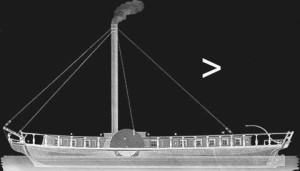
Captain James Williamson’s classic, “The Clyde Passenger Steamer: Its Rise and Progress during the Nineteenth Century,” was published by Messrs James MacLehose & Sons, Glasgow, to great interest and acclaim in 1904. It is one of my favourite books. “The Clyde Passenger Steamer.—Rise and Progress during the Nineteenth Century.—We have received a copy of a book entitled “The Clyde Passenger Steamer: Its Rise and Progress during the Nineteenth Century, from the Comet of 1812 to the King Edward of 1901,” by Captain James Williamson, the well-known marine superintendent the Caledonian Steam Packet Company. No one can rise from perusal of the volume without being conscious of the fact that it is the work of man who has not only had lifelong connection with his subject but thorough acquaintance with and a feeling akin to love for all things pertaining to the steamboat passenger service on...

Strength Through Remembrance

on Nov 11, 2025

I’m working on an article on Lamlash and was reflecting on the last time I was in the village with my family, many years ago now. At the time my son had just entered his teens, and the visit to Arran with his grandfather had an impact. A year or so later, he submitted an essay to a Scottish-American magazine and won $100. I thought it might be worthwhile to post it on this Remembrance Day.      My heritage means a lot to me. I was born in Scotland, though I moved to the United States when I was less than a year old. I know a little about my heritage because of the stories that my father occasionally tells me about growing up in Scotland and about my family history. I have visited Scotland on four occasions and enjoy Scottish music and culture. I have also strengthened my heritage by learning to play the bagpipes.      My grandfather was in the 11th (Scottish) Commando during...

The Colourful Clyde II

on Nov 1, 2025

This is the final article in the series of negatives and slides from my collection that I have attempted to colourize with the aid of photoshop. For a very few of these slides, photoshop has not worked well and I have resorted to a more comprehensive colouring program that uses multiple layering like an impressionist painting to achieve the coloured image. This I dislike as it leads to some curious effects, but it does a better job on crowded scenes. The previous article featured the privately owned Clyde steamers. In this article the steamers of the Caledonian Steam Packet Co., the Glasgow & South-Western Railway Co., and the North British Railway Co., are portrayed. A slide of steamers at Rothesay Pier. The funnel colours attract immediate attention. The only easily recognized steamer is the Caledonian Steam Packet Co.’s Galatea with her two rather awkwardly spaced funnels....

The Colourful Clyde I

on Nov 1, 2025

This is the third article in the series of negatives and slides from my collection that I have attempted to colourize with the aid of photoshop. This article features some of the Clyde steamers. The previous two articles featured the steamers of Messrs MacBrayne and the highlands and islands. Commercial software can often provide a reasonably acceptable representation of the background, although not always, and sky and sea colour are frequently problematic. I have also tried smart iterative software (Photorevive) in a few cases but while it generally does better with details and background, it end up with more complex impressionist-like colouring that I personally dislike. The colorings of steamers and their funnels require special attention. The simplest colourizations are those of the Buchanan and Williamson fleets where funnels are black and white. Some of the earliest slides of...

King’s Cross

on Oct 1, 2025

The hamlet of King’s Cross has a historical association as the spot from which King Robert Buce embarked from Arran to return to the mainland of Scotland and begin his campaign to free the country from the English. Whether the tale is true or not, there has long been a cairn to commemorate the event, not far from the remains of an early fortification last occupied during the Viking era. As the closest spot on Arran to Holy Isle, it has had a ferry from early times and subsequent to the extension of the Ardrossan steamboat service from Ardrossan to Whiting Bay, the ferry at King’s Cross became a port of call for steamers between Lamlash and Whiting Bay. It was never a busy call in its own right, but before the introduction of Whiting Bay Pier, when the weather prevented the call at Whiting Bay ferry, passengers used the more sheltered King’s Cross ferry. Service was maintained till...