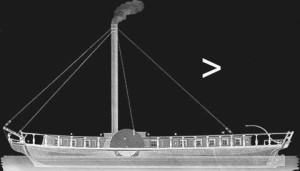

Captain James Williamson’s classic, “The Clyde Passenger Steamer: Its Rise and Progress during the Nineteenth Century,” was published by Messrs James MacLehose & Sons, Glasgow, to great interest and acclaim in 1904. It is one of my favourite books.
“The Clyde Passenger Steamer.—Rise and Progress during the Nineteenth Century.—We have received a copy of a book entitled “The Clyde Passenger Steamer: Its Rise and Progress during the Nineteenth Century, from the Comet of 1812 to the King Edward of 1901,” by Captain James Williamson, the well-known marine superintendent the Caledonian Steam Packet Company. No one can rise from perusal of the volume without being conscious of the fact that it is the work of man who has not only had lifelong connection with his subject but thorough acquaintance with and a feeling akin to love for all things pertaining to the steamboat passenger service on the Clyde. It had long been felt that a complete and permanent record of the rise and progress of the passenger steamer which has made our beautiful firth famous the world over would be valuable addition to marine literature, and it is safe to say that in the present work we have a book which admirably supplies the want. It well written, and the interest of the reader is sustained throughout. Not only on Clydeside, but in almost all corners of the globe, the volume will be read with pleasure, particularly those long in exile who have here brought before them pictures of steamers and captains whose names sound like those of old friends. Captain Williamson opens with interesting chapter on the inception of the passenger steamer on the Clyde, and deals in it with the Port-Glasgow-built Comet and her famous inventor Henry Bell. In subsequent chapters he treats of her successors, many of which were built in Greenock and Port-Glasgow. In connection with this he describes the gradual increase in the passenger traffic by these steamers, the development in their construction, and the efforts which were made by the towns on the lower reaches to provide piers suitable for these vessels, mentioning that in several cases the rise of watering place was the direct result of the building of a pier. Another very readable portion of the book is that dealing with the “Lively Fifties,” when competition was keen, and racing was frequent and exciting. Subsequent chapters deal with the railway invasion and the gradual ousting of the private owner, the history of the turbine type of steamers, and the various owners, masters, and crews. The book, which is well printed, is copiously illustrated with pictures of old time and present day steamers, as well as of past and present owners and skippers. As an appendix there is printed at the end of the book the name, year, builder, tonnage, etc., of all passenger steamers from the first Comet, 1812, to the King Edward, 1901. The book is published by James MacLehose & Sons, Glasgow.”—Greenock Telegraph, July 7, 1904.
There are some gaps that have been filled by others, and some errors that have been pointed out over the years, however, the book remains the best description of the early history and development of the Clyde steamer. I have heard that the idea for the book grew out of some intense correspondence on the subject “Early Clyde Steamers,” that appeared in the Glasgow Herald in the summer of 1897. That seems likely but the depth of the research reveals the author’s intimate knowledge, discernment, and authority.
Such was the interest that the book created, that there was some demand for better illustrations. While the illustrations in the original printed book are good, the resolution is state of the art for the time, they are limited. In 1905 or 1906, photographic prints of many of the illustrations, and indeed many more not included in the book, were available in album form. I know of at least two of these albums that include different selections of the material. It would appear that James Williamson had a hand in the enterprise.
The album that I have in my collection has over 100 illustrations, most of them copies of the drawings from the collection of C. D. Hubbard that are also to be found in Andrew M‘Queen’s “Echoes of Old Clyde Paddle Wheels,” published by Messrs Gowans & Gray Ltd., Glasgow, in 1924. The more recent steamers are illustrated by photographs. What I found of particular value are photographs of paintings that have much detail that is lost when printed. In this article, I have reproduced a number of these paintings. I have used AI to colourize the photographs to help get some idea of the original paintings, and to help delineate the steamers. Generally red and yellow funnels are not reproduced by AI and I have added these by hand.
The copy I have has a dedication “From James Williamson, in grateful recognition of the valuable services during the preparation of the history of the “Clyde Passenger Steamer” from 1812 to 1901,” and is dated January 1, 1906. The date seems a bit suspicious as there are photographs of Atalanta and Duchess of Argyllincluded, though they could have been added by the recipient afterwards.

Inscription
I have also added a few slides of photographs from my collection for completeness.

Inverary Castle of 1820. One of the early Castle steamers with a wooden hull built by Messrs John & Charles Wood, Port Glasgow, and engined by David Napier. She is sporting a black funnel with a white band that was later adopted by many steamship owners who inherited steamers when the Castle Company was broken up. Inverary Castle was scrapped in 1838 (from a glass slide)

Superb of 1830. One of Robert Napier’s Gareloch boats with his characteristic red funnel adopted by the MacBrayne and Cunard fleets. She was built of iron by Messrs J. Reid & Co., Port Glasgow, and engined by Robert Napier. In 1838, she was sold to Messrs Henderson & M‘Kellar for their Gareloch trade.

Duntroon Castle of 1842. Another of the Castle company’s steamers, built of iron by Messrs Anderson & Gilmour, Glasgow. In 1846 she passed to Messrs G.& J. Burns and was transferred to West Highland sailings. She sank after a collision off the Cloch in 1850, and though repaired, was sold soon after coming under the ownership of Messers Hutcheson. (from a photograph of a painting)

Lady Brisbane of 1842. Built of iron from the Paisley yard of Messrs Barr & M‘Nab, for Captain Wm. Young, she sailed on the Largs and Millport station from Glasgow in opposition to the M‘Kellar fleet. After Captain Young withdrew from the business, she was part of the consortium known as the Glasgow, Largs & Millport Union Steam-Boat Co., that included the M‘Kellar steamers and ran the service as a monopoly until the late 1860s when she was purchased by Captain M‘Kellar. She sank after a collision in1869 but was repaired and sold to Messrs Keith and Campbell, becoming their Balmoral, and passed, along with the rest of their fleet to Captain Buchanan in 1884. After her machinery collapsed in 1891, she was sold as a coal hulk to Irish owners.

Lady Kelburne of 1843. Built for Captain Wm. Young in the same yard, as a consort to Lady Brisbane, Lady Kelburne was larger and faster, and was matched to race against the Engineer when both steamers were new for £100. The raced was a damp squib when the Engineer scratched and Lady Kelburne won the wager. Her ownership followed the same course as Lady Brisbane until 1867, when she was laid up for disposal.

Mars of 1845. Mars was an attractive iron steamer built by Messrs T. Wingate & Co., Glasgow for Captain Duncan M‘Kellar, and passed with his steamers to the Glasgow, Largs & Millport Union Steam-Boat Co. a year later. In stormy weather in April 1855, her paddle-shaft broke off Largs, and she went ashore at the mouth of the Gogo Burn, becoming a total loss.

Lochlomond of 1845. The first steamer built by Messrs Denny Brothers for the Dumbarton Steamboat Company, she ran from Glasgow to Dumbarton in connection with the Loch Lomond tours. She is seen in the colours of the Dumbarton steamers with their blue paddle boxes and black and white funnels. She was sold to run in connection with the Greenock Railway in 1852. (William Denny & Bros., 1844-1932 Album)

The Eagle of 1852. Built by Messrs Alex Denny, Dumbarton while Messrs Denny were disposing of the Clyde fleet of Messrs G. & J. Burns, Eagle became part of the “Glasgow and Rothesay Steamers” consortium. The following year, she was sold to Messrs Williamson, Buchanan, and others. Originally she had two funnels aft of the paddle box, but was reboilered with a single funnel. In 1862, she was sold to run the blockade of the Confederate states.

Rothesay Castle of 1854. Messrs Caird & Co., Greenock built the Rothesay Castle for the “Glasgow and Rothesay Steamers,” under the management of Mr W. F. Johnstone. When faster steamers entered the service, she was sold to owners in India in 1860.

Alma of 1855. Messrs Barr & M‘Nab produced the Alma for Captain Duncan Stewart, but she immediately became the property of the manager of the City of Glasgow Bank. Captain Stewart sailed her first on the Gareloch station, and later, on the Rothesay station. She was broken up in 1865.

Iona of 1855. A product of Messrs J. & G. Thomson, Clydebank, Iona was produced for the “Royal Route” service from Glasgow to Ardrishaig for Messrs D. Hutcheson & Co. She was the most splendid vessel on the river until sold in 1862 to run the blockade of the Confederate states. Unfortunately, she was run down by the Chanticleer when sailing off Gourock on her way to Bermuda.

Artizan of 1856. Artizan was a small steamer just 113 feet in length, built by Messrs T. B. Seath & Co., Rutherglen for the upper-river service between Glasgow and Rutherglen. She is seen here passing Renfrew on trials. She was sold in 1857 to Irish owners. In the album, she is labelled as Royal Burgh of 1857, Seath’s replacement for Artizan.

Juno of 1860. The Glasgow, Largs & Millport Union Steam-Boat Co. had the Juno built by Messrs Tod & M‘Gregor, Partick, for their service to Arran, running in consort with the Jupiter built in 1856. Both steamers were taken in 1863 to run the blockade of the Confederate states.

Mail of 1860. Messrs Tod & M‘Gregor, Partick, also built the Mail for the Glasgow to Kilmun service of Messrs J., A. & R. Campbell. She was sold in 1863 to run the blockade of the Confederate states.

Ruby of 1860. Messrs J. Henderson & Son, Renfrew, built Ruby to replace a steamer of the same name that was sold to English owners. She had a reputation for speed and racing on the Glasgow to Rothesay station and received some notoriety under the command of Captain Richard Price. At the end of her first season, she was sold to Indian owners, and replaced by a steamer of the same name.

Rothesay Castle of 1861. Messrs W. Simons & Co., Renfrew, built the Rothesay Castle for Mr A. Watson’s Glasgow to Rothesay trade. She was one of the participants in the surge of racing that took place on the Clyde in the early 1860s. In 1863, she was sold to run the blockade of the Confederate states. After the American Civil War, she was sold to Canadian owners and traded on the Lake Ontario until scrapped in 1892. The colours are those in the painting included in “Clyde Pleasure Steamers,” Ian M‘Crorie, Orr, Pollock & Co., Greenock, 1986.
Neptune of 1861. Messrs Robert Napier & Sons, Govan built the Neptune to compete for the Rothesay trade Under the ownership of J. & W. Napier. Like many of the other steamers in the trade, she was sold in 1863 to run the blockade of the Confederate states.

Ruby of 1861. Built by Messrs Henderson, Coulborn & Co., Renfrew to replace the Ruby of 1860, the new Ruby participated in racing and other dangerous practices much to the delight of those who patronized her. She was the last command of Captain Richard Price who retired when she was sold to run the blockade of the Confederate states in 1862.

Sultan of 1861. Captain Alexander M‘Kellar ordered the Sultan for the Kilmun trade from Messrs Barclay Curle & Co., Whiteinch. She was sold to Captain Alexander Williamson the following year for his Glasgow to Rothesay and Kyles of Bute service. She was the first command of Captain James Williamson, and the initial member of what became known as the “Turkish Fleet.” In 1891, the steamers were sold to the Glasgow & South-Western Railway as the basis of their steamer fleet. She later passed to Messrs David MacBrayne for their Caledonian Canal sailings until destroyed by fire at Fort Augustus in 1919.

Victory of 1863. Victory was a Barclay Curle & Co., Whiteinch, product for Captain Duncan Stewart, and is seen here in his colours. He employed her on the Glasgow to Rothesay station where most of the fast steamers had been sold to run the blockade. In 1865, she was sold to the Wemyss Bay Steamboat Co. running rail connections from Wemyss Bay. In 1869, she became the property of Messrs Gillies & Campbell who took over the Wemyss Bay sailings. They quickly disposed of her and she became a “Sunday Steamer,” renamed Marquis of Lorne, and owned by Duncan Dewar. Messrs Hill & Co. acquired her in 1882, and renamed Cumbrae, she operated from the new Fairlie Pier to Millport and Kilchattan Bay until 1892.

Eagle of 1864. When the Eagle of 1852 was sold to run the blockade in 1862, her owners contracted with Messrs Charles Connell & Co., Scotstoun, for a replacement, but she too was sold off the stocks for blockade running. The following year, Captain Buchanan had a new steamer launched from the Scotstoun yard, and placed her on the Rothesay station. She was of the raised quarterdeck design giving greater headroom in the saloon aft. In 1877, she was reboilered and appeared with a single funnel. After modifications that included a saloon placed above her raised quarterdeck—described as a “double saloon,” she was sold in 1894 to run excursions on the newly opened Manchester Ship Canal.

Undine of 1865. Undine was built by Messrs Henderson, Coulborn & Co., Renfrew, for the Rothesay trade and was run on their own account for a year until Captain Duncan Stewart purchased her. She was reputedly a rather “crank” boat, but served on the Rothesay station until 1879 when Captain Stewart retired and sold her to a Russian owner.

Vale of Clywd of 1865. Vale of Clywd was built by Messrs T. B. Seath & Co., Rutherglen, for Mr R. W. Preston of Liverpool for the North Wales excursion station. The venture was a success and she was replaced by a larger and more heavily built steamer, Elwy, the Following year. Vale of Clywd returned to the Clyde where she was known as “Vale of Clyde,” and ran between Glasgow and Ayr for Messrs Seath, Steel and others. She had a varied career in the 1870s including a charter to Messrs Gillies & Campbell, running railway connections out of Wemyss Bay. (From a carte-de-visite.)

Vale of Doon of 1866. Built by Messrs T. B. Seath & Co., Rutherglen, to run as consort to Vale of Clyde on the Ayr station, Vale of Doon was not a great success. She was sold to Brazilian owners in 1868. The photograph was mistakenly labelled Vale of Clyde in the album.

Athole of 1866. Athole is seen here in the colours of Captain Duncan Stewart for whom she was built by Messrs Barclay Curle & Co., Whiteinch. Of raised quarterdeck design, she was a popular boat on the Rothesay station and in 1870 was sold to the Greenock & Ayrshire Railway for railway connections. In 1872, Alexander and Thomas M‘Lean purchased her to compete for the Glasgow to Rothesay trade until around 1890 when they retired and sold her to the Bute Steam Packet Co.

Meg Merrilies of 1866. The North British Railway had reached Helensburgh in 1858, and in 1866 the North British Steam Packet Co. launched an ambitious plan to capture some of the Clyde steamer revenue. To compete with Messrs Hutcheson’s new saloon steamer, Iona, for the Ardrishaig service, Meg Merrilies was built by Messrs A. & J. Inglis, Pointhouse. At the end of her first season, she was laid up and eventually sold to Turkish owners. (From a carte-de-visite.)

Marquis of Bute of 1868. Marquis of Bute was built by Messrs Barclay Curle & Co., Whiteinch, for Alexander and Thomas M‘Lean and sailed for them in the Glasgow and Rothesay trade for over 20 years. In 1889, she became part of the “Turkish Fleet,” and two years later passed to the Glasgow & South-Western Railway. The M‘Lean colours are those in the painting included in “Clyde Pleasure Steamers,” Ian M‘Crorie, Orr, Pollock & Co., Greenock, 1986.

Sultana of 1868. Messrs Robertson & Co., Greenock, built the Sultana for the “Turkish Fleet” of Captain Alexander Williamson, Snr., that provided steamer service to Rothesay and the Kyles of Bute. She was purchased by the Glasgow & South-Western Railway in 1891 for railway connections.

Viceroy of 1875. The Viceroy was the last vessel built for Captain Alexander Williamson, Snr., and his “Turkish Fleet.” Of raised quarterdeck design, she was built by Messrs D. & W. Henderson at their Meadowside yard. As with the other members of the “Turkish Fleet,” Viceroy passed to the Glasgow & South-Western Railway in 1891.
I recall a visit to the Glasgow Art Galleries and Museum when the Clyde Ship Collection was housed at Kelvingrove. There were some small paintings of steamers in the 1860s, perhaps, Iona, Ruby and Neptune, and I am almost sure they are part of this collection. I photographed them at the time, but my copies were rather blurred. I suppose the paintings are in the Glasgow Museums storage now. A few other paintings of steamers, in colour, can be found in another of my favourite books, “Marine Art & the Clyde,” by A. S. Davidson, Jones-Sands, Wirral, 2001.
December 1, 2025
How wonderful to see some ‘joined up writing’ in Williamson’s hand. I’ve only ever seen his initials in blue pencil on CSP paperwork.
December 1, 2025
Another great article particularly for an artist who likes to try to portray the early Clyde steamers!
I’m currently working on a painting of the Lady Kelburne off Corrie and your colourised illustration of her is immensely helpful.
December 1, 2025
Jim: I must admit that I was thinking of your artistry when I put the article together.
December 3, 2025
I’m deeply honoured Graham, I’ll keep you posted when the Lady Kelburne painting is finished!