
Lochranza, on the mountainous north-west corner of the Island of Arran is a sheltered harbour for fishing boats and traders frequenting the sometimes boisterous waters of the Kilbrannan Sound. A castle, guarding the bay, dates from the 13th century, but from the 18th century has fallen into disuse. Nevertheless, it presents a focal point for the picturesque village. It was only in the 1843, that Lochranza was connected to the road network of the island through Glen Sannox, and at that time, there were a dozen or so fishing boats associated with families in the village. In the immediate hinterland there are numerous farms, and nowadays, a distillery. Tourism thrives, despite a reputation as the village with the least annual sunshine in Scotland.
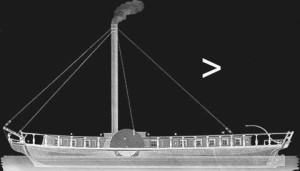
For many years, Lochranza was relatively isolated, connected to Corrie and Brodick by a rough track over the hill and into Glen Sannox. The easiest communication was probably by sea. In the era of the steamboat, it would seem likely that the Britannia, launched in January 1815, and sailing to Campbeltown by 1818 under the agency of Messrs Alex Laird, would have called at Lochranza. In 1826, the Campbelton & Glasgow Steam Packet Co., was founded, and from that date, regular calls were made by their Duke of Lancaster. In the same year, Messrs Alex Laird introduced their Clydesdale on the route, replacing the old Argyle. Local ownership in Kintyre favoured the Campbelton Company’s vessel, and Clydesdale soon changed her station before her end came in 1828 when she caught fire off Corsewall Point and was heroically beached by her pilot. Well into the 1830s, there was further competition on the Campbeltown station from the Londonderry and Larne steamers St Columb and Foyle, and in 1835, the new Glenalbyn, joined the fray. However these steamers generally visited the east Arran ports, Brodick and Lamlash, with occasional diversions into Kilbrannan Sound and Lochranza when the weather, cargo, or passengers required it. The competition was such that the Duke of Lancaster was forced to reduce her fares, and in 1836 the St Kiaran was added by the Campbelton Company. In 1836 also, a new steamer, St Mungo, was placed on a sailing to Arran and Islay, calling at Brodick, Lamlash, Campbeltown, and Port Askaig, and to compete, the new St Kiaran began making a monthly call to Islay, and weekly calls at the east Arran ports leaving those on Kilbrannan Sound to the old “Duke”. The Islay connection was an important one for the whisky trade, and, as the major shareholders in the Campbelton Company were distillers, the efforts of the St Mungo were soon rebuffed. In 1837, while the Duke of Lancaster was offered for charter, St Kiaran resumed the service with an advertised call at Lochranza. In the advertisement, the Company’s name also reflected the new spelling of Campbeltown, though the old and new spellings were used interchangeably.
“The Campbelltown & Glasgow Steam Packet company’s steamer, St. Kiaran, Captain Napier, will sail during the month of June for Campbelltown and Islay calling at Lochranza and Arran—going and returning, where a boat is always in attendance.
“From Glasgow.—Thursday 8th, at 5 a.m., Tuesday 13th, at 8 a.m., Saturday, 17th, at 10 a.m., Thursday, 22d, at 5 a.m., Tuesday, 27th, at 8 a.m.; From Campbeltown.—Tuesday 6th, at ½ past 5 a.m., Saturday, 10th, at 9 a.m., Thursday, 15th, at 9 a.m., Tuesday, 20th, at 6 a.m., Saturday, 14th, at 9 a.m., Thursday, 29th, at 10 a.m.
“The St Kiaran will sail for Islay (calling at Campbelton) on Thursday the 8th, at 5 o’clock a.m., and Thursday the 22d, at 5 o’clock a.m.—James Reid, Agent at Glasgow, Office, 20 Anderson Quay.”—Glasgow Herald, June 5, 1837
In the 1830s, agriculture on Arran went through a transformation. There was much emigration, and the mountainous north of the island was turned into a deer park. In 1820, Henry Westerna, Baron Rossmore, had married Lady Anne Douglas-Hamilton, daughter of the 8th Duke of Hamilton to inherit the estate. He made efforts to develop the village of Lochranza and improve the housing.
“Arran.—The Hon. Mr. Westenra has commenced the formation of a new village, quay, and fishing station at the north-east extremity of the island near Lochranza. The cottages are to be commodious and tasteful, and suited for being let to visitors in summer. An inn is also nearly ready. The same proprietor is contemplating the erection of a mansion-house on his estate in the same neighbourhood, plans for which, in the ancient castellated style, have already been prepared.”—British Statesman, March 26, 1842
Around this time a little descriptive piece on Lochranza was published in Autumnal Rambles Among Scottish Mountains, by Rev. Thomas Grierson (James Hogg, Edinburgh, Second Edition,1851).
“Loch Ranza is a place to dream of, but such as you will rarely see in real life. It is a narrow inlet of the sea, among the lofty and steep mountains, apparently land-locked by a bold rocky precipice. On the foreground, in looking towards the sea, beyond a straggling village and small missionary church, there is a level on which stands an old castle, pretty entire, and of great strength. Eight or nine miles of sea intervene betwixt this and the coast of Kintyre, and beyond all appear the bold and lofty mountains of Jura. The sea here, as all around Arran, is of great depth, and so clear, that you may see shells or any white object forty or fifty feet from the surface. In the bay of Brodick, you have soundings from 12 to 20 fathoms; but a little farther out, from 80 to 100.
“At Loch Ranza, there is a comfortable little inn, kept by Mr and Mrs M‘Larty, no way connected with the Glenbumie family of that name. Upon entering, I was glad to see a roast of mutton at the fire; but, to my mortification, was informed that it was preparing for two gentlemen who had ordered it some days before. Trusting to some favourable arrangement, I loitered about the shore for an hour or so, till the expected arrival, when I was politely invited by the gentlemen to partake. Our dinner consisted also of excellent fresh haddock; so that we had no reason to complain of bad cheer.”—Autumnal Rambles
Unfortunately, Mr John M‘Larty, innkeeper, Lochranza, was sequestered in October, 1850 and imprisoned at Ayr.
The village became a destination for excursions from Glasgow and the Ayrshire coast.
“Excursion to Lochranza, Arran.—To-morrow morning (Tuesday, 16th instant).—The Royal Mail Steam Packet Duntroon, or Cardiff Castle, will sail from Glasgow Bridge at half-past 7 o’clock morning, direct for Greenock, Gourock, Dunoon, and Rothesay; thence to Lochranza, Arran—returning to Glasgow in the evening. Fare from Glasgow, for the whole day’s excursion, Cabin 2s.; Steerage, 1s. 6d. From Greenock, Gourock, Dunoon, or Rothesay, and back, Cabin 1s. 6d.; steerage, 1s.—July 15th, 1844.”—Glasgow Herald, July 15, 1844.
In 1854, a branch post-office was opened in the village.
“A branch post office was opened at the village of Lochranza in the island of Arran on the 14th instant in connection with the head office here. As there was formerly no post office nearer Lochranza than that of Brodick about 14 miles distant, the opening of the branch is a great boon to the inhabitants of the village and the surrounding district.”—Greenock Advertiser, March 21, 1854

Lochranza Castle around 1864 (Annan)
In summer in the early 1860’s, the Campbelton steamers sailed daily from Glasgow and Campbeltown (Sundays excepted) with the Druid, Captain Kerr, and Celt, Captain Eaglesome, calling at Greenock, off Lochranza, and Carradale Pier. Each ship left in the morning and returned the following day. In 1866, a fast paddle steamer, Herald, was launched for Messrs Little & Co., and began offering daily excursions from Glasgow and Greenock to Campbeltown calling at Lochranza and Carradale, weather permitting and at Captain Robert Young’s option. The Campbelton Company responded with their own fast paddle steamer, Gael, in 1867, and, again the local ties of the Campbelton Company prevailed, and Herald was moved to sail to the Isle of Man.
“Grand day excursions.—Every Tuesday, Wednesday, Thursday, and Saturday.—The powerful and commodious new steamer Gael, Captain Kerr, will sail from Broomielaw (foot of Cheapside Street) for Campbeltown, every Tuesday, Wednesday, Thursday, and Saturday, at 6.45 a.m., train to Greenock at 7.40 a.m., calling at Kirn, Dunoon, Innellan, and off Lochranza, on the down and up trips. Returning from Campbeltown same day at 2 p.m. Passengers from Rothesay per steamer Sultan at 8.40 a.m., meet Gael at Innellan, and are landed there on up trip, in time to return per afternoon steamers. Through tickets issued on board Sultan. Fares—to Campbeltown—Cabin, 4s.; Steerage, 2s. Return Cabin, 5s.; Steerage, 3s. To Lochranza,—Return Cabin, 4s.; Steerage, 2s. 6d. From Kirn, Dunoon, Innellan, and Rothesay, to Campbeltown—Return Cabin, 4s.; Steerage, 2s. 6d. Return tickets available for 14 days. Passengers will have about five hours on shore at Lochranza, and 2½ hours at Carradale. This route—through the Sound of Kilbrannan—affords excursionists a view of the Arran mountains, Lochranza, Island of Davaar, and Campbeltown Loch—scenery unequalled for beauty and grandeur.”—Glasgow Morning Journal, July 15, 1867
The following year, 1868, the Company added the Kintyre, a fine screw steamer for the year-round service.
“Glasgow and Campbeltown, (calling off Lochranza & Carradale),—Steamers Gael and Kintyre.—From Glasgow; every Tuesday, Thursday, and Saturday, at 8 a.m., trains to Greenock from Bridge Street at 10 a.m., and from Dunlop Street at 10.04 a.m.—From Campbeltown; every Monday, Wednesday, and Friday (except Friday 21st) and Saturday, 22d May, at 8 a.m.—Apply to John Murray, Campbeltown; John Macmillan, Excise Building, Greenock; or here to R. M. Dunlop, 28 Anderston Quay.”—Glasgow Herald, May 17, 1875

Lochranza Bay around 1870 (Becket)
The ferry at Lochranza came under some scrutiny in letters to the editor of the Glasgow Herald.
“The landing at Lochranza.—Sir,—Last week, I took a lady and her family down from London to stay with some friends at Lochranza. We went on board the Kintyre at Prince’s Pier, and arrived off Lochranza in a squall of wind and rain. The ferry-boat came alongside, and we had to wait about a quarter of an hour while the cargo for the port was put in the boat. This consisted of bags of seed and cases, and on the top of these, hay was piled to the height of about 6 feet. Before the boat had finished taking in her cargo the captain of the steamer told the men in my hearing to look sharp, as he could not wait much longer, or words to that effect. After this the passengers had to get in as best they could, a small space having been left for them at the stem of the boat. Into this space, which was thoroughly saturated with rain and sea water, 10 or 12 persons were crammed, there being comfortable sitting room in it for about five adults. The boat-having thus been laden to within a very few inches of the gunwale, she put off from the steamer. When in the trough of the swell made by the departing steamer I myself saw the water quietly ripple over the side of the boat as she rolled, and it does not need a very extensive knowledge of natural philosophy to know that a boat laden in that manner on a stormy day does not require very much to capsize her. We were larded on a lot of rocks, wet with rain and sea water and covered with seaweed, over which we had to find our way with women and children, the footing being so slippery and uneven that it was very hard to keep one’s feet. A fall on ground of that nature might have been an exceedingly serious thing, more especially to a delicate woman. Now, Sir, I write this to you and ask you to make it public, not because I expected and am disappointed at not finding every appliance of civilisation for landing in a comparatively uncivilised portion of the British Isles—for I am well acquainted with all the means for landing in Arran, as well as on both sides of the Clyde—but in order to warn invalids and delicate persons with children from going to such a place expecting ordinary care and comfort to be shown them in the arrangements for landing. I know few better ways for invalids to obtain a speedy release from their troubles than a landing under similar circumstances to those related above, as, should they escape drowning, the fright, discomfort, and inconvenience of the operation would be eminently calculated to hasten their end.—I am, Viator.”—Glasgow Herald, May 26, 1875
There were two replies the following week. A pier had been opened at Brodick in 1872, and proved successful in attracting visitors and improvements in the economy of the Island.
“Landing at Lochranza.—May 26, 1875. Sir,—Your correspondent “Viator” seems fond of seeing his letters in print, or he would not have said so much about nothing, and tried to make a mountain of a molehill. Lochranza ferry is just like other ferries, and Mr Kerr, the ferryman, is attentive, obliging, and able for his duties. For 18 years he has served the public without accident, and because “Viator” landed on a stormy day he rushes into print, gives his advice gratis, and flares up at everything and everybody. “Viator” got his glove spoiled, and perhaps lost his temper in the storm, but he should not blame the ferry for all the wind and rain. Most people larding at ferries have a grievance of some sort, but it would be nonsense to air them all in the newspapers; and next time “Viator” is gaun to the saut water, his great knowledge of ferries should learn him not to encourage the ferry, but land at some port where he will have all the comforts of a home. His statements about over-crowding, natural philosophy, ripples over the side, British Isles, &c., &c., are very well put, but they are bosh.—I am, &c., A Father of a Family (who was on board).
“Sir,—I trust you will allow me a few words in your columns in reply to the letter of your correspondent “Viator on “Landing at Lochranza;” and at the outset I frankly acknowledge that there is room for improvement in this respect, and I think we are indebted to him for some things in his letter, to which I hope both the steamboat company and the ferryman will attend. The effectual remedy would be a pier, which would be an unspeakable boon to a considerable number of the Duke of Hamilton’s tenants in Arran, in enabling them to send their cattle and farm produce to the best market. But, having said so much, I ask is it fair to represent an exceptional instance of uncomfortable landing as the rule, for your correspondent himself acknowledges that there was a squall of wind at the time? I have reason to know that the amount of goods and number of passengers landed on the day to which he refers were far above the average for the season of the year. A fellow passenger of “Viator’s” on that day has been coming to Lochranza for the last eighteen years, and never landed during all that time with the discomfort of the day referred to. Usually there are two and even three boats provided in such cases, and I cannot tell why there was only one for that day; only I know that no provision can prevent “squalls” occasionally at the time of landing, to which travellers ought just to submit, and not charge them on the want of civilisation in the place landed at. And, in conclusion, let me add a word regarding the last charge against Lochranza. I am at a loss to understand what “Viator” means by “comparatively uncilvilised.” If he merely means that we have not a pier or first-class landing place such as he can have on the Thames, I confess guilty; but if he uses the word in the ordinary acceptation, I must tell him that we are not barbarians, such as his and our forefathers were at the time of Cæsar. We do not paint our bodies, nor do we go naked; neither do we live in incest as they did of old. Moreover, we are strangers to those acts of violence and barbarism which we read are daily committed even in his civilised London, We also have some regard for an old fashioned book called “the Bible,” and I can tell “Viator” that his person and goods would be as secure among us as in any part of London, without even the vigilance of a night or day watchman; and I trust that, when he comes back to visit us again, he will take some pains to know us better before judging us so harshly.—I am, &c., One who Resides in Lamlash.”—Glasgow Herald, June 1 1875

Lochranza Castle in 1881 (Valentine)
In 1885, the Campbeltown Company had a new steamer, Davaar, built, She was a fine two-funneled screw steamer, a bigger version than the Kintyre.
Lamlash had a pier opened in 1884, and two years later, in 1886, the Duke consented to the opening of a pier at Lochranza to serve the west side of Arran.
“Piers and Harbours Provisional Orders.—The Pier and Harbours Provisional Orders Bill came before the Chairman of Committees of the House of Commons as unopposed, and was ordered by Mr. Courtney to be reported. Among the various parts of the United Kingdom affected are Dunbar and Lochranza.”—Scotsman, June 19, 1886
“Lochranza Pier.—We learn with pleasure that Mr Maxwell, Glasgow, has secured the contract for the building of the pier about to be erected at Lochranza.”—Campbeltown Courier, January 29, 1887
The pier was opened at the end of April, 1888, by a call from the Scotia of Messrs Buchanan that was the regular steamer on the Ardrossan to Brodick and Lamlash station and included a round Arran cruise in her schedule on Wednesdays, but this was a special event on Thursday. There was little fanfare; prior to June, the advertisements for the Kilbrannan route mentioned calling at “Lochranza”, and after the beginning of the month, this was changed to “Lochranza Pier”.
“New pier at Loch Ranza.—The new pier at Loch Ranza was opened yesterday, when Captain Buchanan’s steamer Scotia landed from Glasgow an excursion party of the Anderston Weavers’ Society, who were greatly delighted with the picturesque scenery of this part of Arran. The sail to Loch Ranza is sure to be a favourite excursion on the Clyde this summer. The Campbeltown steamers have called here for many years, but the landing has hitherto been by ferry. The pier has been built by the Duke of Hamilton, principally for the convenience of the fishermen in the Sound of Kilbrannan. The structure is of greenheart wood, L-shaped, and has two steamer berths, with waiting room, store, and offices. The engineers were Messrs D.&F. Stevenson, of Edinburgh; and Mr Maxwell, of Glasgow, was contractor.”—Greenock Telegraph, April 27, 1888

Kintyre at the Lochranza Pier

The Two-funneled Davaar crossing the bay to Lochranza Pier (Valentine)
Almost immediately, there was a negative reaction to the pier dues; undoubtedly, the highest of all the piers on the Firth.
“A grievous pier tax.—Lochranza, August 30, 1888.—Sir,—Your correspondent “J.C.C ” has done well in exposing the heavy pier dues in Arran. If he could only come round our length he would find that instead of 2d to get off the pier, the large sum of 4d is extracted. It is simply preposterous, and I think the Duke should be informed, as I understand his factor has all these things in his own hands, and the Duke I believe expresses a strong wish not to make money off his summer visitors. I hear the fishermen complain bitterly also about their charges. They are some way about three-quarters more than any other quay in Arran.—I am &c., Clachan.”—Glasgow Herald, August 31, 1888
“Arran pier dues, Lochranza.—Sir,—l was glad to notice in your issue of to-day’s date the letter signed “Clachan,” which draws attention to a much more iniquitous state of matters than that complained of by your correspondent from Brodick. There is an old saying that it is the last straw that breaks the camel’s back, and this is peculiarly the case at Lochranza. I have now gone there every year for more than ten years, and during that time everyone I have met while travelling has paid the railway and steamboat fare, amounting to 6s 6d, quite cheerfully; but when called on to pay the ferry or pier dues, of 4d each way, the grumbling has been both loud and deep. During this season I think the climax has been reached, as I have heard of several families who have resolved not to go back to Lochranza unless the pier dues are reduced, or a reduction in the rents of the houses is given. I differ entirely from your “Clachan,” who throws the whole blame on the factor to the Duke of Hamilton. I am inclined to cast the blame on the natives of Lochranza themselves, who, with that greed so inseparable from the Arran character, have tried to extort as much as they possibly could from those whom they consider their natural prey —the summer visitors. For many years before the pier was built the fare for landing by the ferry was 4d, and was only reduced to 3d when the steamboat people threatened to lower their own boats and land their passengers themselves. At that time the Duke and his much abused factor had nothing to do with the price, which was fixed by the ferryman himself, a Lochranza man. I would warn the Lochranza people to beware lest some day they find they have killed the goose that laid the golden eggs. I think the attention of the Duke should be drawn to the shameless extortion going on at Lochranza, but would suggest to your Brodick correspondent that he should let well alone, or he may some day be mulcted in 4d every time he lands like us unfortunate Lochranza people, or in 6d like the more-to-be-pitied Pirnmill people. The question is who is to “bell the cat?” I would suggest that “Clachan” should do so, and will guarantee that he will be supported by Meallmhor.”—Glasgow Herald, September 1, 1888
The latter letter writer might just have a point. At the time of the opening of the pier, the village was in the throes of not just one, but two scandals involving slander. The first action involved the postmaster of Lochranza, Robert Kerr. The second was of an ecclesiastical nature. Both involved statements made by Mr Alexander Miller, Auchenrioch.
“A Lochranza slander case.—Kerr v. Miller.—The record was closed on Tuesday and diet of proof fixed for 22nd of March in Rothesay Sheriff Court in an action’of damages, in which Robert Kerr, senr., postmaster, Lochranza, and his son Robert Kerr, junr,, fisherman there, sue Alex Milller, farmer, Knockenrioch, Arran, for damages amounting to £200 in the case of the senior pursuer, and £100 in that of the junior. It is alleged by the pursuers that on the evening of 6th October last while a number of people were assembled in the inn at Lochranza, occupied by Neil M‘Millan, the defender in course of conversation asked Robert Kerr, junr., what his family got for delivering the letters at Lochranza, and that Kerr having declined to answer this question, the defender slandered both pursuers in Gaelic, saying “cha neil unnibh ach rogerain damadi co duibh. Tha sibh a fosglaidh leterichean aun sa Phost Office agus cha phost duinne an Lochraunsa literichean sau oidcke, gus am bhie dhlu do aim diuneadh, chuin tha sibh ga fosgladh agus gan rumagachadh chaneil ‘coonfidence’ aig duinne an Lochraunsa annaibh.” This language translated is somewhat as follows—“You are d–d rogues whatever. You are opening letters in the Post Office and the people of Lochranza will not post letters at night until despatch time, as you are rumaging them, and the Lochranza people have no confidence.” It is admitted by defender that some words were used on the occasion, but not to the effect libelled, and in his defences it is stated that both parties were in a very excited and passionate state, and that the junior pursuer called defender a “d–d liar.” The defender regrets and tenders a full and ample apology for anything he may have said and which may have hurt pursuer’s feelings.—The agents are—For pursuer’s, Mr Robert Kerr, writer, Glasgow; and for defenders, Mr George Thomson, writer, Rothesay.—Helensburgh News, March 3, 1887
“Buchanan v. Miller & Kelso.—Lord Lee to-day closed the records in two actions at the instance of John Graham Buchanan, student missionary of the Church of Scotland at Lochranza, Arran. In the first action he sues Alexander Miller, Knockanrioch House, Lochranza, for £1000 damages for alleged slander. Pursuer states that he is at present missionary at Lochranza. His intention is to qualify for the ministry. He states that on 23d March last defender was walking with Mr Archibald Kelso, Stonefield Cottage, Lochranza, when he met Mr William Kerr, a baker. Mr Kerr is an adherent of the Established Charch, Lochranza. It is averred that in course of conversation the defender stated that if Kerr knew the pursuer’s character he would not go to hear the pursuer preach; that the pursuer was outlawed at the time; that if the pursuer got his will there would be more men in the world; that Kerr need not ask pursuer about these statements, for he would soon hear further of the matter; that Kerr should just ask pursuer whether he was ever preaching in Tiree; and if he looked pursuer straight in the face he would see pursuer’s face change. The meaning conveyed, it is averred, and intended to be conveyed by these statements was that pursuer’s character was so bad and depraved as to render him unworthy of respect, and unfit to officiate as a minister or missionary; that the pursuer was then in disgrace by reason of immoral conduct; that he was a man of lewd, dissolute, and immoral character; that he had debauched women in Tiree, and would debauch women again whenever he got opportunity. It is maintained that these statements were false, and that defender was actuated by malice in making them. In defence, it is stated that defendant is a member of the Free Church at Lochranza. The conversation, it is explained, was carried on in Gaelic. It is also explained that pursuer recently referred from the pulpit at Lochranza to rumours in circulation regarding him, and alluded to an action of affiliation which was raised against him in the Sheriff Court of Glasgow in 1884. That action was decided in his favour, both by the Sheriff and the Court of Session. The defender does not admit making libellous statements about the pursuer, but he has, through his agents, stated his willingness to express regret if anything said by him with reference to the pursuer should have in any way injured his feelings and reputation. Pursuer, however, has declined to accept this as an apology. The second action is against Mr Kelso, and concludes for the same sum. In that action defender is said to have stated that pursuer had been proved to be the father of an illegitimate child, and that he was then paying aliment for it. This statement, it is also maintained, is false. Defender calls upon pursuer to state specifically what the alleged caIumnious statements were, and defender also intimates his willingness to express regret for the statements, and retract anything which might have given offence to the pursuer. Counsel for Pursuer—Mr Wilson. Agents—Macpherson & Mackay, W.S.; Counsel for Defenders—Mr Baxter. Agents—Smith & Mason, S.S.C., and F.J. Martin, W.S.”—Glasgow Herald, June 30, 1888
A year after opening the bye-laws of the pier were finally provided, reducing the pier dues to 2d., in line with the other Arran piers.
“Lochranza (Arran) Pier.—Notice is hereby given that it is the intention of His Grace the Duke of Hamilton, Brandon, and Chatleherault, to apply for the allowance and confirmation of Her Majesty’s Board of Trade of certain bye-laws to be made by His Grace for the government of the above pier under the provisions of the “Lochranza Pier Order, 1886.” A copy of the proposed bye-laws may be seen in the hands of Patrick Murray, Strabane, Brodick, Arran; or the subscribers, and any person objecting to the proposed bye-laws must lodge such objections in writing with the subscribers within one calendar month of the date hereof.—Tods, Murray, and Jamieson, W.S., 64, Queen Street, Edinburgh.—3rd June 1889.”—Lloyd’s List, June 6, 1889
There was a flurry of sailings to Campbletown in the mid 1890s, with calls at Lochranza, in conjunction with the new railhead at Fairlie Pier. Initially the steamer involved was the Culzean Castle, brought in from Bournemouth where she had sailed as Windsor Castle. Messrs John Williamson placed their new steamer, Strathmore, on the route in 1897, and Culzean Castle was sold.

Strathmore at Lochranza

Smack Fairy Dell at Lochranza
What follows is a little album of Lochranza and its hinterland, mostly from postcards locally produced as the Steen series in the 1920s and 30s.

Lochranza from the Corrie Road (Steen)

The old Manse and Mill Lands, Lochranza (Steen)

Lochranza Hotel and Castle (Steen)

Westwood, Hillcrest and the Sheiling from Lochranza Pier (Steen)

H.M.S Savage and H.M.S Pincher in Lochranza Bay (Steen)

Leda Seaplane S1263 at Lochranza in 1930 (Steen)

With the wind in the right direction, the sheltered bay could experience severe storms (Steen)

Craw Farm, Lochranza (Steen)

Around White Point and down the coast a mile or two is Catacol Bay (Steen)

Trading Smacks and fishing boats behind the bar at Lochranza (Steen)
From its opening in 1888 until it closed in May 1972, the pier at Lochranza was a call for the steamers between Glasgow, Greenock, Gourock, Fairlie, and Campbeltown. The steamers and the Campbeltown sailings are detailed elsewhere, but it was the introduction of day excursions by the turbine steamers that revolutionized the route. This is an album of some of the steamers calling at the pier.

Kintyre at Lochranza Pier. Kintyre was lost in a collision off Skelmorlie in 1907. (Stengel)

Turbine steamer Queen Alexandra of 1902 approaching Lochranza Pier. She was damaged by fire and replaced by a new steamer of the same name in 1912 (Stengel)

Davaar was reboilered in 1903, and emerged with a single funnel; here approaching Lochranza Pier

Davaar at Lochranza Pier (Lilywhite)

Lochranza Pierhead (Lillywhite

Davaar at Lochranza Pier (Steen)

Queen Alexandra of 1902 at Lochranza Pier

Queen Alexandra of 1902 at Lochranza Pier (Ritchie)

Leaving Lochranza by turbine steamer

The new Queen Alexandra of 1912 approaching Lochranza

The new Queen Alexandra at Lochranza

Queen Alexandra of 1912 at Lochranza (Steen)

Queen Alexandra of 1912 returning from Campbeltown at Lochranza (Ritchie)

After the first world war, the pioneer turbine King Edward spent some time on the Campbeltown run (Holmes)

In 1925, a new turbine, King George V, was added and here is approaching Lochranza Pier

The Campbeltown Company also added a fast steamer, Dalriada, in 1926

The Campbeltown Company steamers were taken over by Clyde Cargo Steamers early in 1937, and until the second world war, sailed with red, black-topped funnels. This is Davaar at Lochranza (Holmes)

Davaar at Lochranza after 1937 (Valentine)

After the second world war, and nationalization of the Clyde fleet, the Caledonian Steam Packet Company assumed responsibility for Campbeltown sailings. The Duchess of Hamilton was the main vessel on the route, seen here rounding Newton Point in 1956 (Valentine)

Duchess of Hamilton at Lochranza (Ralston)

Duchess of Hamilton at Lochranza

Farewell to Lochranza Pier (Ralston)
The pier was replaced by a slipway for a car ferry service to Claonaig, on Kintyre.
With the rise in tourism in Scotland, Lochranza pier was rebuilt, and in June 2003, was reopened by a call from the Waverley, and a speach from Harold H. Mills, Chairman of Cal Mac.
“Sunday 29 June 2003 was a glorious day – at least it was in Lochranza – not quite so nice at Mull of Kintyre I am told. The opening of the pier was marked by speeches from Harold Mills, chairman of Cal Mac, Ian MacLeod, chairman of Waverley Steam Navigation Co Ltd and the local councillor, Margie Currie, who cut the ribbon and unveiled the plaque. There was a large crowd – more got on than off, and the ceremony delayed the ship a little.”
March 1, 2026
You’ve done a fantastic description.
March 1, 2026
Thanks for a very interesting set of pictures and overview of Lochranza.
One slight omission when stating “From its opening in 1888 until it closed in May 1972, the pier at Lochranza was a call for the steamers between Glasgow, Greenock, Fairlie, and Campbeltown. ” Gourock of all places should have been included as many of the Clyde steamers were based there.
Back in 1962 or 63, I was part of a group of boys and two teachers from Gourock High School who sailed on the Duchess of Hamilton to Lochranza. We spent a long weekend hiking and staying at the three Youth Hostels at Lochranza, Brodick and Whiting Bay. I believe we returned on either the PS Jeannie Deans or Waverley and thoroughly enjoyed our visit.
March 2, 2026
Thanks Alistair: An unacceptable omission on my part. School trips have a way of planting lasting fond memories. I never sailed on either Duchess but the Hamilton was a favorite of my mother.
March 2, 2026
You probably can detect that I’m somewhat biased, being originally from Gourock but now living in Florida.
However, the older I get the more mistakes and omissions I make, so I shouldn’t be casting stones, as it were.
I loved sailing on both Duchesses, especially when they were running the cruises around Ailsa Craig on a breezy day. I remember two separate occasions when trying to come alongside Dunoon pier when mooring lines would stretch then snap with a loud crack. I also enjoyed a good heave when we got further down the firth.
Another memory I have was when one of them came storming up past Ashton at full speed, just before the start of a new season, so no passengers onboard. I was up the Tower Hill at the time and watched as she came up to about 1/4 mile before the pier and did what seemed to be an emergency stop. The stern rose up quite a bit and the water was really churning as she slowed to a crawl. A wonderful display of power!
It’s sad that apart from the Waverley, we have nothing left from those great days of the steamers or even the smaller ferries. Gourock and the Clyde in general were really busy in those days.
March 16, 2026
Alistair: I was a north banker growing up and there were fewer opportunities for taking a turbine. The only one I was on and have just the vaguest memory of was the Marchioness of Graham on a trip to Arran. Funny how so many with strong attachments to the Clyde, end up so far from its banks. I managed a trip back across the Atlantic last spring, and had a couple of trips on the Waverley. Graham
March 18, 2026
I just came across this – thank you very much for posting such a well-researched compilation!
My great-great-grandfather was the Robert Kerr mentioned : ferryman, postmaster and first piermaster. His son (Robert Kerr Jr) and grandson (John Kerr) were piermasters after him. Just a couple of notes : the steamer also stopped at Largs, where I used to love boarding in the ’60s with my great-aunt to visit my grandparents at Lochranza; and the pier dues, seen by many as being excessive, were set by the Estate – the piermaster had no control over that (I have the original correspondence of 1888 between my g-g-grandfather and the Arran Estate factor).
March 17, 2026
Hi Graham, I never had the pleasure of sailing on the Marchioness of Graham, at least not to my knowledge. I know she sometimes sailed from Gourock in the early 1950’s but I don’t recall even hearing about her.
The only Marchioness I sailed on was the Marchioness of Lorne and like yourself, I have vague memories of that. My mother once told me that during the summer, we regularly sailed to Blairmore for picnics and that the crew would sometimes hold back at Gourock if they saw us running along Gourock pier. I do remember that happening at least once but have no recollection of which steamer it was.
Alistair
July 29, 2026
Graham,
ref the opening of Loch Ranza pier I have the following which you may wish to correct,
Craig
Extract from The Greenock Telegraph 27-4-1888
NEW PIER AT LOCH RANZA
The new pier at Loch Ranza was opened yesterday, when Captain Buchanan’s steamer SCOTIA landed from Glasgow an excursion party of the Anderston Weavers’ Society, who were greatly delighted with the picturesque scenery of this part of Arran. The sail to Loch Ranza is sure to be a favourite excursion on the Clyde this summer. The Campbeltown steamers have called here for many years, but the landing has hitherto been by ferry. The pier has been built by the Duke of Hamilton, principally for the convenience of the fishermen in the Sound of Kilbrannan. The structure is of greenheart wood, L shaped, and has two steamer berths, with waiting room, store, and offices. The engineers were Messrs D&F Stevenson, of Edinburgh; and Mr Maxwell, of Glasgow, was contractor.
July 29, 2026
Dear Craig: Many thanks for this. I will make the amendment. I had not discovered a date for the event, and was going by when the advertisements changed. It is good to nail it to a proper date. Graham
July 30, 2026
Craig: I see that this information was included to me earlier in your major compendium. I’m so sorry I missed it when writing the little article. I usually check with your documents for things I miss. Graham