Edgar Battersby’s trip to Rothesay

on Sep 25, 2019

I was recently contacted by a gentleman by the name of Rupert Battersby who has a large number of quarter-plate glass negatives taken by his great uncle, Edgar Battersby. Some of these were taken on a trip to Scotland in August 1913, and just over twenty feature views taken on the Clyde and Loch Lomond. This is an important and interesting collection and I have been given permission to reproduce the photographs of the Clyde on this site. I have to point out that these images are copyright and any further use requires permission of the owner. The Battersby family were hat manufacturers from Stockport in Lancashire. A history of the business has been documented in a book “Battersby Hats of Stockport — An Illustrated History” also by Rupert Battersby and published by Amberley in 2016. The factory in Stockport closed in 1966. Edgar Battersby was a young man on his visit to Scotland. He is...

David Napier on the Clyde

on Sep 10, 2019

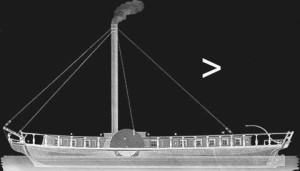
In 1816, just four years after the Comet commenced her role as the pioneering steamboat on the Clyde, David Napier had a small steamboat built for himself. He named his little boat Marion, after his wife, and for just over a year she was well known on the Clyde, sailing to Greenock and Helensburgh. Her advantage was that she had a shallow draft and could sail at any state of the tide to provide a regular and reliable service. “The Marion steamboat will commence sailing to-morrow for Greenock and Helensburgh, and every lawful day at 8 o’clock morning) and on Saturday evening at 6 o’clock. Will leave Greenock for Glasgow at 2 o’clock every afternoon, and on Monday morning at 4 o’clock.  Those intending to go by the Marion will require to be on board by the hour fixed, or they will lose their passage.  From her draught of water she is enabled to sail at all times of the tide, and will...

The twins of 1937

on Aug 1, 2019

From 1930 onwards, the L.M.S. railway company had embarked on a program of replacement for the fleet of steamers built before the first world war. The Duchess of Montrose in 1930, Duchess of Hamilton in 1932, Caledonia and Mercury in 1934, Marchioness of Lorne in 1935 and Marchioness of Graham in 1936 had been revolutionary and a tremendous investment at a time when shipbuilding work on the Clyde was scarce and prices were low. Additional tonnage was required, however, for the popular routes to Dunoon and Rothesay and in 1936, an order was placed with the Fairfield Company in Govan for two steamers, designed as ferry-class vessels like Marchioness of Lorne, but with higher speed and greater capacity. The new steamers, to be named Jupiter and Juno, were built on the same slipway at the Govan yard. Although named after two steamers of the former Glasgow and South Western Railway Co.,...

Caledonia and Mercury of 1934

on Jul 23, 2019

The trade depression of the early 1930s had many consequences on Clydeside. Prolonged periods of unemployment and short-time working in the shipyards meant that shipbuilders trying to weather the economic crisis offered low prices for new construction just to keep key employees and equipment in operation. The Government of the day stepped in slowly with help for replacement tonnage and eventually also for warships. Both railway companies had seen some benefit from the low prices. In 1930 and again in 1932, the L.M.S. Railway Company had placed orders for the turbine steamers Duchess of Montrose and Duchess of Hamilton respectively from Messrs Denny at Dumbarton and Messrs Harland and Wolf at Govan. The L.N.E.R. had gone to the Fairfield Company in Govan for the paddle-steamer Jeanie Deans in 1931, and Williamson-Buchanan Steamers had the turbine Queen Mary built by Denny in 1933. In...

Duchess of Hamilton (1932)

on Jun 11, 2019

The success of the Duchess of Montrose in 1930 as a one-class cruise steamer brought forth a proposal to the L.M.S. board to build a second steamer of the same class. In the trade depression of the early 1930s, there was an incentive to take advantage of the low rates for shipbuilding on the Clyde and at the end of the 1931 season, an order was placed with Messrs Harland and Wolff, Govan. The new steamer was launched as Duchess of Hamilton on May 5, 1932. “New steamer for Clyde Service.—Duchess of Hamilton names the ship.—Brightening the lives of city dwellers.—The Duchess of Hamilton performed the naming ceremony at the launch of the new L.M.S. steamer named after her at Messrs Harland and Wolff’s Govan Shipyard yesterday. “The new ship, said the Duchess, was one of the hopeful signs of the future, as she was designed and built to bring to the people of towns the opportunity of...

David Napier and the Belfast trade

on May 28, 2019

Most of what is known of the career of Mr. David Napier, the eminent engineer responsible for many of the early advances in the application of steam to navigation on the Clyde and around the coasts of Great Britain, comes from his autobiographical memoir and the associated biographical notes published in 1912. It would appear that Napier was setting down these memoirs around 1860 when he was resident in Worcester, and at that time he engaged in a letter-writing campaign with the newspapers in Glasgow and Greenock. In a few essays, it is my aim to document the impact that Mr. Napier had on the steamboat traffic on the Clyde and on Loch Lomond. In this first part, the early years of Napier’s career as an engineer and steam-ship owner are covered, with an emphasis on the cross-channel shipping that initially brought him to the public’s attention. David Napier was born on October 29, 1790...