Early Arran Steamers

on Dec 30, 2015

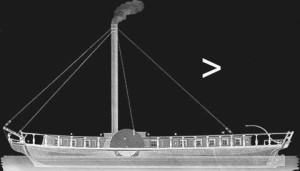
It was in 1834 that the Castle Company introduced a service from the Ayrshire coast to the Island of Arran. The veteran Inverary Castle sailed to Brodick from Troon where she connected with the horse-drawn railway from Kilmarnock. Ardrossan was included as a call in 1834 and the following year, Ardrossan was the Ayrshire terminus with a connecting coach from Kilmarnock. Although the Inverary Castle was described as extensively improved in both speed and comfort, she had been advertised for sale in the Spring, and was disposed of the following year when M‘Kellar’s Hero appeared on the route. The hull of the Hero was built by William Denny in Dumbarton in 1832 and her machinery was produced by Robert Napier. Duncan M‘Kellar added a larger and more successful vessel, the Victor, in 1836 so that Hero was available for the Arran service. Plan of the Glasgow, Paisley, Ardrossan and Ayr...

Queen Mary—534

on Dec 26, 2015

During the roaring twenties, with prohibition in the United States, the Transatlantic trade expanded rapidly. Cunard with Mauritania and the Clyde built Aquitania, were experiencing severe competition from White-Star, the French Compagnie Générale Transatlantique and German Norddeutscher Lloyd. The advent of the Bremen in 1929 demanded a response and while the French line laid down Normandie, and White-Star planned a new vessel, to be named Oceanic, Cunard planned to have its own vessel built on the Clyde. Yard number 534 The steamship with yard number 534 was laid down in John Brown’s yard in December 1930. Good progress was made with the construction of the hull but the project fell victim to the depression that followed the Wall Street crash. Work was suspended late in 1931 as the Cunard Company could not raise the capital to complete the ship. The partially completed hull lay...

Campbell and Kilmun

on Nov 29, 2015

The pier at Kilmun, the first on the Cowal peninsula, dates from 1828 when David Napier purchased land on the north shore of the Holy Loch. Napier’s vision opened up the feuing of the region and he built a number of villas along the shore. It also opened up a new route to Inveraray by way of Loch Eck and Strachur and his efforts to popularize this route will be found in other articles on this site. In Napier’s biography an advertisement of 1829 is quoted “At Kilmun there is now a substantial quay built, where passengers can land at all times. Houses to let, ground to feu,” and Napier had his steamers Kilmun and Earl Grey built to serve the needs of his feuars and the new route patrons. The boiler explosion of the Earl Grey steamer in 1835 signaled the end of David Napier’s interests in owning a steamboat fleet on the Clyde. The steamers, Kilmun, Saint Mun, Cupid, and the wreck of the...

Kilmun—David Napier on the Severn…and briefly on the Clyde

on Oct 21, 2015

The saga of David Napier’s rotatory steamer, Dumbarton, on the Clyde, and his frequent references to the success of a steamer on the rotatory principle on the Severn merits investigation. Napier had moved his business dealings to London in the middle of the 1830s but by 1850, he was living in Gloucester, though he maintained connections in London and Glenshellish near Loch Eck. He also owned and fued land in the vicinity of Kilmun where had built and still owned the pier. David Napier The first attempt to bring a steamboat to the upper reaches of the Severn in 1850 appears to have had limited success.  The Star was too long for the locks and the twisting navigable channel. The improved patent suggests that the Star might have had a rotary engine. “Passenger steamer on the Severn.—A steamer has arrived in the Severn from Glasgow. She is named the Star, and is intended to trade between...

To Rothesay

on Oct 4, 2015

After almost a decade in a partnership with Captain William Buchanan when they owned the Eagle steamer on the Rothesay route from Glasgow, Captain Alexander Williamson purchased the Sultan steamer in 1862 and set up on his own account. The Sultan had been built the previous year by Messrs Barclay Curle & Co. for Alexander M‘Kellar’s Holy Loch service and had a good reputation for speed and being an easy boat to handle at piers. Captain Williamson sailed her on the Rothesay station, calling at Hunter’s Quay and Greenock to make a connection with the Caledonian Railway. In her first season, Sultan left Rothesay at 7:40 a.m. to meet the 9:15 a.m. up train for Glasgow at Greenock, and then proceeded to the Broomielaw from where she departed on her return to Rothesay at 2:00 p.m. with a rail connection at Greenock leaving Glasgow at 3:00 p.m. Overnight her base was at Kamesburgh or Port...

Railway connections and racing

on Aug 23, 2015

When the Caledonian Railway took over the Glasgow, Paisley and Greenock Railway in August 1851, the relationship between the railway and the steamboat owners had reached a low point. However, matters on the water had also greatly changed with the withdrawal of Messrs. G. & J. Burns from the river trade and the proliferation of new ownership. In the following year, 1852, the Caledonian Railway made a determined effort to run its own steamers to the coast resorts and bring the revenue earnings of the railway closer to their potential. “We observe the Caledonian Company have advertised frequent trains to run on the Greenock section of their line after 15th April, which will afford great facilities to our citizens and to the inhabitants of Paisley who reside during the summer months on the coast, by means of these trains and the present steam vessels on the river, as also a superior...