In the late 1840s, Clyde steamer services were controlled by monopolies that provided year-round service and at a reasonable price to the general public. The Castle Company that had dominated the sailings to Dunoon, Rothesay, the Kyles of Bute, and Loch Fyne since the 1830s had recently been taken over by Messrs Burns, expanding their hold on the tourist routes to the Western Highlands and Islands. They had also taken a lease on the Bowling to Balloch Railway, providing access to steam-boat services on Loch Lomond, and had the fast two-funnelled steamer, Plover, built by Messrs Wingate in 1848, to provide the connection between Glasgow and Bowling. The south-bank services to Largs, Millport, Ayr, and Arran had been in the hands of the Union Steam-Boat Company since 1846 with Duncan M‘Kellar as the principal owner. Messrs Henderson & M‘Kellar (Alexander M‘Kellar, snr., was the elder brother of Duncan) had gained control of the Gareloch and Helensburgh route by 1840, but in 1848 a new venture of Messrs Napier with the steamer Duchess of Argyle had begun to challenge this. The Duchess of Argyle had been built as a yacht, Jenny Lind, but had been rebuilt as a fine, two-funnelled steamer for the Gareloch trade. Her introduction had caused considerable friction with the Henderson & M‘Kellar steamers. It would seem that these speedy new two-funnelled vessels were responsible for an outbreak of racing on the river.
There was general dissatisfaction with the steamer service between Dunoon, Kirn, and Glasgow. More specifically, the lack of an early morning boat from Dunoon, and a later return from Glasgow, would be more useful to passengers. For the most part, the sailing of the Castle steamers was dictated by the departures and arrivals at Rothesay, rather than the needs of the Cowal coast.
“Change of hours on and after Wednesday the 7th current.—The Castle steamer from Glasgow at 10 a.m. will call at Greenock, Gourock, Strone, Kirn, Dunoon, and Rothesay, leaving Rothesay at 2.30 p.m. for Dunoon, Kirn, Gourock, Greenock, and Glasgow, arriving at Greenock with the view to be in time for the 4.30 p.m. train. The 3.30 p.m. hour from Rothesay is discontinued. The steamer at 2.55 p.m. does not convey passengers for Kilmun; but the 1 p.m. steamer conveys the Kilmun passengers to Greenock, and from thence by another steamer about 3 p.m. direct for Kilmun, train 2 p.m.—Geo. and James Burns, 9 Buchanan Street.—Glasgow. November 1849.”—Glasgow Herald, November 5, 1849
“Notice.—Express steamer between Rothesay, Dunoon, Kirn, and Glasgow.—In addition to their other steamers, the subscribers will commence, early in May, to run one of their swift steamers from Rothesay every morning at 6.30 a.m., calling only at Dunoon and Kirn, and proceeding without further stoppages to Glasgow, arriving about 9.50 a.m. Fares by Express steamer from Rothesay, any part of the vessel 2s. 0d.; from Dunoon or Kirn, 1s. 6d.—George & James Burns, 9, Buchanan Street, 25th April 1850.”—Mail, April 27, 1850
The general dissatisfaction with steamer services was voiced in a series of public meetings at Dunoon, culminating in a notice in the Glasgow Herald in February, 1850.
“Notice to steam-boat proprietors. Several large meetings of the inhabitants of Dunoon and Kirn were lately held at Dunoon, for the purpose of considering steam boat accommodation, sailings, fares, &c., betwixed Glasgow, Greenock, Kirn, and Dunoon.
“From a statement made by the Committee at a recent meeting, taken from sure and proper data, showing the large amount of profit, derived from the increasing number of passengers and the goods traffic betwixed the above ports, the inhabitants at their last meeting, held on the 7th February, have resolved to invite respectable proprietors of steam boats from any quarter to put suitable boats to ply on the station; and they do pledge themselves (the owners agreeing to terms) to give them support to the utmost of their power.
“Offers will be received and further information regarding the profits of the traffic may be obtained by applying to the “Committee on Boats,” Post Office, Dunoon, as soon as possible.”—Glasgow Herald, February 15, 1850
It was into this situation that Mr Alexander M‘Kellar, snr., introduced a new vessel to compete on the Dunoon and Holy Loch station, expanding from the Gareloch into territory normally associated with Messrs Burns’ Castle steamers. The new steamer was the Eclipse, captained by Alexander M‘Kellar, yr., the 25 year old son of the owner.

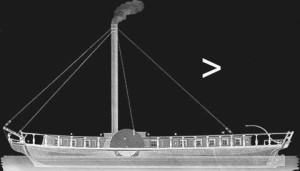
Eclipse (Williamson)
Eclipse was an iron hulled steamer that had been reportedly launched with little fanfare from the yard of Messrs Thomas Wingate & Co., Whiteinch, at the beginning of June, 1849. She was 156¾ feet in length by 15¼ feet in breadth, slimly built, with a depth of 6½ feet. She was fitted with a steeple engine of 62 h.p., and was reputedly a fast sailer.
“New steamer for the Dunoon station.—We observe that the frequenters of Gourock and Dunoon are to be furnished to-day with additional facilities of communication with this city. A new steamer, named the Eclipse, built by Messrs. Wingate & Co. at White-Inch, is to commence plying on that station this afternoon, making four trips a-day. We understand that she is a “clipper,” and likely become a favourite with the public.”—Mail, July 1, 1850
The new steamer was scheduled to make two return trips daily, between Dunoon and Glasgow.
“Gourock and Dunoon.—On and after Monday, 1st July, the new and fast-sailing steamer, Eclipse, will sail from Glasgow for Greenock, Gourock, Dunoon, and Kirn, every forenoon, at ½-past 10; every afternoon, at ½-past 5; and sails for Greenock and Glasgow from Dunoon, every morning, at ½-past 6; every afternoon, at 2; from Gourock, every morning, at ¼-before 7; every afternoon, at ¼-past 2. The steamer leaves Kirn five minutes before the hour of Dunoon.”—Glasgow Herald, July 1, 1850
The response of the Castle steamers was to place in opposition, the steamer Merlin, recently acquired by them but now completely rebuilt and refurbished with two funnels like the Plover.
“River steamers.—We observe that the Castle Company have made another handsome addition to their splendid fleet of river steamers. Some time ago the Queen of Beauty steamer was purchased by the company. Since then, she has been undergoing extensive alterations at the building-yard of Messrs Wingate and Co., which have just been completed. A considerable addition has been made to her length, and an improvement effected in the machinery. She is now furnished with two funnels, similar to the Plover and Duchess of Argyle steamers, the former of which belongs to the same company, and is reputed one of the fastest steamers on the Clyde. To mark the change of ownership, the name has also been changed, and she is now the Merlin.”—Mail, April 9, 1850

With no clear picture for the Merlin, the only guide to what she may have looked like comes from the paintings of Sam Bough who produced a view of the Broomielaw around 1852 or 1853 that contains at least two two-funnelled steamers. This is a crude representation.
The dimensions of the Merlin are quoted as 151 feet in length by 16 feet in breadth, with a depth of 8 feet. She was fitted with a two-cylinder oscillating engine of 80 h.p. that replaced the engine of the Leven that had been placed in her hull in an earlier modification in 1845, a year after she had been tried on the river with John Kibble’s propulsion system.
“Notice.—On and after Monday, 1st July, and till further notice, the 11.30 a.m. steamer from Glasgow will be discontinued; also the connection with the 2.55 p.m. steamer, and 4 p.m. train, from Glasgow for Kilcreggan and Kilmun; but the steamer from Glasgow at 10 a.m., and 4 p.m., will call at Kilmun.—G.&J. Burns, 9 Buchanan Street.—Glasgow, June 29, 1850.”—Mail, July 1, 1850
The Merlin was scheduled to leave the Bridge Wharf at the same hour as the Eclipse, running head-to-head throughout the day. The inevitable result was a race for every pier, down the river, and on to Gourock and Dunoon. Fares were also reduced.
“Opposition in the river steamers.—We notice with the greatest regret that we are probably to have this season a system of steam-boat racing on the Clyde, which, some of these days, may be as disastrous in its consequences, or even more so, than the recent loss of the Orion. The Dunoon people have long been dissatisfied with the accommodation which is offered them in steam communication with Glasgow. Last winter a series of resolutions appeared in the Herald to that effect, inviting steam-boat proprietors to meet the necessities of the public, and they would receive support. We heard no more of this till last week, when we were informed that a new boat was to be put on the station, which would not only leave Dunoon an hour earlier than the present steamers, but Glasgow an hour and a half later; thus supplying a known want to the residents of Dunoon, besides being an additional accommodation to the public generally. This, it would seem, was what the Castle Company would not tolerate, and we have now the dangerous sight, four times a day, of two of the fastest sailing steamers in the river racing within a few yards of each other up and down the Clyde. The thing should not be tolerated a day, and we call upon the River Trustees to exercise their powers, if they have any, of prohibiting two steamers sailing from the Broomielaw for the same place at the same hour; or if they have not the power they should get their act amended without delay. Last year it was the wonder of every one, when there was a similar opposition on the Helensburgh station, that the boats did not upset from the crowds in them, and now we are to have something as bad, if not worse, repeated. The fares, we may further state, have been reduced to 6d. and 3d. by the new company, and 4d. and 2d. by the old company; and when we consider that Glasgow Fair is next week, we think we have stated reasonable and proper grounds for the authorities to interfere. The Castle Company has, perhaps, as good boats as any steam-boat company in the kingdom, and seem to be well managed, and, on the whole, the fares may be considered moderate; but competition in business, which every one has to meet, seems too much for them. The following, amongst other communications which has been handed to us, will illustrate this:— “The people of Dunoon, and other places on the coast, have long complained of the want of regard for their accommodation exhibited by the owners of the Castle steamers. Yesterday (Monday) a very egregious instance occurred, which caused great inconvenience to the passengers from Rothsay and Dunoon. The boat which leaves Rothesay at half-past 10 in time for the half-past 12 train at Greenock, was, without previous warning, as far as known, taken round to Kilmun, Sandbank, and Strone Point, and did not reach Greenock till a quarter to 1 o’clock, so that the passengers, most of whom had return tickets by the railway, which were not available after half-past 12, were deprived of the opportunity of reaching Glasgow in that way, and were obliged to remain in the steamer, which did not, of course, arrive at the Broomielaw till one hour and a half after the train. This, we believe, arose from the steamer on the Kilmun station being withdrawn to oppose the new boat. We need hardly say that these disappointments caused the greatest dissatisfaction amongst the passengers, and it is certainly not what the public deserve nor what they are likely to submit to.”—Glasgow Chronicle, July 3, 1850
The reference to the Orion was the loss in June of Messrs Burns’ Channel Steamer off Portpatrick, with heavy loss of life. The racing merited a leader in the Glasgow Herald.
“River competition and steam-boat racing.— We observe, with much regret, that competition of a very virulent kind has commenced this week on the Clyde, and should it continue as it has hitherto gone on, it may lead to something disastrous. This has been caused by a new steamer called the Eclipse having been put on the station between Glasgow and Dunoon—a territory which has hitherto been worked almost exclusively by the Castle Company, and which regards this new candidate for public favour in the light of an intruder. It may be stated generally, that the various watering places on the Frith of Clyde are accommodated with steam communication by five Companies or associations, which, though separate in interest, are yet agreed in this, that the one shall not encroach on the territory which has been occupied by the other. For instance, the Castle Company, having perhaps the finest and largest fleet of the kind in the kingdom; takes the north side of the Clyde from Kilmun to Inverary; including Dunoon and Rothesay, and all the ferries along the route. The Largs Company takes the south side, from Innerkip to Arran, including Wemyss Bay, Largs, Fairlie, and Millport, in Cumbrae. A third company takes up Helensburgh and the Gareloch. A fourth, the new watering place of Kilcreggan, Ardentinny, Lochgoil, and Arrochar. And a fifth takes up, exclusively, the Dumbarton trade, and the route so far to Lochlomond. Greenock is common to all, and Gourock is common to all that pass Greenock. Now, although it would be ridiculous to say that any class of steamboat owners have the right to navigate this or that portion of the Clyde to the exclusion of new-comers, still, practically, the public have been great gainers by the system of forbearance which the several companies have shown to each other. On the tacit understanding that present arrangements were not likely to be disturbed on slight grounds, capital has been invested to an immense extent in these river steamers; the Clyde boats have become proverbial over the world for beauty, speed, and safety; and a class of men have been trained up to command them, of whom it is the best recommendation to say that, notwithstanding the thousands who traverse the Clyde daily in the summer season, and the vast numbers who are taken in from open boats, such a thing as an accident is scarcely ever heard of. We trust the trade is reasonably remunerative to all concerned, but surely a fare of 1s. 3d. for a cabin passage of more than 30 miles to Dunoon or 9d. in the steerage, with one cwt. of luggage in addition, is about as low as the thing can be done to allow something for risk and capital (for there is no insurance in the case of these steamers), after wages and other outlay are paid. These companies draw perhaps four-fifths of their remuneration during five months in Summer and Autumn, but as a matter of honour they keep up a daily communication with all the watering villages in Winter when the trade is not remunerative, and indeed does not pay itself. We have selected the fares for Dunoon, simply because we started with an allusion to it, but on all parts of the Clyde, both North and South, the accommodation is correspondingly good and moderate in price. Now, so long as conveyance can be secured in these steamers so often, so regularly, and so cheaply, we do not hail with satisfaction any competition which will dislocate this state of things, and carry the system of profitless rivalry into other or all the stations on the Clyde. Should it continue, we can foresee ruinously low fares, of ricketty steamers, ignorant or reckless captains,—and all to end in rates augmented beyond their present scale to make up for the money which has been squandered during the contest. Like in the case of war expenses, the public must pay all the cost of the fighting in the long run.
“Meanwhile the racing and chasing on the Clyde are going on fast and furious. The Castle Company, resenting what they deem an encroachment on the territory which they have nursed have placed a fine steamer alongside of the Eclipse, and both start from the Broomielaw at the same hour, and keep up the contest all down the Clyde, and then across the Frith to the Kim and Dunoon. As he they are both admirable vessels, it is often a “neck and neck” affair, and this system is, kept up during the entire day, in the course of which two trips are made each way. For these special runs the fares have been reduced by the Castle Company to 4d. in the cabin and 2d. in the steerage, and by the Eclipse to 6d; and 3d. to respectively. Already accidents have occurred, but happily they are not as yet of a serious kind. The Eclipse, on Monday, in her hurry to be off, started from Greenock before her gangway was drawn ashore, and two persons were tumbled into the water, but they were got out without sustaining any injury; a similar occurrence took place at Renfrew; and if we are not mistaken, the captains of both vessels will be arraigned before the River Bailie Court for breach of the river regulations. If this system should continue, we will have, as a matter of course, the upsetting of boats at the ferries while engaged in landing or putting on board passengers; or perhaps something worse. In plain fact, we may look forward to collisions and explosions should this virulent competition continue. We trust the authorities will do all in their power to repress it; but better still, we hope the parties themselves will call common sense and prudence to their aid, and abate a game which must be a losing one to both, and from which both may reap a bitter harvest.
“That the present companies may have occasionally given cause for dissatisfaction, is not unlikely; but it is for their own to interest to grant reasonable accommodation and concessions when asked; and we are informed this course has been uniformly followed. At the same time each coast family, or class of families, cannot expect that a steamer is to come and go for their convenience alone. We should consider competition laudable, and rejoice to see it, when high fares are exacted in virtue of a monopoly—when accommodation is inadequate, or officials saucy. But we do not know that these grievances exist on the Clyde during the present season.”—Glasgow Herald, July 5, 1850
The situation was deemed sufficiently serious that the Lord Provost appealed to George Burns himself to take measures to reduce the competition. This he accomplished by changing the departure times for the Merlin.
“The rival steamers Merlin and Eclipse.—We are happy to learn that in consequence of representations made by the Lord Provost of the alarm occasioned to many persons by the racing of the Dunoon rival steamers, the Messrs Burns have very readily agreed to put an end to it, as appears from the following communication:— “To the Hon. the Lord Provost. Thursday evening, 4th July, 1850.—In reference to the conversation which you had with me this morning, I beg to inform you that we have given orders to withdraw the Merlin from the hours at which the Eclipse goes, so that there may be no strife in that respect.—Yours very truly, G. Burns.”—Glasgow Herald, July 8, 1850
“Castle steamers.—On and after Monday, the 22d inst., Glasgow to Greenock, Gourock, Kilcreggan, Strone, Kilmun, Kirn, Dunoon, and Rothesay, cabin, 9d., steerage, 6d.; Greenock to Rothesay, cabin, 9d., steerage, 6d.; Greenock to Kilmun, Kirn, and Dunoon, 6d.—G. & J. Burns.—Glasgow, 16th July, 1850.”—Glasgow Courier, July 20, 1850
The mechanisms for dealing with racing on the Clyde depended on enforcing the by-laws that were in place at the time. The Eclipse had been reported for causing a surge that fractured the chain on a punt. It seems likely that the Merlin had passed earlier, also at speed, but no damage could be brought forward as evidence, and so no charges were forthcoming.
“Steamboat racing.—Yesterday, at this court, a case, which originated in the dangerous practice of steamboat racing, was brought under the notice of the Magistrate. The circumstances as they came out in evidence, appeared to be that, on Thursday last, the Eclipse and Merlin were coming up the river at full speed. The Merlin, being somewhat a-head of her rival, the latter neglected, according to regulation, to slow her engines while opposite Whiteinch, near which a number of punts were moored, and the consequence was that the heavy swell, produced by the rapid motion of the steamer caused some confusion among the boats, one of which had her mooring chain snapped. The Lady Kelburne steamer chancing to be passing at the same moment, the master in charge of her was, with the captain of the Eclipse, summoned to the Court, to answer for the contravention. The master of the latter vessel, however, very handsomely took all the blame to himself, acknowledging that the swell was occasioned by his neglecting to slow his engine, and that the Lady Kelburne was not to blame. The charge against her master was, under the circumstances, not pressed. In inflicting a penalty of two guineas upon the other defendant in the case, the sitting Magistrate, Bailie Pearson, remarked that very considerable sensation had been produced during the last week or two among the sober-thinking portion of the community, in consequence of the reckless and uncalled-for competition, for he could not characterize it by any other appellation, in which several parties had been engaged. He believed there was no river in the world where there were more comfortable or swift steamers than on the Clyde which could be obtained every hour of the day. Were it otherwise, there might be something like plausibility for competition, but such did not exist. Cheap fares, splendid boats, pleasure excursions, and every other convenience were maintained, and that too under such bye-laws and regulations as the River Trustees thought fit to adopt, both for the comfort of the lieges and injustice to proprietors. Still in the spirit of monopoly or of strife, he could not tell which, these regulations were openly evaded or disregarded in such a manner as to call forth the interference of the authorities. Serious calamities had taken place in years bygone, and the remembrance of these ought to prevent parties from similar strife. When the fearful effects of carelessness (not to use a harsher term) were at this moment wringing the hearts of surviving relatives in the loss of one of their finest steam-ships, it was matter of astonishment that this strife had been tolerated so long. He was happy to observe that one of the proprietary had properly withdrawn. He regretted that no regulations existed to prevent steamers sailing at the same moment, but he trusted this would soon become the subject of consideration, in order to prevent similar competition. He had deemed it proper to make these remarks now, seeing that the annual holidays had commenced, and he would earnestly hope that the public would manifest its own disapproval by giving no countenance to measures so dangerous to the lives of themselves and their families or friends.”—Mail, July 9, 1850
A few days later, the master of the Eclipse was again before the Magistrate, this time for having the steamer’s small boat improperly stowed.
“River Bailie Court.—At this Court, on Wednesday, the master of the Eclipse steamer was summoned before the Bailie, charged with a contravention of the 36th clause of the Harbour Regulations, by having the boat attached to his steamer in an improper condition, by not being provided with sufficient lowering tackling, nor suspended to proper davits. Captain Johnston, the Harbour Master, stated that the boat was not at all in a safe condition at present. The master of the Eclipse admitted that the boat could be made better, and promised that he would have it immediately put into a proper condition, by complying with the terms of the regulations. The Magistrate (Deputy Bailie Harvey), to mark the sense of the Court, fined the defendant in the modified fine of 10s., the full penalty being £5, and hoped that strict attention would be paid to having boats in an efficient state at all times.”—Mail, July 12, 1850
Although the racing with the Merlin had been defused, the reckless behaviour of the Eclipse persisted into the Glasgow Fair. It seems the following accounts refer to an accident, but whether they were the result of passengers being hurried over the gang-plank, might well be the result of the cavalier management of the steamer.
“Accident.—On Saturday afternoon, while a young lad, belonging to Glasgow, named Devlin, was stepping on shore at Dunoon from the gangway of the Eclipse, his foot got entangled between it and the quay. The steamer, from some cause or other, suddenly shot forward at the moment, and before the lad could be extricated from his position, his right leg was dreadfully crushed. The poor fellow was instantly conveyed below, and carried back to Glasgow, where he was immediately removed to the Royal Infirmary. Though his injuries are severe, we understand that no bones are broken.”—Mail, July 16, 1850
“Accident at Dunoon.—The only mishap in connection with the Fair marine excursions which has yet transpired occurred at Dunoon on Saturday. A passenger by the Eclipse, on board that vessel at Dunoon Pier, missed his footing, and fell betwixt the steamer and the pier, where he remained jammed for several minutes until assistance was rendered. His leg was bruised severely, and otherwise he suffered considerable injury from the fall.”—Glasgow Courier, July 18, 1850
A new steamer appeared on the Gareloch as consort to Duchess of Argyle, and in direct opposition to the interests of Alexander M‘Kellar (Snr). She was the Victoria, from the yard of Messrs Robert Napier & Sons, Govan, and a fine iron steam she was, at 157 feet in length by 16 feet in the beam, and powered by an oscillating engine of 80 h.p.

Victoria
With animosity already roused between the two parties contesting the Gareloch trade, it was not long before the new steamer encountered the Eclipse. Although the two steamers were scheduled to return to Glasgow with half-an-hour separating their departures from Greenock, the newspapers reported a collision between the Eclipse and the Victoria at the end of July.
“Reckless steamer management.—Yesterday morning, at seven o’clock, as the Eclipse, river steamer, from Dunoon and Gourock, was making for the harbour of Greenock, the passengers were very much alarmed by the Victoria, Helensburgh steamer, coming close alongside of her, with the view of reaching the quay first. The attempt was, however, abandoned, and both steamers, after landing and receiving passengers, immediately started, the Eclipse being a-head 100 yards or so. On sailing about half-a-mile, the Victoria following, exactly in the course of the Eclipse, made up to her, and from the close proximity of the former vessel, created some consternation on board the latter. The vessels sailed for a minute or so in this precarious position, the Helensburgh boat pressing against the stern of the Dunoon boat. The excitement at this moment on board the Eclipse was so great, that the parties in command of the Victoria gave orders for altering her course to starboard, and, in doing so, carried away the stern boat with all her tackling, including the divets, which were wrenched from their fastenings as well as a life buoy, which was drawn out to a considerable length. The Victoria was now stopped to get disentangled from these encumbrances. It is computed that there were about 500 passengers on board of the Eclipse, and, had any serious accident occurred by the imprudent conduct of the other vessel, the consequences must have been frightful. We refrain from comment on such reckless conduct, unfortunately too much practised on the Clyde by those in command of steamers, to the imminent danger of lives and property committed to their charge, as we are informed that, in this case, a thorough investigation is in the course of being instituted.
“Since the foregoing was written, an esteemed correspondent who witnessed the casualty, writes us similar details regarding it. He speaks strongly as to the culpability of such conduct, and adds—“The passengers in both vessels were much alarmed; and, as a great number of those on board the Eclipse were clustered around the stern, it was a most fortunate circumstance that none of them were drawn into the river by the ropes connecting the boat with the steamer. That one or both of the parties to this transaction were highly culpable was self-evident, but as the casualty will undoubtedly form the subject of judicial investigation, we refrain from making any farther comments. In backing out of her position after the accident, the Victoria unfortunately struck one of the small craft which are so numerous at that part of the bay; but of the nature or the extent of the damage to the I latter we have not learned.”—Glasgow Courier, July 30, 1850
Not all the news concerning the Eclipse was bad. She had a distinguished visitor cross her decks in August.
“Incident on a Clyde steamer.—On Thursday evening last, while the steamer Eclipse was on its way down the river, it called at Bowling, and received on board a party of ladies and gentlemen, to one member of which the attention of nearly the whole passengers was speedily attracted. He was an old man, seemingly about 70 years of age, with grey hair and moustache, the latter quite silvery. His features were very prominent, his nose, indeed, so prominent as to put the famous beak of the Iron Duke himself in the shade. But his eye most caught the attention of all. There was a fire and lofty expression of dignity in it which awed every beholder. It was evident that here was no ordinary man. All around were heard exclamations of “Who can it be;” “What an eye he has!” &c. Curiosity directed some gentlemen to examine the luggage of the party, and faintly engraved on the name-plate of a portmanteau were the words “Viscount Gough.” ’Twas even so, as was learned by subsequent inquiries from the servants. There sat the hero of Goojerat! gaily chatting to his lady and daughters, and admiring the scenery. When the boat arrived at Greenock he threw a Spanish cloak over his arm, mounted the paddle-box, and left with the rest of his party, leaving impressions, not soon to be effaced, on the minds of the passengers, of their meeting with “Tipperary Joe.””—Glasgow Herald, August 16, 1850
Racing was very much viewed as a necessary evil for passengers on the river. At the time, there was substantial engineering work taking place to broaden and deepen the Clyde, and the bustling traffic of the summer season resulted in collisions that, although alarming to the passengers, were considered minor affairs as long as no one was injured. The captains of the vessels tended to take such matters in stride, and if reported, a trip to the River Bailie Court would result in a modest fine that had little effect on the perpetrators.
“To the editor of the Reformer’s Gazette.—Portobello, 12th September, 1850.—Sir,—Can you inform me if steam-boat collisions are very frequent on the Clyde? Being tempted by the cheapness of the excursion, last Saturday I started from Edinburgh to visit Lochlomond, and should have had a very pleasant excursion but for one unlucky hit, which nearly frightened my timid self and a few score of other persons out of our five senses. The hit to which I refer was that which the Plover steamer dealt the Pioneer about half way between Renfrew and Bowling. Fortunately there were no lives lost; no thanks to the captain of either vessel. The coolness with which the parties in charge of these steamers viewed the whole matter, though the wing of the one and the bow of the other vessel was stove in, attracted my particular attention, and has prompted the question with which I have begun this letter. Can you give me any information on the subject? and oblige yours truly, Jacques”—Glasgow Gazette, September 14, 1850
In September and October, the court cases for the earlier behaviour between the Eclipse and the Victoria took place. There were at least two incidents between the two steamers, both involving the Eclipse zig-zagging to prevent the speedier Victoria from overtaking. In one instance coming up the river below Bowling, on Friday, July 26th, the master of the Eclipse, in addition to zig-zagging, repeatedly slowed down, and while the Victoria also slowed down to pass, as specified in the Regulations, Captain M‘Kellar immediately threw the steam on again and raced forward, preventing the Victoria from getting ahead of his vessel. Wary of this behaviour, Captain Campbell of the Victoria eventually held back but gathered some of his regular passengers as witnesses to explain his actions, thereby ensuring he could bring a solid case before the River Bailie Court for the behaviour of the Eclipse. On the following Monday, the 29th of July, a similar display of zig-zagging was carried out by the Eclipse, but the Victoria, determined to pass, approached too closely and swept away the boat and davits from the stern of the Eclipse.
The Glasgow Gazette, or to give the newspaper its proper title, The Reformer’s Gazette, closely followed the court cases, and campaigned for stricter penalties for the outrageous behaviour, insisting the collision was not “a steam-boat accident,” but “was a most willful, reckless, and daring piece of conduct deserving of the severest reprobation”. The reporting is a little extreme, but verbatim accounts provide an interesting insight into the attitudes of the parties in the dock.
For the first encounter, Captain M‘Kellar of the Eclipse was charged by the Procurator-Fiscal with “obstructing the navigation of the steamer Victoria on the Clyde, between Port-Glasgow and Bowling, on Monday the 26th of August, in so far as he, the said Captain M‘Kellar, when made up to by the Victoria, refused to allow her to pass; and, secondly, that he improperly took possession of the wharf at Bowling, to the exclusion of the Victoria.”
The young captain of the Eclipse, presented himself with plenty of confidence.
“Bailie— Well, Captain M‘Kellar, what do you say to these charges?
“Captain M‘Kellar—None of them are true.
“Bailie—Then you deny them?
“M‘Kellar—I do. “
At one point in the proceedings “Captain M‘Kellar, senior, who was in Court, now advanced to the bench of the Court and ordered his son “to go away.”
“Court—What is the meaning of this?
“Captain M’Kellar, senior—His time is up. He sails at half-past 10. He must go.
“Court (to the accused)—We have every disposition to oblige Captain M‘Kellar. Do you wish your father to appear for you?
“Prisoner—Yes, I do.
“Court—Very well. You may go away, Captain M‘Kellar.
“Captain M‘Kellar, senior, then took his son’s place at the bar, and cross-examined the witnesses.”
Captain Campbell of the Victoria was praised for his restraint in holding back his vessel and not endangering the passengers. The charge was proven against Captain M‘Kellar who was fined two guineas, or about a tenth of the receipts on a single voyage of the steamer carrying 400 souls at 6d each.
Other newspapers reported the trial in a much more matter-of-fact style.
“River Bailie Court.—At this court on Wednesday, Mr. Alex. M‘Kellar, of the steamer Eclipse, was charged with contravention of the river and harbour regulations. It appeared that, on the 26th ult., the Eclipse, on the passage up to Glasgow, had, after passing Dumbarton, got precedence of the Victoria, another steamer, and, as it seems, a faster river steamer. The Victoria, on walking up to the Eclipse, attempted to get past the latter, but her captain, the defendant, failed to comply with the regulations in such cases provided, by not slowing his engines, so as to allow the swifter vessel to pass. The Eclipse thus kept the lead for the greater part of the way tip the Clyde, and the charge of contravention was, in these circumstances, preferred against the master. There was a second charge of a somewhat similar nature, in which the master of the Eclipse was accused of having, on the same occasion, taken up a wrong berth at Bowling wharf, in consequence of which the Victoria could not get a proper place. This part of the charge was, however, held not to be proved; but the court considered the evidence quite conclusive as to the contravention involved in the first charge, and fined the master in the sum of two guineas.”—Glasgow Herald, September 6, 1850
The Greenock Advertiser expressed some incredulity at the outcome of the case.
“More Steam-boat Racing on Clyde.—lt seems all the late warnings have been lost on some of our Clyde steam-boat captains. They go ahead as if no explosions had ever been heard of, and as if they had never been fined for their recklessness. On Monday last the Eclipse and Victoria had another “dead heat.” Shortly past seven o’clock on the morning of that day they started alongside each other at Greenock, and raced all the way to Bowling, to the terror of some the passengers, sometimes the bow of the Victoria was over the stern of the Eclipse, and when it endeavoured to pass, the Eclipse manoeuvred still in its way. It is time that something decided was done to put end to these dangerous and unseemly practices. —Glasgow Examiner.—[We were in hopes that our contemporary had been misinformed as to this case, and therefore hesitated to publish it, but a conviction in the River Bailie Court confirms the Examiner’s accuracy. A severe lesson was last week taught to those in charge of steam-boats of the danger of even momentary neglect of the duties entrusted to them; if such recklessness, as is described above be continued, and loss of life ensue to passengers, as it is all but certain will result here long if a stop is not effectually put to this system of racing, the parties to it may depend on having to answer at the bar of the Justiciary Court to a charge of manslaughter if not of murder. The public ought to be on their guard against putting a foot on board of steamers so conducted.—Ed. G. A.]
“At the River Bailie Court, Glasgow, on Wednesday, Mr. Alex. M‘Kellar, of the steamer Eclipse, was charged with contravention of the river and harbour regulations. It appeared that, on the 26th ult., the Eclipse, on the passage up to Glasgow, had, after passing Dumbarton, got precedence of the Victoria, another steamer, and, as it seems, a faster river steamer. The Victoria, on coming up with the Eclipse, attempted to get past the latter, but her captain, the defendant, failed to comply with the regulations in such cases provided, by not slowing his engines, so as to allow the swifter vessel to pass. The Eclipse thus kept the lead for the greater part of the way up the Clyde, and the charge of contravention was, in these circumstances, preferred against the master. There was a second charge of a somewhat similar nature, in which the master of the Eclipse was accused of having, on the same occasion, taken up a wrong berth at Bowling wharf, in consequence of which the Victoria could not get a proper place. This part of the charge was, however, held not to be proved; but the court considered the evidence quite conclusive as to the contravention involved in the first charge, and fined the master in the sum of two guineas.”—Greenock Advertiser, September 6, 1850
The Court case for the more serious incident involving the collision was delayed over legal wrangling as the Procurator tried unsuccessfully to have it moved to a regular criminal proceeding with the possibility of a more substantial fine or a jail term. Precedent had been set by the trial resulting from the fatal sinking of the Orion where the Captain was sentenced to 18 months in jail and the second mate was transported. When it was agreed to continue the trial of the captain of the Victoria at the River Bailie Court, the indictment specified a penalty greater than could be imposed, and the case was dismissed, requiring a new indictment.
“The Collision betwixt the Victoria and Ecllpse.—It may be recollected that, on the 29th of July last, a collision occurred on the river, near Greenock, betwixt the Eclipse and Victoria steamers. The accounts given at the time stated that the two vessels left the Greenock quay almost simultaneously, the former being a little way a-head; but the Victoria, being a faster boat, soon gained upon her, and, as she was steered in almost the same track, her bow ran into the stern of the Eclipse, carrying away one of her boats, and greatly alarming her passengers. The circumstances have, it seems, been under the attention of the authorities, though a considerable delay has been suffered to elapse ere any definite step has been taken. in the matter. On Monday morning the case was brought up at the, River Bailie Court—Captain Campbell, of the Victoria, being accused of having culpably, recklessly, and negligently navigated his vessel, whereby the consequences detailed were given rise to. Mr. William Steele appeared as the defender’s agent, and took a preliminary objection in the case. He opposed the competency of the complaint, in respect of the amount of damages concluded for being £10 sterling, whereas the Act 3 and 4 Vict., cap. 118, sec. 86, only gives the court jurisdiction where the damages sued for do not exceed £5. The Procurator-Fiscal tendered a restriction of the complaint, limiting the damages craved to the sum specified. The defender objected, however, to such an amendment being sanctioned, and the Court sustained the objection, and dismissed the complaint on the ground of incompetency. We believe it is open to the prosecutor to institute a new action, and that this course has been resolved on.”—Glasgow Herald, October 11, 185o.
“Steam-boat collision.—Most of our resident will recollect that, towards the latter end of July last, some excitement was created in town in consequence of the frequent collisions occurring between the river steamers, which at that time were racing against each other in a manner that occasioned considerable alarm to the passengers on board. One of most serious of these occurred on the 29th of July, between tile Eclipse and Victoria, in which the former was run into by the latter, and had her stern damaged, and small boat carried away. Statements of passengers and notices of occurrence, appeared in the newspapers of the day; and it was considered that the affair would have immediately been made the subject of an inquiry by the proper authorities. This appears to have been done; but, from a variety of circumstances, the case was not properly brought under the notice of the River Bailie Court till yesterday, when Mr. John Campbell, Captain of the Victoria, was charged before Bailies Pearson and Harvey with having been the occasion of the collision. The indictment, which was framed under common law, accused the party at the bar with the crime of culpably and negligently, directing, managing, or steering a steam vessel on the River Clyde, in so far as, on the 29th July, the Eclipse having sailed from the quay at Greenock, on its way to Glasgow, with 400 passengers on board, and the Victoria having sailed from the said quay, for the same destination, a few minutes afterwards, he (the defendant) did, when at that part of the river opposite the yard of Mr Robert Steele, Greenock, culpably and negligently so manage and direct or steer the Victoria, as to cause her to follow direct in the track of the Eclipse; and did cause the bow of the Victoria to run against the stern of the Eclipse, in consequence of which her stern was damaged, and the small boat destroyed, and the passengers on board put into a state of great bodily fear and alarm, and in danger of their lives. The penalty concluded for was £10 or sixty days’ imprisonment. Mr Steele, who appeared for the defendant, said that, before proceeding with the case, he had an objection to slate against the competency of the libel. Mr Burnett, as Fiscal of the Court, thought that Mr. Steele had mistaken the nature of the complaint. Mr Steele replied; and the Assessor of Court, Mr. Forbes, having given it his opinion that the objection was well founded in law, the Court dismissed the case, leaving it with Mr. Burnett to bring it again before them in a more competent form.”—Mail, October 12, 1850
For the second incident, only Captain Campbell of the Victoria appeared in the dock, being accused of having culpably, recklessly, and negligently navigated his vessel. It was revealed that he had left Greenock about 10 minutes before his regular time, on the heels of the Eclipse, but had to stop at Port-Glasgow. Even so, he quickly made up to the Eclipse near Gemmil’s Point, and pressed on her stern so closely that a collision resulted.
The Bailie indicated that he felt that both masters should have been in the dock, but that circumstances dictated that he must extract the full penalty of £5 from Captain Campbell.
“River Bailie Court.—Steam-boat racing.—On Tuesday, this Court was engaged, from three o’clock in the afternoon up till nearly ten in the evening, hearing evidence in a case against John Campbell, master of the steamer Victoria, who was charged with having, in the end of July last, been guilty of culpably, negligently, and recklessly steering his vessel in the river, off the harbour of Greenock, whereby the said steamer Victoria ran foul of the steamer Eclipse, the passengers on board of which vessel were dreadfully alarmed, and several slightly injured. Campbell pleaded not guilty. His case was conducted by Mr. Steele, writer. We believe the circumstances of this case will be fresh in the recollection of our readers, and it is unnecessary to give the evidence in detail. It appeared that the two steamers, who were running in opposition, had arrived at Greenock on their way up the river, on the morning of Monday the 29th July last, about a quarter past seven o’clock. The Eclipse first left the quay, but while passing the Victoria, that vessel immediately got on her steam, and followed closely after. Before either vessel had proceeded far, the bow of the Victoria was run into the stern of the Eclipse, and her boat, which hung thereon, wrenched from the davits. Meanwhile, the utmost alarm prevailed on board the Eclipse—one lady is said to have fainted on the quarter-deck, some individuals received slight bruises, while all on board, the passengers numbering 500, were put in bodily fear. It was clearly proved for the prosecution that the Eclipse was in the right course; while the agent for the master of the Victoria endeavoured to establish that the Eclipse had been skulled, or sailed in a zig-zag course, with the view of preventing the Victoria passing her. It was agreed, after the hearing of the evidence, to adjourn till next day for the purpose of hearing the addresses by the Procurator-Fiscal and the agent. On Wednesday, the Court was addressed at great length by Mr. Steele for the defence, and Mr. Barnet for the prosecution. Bailie Pearson then summed up the evidence, and found the charge of negligence and recklessness proved. Captain Campbell was then fined in the full penalty, viz., £5 with costs.”—Glasgow Herald, October 18, 1850
A more detailed account of the trial appeared in the Mail.
“Monday, October 14.—River Bailie Court.—Steam-boat collision.—The case, in reference to the collision between the Victoria and Eclipse, which, as noticed at the time by us, was postponed on Monday week, again before the River Bailie Court on Monday last—Bailie Pearson presiding.
“Mr. Campbell, master of the Victoria, having been placed at the bar, a number of witnesses were examined for the prosecution.
“Captain M‘Kellar of the Eclipse stated the circumstances under which the accident occurred. The Eclipse left the quay of Greenock shortly after seven o’clock on the morning of the 29th July, being about nine minutes after her usual time. When nearly opposite Steele’s building-yard, the Victoria came up on the same track, and struck with her bows the small boat at the stern of the Eclipse, which had its davits torn away, and in consequence fell into the water. One lady fainted, and a number of other passengers, of whom there were 497 on board, sustained slight bruises. The channel which he took was the usual one, and rather nearer the north bank than was customary. There was no depth of water for the Victoria to have passed on that side, but on the south half-a-dozen could have done so with ease. He slowed his engines immediately on the collision. In answer to Mr. Steele, who appeared as agent for Captain Campbell, he denied that he had “sculled” the Eclipse. He did not steer a straight course from the quay, because he had to follow the line of the buoys. If he had slowed his engines when the Victoria was behind, she would have went through the Eclipse.
“John Steven, a passenger on board the Eclipse, stated that the Victoria left Greenock quay immediately after the Eclipse. He was on the stern, and looked to see if the other vessel was coming up. He saw the bow of the Victoria coming direct for the stern of the Eclipse, and was very much astonished. When close upon the latter vessel, the Victoria steered in a line across her stern, tearing away the davits, and the small-boat attached. The crashing and tearing continued so long, that he expected a hole would have been torn in the Eclipse—he felt in terror of his life. The Victoria never slowed at all, and passed on to the south side. She did not attempt, so far as he saw, to pass on either side, but came straight up for the stern of the Eclipse. The passengers were all in a state of the greatest alarm. Thought they were about ten minutes away from the quay at the moment of the collision. As the Victoria was passing, heard some parties from the deck of the Eclipse calling out to the commander of the other vessel, that he was a rascal. The master of the Eclipse appeared to be steering a straight course.
“James Gilchrist, also a passenger on board, stated that on seeing the Victoria approach he ran forward to the stern and cried out to her captain, “What are you about; are you going to run us down.” The collision instantly afterwards occurred.
“A number of other witnesses, whose testimony was of a similar tendency, having been examined, Mr.Steele led evidence at great length, the object of which was to show that the commander of the Eclipse was to blame for the collision—the Victoria having repeatedly attempted to pass the latter on the south side, which was prevented by the Eclipse throwing herself in the way. The harbour-master of Greenock, who was one of the witnesses for the defence, stated that at the place where the collision occurred, there was depth of water on the north side of the river for three steamers to have passed—the depth of water at that spot being 25 feet at ebb tide. The south side, according to the river regulations was the side on which the Victoria ought to have passed, and the Eclipse should have kept to the north. The above is the general purport of the evidence, which occupied, in the taking down, from three o’clock till nine p.m. On the suggestion of Mr. Steele, the Court delayed coming to a decision till next morning at ten o’clock, and the final disposal of this tedious and protracted case was accordingly adjourned till that time.
“Tuesday, October 15.—This morning, at ten o’clock, this case was again resumed before Bailie Pearson—Mr. Forbes, town-clerk, acting as assessor.
“Mr. Burnet addressed the court in support of the prosecution; and, after pointing out the nature of the charge, he maintained that there could be no doubt the corpus delicti was fully established.
“After counsel for the defence had been fully heard, Bailie Pearson said that he felt himself placed in a most responsible situation. The Bailie then went over the evidence on both sides, touching on those points which were difficult to reconcile, and endeavoured to show, from the natural curve in the channel of the river, between the Custom-house and Gemmil’s Point, that it was possible for witnesses to make mistakes regarding the zigzagging alleged in the defence, as having been adopted by the Eclipse, in order to prevent the Victoria passing her. Amidst the conflicting evidence, however, he felt bound to express his conviction that the prosecution would have been justified in placing the captain of the Eclipse side by side with the captain of the Victoria, to answer for conduct, which, on the whole, he was afraid there was too much ground to believe was not what it should be. No less than 497 passengers were on board the Eclipse at the time, besides the vast number which must have been on board the Victoria; had he slowed his vessel, no collision would have taken place, and no danger would have threatened the passengers. Whatever blame, therefore, might be attributable to the Eclipse, it is quite clear that it was as much in his power, as it was his duty, to prevent that danger, and under all the circumstances, found himself impelled, however painful, to find the charge of negligence, and recklessness fully proven against him, and in the discharge of his duty in this court, and to the public, could not inflict a penalty anything less than that imposed by the regulation. Capt. Campbell was then fined in the sum of five pounds. Mr. Steele, on the part of the defendant, appealed to the Court of Justiciary against the decision.”—Mail, October 19, 1850
In November, the schedule for the Eclipse was reduced to one sailing each way, daily.
“Change of Hours.—The steamer Eclipse, will, on and after Monday, 23d September, sail from Glasgow for Greenock, Gourock, Dunoon, and Kirn, at ½-past 19 forenoon, returning from Dunnoon at ½-past 1, and from Gourock at 2 afternoon. And on and after the above date, the ½-past 5 afternoon hour from Glasgow, and the morning hour from Dunoon and Gourock will be discontinued.”—Glasgow Herald, September 23, 1850
It was soon time for the winter lay-up and for tempers to be cooled.
In the new year,1851, the Messrs Burns divested of their Clyde fleet to Messrs William Denny & Brothers, under the management of their Clerk, Mr William Findlay Johnstone. The two-funnelled Plover, operating with the Bowling Railway from the Broomielaw, suffered a boiler explosion, with fatalities, on February 5th, casting gloom on the Clyde steamer services. The Eclipse was brought out in the middle of March.
“Notice.—The steamer Eclipse will, on and after Saturday 15th instant, sail from Glasgow every afternoon at one o’clock for Greenock, Gourock, and Dunoon; and will leave Dunoon for Glasgow every morning at ¼ past 7, and from Gourock at ¾ past 7.”—Glasgow Herald, March 14, 1851
There were no reports of reckless incidents, and an intimation in the middle of July revealed that the young master of the Eclipse had died. Captain James Barrie was appointed to command the vessel in his stead. With no death certificate in the records, a cause of death for the younger Captain Alexander M‘Kellar is not known.
“At 23, Lynedoch Street, on the 12th instant, Mr Alex. M‘Kellar, yr., late master of the Eclipse steamer.”—Glasgow Herald, July 14, 1851
On the Dunoon station, the Eclipse made calls at intermediate piers and ferries and in 1851 began to expand to provide a call at Strone when required. Strone and Kilmun had piers from the time when David Napier had pioneered the Loch Eck route to Inveraray. When Napier had relinquished his business, the piers had been leased to the Castle Company, subsequently Messrs Burns, until they divested ownership in the Clyde and West Highland fleet in February 1851. Strone was important as the mails passed through the post office there. The lease for Strone Pier continued during 1851, and until it was renewed, the Eclipse was excluded from calls at the pier, and had to land passengers by ferry-boat.
“On and after Monday, the 6th instant, the steamer Eclipse will sail from Glasgow for Greenock, Gourock, Dunoon, and Strone, every forenoon at half-past 10, returning to Glasgow in the afternoon. After Saturday the 4th inst., the half-past 5 hour from Glasgow will be discontinued. On Monday morning, 6th inst., the Eclipse will leave the above places at her usual hour for Glasgow.—Glasgow, 2d October, 1851”—Glasgow Herald, October 3, 1851
Competition for the Holy Loch was provided by the Ardentinny, supplemented by the Pilot, recovered from her sinking on Loch Lomond and now sailing on the Clyde.
“Kilmun and Lochgoilhead steamer.—On and after Monday the 6th October, the steamers Ardentinny or Pilot will sail, until further notice, between Glasgow, Greenock, Gourock,Kilcreggan, Cove, Strone, and Kilmun, as follows:—from Glasgow at 3:15 p.m.; from Kilmun at 7.15 a.m. On Saturday afternoon the steamer proceeds to Lochgoilhead, and returns on Monday morning. Fares to Kilcreggan, Cove, Strone, or Kilmun— cabin 1s. 3d.; steerage 9d.—Glasgow, 3d October, 1851.”—Glasgow Herald, October 3, 1851
The absurd unfairness of excluding the Eclipse from Strone pier was brought to public attention.
“Strone Point quay.—The construction of piers and wharves at the various watering villages on the coast affords the newspapers occasional subject of congratulation. The exclusion of the public from the use of a quay already formed may no less fitly form matter of remark. At the Strone Point a pier has for many years existed, and a toll of one penny is exacted from each person passing along it to or from steamers. For some reason, or rather by means of some management, the steamboats of one company have a monopoly of the privilege of taking passengers to and from this quay, those using another vessel having to be embarked and landed by means of small boats. On what ground the public are thus excluded from the privilege—for it is to be observed that the public are the real sufferers in the case—we know not, nor care to enquire. The steamer whose passengers are landed by small boats is the Eclipse. On Saturday evening some of the passengers by her had evidently been fortifying themselves against the night air, and although it would be improper to say there was any danger, yet there was abundant room for anxiety to be in a small boat, on a dark night, with half-a-dozen persons not disposed either to take or keep their seats quietly. The same thing might happen on a blowy stormy night, and then danger would not distant. The proprietors of the quay at Strone Point ought to make it a condition at letting, that the owners of every steamer on the station should have permission to use the quay to land and ship passengers, on his or their paying the ordinary dues. This the public have a right to ask, and to protest against its being refused. The steamers Ardentinny and Pilot do call at the quay. We are not aware whether their owners are parties to the exclusion of the other boat; but if they are it says little for their confidence in the character of their own vessels. With good and swift boats, and by adopting suitable hours, no competition need be feared; and they can only suffer by appearing to countenance or exercise a monopoly, as nothing, they may certain, will secure public support faster for any enterprise than an unhandsome opposition. In case of mistake we may say that we know nothing of the proprietors of any of the boats, nor why some are admitted to and others excluded from the quay; we simply mention the fact. They are all fast and well-appointed vessels; but we should not do our duty did we not point out what may lead to accident in the approaching dark and coarse winter nights.”—Greenock Advertiser, September 23, 1851
The former Castle Company enterprise, now renamed “The Rothesay Steamers,” was not viewed well by many members of the public on the Cowal coast.
“To the Editor of the Greenock Advertiser.—Greenock, 8th December, 1851.—Sir,—l went to Innellan last Saturday evening, with the intention of remaining over Sabbath and returning up Clyde by the steamer that should have left Rothesay at seven o’clock this morning, she being advertised to touch at Innellan for passengers. The morning was very blowy, and this, together with its being dark, may account for the Craignish Castle, Capt. Gillies, being half-an-hour later than the regular hour of getting to Innellan. I and other passengers waited on the steamer coming in to the quay, and that there might be no mistake, the person who has charge of the pier was requested to hold up a light to show the steamboat people that there were passengers waiting to get on board. What was my disappointment on going to the end of the pier to see the steamer passing quite close (none of us having the least doubt but she would touch), and not making the slightest attempt come in for the passengers. Now, Sir, it was perfectly calm at Innellan pier at the time, and there was nothing to hinder the boat coming in. I had a particular engagement up Clyde which, of course, has been frustrated, and I do think that I am entitled to make an example of such misconduct on the part of the steamboat proprietors or their servants, by claiming damages at court of law, seeing they advertise to call at the quay. And as such instances of incivility are much against the spirited proprietor of Innellan and his excellent factor, I hope they will see to get good opposition on the Dunoon and Rothesay station next season, as the incivility of many connected with the Castle steamers was proverbial during last summer; and I am certain that good steamers with obliging servants will be fully supported by frequenters of the coast. I may mention that since May last 20,000 persons have landed on Innellan quay—a number whose convenience ought not to disregarded by the owners of steamers.—I am, &c., A Feuar at Innellan.
“[Every man in business will feel that our correspondent has very sufficient reason to be displeased in the circumstances, which, however, we hope, admit explanation. While giving admission to this complaint, it may fair to mention that the proprietors of the same boats are at present affording a much needed accommodation to the inhabitants of the Kilmun shore. The steamers Pilot, Ardenteeny, and Eclipse—which during the summer drove a profitable trade—have of late been all withdrawn from the station, so that the locality referred to, but for the liberality and spirit the Castle Company, would be in even a worse position during the winter months than if steam navigation did not exist, as they have now no other means of voyaging. The Company’s fares are also one-half lower than the other boats were charging. These facts, so honourable to the proprietors, ought not to pass unnoticed and unrewarded, while omissions and faults are freely commented on.— Ed. G.A.]”—Greenock Advertiser, December 12, 1851
The new year, 1852, saw the Eclipse now able to access the Holy Loch piers with no restrictions.
“Dunoon and Kilmun.—The steamer Eclipse will, on and after Thursday, 1st April, sail from Glasgow Bridge for Greenock, Gourock, Dunoon, Kirn, Strone, and Kilmun, every forenoon at half-past 9 o’clock, every afternoon at half-past 5 o’clock, waiting for no trains. The Eclipse lands passengers and luggage at Strone and Kilmun Quays.”—Glasgow Herald, March 29, 1852
Sailing too fast on the river remained an issue with the Eclipse.
“Boy drowned.—On Thursday afternoon, a young lad, named Alex Simbel, in the employment of Mr Napier, was accidentally drowned in the harbour. He had been standing on a ladder suspended from the steamship Hibernia, and while in that position, the surge from the steamer Eclipse, which passed at the time, caused the ladder to move, whereby the poor fellow lost his balance, and fell into the river. Search was instantly made, but an hour elapsed before the body was recovered.”—Glasgow Gazette, April 17, 1852
A narrow escape for a ferry boat that was rowed perilously close to the Eclipse is recorded.
“River Bailie Court.—At this court on Wednesday one of the harbour ferrymen, named Williamson, was fined in the sum of one guinea, for recklessly rowing under the bows of the steamer Eclipse, while that vessel was on her way down the Clyde.”—Glasgow Sentinel, May 29, 1852
“A hint to ferrymen.—at the River Bailie Court, on Wednesday, Charles Williams, ferryman, was charged with contravention of the 47th article of the River and Harbour Regulations, in so far as on the morning of Monday the 24th May current, he did approach with his said ferry-boat under the bows of the steamer Eclipse, when the same was going down through the harbour, to the interruption of the said steamer, and thereby endangering the lives of the persons in the said ferry-boat. Williamson pled guilty, and promised to be more careful in future. Yes said the Bailie, but that is not enough. From the evidence of Mr. Alexander, your conduct was of the most reckless description. In no case can even the most practised and skillful ferryman compete with the speed of a steam-boat with certain impunity. It is the duty of the ferryman, as well as the dictate dictates of common sense, to wait and permit the steamer to pass, and not rashly to endanger his own life and the lives of his passengers by running under the bows of the steam-boat. The Bailie fined Williams in one guinea, and he begged to appraise all the ferrymen that, if a case of a similar kind occurred he would feel it his duty send the offender to prison.”—Glasgow Chronicle, June 2, 1852
Failure of the Eclipse to depart for Dunoon on time resulted in fines in July.
“Captain James Barry, of the steamer Eclipse, was charged with having been too late in sailing from the harbour on the morning of Monday the 5th of July. Captain M‘Kellar, who appeared for the defendant, stated in mitigation that the delay was occasioned by the engineer having left the vessel on short warning on the Saturday previous, and that he was without competent hands at the time. The plea was not sustained, and the defendant was fined in 10s. 6d.”—Glasgow Herald, July 16, 1852
“River Bailie Court.—At this court on Wednesday, Mr. M‘Donald, captain of the steamer Citizen, was charged with neglecting to depart with his vessel from the Broomielaw at the appointed hour, on the 7th of July last. The charge was proved, and the Bailie adjudged the defendant to pay a fine of half-a-guinea.—Mr Barrie, captain of the steamer Eclipse, was charged with a similar offence, in not having sailed with his vessel at the appointed hour, on Monday last. The owner of the Eclipse (Mr. M‘Kellar) appeared to answer the charge. Evidence having been adduced, the charge was proved, and a fine of half-a-guinea imposed.”—Glasgow herald, July 23, 1852
There were other irritations for Captain Barrie to deal with.
“Pocket picking on board steamers.—The public ought to be put on their guard at this season against a gang of pickpockets who frequent steam-boats. In most cases the suspected parties are genteelly dressed lads who mix with the passengers. On Tuesday last a lady had her pocket picked of £4 on board the Eclipse, when on the passage from Strone Point to Greenock. The thief was not discovered.”—Mail, August 13, 1852
“River Bailie Court.—At the River Bailie Court on Monday the owner and captain of the steamer Eclipse were complained against, at the instance of the Procurator Fiscal, for culpable and rash conduct in leaving the Broomielaw on the 21st July last without the engineer, by which the steamer came into collision with Henderson’s Wharf at Renfrew, to the damage of the vessel and the alarm of the passengers. It appeared from the evidence that the engineer had gone to a doctor’s shop ashore a few minutes before the hour of starting, and when he returned he stated that the gates were shut, and the policeman on duty refused to admit him, although the boat had not then left the quay. This statement was, however, contradicted by the policeman on duty, who swore that no one applied for admission on that occasion. Mr. M‘Kellar the owner of the Eclipse, finding his engineer did not return in time got the engineer of the Gourock to work the engine, aided by Mr. Cormie, a machine maker. At Renfrew the current carried the boat past the quay, and the engine having stopt upon its centre, it could not be backed. The steamer was accordingly brought up at Henderson’s wharf, but, in doing so, she struck the breastwork and damaged her bow above water mark. The passengers became subsequently alarmed in consequence of the damage sustained; and when they learned that the ship’s engineer had been left behind, most or then went ashore at Bowling. The Eclipse, however, proceeded safely to Greenock, and then returned to Glasgow. After hearing a large mass of evidence, which occupied the Court for several hours, the presiding Bailie (Macgregor) decided that the captain had acted judiciously under the circumstances in sailing with the engineer he had engaged, in place of the one left behind, and that the untoward circumstances which occurred were beyond his control. It also appeared that Mr. M‘Kellar sailed with the boat himself to see that every care and attention was paid to the safety and comfort of his passengers. Under these circumstances he must dismiss the complaint.”—Glasgow Herald, September 3, 1852
As the season ended, the Eclipse limited sailings to a single run each way daily.
“Change of hours.—On and after Monday, 4th October, the steamer Eclipse will discontinue sailing at half-past 5 afternoon, and after Monday at the morning hour up. The Eclipse will continue sailing from Glasgow for Greenock, Gourock, Dunoon, Kirn, Strone, and Kilmun, every morning at half-past 9, returning to Glasgow in the afternoon.”—Glasgow Herald, October 1, 1852
“Notice.—The steamer Eclipse, on and after Monday, 8th November, ceases plying between Glasgow and Kilmun till further notice.”—Glasgow Herald, November 8, 1852
The expansion into the Holy Loch trade appears to have been a success, encouraging Captain M‘Kellar to add a further vessel to his fleet to serve as consort to the Eclipse in 1853.
Messrs John Barr, engineers, of 100 Clyde Street in Anderston had begun shipbuilding at Kelvinhaugh, the mouth of the Kelvin. In 1852, they had produced their first steam ship, Glasgow Citizen, in 1852, running on the Kilcreggan and Rothesay station on their own account. The Caledonian Railway had taken over management of the Greenock Railway in 1851 and in August 1852, the Glasgow Citizen was acquired by the Railway Steam Packet Co. to run on the Rothesay station in conjunction with the railway at Greenock. At the beginning of 1853, Messrs Barr received three orders for new steamers, all of similar dimensions, 150 tons and 80 h.p. As noted in the Mail of March 24th, they were a consort for the Eclipse, named Wellington, a new Largs steamer, named Vesta, and the Lochgoil for the Lochgoil Company. Wellington was 163½ feet long by 16 feet in breadth, with a depth of 6¾ feet.

Wellington
Eclipse began sailing in March. In April, she added her second, late afternoon run to Kilmun, in addition to her usual ½ past 9 morning departure.
“Dunoon and Kilmun.—The steamer Eclipse will, on and after Friday, 22d inst. (to-day), sail from Glasgow every afternoon, at ½ past 5, for Greenock, Gourock, Dunoon, Kirn, Strone, and Kilmun, leaving Kilmun for Glasgow every morning at ½ past 6, and Dunoon at 7. The new steamer Wellington will commence to run, in consort with the Eclipse, on Tuesday first, when the summer hours will be announced.”—Glasgow Herald, April 22, 1853
With the new Wellington, there were three sailings each way each day.
“Reduced fares.—The steamers Wellington or Eclipse sail from Glasgow Bridge for Greenock, Gourock, Dunoon, Kirn, Strone, and Kilmun, every morning, at ¼ before 9; every forenoon, at ¼ past 12; every afternoon, at ½ past 5. Up—from Kilmun and Strone, at 6.15 a.m., 11.15 a.m., 2.30 p.m.; from Kilmun and Dunoon, at 6.45 a.m., 11.45 a.m., 3 p.m. The steamers at ¼ past 8 and at ½ before 9 and ¼ past 12 return in the evening.
“Cheap pleasure sailing.—Passengers by the steamer at ½ before 9 morning will have 4 hours at Dunoon or 3 hours at Kilmun, arriving at Glasgow about ½ past 7 evening. Fares to any of the above places—cabin, 1s; steerage, 6d. Return tickets for the same or following day—cabin 1s 3d; steerage 9d. There will shortly be an additional steamer from Glasgow on the Saturday evenings, returning early on Monday Morning.”—Dumbarton Herald, May 12, 1853
The new schedule was interrupted when the Eclipse took over sailings to Arrochar in connection with the Loch Lomond tour as the new steamer, Chancellor, was delayed in entering service beyond the start of the season.
“Arrochar steamer.—The steamer Eclipse sails from Glasgow every morning at ¼ before 9 o’clock for Greenock, Gourock, Dunoon, Kirn, Kilmun, Strone, Ardentinny, and Arrochar, returning to Glasgow by the same route in the evening. Passengers for Lochlomond proceed by the Eclipse to Bowling at ¼ before 9 morning.—Glasgow, 20th May, 1853.”—Glasgow Herald, May 23, 1853
By the height of the season, both steamers were engaged in a smooth-running service.
“Dunoon and Kilmun steamers.—The steamers Wellington or Eclipse, will, on and after tomorrow, 23d July, sail for Greenock, Gourock, Dunoon, Kirn, Strone, and Kilmun, at ½ past 10 forenoon, at ¼ past 12 noon—train 1, at ½ past 5 afternoon. The boats at ½ past 10 and a quarter past 12 return to Glasgow in the evening. Fares—cabin 1s, steerage 6d.; fares—going and returning—cabin 1s 3d; steerage, 9d. The steamer at ¼ before 9 is now withdrawn.”—Mail, July 23, 1853
The hazards of accessing a river steamer by ferry-boat were well illustrated in a tale that involved the Eclipse.
“Dumbarton ferrymen.—To the Editor of the Dumbarton Herald.—Sir,—Last week I had occasion to go to Greenock; and being past the hour that I could get a Dumbarton boat, I took a ferry-boat from the Quay, for the purpose of catching a Clyde steamer. We arrived beyond the Castle, and were transhipped into another ferry-boat with a few passengers on board, waiting for a steamer going up the river. Well, after enjoying a ride at a rope’s-end for halt-an-hour or so, three boats came up the river close on each other—the last of which (viz., the Eclipse) the ferrymen resolved to put two of our passengers into. After a great deal of tugging and straining, missing the painter thrown to them by the steamer—the Eclipse backing, and the ferrymen trying to pull—we got them safely on of her; and on went the Eclipse. But we were on the verge of being eclipsed; for what with the current down, and the surge from the steamer, on we were hurrying, evidently to our doom, as right behind was a dredging-machine, and we fast drifting on to its rope. The imbecile, nerveless old men, whose pith had vanished years ago, could not keep her from it. Now, we are on it; and having a little self-possession about me, I caught hold of the rope, and lifted it over the stern, and crouched down to let it pass over. On the boat went; and a lady’s bonnet, and head together, got pretty well smashed by the rope. Now it Is stopped by the rowlocks, and there we stuck; and the energetic fisherman sat quite cool, wondering evidently at the whole affair. I likewise had to lift the rope over the rowlocks, and then she was comparatively free from danger.
“Now, I would ask the river authorities if they are discharging their duties aright, in thus trusting imbecile men—men of dimmed eye, tottering step, and nerveless arm—men quite unequal to any emergency with the lives of the lieges. ’Tis no time to put a stop to such a shameful practice when perhaps a few lives are sacrificed. No; the time is now, before any occurrence takes place. That course is the ugly course that is consistent with the spirit of the age, and the town we live in. In fact, men of the highest rank in town are deeply interested in settling this matter right, as they are in the habit of using these boats. Therefore, as a matter of self-interest, if from no higher motive, they surely ought to set about rectifying this dangerous state of affairs. Apologising for trespassing so far on your valuable space, I am, &c., A Dumbartonian.”—Dumbarton Herald, June 9, 1853
Others accessing the quay at Glasgow Bridge were also problematic when approaching the steamers.
“Warning to Porters.—According to the Police regulations in force at the harbour, no porter plying for hire is permitted to approach within a certain number of feet of the breast of the quay, or to go on hoard any steamer unless specially called by some passenger, or by the sanction of’ the officer on duty at the time. In their anxiety to procure employment, however, these worthies are apt occasionally to overstep the prescribed limits, and thus at times cause considerable confusion and annoyance to passengers when in the act of landing. The authorities have very properly, we understand, determined to enforce compliance in this respect with the provisions of the act; and at the Harbour Police Court, on Friday, one of the fraternity was brought before the sitting magistrate, Bailie Galt, charged with proceeding in an irregular manner on board the steamer Eclipse, while she was landing her passengers at the wharf on the previous day. After investigation, the charge was found to be fully substantiated, and the offender was fined in the sum of 10s. 6d. It is to be hoped that this will act as a warning to others, and thus tend to preserve due order and regularity on the quay.”—Glasgow herald, June 6, 1853
Dealing with intoxicated passengers might be tricky but the crew had to treat them with a semblance of respect as one of the hands on the Eclipse found out to his cost.
“Offences in a steamer.—On Monday, at the River Bailie Court, a labourer, named Bryan, was convicted of having been drunk and disorderly, refusing to pay his fare up the river on board of the steamer Eclipse on the night of Saturday last. He was convicted, and sentenced to pay a fine of half a guinea, or go ten days to prison. Out of this case sprung another. It would seem that when the steamer arrived at the Broomielaw, one of the hands, named Gillies, thinking that the misconduct of Bryan placed him beyond the protection of the law, fell to abusing and maltreating him, without of course the cognizance of Captain Barrie, who was busied in discharging his passengers. Some gentlemen on the quay observing what was going forward, inquired into the circumstances, and seeing the abused lad handed over to the police, insisted on the man Gillies being also taken into custody on a charge of assault. This was done, and he was convicted at the same sitting, and fined also in half a guinea, or ten days’ imprisonment.”—Glasgow Courier, August 25, 1853
There were other tragedies rescues for the crew to deal with.
“Attempted Suicide.—on Tuesday afternoon, as the steamer Eclipse was on her passage up the river, when near to White Inch, a man jumped overboard immediately before the larboard paddle. The steamer was instantly stopped, and the boat, containing the pilot, dropped astern, and succeeded in rescuing the man from his perilous predicament. He had come on board Greenock, and was proceeding to Partick, where he works as a ship carpenter. He stated that some domestic quarrel was the cause of his inconsiderate act. He was the worst of liquor at the time.”—Glasgow Free Press, August 20, 1853
“Accident.—At half-past four o’clock on Saturday afternoon, a tinsmith, named Thomas Gracie, was stepping from the quay on to the paddle-box of the steamer Eclipse, when he lost his balance and fell backwards into the river. He was got up through the steamer’s paddle, and conveyed to the Clyde Police Office, where Dr Robertson assisted in effecting his recovery, and in a short time afterwards he was able to be taken home, little the worse of his ducking.”—Mail, August 22, 1853
“On Saturday afternoon, while a man named Gracie was stepping on board the Eclipse steamer, from the Broomielaw quay, he fell backwards into the river. He was instantly rescued by the hands employed in the steamer, and taken to the Clyde Police Office, where, after proper attention, he recovered.”—Glasgow Herald, August 22, 1853
The urge to race when another steamer was in proximity continued with the master of the Eclipse. While returning from Dunoon on Monday afternoon of the 1st of August, the Eclipse encountered the Dumbarton steamer Queen making her way up river, and a race began. The Queen had been built in 1850, and at 141¾ feet in length was much smaller than the Eclipse. She had been built for the Dumbarton Company and spent her first year or two on the Arrochar service in connection with the Loch Lomond tour until displaced by the Chancellor in 1853. She spent her service sailing between the Broomielaw, Bowling, Dumbarton, and Greenock. The two masters were brought before the River Bailie as a result.
“Steam-boat racing on the Clyde.—On Monday morning, at the sitting of the River Bailie Court, Capt. James Barrie of the steamer Eclipse, and Capt. John Barr of the Queen, were brought up before Bailie Galt at the instance of Assistant-Superintendent Macfarlane, on a charge of wanton and reckless conduct, in so far as, on the afternoon of Monday, the 1st inst., in that part of the river between Bowling and Govan Ferry or the harbour of Glasgow, they did steer the two steamers (both of which were sailing in the same direction) so as to cause them to come close to and alongside of each other, to the great danger and alarm of the passengers on board both vessels, and contrary to the rules for navigating the Clyde. The defenders pled not guilty. After the evidence had been led, which went to prove that a desire had been shown by both parties respectively to outstrip the other, Bailie Galt animadverted in severe terms on the impropriety of captains of steamers practising any such dangerous conduct at any season, but more particularly now, when there was such a vast passenger traffic on the Clyde, and consequently the greater necessity for caution, and concluded by amercing both of the defenders in a penalty of £5.”—Glasgow Courier, August 11, 1853
A more detailed account of the trial was published in the Mail.
“Steamboat racing on the Clyde.—On Monday morning, at the sitting of the River Bailie Court, Captain James Barrie of the steamer Eclipse, and Captain John Barr of the Queen, were brought up before Bailie Galt at the instance of Assistant Superintendent Macfarlane, on a charge of wanton and reckless conduct, in so far as, on the afternoon of Monday the 1st instant, in that part of the river between Bowling and Govan Ferry or the Harbour of Glasgow, they did steer the two steamers (both of which were sailing in the same direction) so as to cause them to come close to and alongside of each other, to the great danger and alarm of the passengers on board both vessels, and contrary to the rules for navigating the Clyde. Both of the defenders pleaded not guilty, and the case went to trial.
“The first witness called was Mr James Howie, writer, 66 Miller Street, who deponed that he was a passenger on board the Eclipse from Strone to Glasgow, on the day libelled. About four o’clock the Eclipse reached Bowling, when the Queen was moored at the railway wharf. The latter came up on the Eclipse after starting, and both vessels sailed up the riverside by side for about a quarter of a mile. Witness remonstrated with Captain Barrie on the impropriety of his conduct, but he said he could not help it. Ultimately, however, he did give way, and the Queen passed the Eclipse. Both steamers were to blame. The greatest alarm and confusion prevailed.
“Mr James M‘Arthur, shipping agent, Madeira Court, was on board the Eclipse. As she was about to start from Bowling the Queen came up at full speed and shot ahead before the Eclipse got under full way. Shortly afterwards the Eclipse neared the Queen, and they sailed a considerable distance side by side with each other. There might be between 490 and 500 passengers on board the Eclipse. Was of opinion the Queen was most to blame. Witness remonstrated with the captain.
“Mr Alexander Tolmie. agent, 166 Buchanan Street, was on board the Eclipse. The two steamers were quite close together a part of the way, and came into contact with each other two or three times before reaching Erskine Ferry, where the Queen stopped to land passengers, when the Eclipse got ahead, and continued in that position till Renfrew was reached. Both steamers stopped there, but started again—the Queen keeping very close to the stern of the Eclipse. Mrs Tolmie asked witness to speak to the Captain to desist racing, with which request witness complied. Some time afterwards the Captain did desist, but witness has no hesitation in saying that the boats were racing. and were both culpable.
“Mr David Ritchie, wine and spirit merchant, Stockwell Street, gave similar evidence, and in addition stated that he heard several ladies on board the Eclipse scream, when he tried to persuade them there was no danger, although he was not at ease himself.
“The Rev. James Gordon, and Messrs Duncan Lennox and Robert Lochore, corroborated the preceding witnesses.
“Bailie Galt animadverted in severe terms on the impropriety of captains of steamers practising any such dangerous conduct at any season, but more particularly now when there was such a vast passenger traffic on the Clyde, and consequently the greater necessity for caution, and concluded by amercing both of the defenders in a penalty of £5. “We trust this case may act as a warning to the commanders of the river steamers, on whom, in a great measure depends the safety of the navigation of the Clyde, and that this will be the last instance of culpable and reckless racing which we shall have to record this season.”—Mail, August 9, 1853
Sailings by Wellington and Eclipse were cut back in October after the close of the season.
“Dunoon and Kilmun.—The steamer Wellington or Eclipse will, on and after Saturday, 1st October, sail from Glasgow Bridge for Greenock, Gourock, Dunoon, Kirn, Strone, and Kilmun, every morning, at ¼ past 8; every forenoon, at ½ past 10; every afternoon, at 4. Up—from Kilmun and Strone, at 6.15 a.m., 11.15 a.m., 2.30 p.m.; from Kilmun and Dunoon, at 6.45 a.m., 11.45 a.m., 3 p.m. The steamers from Glasgow at ¼ past 8 and at ½ past 10, return early in the evening.”—Greenock Advertiser, October 1, 1853
The Eclipse and her old nemesis, Merlin, met again in October 1853, but this time the two ships were sailing in opposite directions near the Clyde Street ferry, in dense fog. The resulting collision damaged the Merlin so severely that, after drifting downstream, she sank alongside a vessel moored on the south bank of the river.
“Collision at the Harbour: Steamer Sunk.—On Tuesday morning and up till noon, a dense fog prevailed over the city, and especially on the river. At half-past ten o’clock the steamer Eclipse left the Bridge Wharf on her outward trip to Dunoon. About the same time the steamer Merlin left the lower part of the quay, where she had been getting overhauled, and proceeded up to take her berth at the wharf for Rothesay. So dense was the fog that the two vessels came into violent collision, bow to bow, when opposite Clyde Street; and it was immediately ascertained that the Merlin’s bow was stove in, and that the vessel was fast filling and settling down by the head. She was allowed to drop down the river a short distance from where the collision took place, and was got alongside of a vessel lying at the South Quay, into which not only did those on board escape, but a goodly number of portable articles from the cabin and elsewhere were got out before the Merlin sank, which she did in less than half an hour from the time she was struck. She now lies in the harbour with about ten feet of her funnels above the surface. The Eclipse sustained little damage, and was able to proceed on her trip. So far as we have been able to learn, the collision was purely the result of accident arising out of the fog. It is a great source of satisfaction that no one sustained bodily injury from the unfortunate occurrence. Had the Merlin had passengers on board, and the collision taken place farther down the river, we might have had a much more unpleasant duty to perform; as it is, the sinking of the steamer will prove both annoying and expensive to the owners.”—Glasgow Herald, October 22, 1853.
Another account with a little more detail
“A serious accident, happily unattended with loss of life, occurred on Tuesday morning about half-past ten o’clock to the steamer Merlin, one of the Rothesay Company’s boats, on her passage from the lower to the upper wharf, Broomielaw, by coming into violent collision with the steamer Eclipse, on her way to Dunoon The Merlin was so much damaged that she had only time to back alongside of a ship opposite Napier’s Dock, when she went completely down, the water rising to the hurricane deck. The Eclipse we believe was little injured. Means are being taken to raise the Merlin, and it is hoped that inquiries will be made whether the vessels were, as we are informed they were not, on their proper tack.—Constitutional.”—Greenock Advertiser, October 21, 1853
Merlin was raised and after languishing for a year in Bowling Harbour, was placed on the Largs and Millport station.
“The sunk Merlin.—The steamer Merlin, that came into collision with the Eclipse, and sank in the harbour about a fortnight ago, was weighed by four punts with Friday morning’s tide, and lifted down the river opposite to Messers Barclay and Curle’s building yard.”—Glasgow Chronicle, November 2, 1853
The Eclipse was able to continue her Dunoon and Holy Loch sailings in 1853
“Dunoon and Kilmun steamers.—The steamers Wellington or Eclipse will, on and after Tuesday, 1st November, sail from Glasgow for Greenock, Gourock, Dunoon, Kirn, Strone, and Kilmun, every forenoon, at ½ past 10, every afternoon, at 1, train 2; Up from Kilmun and Strone, every morning, at ¼ before 9, train 10.30, every afternoon, at ¼ past 1; from Kirn and Dunoon, every morning, at ¼ past 9, train 10.30, every afternoon, at ¼ before 2.”—Greenock Advertiser, November 1, 1853
In 1854, Wellington was the first of the M‘Kellar duo to appear after the winter lay-up.
“Dunoon and Kilmun.—On and after Saturday, 4th March, the steamer Wellington will sail from Glasgow for Greenock, Gourock, Dunoon, Kirn, Strone, and Kilmun, every afternoon at 4 train at 5. Up from Kilmun at 10 a.m.; Dunoon at 10.30, Gourock at 11. The Eclipse will shortly commence plying on the above station leaving Glasgow in the forenoon and returning in the evening.”—Mail, March 4, 1854
A month later, she was joined by the Eclipse.
“Dunoon and Kilmun steamers.—The steamers Wellington and Eclipse will sail on and after Friday, 7th April, every day at ½ past 9 morning; every day at 4 afternoon. The steamer at ½ past 10 will commence plying in a few days.”—Glasgow Herald, March 4, 1854
Fares were reduced in June.
“Reduced fares on and after Monday, 5th June.—The steamers Wellington and Eclipse will sail from Glasgow for Greenock, Gourock, Dunoon, Kirn, Strone, and Kilmun, every morning at half-past 9; every forenoon at half-past 10; every afternoon at 5. Passengers by the steamer at half-past 9 can land at Kilmun for two hours, or at half-past 10 for one hour, returning to Glasgow in the evening. Single fare to Dunoon and Kilmun—cabin, 1s.; steerage, 8d. Return tickets—cabin, 1s 6d.; steerage, 1s.”—Glasgow Herald, June 2, 1854
A repeat of the advertisement suggests that there was increasing competition of the station.
“Reduced fares on and after Monday, 5th June.—The steamers Wellington and Eclipse will sail from Glasgow for Greenock, Gourock, Dunoon, Kirn, Strone, and Kilmun, every morning at half-past 9; every forenoon at half-past 10; every afternoon at 5. Pleasure parties by the steamer at half-past 9 will have three hours ashore at Dunoon, or two hours at Kilmun; or by the half-past 10 steamer, two hours at Dunoon and one hour, at Kilmun. Fares to Greenock or Gourock, cabin 1s.; steerage, 6d.; to Dunoon and Kilmun—cabin, 1s.; steerage, 8d. Return tickets—cabin, 1s 6d.; steerage, 1s.”—Commonwealth, July 22, 1854
Perhaps the contents of the steward’s cupboard added to the attractiveness of the steamer for some onboard.
“Harbour accidents.—About 5 o’clock on Saturday evening, as a man named David M‘Intosh, a cooper, residing in Greenock, was going ashore from the steamer Eclipse, at the north quay, he fell into the water, but was fortunately rescued by the hands of the steamer, and some labourers on the wharf. He was taken to the Clyde Police Office, where by proper treatment he soon recovered. He was the worse of liquor at the time of the accident.”—Mail, August 14, 1854
New bye-laws requiring annual renewal of the pilot’s certificates were brought into force in 1854, and there appears to have been some resistance to meeting the requirements. Captain Barrie of the Eclipse was one of the Masters who was out of compliance.
“River Bailie Court.—Important to pilots and masters of vessels —On Tuesday, at the River Police Court, the masters of the steamers Rothesay Castle, Cardiff Castle, and Eclipse, were severally tried before Bailie Galt for having, on the 9th day of August last, contravened the Act 9th Victoria, chap. 23, and the 16th article of the bye-laws of the harbour, by having acted as pilots in their said vessels, between the harbour of Glasgow and that of Port-Glasgow, without being licensed by the Pilot Board, or having on board a licensed pilot. The defenders, through their agent, Mr William Steele, junior, admitted that they had piloted their vessels on the occasion libelled, but explained that they held licenses of date 1853, which they considered quite sufficient. The Court, however, found the charge proven, and the defenders were each fined in the sum of 10s 6d. Mr Steele then, on behalf of his clients, intimated an appeal to the ensuing Court of Justiciary. In connection with these cases, we think it necessary to state that the masters of the three steamers above mentioned hold each a certificate from the Pilot Board of date 1853, but one of the Town Clerks of Glasgow (namely Mr Angus Turner, who officiates as clerk to the Pilot Board), considers it necessary that the pilots should renew their certificates every year in the same way as the publicans. The effect of the carrying out of such an arrangement would be to bring these well-known and experienced men annually before the board, and to make them pay from year to year the sum of 26s each—five shillings of which sum would go to the clerk of the board in name of a fee, and the other 21s to the Pilot Board Fund, and from which they can get no benefit. In a case such as this, therefore, the public will at once perceive who is most likely to be benefitted by the enforcement of the tax and who have an interest in resisting its imposition.”—Glasgow Sentinel, August 26, 1854
In a twist of irony, it was the pilot, deputising for the master of the Eclipse that brought about her demise. The Greenock Advertiser was first with an account of the disaster that led from grounding on the Gantocks off Dunoon, to breaking her back over the span of just 14 hours.
“The steamer Eclipse, which plied between this and Dunoon, Kirn, and Kilmun, ran upon ledge of the Gantock Rocks, opposite Dunoon, between12 and 1 o’clock of Tuesday. There were several passengers on board at the time, who were landed by boats that put off from the shore. The captain being unwell, was not on board, and the vessel was in charge of the pilot. During the evening a tug-boat proceeded the wreck with pumps and a number of workmen on board, to get her pumped out and the damage temporarily repaired, so as to admit of her removal, but about two a.m. the steamer (which was afloat at both ends at high water) parted almost in two at the funnel, and became a complete wreck. She was not insured, and was worth £2000 or £3000. Under less favourable circumstances, the accident might have been a very distressing one.”—Greenock Advertiser, September 8, 1854
A more complete account was published in the mail a few days later.
“Loss of the steamer Eclipse.—We regret to report that fine steamer Eclipse, consort of the Wellington, was lost on the Gantocks rocks, near Dunoon, on Tuesday, while in charge of the pilot, Captain Barrie being unable from illness to remain on board in performance of his usual duty. About 12 o’clock on Tuesday, the Eclipse, on her downward trip, was turning into Dunoon, rather close on the Gantocks, and the danger of her position being perceived, she was backed, but not sufficiently to avoid the imminent peril, for, on the steam being again put on, the vessel ran on a ledge of rock, and remained balanced on her middle, with the bow and stern over deep water. Naturally, a good deal of alarm was manifested by the passengers, but as the steamer remained whole and stationary, they were all got off safely in small boats, and landed at Dunoon. Intelligence of the “untoward” occurrence was immediately forwarded to Mr M‘Allister, the agent for the company here, and to the owner, Mr M‘Kellar, Glasgow. With the greatest promptitude, measures were devised for getting the Eclipse off the rock,, and carried to some place of comparative safety; and on the same evening, Mr M‘Kellar, Mr M‘Allister, and a number of men, sailed hence in a tug for the Gantocks. The intention was to set the men to pump out the water, stop the leak with clay and other suitable materials, and carry her off by the tug on the top of a tide. On Wednesday morning, while the men were actively engaged at the pumps, the back of the Eclipse suddenly broke, to the great consternation of all on board. As, however, the separation was not complete, no person was injured, nor even immersed. The Eclipse cannot now, by any possibility, be got off. The engine, which does not appear to be damaged, will require to be removed piecemeal while the weather remains fine; and it is difficult to say whether the hull can broken up, and removed in fragments, before it gives way and sinks in deep water. We understand that the Eclipse cost between £3000 and £4000. She was not insured.
“In reference to the above catastrophe, the Advertiser has the following:—Another Clyde steamer thrown away.—On Tuesday last, the Eclipse steamer, which plied betwixt Glasgow, Kilmun, and Dunoon, managed, while under the charge of the pilot, in the absence the captain, to get aground upon a ledge of rocks opposite Dunoon, called the Gantocks, where she holed herself. On the tide receding she strained very much, and indeed broke up to such an extent that she may be pronounced a wreck, although it is more than likely that the fragments thereof will be saved, in consequence of the sheltered locality. This event happened exactly at noon, while the weather was bright, clear and calm—so much for good seamanship.”—Mail, September 8, 1854
The Herald had a similar account and emphasized the statement; “Another steamer thrown away” that had been coined in the Paisley Advertiser a few days before, relating to the sinking of quite a different vessel.
“Truly, this may be called “Another steamer thrown away.” One would as soon think of a vessel running against Ailsa Craig in broad day light, as against the Gantocks. We have been informed that the pilot, under whose charge the vessel was wrecked, was the first to make off.”—Glasgow Herald, September 8, 1854
Salvage attempts were made, and further details emerged. The pilot, who had caused the incident had rowed over to the Renfrewshire coast and disappeared, never to be brought to account for his action.
“The fore portion of the steamer Eclipse has been got off the Gautocks and towed in shore to the East Bay of Dunoon, where it now lies. The after portion still remains on the rock despite the heavy gales of the last few days. It is reported that the accident was caused by the pilot, who had been below, suddenly ordering, when he again came on deck, the man at the wheel, who was steering the vessel round the southern end of the Gantocks, to go past the northern extremity, and the vessel not having room to come round, struck the rocks, where she remained.”—Greenock Advertiser, September 15, 1854
“The Eclipse steamer.—The fore portion of the steamer Eclipse has been got off the Gautocks and towed in shore to the East Bay of Dunoon, where it now lies. The after portion still remains on the rock despite the heavy gales of the last few days. The question has been more than once addressed to us— Whether or not the authorities of Argyllshire are making any exertions to bring to justice the man whose negligence was the cause of this most scandalous occurrence? We cannot answer the question. No thanks to him that every soul on board did not perish; and though, happily, no life was lost, this is no reason why the pilot should not be arraigned for negligence and recklessness. We have been informed that the man readily took guilt to himself—that immediately after the vessel was run upon the Gantocks he crossed to Innerkip in an open boat, where he was picked up by the Largs steamer for Greenock, whence he started for Liverpool. We trust, however that the Sheriff of Argyll will not allow the matter to drop.”—Glasgow Courier, September 19, 1854
The machinery of the Eclipse was dismantled and salved. It was placed in a new hull, the Nelson, that partnered the Wellington for a few years before ending her days sailing on the Gareloch service.
“The Eclipse, or what remains of her, is an object of great interest to the inhabitants of Dunoon. A tug steamer has been employed for several days getting out her machinery.”—Commonwealth, September 16, 1854
May 7, 2025
Thank you for another engrossing essay. The demise of the Eclipse of course brings to mind the Waverley’s grounding on the Gantocks in July 1977. Thank goodness the outcome was very different but I remember there were not a few worried faces at the coal pier in Dunoon on that now long ago summer’s evening!