When the gaiety of the summer season wanes, and the autumn gales begin, some of the Clyde steamers began to slip into their winter quarters, while others batten down the hatches to prepare for a winter providing a vital lifeline for the islands and coast communities. Most of the steamers that are laid up, at first looking rather down at the heel from their hard summer work, were slowly and surely transformed over the following months as they were repaired and reconditioned for the new season. However, there were some vessels, facing an uncertain future, that gradually became more rust streaked and forlorn until they were removed by sale to new owners, or the breaker’s yard.
For many years, Bowling harbour was a favourite winter sanctuary for steamers. It was generally a safe shelter from gales and storms, although there was one notable event in February 1856 when a hurricane combined with a high tide to cause havoc.
“The Storm—The river and frith were terribly agitated. Ships were driven from their moorings from the Tail of the Bank, and a large vessel was driven up the river by the gale, and cast ashore near Cardross Bay, where she lies on her beam ends. The steamers which were moored, or lying “in ordinary,” in Bowling Bay, were driven from their moorings. Almost the whole of the mooring posts were torn up, and, in consequence, the Bay presented a fearful spectacle of wreck and damage. The steamer Chancellor was driven upon the dyke, and the water washed in and out of her hold. The steamer Glow-Worm lay hard and fast by the bow on the same dyke; and the steamer Eagle was jammed between the other two vessels, with her back broken and her funnels meeting at the top through the effect of the fracture. The steamer Wellington has sunk in the bay; and the steam-yacht of Mr. M‘Iver of Liverpool remains in a similar position. The steamer Venus has been stripped of her paddleboxes, and her paddle-wings have been carried away. The bow of the steamer Merlin was driven upon the river dyke, her stern being in the water, and the flood washing into her hold. The Invincible is in a similar position. The ships Eromranga and Cambria have been dismasted by the violence of the gale. A small smack ran into Bowling Bay during the night for shelter, struck against some of the steamers, and sank. Two men who were seen on board are supposed to be drowned. A raft of timber, containing, four men, coming up the river, has not been seen or heard of since. Some small craft lay dry on the river banks, having been driven there with the flood.”—Glasgow Herald, February 8, 1856

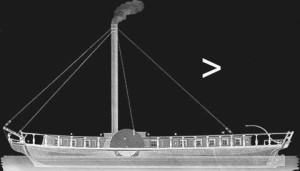
Bowling Harbour in the 1880s with the Industry of 1814 deteriorating in the foreground. Identifiable steamers on the left are the Vivid of 1864, the Edinburgh Castle of 1879, with the black-topped red funnels with white, black, and white bands, notable for her very large paddle-boxes, compared with her adjacent stable-mate, Windsor Castle of 1875. The two-funneled steamer with the same funnel colouring is the Lord of the Isles of 1877. There are also some of the North British and MacBrayne fleets present.
The coming of the railway steamers in the 1890s meant a significant increase in the numbers of vessels. The Caledonian Steam Packet Company, and the Glasgow & South-Western Railway Company used Greenock Harbour for winter lay-ups.

The Caledonian Steam Packet Company’s Duchess of Hamilton of 1890, Ivanhoe of 1880, and a Marchioness of 1890 in the West Harbour. The Glasgow & South-Western’s Marquis of Bute in on the right.

Marquis of Bute

A postcard view of the West Pier with Chancellor of 1880, the Arrochar steamer of the Glasgow & South-Western Railway. The Caledonian Duchess of Hamilton, and Ivanhoe are the next two in line.

Glasgow & South-Western Sultana of 1868 and Neptune of 1892 with Duchess of Hamilton

Viceroy of 1875, another of the original Glasgow & South-Western fleet

Glasgow & South-Western Juno and Glen Sannox
Greenock and Port-Glasgow were also where most of the reconditioning and repair of the steamers took place during lay-up, although the North British repaired to Messrs Inglis at Partick.

Duchess of Hamiton undergoing a spruce-up on Messrs Blackwood & Gordon’s slip

Benmore looking like she needs some paint at Messrs Lamont’s yard

A 1926 photograph with Duchess of Argyll of 1906 in Lamont’s dry-dock, MacBrayne’s Fusiler and the L.M.S Atalanta awaiting work to make ready for a new season

The Turbine steamers of the new century wintered in James Watt Dock. Here King Edward of 1901, and Queen Alexandra of 1902 take their place between timber rafts and steam lighters.

After the first world war, the steamers of Turbine Steamers Ltd., found a berth at Irvine. The photograph shows the paddle steamer Lord of the Isles of 1891, purchased by Turbine Steamers before the war, and Queen Alexandra of 1912.
The North British and L&NER continued to use Bowling Harbour as did the steamers of Messrs Buchanan and Williamson, Messrs MacBrayne, and the Lochgoil and Inverary steamers.

Bowling Harbour before the first world war with North British, MacBrayne, and Buchanan steamers, including Mountaineer of 1910, and Marmion of 1906.

After her war service, the Caledonian steamer Marchioness of Lorne of 1891 was not considered worth reconditioning. She languished in a corner of Bowling Harbour until scrapped at the end of 1923.

Marchioness of Lorne

Marmion is seen here, laid up in 1921. She returned from war service and had her saloons restored but the plating of the promenade deck that had been part of her conversion to a minesweeper was retained, and she proved to be unstable and “down at the head” when sailing.

MacBrayne’s Iona of 1864, and Columba of 1878, straddle the North British Waverley of 1899 in this post world war one photograph.

Waverley and Columba are to the fore of this group from around 1930 that included the Williamson-Buchanan Queen Empress of 1912

The same group with Eagle III of 1910 replacing Queen Empress

Waverley and Jeanie Deans of 1931 around 1935

Marmion had her bow plating cut back and re-entered service in 1925. She is seen here with Jeanie Deans in the new L.N.E.R. livery introduced in 1937

A forlorn sight in 1939. The Diesel-electric Talisman of 1935 suffered a series of breakdowns in 1939 and was laid up for most of the season. With the grey hull colour covering above her saloon windows, she was not a pretty sight. Fortunately her mechanical issues were overcome and she went on the have a distinguished career in world war two, and beyond.

Nationalization in 1948 meant the loss of the L.N.E.R. colour scheme and adoption of the buff funnels of British Railways, taking place on the new Waverley of 1947, and Jeanie Deans in this Ralston postcard

Waverley flanked by Lucy Ashton of 1888 and the cargo steamer Ardyne. The Lucy Ashton was shortly to depart to become propelled by jet engines.

Jeanie Deans and Waverley in Bowling Harbour in the early 1950s.
Growing up in the Vale of Leven in the 1950s, I had two train routes into Glasgow. These diverged at Dumbarton, with the old L.N.E.R. line to Glasgow Queen Street, passing through the western suburbs of Dumbarton to Bowling, adjacent to the Harbour, and then deserting the riverside through Dalmuir and Clydebank to Partickhill, beyond which there was a brief glimpse of Yorkhill basin where some of the railway steamers could be seen on winter lay-up. I do not remember ever seeing a steamer in Bowling Harbour, although in those days there was always some activity. The other route, the L.M.S. route, left Dumbarton for Dumbarton East and then climbed to the station on the hill behind Bowling, crossed the canal, and followed the riverside through Clydebank to Glasgow Central. There were occasional glimpses of the river and the busy river traffic, but mostly it was obscured by shipbuilding yards and industrial concerns. I found both routes interesting but preferred the riverside line that was axed by the Beeching cuts.
April 1, 2026
Wonderful as always!