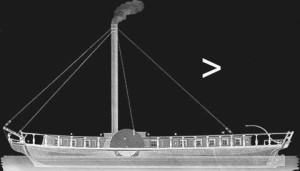
The early years of the application of steam-power to coastal navigation on the river and firth of Clyde remain an intriguing area of study. A good deal has been uncovered by careful research, but the lack of surviving documentation has meant that an understanding of much important information relies on scant newspaper accounts and advertisements, and anecdotes drawn from memories of a dim and distant past. The subject of this essay is the “Castle Company,” one of the most successful of the early steamboat concerns; one that reorganized on at least two occasions; one that had rivals on several fronts that attempted to topple its prominence; and one that eventually succumbed to a take-over by Messrs G. & J. Burns in June 1846, though it effectively carried on for a few years afterwards.
Surprisingly little has been written about this important company, and as far as I am aware, there are no company records to guide a narrative. Messrs Duckworth and Langmuir in their “West Highland Steamers,” have provided a good, if brief, account that I have used as a template. Mr Ian M‘Crorie has also furnished “The Last of the Castle Steamers,” in Volume 6 of Clyde Steamers (1970), revealing the complexity of the Clyde steamer services in the 1840s. My own attempt is long, too long in fact (and can do with a great deal of editing), for a company that stayed true to its initial goals of providing a steam-boat service to Rothesay and Inveraray with little divergence therefrom. However, I feel that it important to provide sources that justify the narrative. It has proved impossible to write about the vessels of a single company, without providing details of competitors and other matters that impacted the company’s development. This is particularly true of the 1840s when the Glasgow, Paisley, and Greenock Railway came into being.
Throughout, in my own writing, I have used modern spellings for places. Archaic spellings for both places and names are used where contemporary sources dictate.
The Castle Steamers—Part 1.
The earliest vessel, Dumbarton Castle, was launched on February 20, 1815, from MacLachlan’s yard at Dumbarton, for the aptly named Dumbarton Castle Steamboat Company, of whom some of the proprietors were Alex Hamilton, spirit dealer, 47, Prince’s Street, Alexander Denny, manager of MacLachlan’s shipyard, Walter McKinlay, spirit dealer, 609, Argyll Street, John Wilson, spirit dealer, 415, Gallowgate, John Wilkie, owner of a spirit cellar, 3, Prince’s Street, and Dugald McMillan who owned a provision shop on 134, Saltmarket. Ownership of steamers at this time was generally divided in the form of shares representing 1/64th of the total investment, and in this instance, there were no less than 48 shareholders in the vessel, most of whom likely owned a single share. It was common, also that the master of the vessel would invest in a share.

Dumbarton Castle passing Dumbarton Rock (National Maritime Museum)
“On Monday last, a new steam boat, on a large scale, was launched from Mr Maclauchlan’s building yard, Dumbarton; she went off in grand style, amidst a great concourse of spectators, and many of the proprietors from Glasgow, to witness the scene.—She is esteemed to be a very fine vessel of the kind, and the largest that has been yet built on the Clyde, measuring 84 feet keel. The engine is to be of 30 horse power. She is named the Dumbarton Castle. The launch took place under the discharge of cannon and hoisted colours from the Castle, an honour which General Ferrier, the Governor, was pleased to confer, from her being named after that ancient fortress.”—Caledonian Mercury, February 25, 1815
Dumbarton Castle was 87 feet in length, by 16½ feet in breadth, and 7½ feet in depth, with a two-cylinder engine supplied by Duncan M‘Arthur, of Camlachie generating 30 h.p. She was one of the largest steamboats of her day, and quickly established that she could sail beyond the confines of the river to the sea lochs and the lower firth. Her first master was James Johnston, and she was the first vessel to provide a regular service to Rothesay.
In July, Dumbarton Castle ventured to Inveraray, and a good account of her progress was provided in the Glasgow Herald.
“Glasgow, July 7, 1815.—We started from the Broomielaw, in the Dumbarton Castle steamboat, at 6 a.m., on Saturday (1st July), and from Port-Glasgow at 9, Greenock at 10, Gourock at 11, Rothesay at 2, Otter Ferry at half-past 8, and were landed at Inverary at 12 o’clock at night, having sailed 107 miles or more. It was very pleasant, being fine weather, and all the way so near land, and the scenery so beautiful, that although it was a long day’s sail, the attention was always kept alive with something new, either from the novelty of the high mountains and rugged rocks we were continually passing, or the terror and flight of the highland fishermen in their boats when we came near them or attempted to hail them when we passed. They took us for some King’s vessel come out to impress men for the Navy; they took the windows for gun ports; and then the great numbers on deck made them conclude we were most certainly on that service. No steamboat had ever gone farther than Rothesay until that day, and I suppose the Glasgow also arrived at Ayr that evening. There was a terrible scramble for beds at Inverary, there being only one inn; about 40 or 50 had to be accommodated. I slept with a gentleman as big as myself in a room with four beds, three and two in each bed, and a few remained in the boat. On Sunday, we all went through the Duke of Argyll’s Castle, and saw all the apartments, furniture, pictures, &c., and also had full liberty to walk through the whole of the pleasure grounds and gardens. It was delightful. We left Inverary on Monday morning, at half-past four a.m., arriving at Rothesay at half-past one. The boat stopped only for half-an-hour and went for Glasgow, where she arrived that night, but I and several others waited at Rothesay to return by the same boat on Thursday, as she was to be back again on Wednesday night. She came, and sailed again for Largs at half-past five, and after touching at all the ports on our way back we arrived in Glasgow before three, in time for dinner. We had breakfast and tea in the boat, as also ham and cheese for dinner. Upon the whole we were well pleased. The passage is cheap—21s back and forward. Our other expenses were high enough.”
It would appear the sailing to Inveraray had become very fashionable. On September 19th, the owners of the Greenock inserted an advertisement for an excursion to the Lochfyneside town in the Glasgow Courier.
“…the scenery of the Clyde, the Kyles of Bute and Lochfine, are excelled by none in Europe. It is particularly grand at this time of year, and the beauties and grandeurs of Inveraray Castle, the Pleasure Grounds and Deer Park exceed description, and all respectable visitors are allowed to see the whole. Refreshments can be obtained on board, and accommodation at Inveraray for three hundred people.”
The trip did not go quite as planned as can be determined from the September 28th edition of the same paper. There might be some comfort taken that the public could appreciate that she survived the experience.
“The Greenock Steam Packet, which sailed from Glasgow on Friday last for Inveraray did not, owing to the late boisterous weather, return to the Broomielaw until yesterday afternoon. Off Otter Ferry she encountered a dreadful storm, and at Tarbet she was drove from her anchors, which were, next day, recovered; but by her powerful machinery she was soon carried into Tarbet Harbour. Two naval officers, who were passengers, are of the opinion that scarcely a cutter in his Majesty’s service, could have rode out such a gale as the Greenock encountered.”
The Greenock had been built in May 1815 a few months after the Dumbarton Castle, also at the Woodyard, Dumbarton, by Archibald M‘Lachlan, for Messrs Wm. Anderson and John M‘Cubbin of Glasgow. She was 85¼ feet in length by 15¾ feet in breadth and 7¾ feet in depth with a two-cylinder engine supplied by Duncan M‘Arthur, of Camlachie generating 32 h.p. As she was of similar dimensions and power to the Dumbarton Castle, one can imagine that she would be similarly matched and have provided strong competition. However, in April of 1816, she made her way to Belfast. The description of her from a newspaper correspondent gives an impression of the steamboats of her day.
“Steam boat.—Belfast, April 23.—It was formerly mentioned, that a steam boat, called the Greenock, was to sail from Glasgow on Friday morning for this port, to call at Rothsay and Campbeltown on her way. She left the latter port yesterday morning between nine and ten o’clock, and in seven hours was off Bangor, and reached the quay at Belfast at eight o’clock at night. In the course of her passage she had five hours of the tide against her, and the wind at N.W. Carried sail part of the way, but from entering Belfast Lough had no sail hoisted; went at the rate of six or eight knots an hour without sails.—She is a very beautiful vessel, about 100 feet in length of deck, and 31 in breadth, covering the wheels or paddles; 98 tons register, has one wooden mast, and the iron funnel; the latter is 40 feet in height and six feet in circumference.—She draws about four feet water, is a very stout vessel, was built at Dumbarton last year, and is elegantly fitted up for the accommodation of passengers. We understand that for some time she is intended to ply between Belfast, Bangor, and Carrickfergus. The novelty of the sight attracted an immense crowd of spectators to the quay, who hailed her arrival with loud cheers. There were a number of passengers on board.”—Glasgow Herald, April 26, 1816
On his last visit to his native Greenock in 1816, James Watt and his friend Mr Walkinshaw sailed on the Dumbarton Castle to Rothesay. During the voyage, Watt struck up a conversation with the engineer of the boat. The latter related an unusual occurrence the previous evening when the steam-boat was stuck on a sand bank. With the rising tide, the flood caused the engine to reverse. Watt immediately understood the significance of the event and explained what had happened to the engineer, later demonstrating how to reverse the engine when approaching Rothesay quay. Up until that time, when approaching a quay or landing place, the engine was stopped and the steam-boat allowed to drift alongside.
In April 1816, Rothsay Castle was launched from the yard of Messrs Maclauchlan, Dumbarton, for the Rothsay Castle Steam Boat Company, Rothesay. She was 76 feet in length by 16½ feet in the beam, and driven by a two-cylinder engine of 34 horse power furnished by Messrs Duncan M‘Arthur & Co., Camlachie, Glasgow.
Captain Johnston moved to the new Rothsay Castle as master, revealing the continuity between the Dumbarton Castle and the new vessel. His place on Dumbarton Castle was taken by Dugald Thomson. Under Thomson’s command, the Dumbarton Castle was advertised to take passengers for a trip from Glasgow round Ailsa Craig on 7th August 1816. She was the first steamer to take passengers on a deep sea trip.
In the meantime, the new steamer also offered excursions. Some newspaper notices are provided from June 1816.
“June 4.—The Rothesay Castle left Inverary on Monday about 5 o’clock in the morning, touched at the different ports in her passage, stopped at Greenock an hour and a half, and arrived at the Broomielaw before 7 o’clock evening.”
“June 17.—There are now plying on the Clyde sixteen steamboats, all of which with the exception of two, are solely employed in the conveyance of passengers, the cost and outfit of which could not be less than £50,000.
“The Rothesay Castle steamboat, Captain Johnston, will sail on Tuesday for Rothesay and call at the Largs. Will sail on Wednesday early in the morning. She leaves Rothesay, goes through the Kyles of Bute, round the west side of Arran, lands passengers on the Rock of Ailsa, and returns in the evening to Rothesay.”
The trip advertised to sail round Arran and to Ailsa Craig occurred on Wednesday, June 26th, 1816. The weather did not cooperate.
“The steam boats have succeeded so well on the river that intelligence respecting their state at sea cannot fail to be interesting. We are indebted to a well-informed correspondent for the following particulars of the voyage of the Rothesay Castle round Arran. She sailed on Wednesday morning at six o’clock, passed the Kyles of Bute, the mouth of Loch Fine, the Cock of Arran, Loch Ransy, Lamlash, Brodick, Garroch-head, and the Cumbraes, and, after a voyage of nineteen hours, returned to Rothesay at one o’clock on Thursday morning. The voyage was in the highest degree pleasant till the Kyles of Bute were passed; but it blew fresh during the remainder of the voyage. When the broadside of the boat was at all to the sea, the rolling was great enough to make many of the passengers sea-sick, and almost all wished, on arrival at Loch Ransy, to sail down the weather shore, and land at Arran, instead of prosecuting the original voyage. With this the master of the vessel, Mr Johnston, was willing to comply; but he was overruled by one of the proprietors, who insisted, whatever the wishes of a great majority were, to finish the voyage as it was advertised. The swell, however, was too high to let Ailsa be approached; and the voyage, after leaving Loch Ransy, failed to give satisfaction. The boat stood it out remarkably well, and did not ship a sea all the time. By keeping the head to the wind, the dexterous pilot got her well through. But at Brodick the vessel rolled so much, that the water, dashing from side to side of the boilers, made one of them leak too copiously to be made to boil for some time. Alarm prevailed among some of the passengers, and such as were most anxious to face the high sea seemed most terrified; but those who knew the worthiness of the boat, and the skill of the pilot, and were at all conversant with sailing, had no fear whatever. The grandeur of the scenery at the Kyles or straits of Bute is well known; they are generally considered by those who have visited both to be superior to the Trosachs. The whole coasts of Arran and Kintyre are also very fine; but the day being hazy, and the passengers mostly sick with the heavy swell, the view was indistinct, nor could they enjoy it.—Glasgow Chronicle.”—Caledonian Mercury, July 1, 1816
Rothsay Castle also found herself in difficulties when homeward bound on a trip to Inveraray on July 8th when she struck a rock. Fortunately her rival, the Argyle was on hand to take the passengers to Greenock.
“Monday at noon, the Rothesay Castle steam boat, on her homeward passage from Inverary, with from 80 to 90 people on board, struck on a sunk rock, opposite Tarbert, and immediately filled with water. Most fortunately a number of fishing-boats were in the vicinity of her at the time, and about 30 of them having got promptly alongside, rescued the passengers from their perilous situation. One of them in the confusion swamped, but those on board were safely extricated. The Argyle steam boat arrived at Greenock, in the evening, with the passengers of the Rothesay Castle.”—Caledonian Mercury, July 13, 1816
Argyle was launched by Messrs John Wood & Co, Port Glasgow, on July 10th, 1815, for Messrs George Brown & Thomas Buchanan under the agency of Lewis MacLellan, Glasgow. She was 79 feet in length by15½ feet in breadth. Her engine, supplied by the Greenhead Foundry Co., Glasgow, was a two-cylinder model providing 32 horse power.
The Rothsay Castle was refloated and repaired, and the following year, 1817, the new steamer showed her paces.
“June 9.—On Wednesday afternoon the Rothesay Castle steamboat, Captain Johnstone, made her passage from Rothesay to the Broomielaw (Glasgow) in four hours, the fastest ever known, being at the rate of nearly eleven miles an hour.
Later in the month, there was an unfortunate accident that involved loss of life. Mr Alex Hamilton, mentioned previously as an owner of the Dumbarton Castle, and likely also of the Rothsay Castle, travelled with some friends on the Defiance steamboat to meet the Rothsay Castle on her return from Inveraray.
“Monday afternoon another melancholy accident happened on the Clyde:—A party of five gentlemen, leaving the Defiance steam boat, a short distance below Govan, went into a small boat for the purpose of going on board the Rothesay Castle, coming to Glasgow. At this instant, the painter was dropped, and the boat upset. Two of the gentlemen, Mr Napier and Mr Hamilton, sunk and never appeared; one, by swimming, reached the bank; another floated by means of the small boat till rescued by the Rothesay Castle, and the fifth was also saved by that vessel. The boat righted and turned several times. A young man, belonging to the Rothesay Castle, exerted himself in diving for Napier and Hamilton. As the steam engine of the Defiance was allowed to remain at work, it is alleged that this circumstance, along with the shortness of the painter and smallness of the boat, was the cause of the accident. Mr Hamilton was a spirit dealer in Prince’s Street, Glasgow. The bodies of the unfortunate men were found on Tuesday morning, lying close to each other.”—Caledonian Mercury, June 26, 1817
“A most melancholy occurrence took place on the Clyde on Monday, a few miles below Glasgow. In the afternoon, two or three gentlemen went down the river in the Defiance steam-boat, with the intention of meeting and getting on board the Rothesay Castle, on her return from Inverary. They met their boat near Scotstown, five miles from the Broomielaw, when the party, five in number, went into the small boat of the Defiance, to proceed on board the other vessel. Unfortunately the people on board the Defiance did not let off the steam when the party were getting into the boat, and, as might be expected, she was almost drawn underwater, and just as the last person was getting in and the rope thrown off, she instantly sunk. Three of the persons were saved by the exertions and activity of Captain Johnson of the Rothesay Castle, who instantly let off the steam, and repaired to the spot at which the accident happened, but the other two perished; their bodies not found till next morning. One of the crew of the Rothesay Castle leaped into the river, and repeatedly dived, but without success.”—St James’s Chronicle, June 28, 1817
By this time the Clyde was a mecca for the more adventurous tourists.
“Steamboats.—These vessels appear to have come into very great and general use on the Clyde. No less than three sailed from Glasgow on Saturday last, on excursions of some length, viz. the Dumbarton Castle, for Inverary, the Britannia, for Campbelton, and the Albion, for Arroquhar. This circumstance is of importance to tourists, who wish to be conveyed with expedition to some of the most picturesque parts of the Highlands; for it is possible to dine on Monday in London, and on the Thursday following at Inverary, the beautiful and romantic seat of the Duke of Argyle.”—Sun (London), September 23, 1817
Sailing on the early steamboats was not without hazard.
“On Thursday, such was the press of business among the steam-boats on the Clyde, that the Waterloo performed five voyages to Greenock within 24 hours. A man leaving the Rothesay Castle at Broomielaw, after dusk, fell; but was prevented from getting into the water by the vessel being near the breastwork. Much inconvenience was felt from the want of lanterns.”—Public Ledger and Daily Advertiser, April 9, 1817
“Saturday morning, about seven o’clock, a porter belonging to Glasgow, of the name of John Cameron, went on board the Rothsay Castle steam-boat, at the Broomielaw, with a view to convoy a friend a little down the Clyde. On reaching Erskine Ferry, he got safe into the passage boat, and, in shaking hands with his friend at parting, he took too firm a hold, tumbled overboard, and was drowned.”—Caledonian Mercury, October 27, 1817
“On Thursday the Waterloo steam boat, when near Port Glasgow, in consequence of striking upon some stones, sprung a leak, and received such damage as to sink two feet before she could be carried into dock. The passengers were taken out by the Dumbarton Castle steam boat.”—Caledonian Mercury, April 2, 1818
The regular steamers to Inveraray were the Argyle, and the two Castle steamers. The owners of all three steam-boats participated in a conference to set the rates for steamboat passage in 1818. The cost of a single journey between the Broomielaw and Rothesay was 7/6d in the cabin and 5/- steerage; and to Inveraray was 12/- in the cabin and 8/6d in steerage. These fares were expensive, roughly comparable to the weekly wage of most working males.
Dumbarton Castle with Captain Thomson was advertised in the Glasgow Herald of June 10th as sailing to Inveraray on Tuesday morning at five o’clock, and a weekly service was maintained early in the summer season.
“The Rothsay Castle steam boat, Captain Johnston, will sail, on Saturday morning, 18th July, at four o’clock, —for Inveraray, calling at Greenock, Gourock, Rothesay and Otter Ferry, and return to Glasgow on Monday, calling at the above places. Passengers are particularly requested to be pointed at the hour fixed for sailing. The Rothesay Castle will also sail for Inveraray early on Tuesday morning the 21st current, stop there all Wednesday, and return to Glasgow on Thursday. The hour of sailing on Tuesday to be seen on the boards. The Rothesay or Dumbarton Castle will sail for Inveraray regularly once a-week during the summer months.—Glasgow, 17th July, 1818.”—Glasgow Herald, July 17, 1818
The Argyle, or Argyll as she was advertised, was the main competitor sailing to Inveraray that season and appears to have been experiencing some sabotage with her advertising.
“The Argyll steam boat, Captain McArthur, will sail on Saturday the 27th June at five o’clock morning, for Inverary, and return on Monday. Passengers are requested to send their luggage on Friday evening. The Argyll will sail on Tuesday for Inverary and return on Thursday. The Argyll will continue to sail betwixt Glasgow and Inverary during the season, and the public will find in her the best accommodation to be met with in a steam boat.
“Reward of Twenty Guineas—The just celebrity and consequent success of the Argyll steam boat, having goaded some person or persons to the pitiful expedient of altering the days and hours of her sailing on the intimation boards, in different parts of the City, evidently with a view to defrauding the proprietors and disappointing the public—Twenty Guineas of reward is hereby offered to any person whose information will convict the offender or offenders.—Glasgow 23rd June, 1818.”—Glasgow Herald, June 22, 1818
In July, the Castle steamers began to sail on the same days as the Argyle.
“The Rothsay Castle steam boat, Captain Johnston, will sail, on Saturday morning, 18th July, at four o’clock, —for Inveraray, calling at Greenock, Gourock, Rothesay and Otter Ferry, and return to Glasgow on Monday, calling at the above places. Passengers are particularly requested to be pointed at the hour fixed for sailing. The Rothesay Castle will also sail for Inveraray early on Tuesday morning the 21st current, stop there all Wednesday, and return to Glasgow on Thursday. The hour of sailing on Tuesday to be seen on the boards. The Rothesay or Dumbarton Castle will sail for Inveraray regularly once a-week during the summer months.—Glasgow, 17th July, 1818.”—Glasgow Herald, July 17, 1818
Towards the end of July, the Castle steamers called at Tarbert and Lochgilphead rather that Otter Ferry.
“The Rothsay Castle steam boat, Captain Johnston, will sail, on Tuesday morning, 28th July, at six o’clock, for Inveraray, calling at Greenock, Gourock, Rothesay, Tarbet, and Lochgilphead; will wait all Wednesday at Inverary, and return to Glasgow on Thursday.”—Glasgow Herald, July 27, 1818
“The Dumbarton Castle steam boat, Captain Thomson, will sail on Tuesday morning at five o’clock, for Inverary, where she will remain on Wednesday, and return to Glasgow on Thursday, calling at the usual places.”—Glasgow Herald, August 3, 1818
“The Dumbarton Castle steam boat, Captain Thomson, will sail on Tuesday, 11th current, for Inverary, calling at Greenock, Gourock, Rothsay and the usual places on Lochfine. She will remain on Wednesday at Inverary, and return to Glasgow on Thursday. Hour of sailing to be seen on the boards.”—Glasgow Herald, August 7, 1818
In August for the remainder of the summer, Inveraray featured twice weekly, sailing on Saturdays and Tuesdays, and returning on Mondays and Thursdays. Despite this aggressive competition, Argyle continued to sail to Inveraray until 1821, but changed to the Campbeltown station in 1822.
“The Rothsay Castle steam boat, Captain Johnston, will sail, on Saturday morning, 15th August, at three o’clock, for Inveraray, calling at Greenock, Gourock, Rothesay and Otter Ferry, and return to Glasgow on Monday, calling at the above places. Passengers will send their luggage on Friday evening. And on Tuesday morning the 18th will sail for Inveraray, will wait all Wednesday at Inverary, and return to Glasgow on Thursday, calling at the above places. The hour of sailing will be seen on the boards. The Rothesay Castle and Dumbarton Castle will, during the remainder of the season, sail regularly twice a week to Inverary.”—Glasgow Herald, August 14, 1818
“The Rothsay Castle steam boat, Captain Johnston, will sail for Inverary, on Tuesday, 25th instant, at five o’clock morning, calling at Greenock, Gourock, Rothsay and Otter Ferry, will wait all Wednesday at Inverary, and return to Glasgow on Thursday, calling at the above places. The Rothsay and Dumbarton Castle will, during the remainder of the season, sail regularly twice a week to Inverary.—Glasgow, 21st August, 1818.”—Glasgow Herald, August 21, 1818
The appearance of the Rob Roy in 1818, and her success in sailing on the open sea had a profound impact on the steam boats sailing on the Clyde. The great improvement in speed and handling that was apparent with Rob Roy prompted the owners of the other steamboats to carry out modifications. Changes in the length of the hull before or aft of the machinery were commonly carried out to improve the trim of the vessels and now the importance of the sheer at the bow was apparent. For example, the Glasgow was lengthened at the bow by five feet and had her profile sharpened. Clyde had her hull deepened and sharpened, improving her sailing. Argyle had been built with a square sailing barge bottom that was altered first to a round form and later sharpened. Neptune’s bottom was rebuilt and sharpened and Albion that had originally had sharp hull lines was further sharpened. Others underwent more significant alterations and reappeared on the river under different names. This was particularly true if the original form had been unsuccessful. It seems likely that some modifications were also made to the Castle steamboats over the following year.
In 1819, there was a split in the ownership of the Dumbarton Castle and the Rothsay Castle. The Rothesay focused faction sold their shares in the Dumbarton Castle, and were likely the driving force for a new steamer with the idea of providing regular and reliable steamboat services to Rothesay and Inveraray. They included the masters of both steamboats, and a number of other individuals.
“James M‘Intosh, Dugald Thomson, James Mains, J. Johnston, George Cunningham, and John M‘Vicar ceased to be partners in the Dumbarton Castle, steam-boat, on the 6th April 1819”—Law Chronicle, Commercial and Bankruptcy Register, August 5, 1819
In June, the Dumbarton Castle sailed round the north of Scotland to the Forth. She later returned to the Clyde but had no further contact with the Castle Company.
“The Dumbarton Castle steam boat sailed on Saturday morning from Glasgow, to go round the north of Scotland, for Leith. We understand she is to ply with passengers between Leith and Grangemouth.”—Caledonian Mercury, June 3, 1819
“On Saturday the Dumbarton Castle steam-boat arrived in Leith harbour from Glasgow, in eight days, having sailed north about by the Pentland Firth. She is a large and handsome vessel.”—Caledonian Mercury, June 10, 1819
“Both the Dumbarton Castle and Tug, steam boats, have begun to sail daily between Leith and Grangemouth.”—Caledonian Mercury, June 10, 1819
In June, the Neptune was advertised to sail to Inverary. Neptune had been launched on February 20, 1816, from the yard of Messrs John Wood & Co, Port Glasgow, and was 78 feet in length by 15½ feet in breadth. Originally, she was underpowered with a 20 h.p. engine supplied by Messrs Duncan M‘Arthur, Glasgow, and had been sailing to the Gareloch. However, she had undergone considerable hull modifications in the early part of 1819, and her original engine was replaced by a more powerful model providing 40 h.p. supplied by Messrs James Cook & Co., Glasgow. She was a powerful competitor for Rothsay Castle.
“The Neptune steam boat, Captain Leitch, will sail on Tuesday first, the 22d instant, at four o’clock morning, for Greenock, Gourock, Rothesay, Tarbert, Lochgilphead, and Inverary, and return on Wednesday. Passengers are requested to be punctual at the hour.—Glasgow, 21st June, 1819”—Glasgow Herald, June 14, 1819
“The Neptune steam boat, Captain Leitch, will sail for Inverary on Tuesday first, the 31st instant, at seven o’clock morning, for Greenock, Gourock, Rothesay, Tarbert, and Lochgilp; and in order to give the passengers time to see the place, will remain all day Wednesday at Inveraray, and return on Thursday.”—Glasgow Herald, August 27, 1819
In October 1819, Inverary Castle was launched for the Inverary Castle Steamboat Co, Glasgow, by Messrs J. Wood & Co. Port-Glasgow. She was 82 feet in length by 16 feet in breadth, 112 tons, and propelled by a two-cylinder engine of 40 h.p. provided by Messrs Duncan McArthur of Camlachie. Her boiler was of copper.

Inverary Castle
Just before Christmas, the floes of ice on the Clyde put several steam boats, including the Rothsay Castle, in danger.
“Early this morning, owing to great quantities of floating ice coming down the Clyde, the cables of the following steam boats were cut, and they drifted down the river, viz. the Port-Glasgow, none of the crew on board—the Rob Roy, with one boy—and the Rothesay Castle, with several hands. One of them, supposed the Rothesay Castle, was said to be brought up on this side of Renfrew. Several yawls were crushed to pieces by the ice.—Courier.”—Caledonian Mercury, December 20, 1819
On the 18th of April, 1820, the owners of the new Inverary Castle, James Johnston, Commander, announced that their vessel would sail on Saturday April 22d, at seven o’clock morning, for Inveraray calling at Port Glasgow, Greenock, Gourock, Rothesay, and the usual places in Lochfine, and will return to Glasgow on Monday. The two Castle steamers took up sailing to Inveraray on Wednesdays and Saturdays, returning on Thursdays and Mondays. One steamer was available to make a return journey to Rothesay each lawful day, and on Tuesdays and Fridays, both steamers could offer return sailings to Rothesay.
“The Inverary Castle steam passage vessel, James Johnston, Commander. —Safe, elegant & commodious conveyance by sea.—The attention of the public is particularly requested to the Inverary Castle steam vessel. This vessel having been fitted up in a manner far superior to any at present in the trade; and, for speed of sailing, seaworthiness, comfort and the convenience afforded to passengers, is quite unrivalled, the proprietors having spared no expense to attain these objects. The vessel being fitted up in this elegant style, of which are correct idea can only be formed by inspection, to which the public is respectfully invited. The carpenter and engineer departments were furnished by Messrs Wood of Port-Glasgow, shipbuilders, and Mr. D. Macarthur, engineer, Glasgow. Steam engine boilers made of copper. The above vessel will sail alternately to Inverary with the Rothsay Castle. The Rothsay Castle will be ready to ply in a few days, having undergone a complete repair, which will make her equal if not superior, to any other steam vessel. The Inverary Castle steam passage vessel will sail for Inverary on Saturday first, the 29th, at five o’clock in the morning. The proprietors will not be responsible for any parcel over the value of two pounds Sterling unless entered and paid for accordingly.—Glasgow 23rd April 1820.”—Glasgow Herald, April 24, 1820
The main competition for the two Castle steamers was the Neptune. Both the old rival, Argyle, and Neptune steam-boats had undergone considerable hull modifications in 1819. And while these appeared successful with the Neptune, particularly with her new engine, the Argyle was not advertised for much of the season suggesting that she was still in the throes of her conversion. She was sailing to Campbeltown in 1822.
The Neptune, under Captain Thomas Kirkwood was advertised in May, sailing to Inveraray on Tuesdays, returning on Wednesdays.
“The Neptune steam boat, Capt. Thomas Kirkwood, will sail for Rothsay, on Monday first, and will continue to sail to and from it four days in the week during the season, viz. Thursday, Friday, Saturday, and Monday; and every Tuesday she will sail for Inverary, calling at the usual places on Lochfine, and will return on Wednesday.—The Neptune has lately undergone repair, and owing, to the peculiar construction of the machinery she is now well known to be the speediest and smoothest sailer, and most seaworthy vessel on the river. Her cabin and rooms are fitted up in the most elegant and commodious manner. The newspapers and a handsome collection of books are kept; and the strictest attention is paid to the accommodation of the Ladies and Gentlemen. Families going to the watering places are requested to send their luggage a few hours before sailing. Attention will be paid to make the hours of sailing from Glasgow most convenient for families during the forenoon. The hours of sailing will be regularly seen on the boards. The Neptune Company has for sale a steam engine cylinder of 20 horse power, with nozles and side valves complete. To be seen at Mr James Ritchie’s, Three-mile-house.”—Glasgow Herald, May 5, 1820.
It did not take long for the new Inverary Castle to demonstrate her superior speed, shortening the time between the Broomielaw and Inveraray by almost two hours compared with her rivals. For most of the season, she was advertised to sail on the twice weekly sailings to Inveraray. Rothsay Castle under the command of Dugald Thomson, maintained the Rothesay sailings with occasional forays to Inveraray, particularly outside the main season.
“The Inverary Castle steamboat, Captain Johnstone, sailed from Glasgow on Saturday morning for Inverary, and performed her journey in the astonishingly short period of 11½ hours. On her way she landed passengers at Port Glasgow, Greenock, Gourock, Dunoon, Auchinwillan, Rothesay, Tarbert, and Lochgilphead, a distance of at least 120 miles, besides her stoppages.”—Glasgow Herald, May 12, 1820
“ ‘Facts are Stubborn Things,’—The Inverary Castle steam passage vessel, Captain Johnston, will sail from the Broomielaw on Wednesday morning the 19th July, at half-past six o’clock, for Inverary, calling at Port Glasgow, Greenock, Gourock, Rothesay, and the usual places in Lochfine, and will return to Glasgow on Thursday. She will again sail on Saturday the 22d July, for Inverary, and return on Monday. The hour of sailing will be seen on the boards. From the great quickness of the sailing of the Inverary Castle means she makes her passage from an hour to an hour and a half quicker than any other boat that sails for Inverary, no withstanding the calls at the different ports on her way out; passengers may therefore rely on reaching Inverary by six o’clock in the afternoon. Those who wish to leave Glasgow on Tuesdays and Fridays, may have tickets for Rothesay (where they can stay the night), either by the Rothesay Castle or Inverary Castle, at the same fare as going direct from the Broomielaw for Inverary.—15th July, 1820.”—Glasgow Herald, July 17, 1820.
On Fair Saturday, July 22, Neptune sailed via Rothesay to Brodick and Lamlash Bays, Isle of Arran but resumed her normal sailings to Rothesay and Inveraray thereafter. Arran was becoming popular as a destination for the more adventurous tourists.
“The Neptune Steamboat, Captain Kirkwood, sails on Saturday morning for Greenock, Gourock, Rothesay, and Brodick & Lamlash Bays, Arran, and returns same night to Rothesay. She will again sail on Tuesday first from Glasgow to Inverary, calling at Greenock, Gourock, Rothsay, Port-Bannatyne, and the usual places in Lochfine, and return on Wednesday. Passengers may therefore rely on being taken to or from Rothesay every lawful day during the season. Hour of sailing to be seen on the boards.—Glasgow 20th July 1820.”
The Castle steamers maintained an abbreviated service throughout the winter months and in the following year, 1821, aggressively pursued competition with their rivals on the Inveraray station. Between March and May, the Rothsay Castle was modified; lengthened by 22 feet, and provided with a new, more powerful engine of 55 h.p., at the yard of Messrs James Lang, Dumbarton. She was placed in direct opposition to the Neptune, sailing on Tuesday for Inveraray, and returning on Wednesday. During the absence of the Rothsay Castle, the Castle Company appear to have secured the services of the west highland steamer, Highland Chieftain to maintain the Rothesay service.
In addition to sailing on Wednesdays and Saturdays to Inveraray, on June 23, 1821, the Inverary Castle was advertised to sail at seven o’clock in the morning for the Island of Arran, returning on Monday. This was repeated two weeks later on July 6th. The Rothesay Castle meanwhile sailed on Saturday on the normal route to Inveraray.
“The Inverary Castle Steam Packet, Captain Johnston, will sail from Broomielaw on Saturday morning the 23rd instant, at seven o’clock, for the Isle of Arran, calling at Port-Glasgow, Greenock, Gourock, Rothesay, Brodick, and Lamlash; will remain at Lamlash till Monday, and leave thence early that morning for Glasgow.—21st June, 1821.”—Glasgow Herald, June 22, 1821
A new consort for Rothesay Castle and Inverary Castle, the Toward Castle, was launched at the end of February, 1822.
“Launched from the building-yard of Mr. James Lang, Dumbarton, on Friday last, a fine steam vessel, called the Toward Castle, intended to ply between Glasgow, Rothesay and Inverary. She is of the largest class in that trade, being about 130 tons register, and is to be propelled by an engine of 50 horse power, with copper boilers and copper flues, made by Mr. Duncan M‘Arthur of Glasgow: she will be fitted up in an elegant style with cabins, state-rooms, &c., and, we understand, will be commanded by Captain Johnston of the Inverary Castle.”—Glasgow Herald, March 1, 1822

Toward Castle
The dimensions of the new Toward Castle were 101¾ feet in length,16¾ feet in breadth,10¾ feet in depth. She was powered by an engine of 45 h.p. Those in command of the vessels were promoted to new responsibilities; Captain Johnston to the new Toward Castle, Captain Thomson to Inverary Castle, and Captain Brown to the Rothsay Castle.
In the early part of the year, there was daily service to Rothesay, except Sundays, and sailings to Lochgilphead on Wednesdays, returning Thursdays, and Inveraray on Saturdays, returning on Mondays. After May, with three steamboats available, Lochgilphead was the destination on Tuesdays and Thursdays, and Inveraray on Saturdays. The Lochgilphead sailings were extended to Inveraray after June 1st. Regular Saturday sailings were also provided to Bodick and Lamlash, returning Monday, after July 8th.
“The Inverary, Rothesay, & Toward Castle Steam Packets.—The Inverary Castle steam packet, Captain Thomson, will sail from the Broomielaw on Saturday the 1st June, at ten o’clock morning, for Inverary, calling at Greenock, Gourock, Rothesay, Tarbert, and Lochgilphead, and return to Glasgow on Monday.—The Toward Castle, Captain Johnston, will sail from the Broomielaw for Greenock, Gourock, Rothesay, Brodick & Lamlash, Island of Arran, on Saturday the 1st June, at eleven o’clock forenoon, and return to Glasgow on Monday.—The Rothesay Castle, Captain Brown, will sail from the Broomielaw on Tueesday the 15th June, for Inverary, calling at Greenock, Gourock, Rothesay, Tarbert, and Lochgoilhead, and return to Glasgow on Wednesday—Hour of sailing to be seen on the boards.—These packets will sail regularly for Inverary three times every week, leaving Glasgow Tuesdays, Thursdays, and Saturdays; and Inverary Wednesdays, Fridays, and Mondays, during the season, till further notice.—Glasgow, 29th May, 1822”—Glasgow Herald, May 31, 1822
“The Inverary Castle steam packet, Captain Thomson, will sail from the Broomielaw on Tuesday morning, the 9th July, at half-past four, for Inverary, calling at Greenock, Gourock, Rothsay, Tarbert, and Lochgilphead, and return to Glasgow on Wednesday. The Company will sail every Saturday till farther notice, one of their steam packets for the Island of Arran.—Glasgow, 6th July, 1822.”—Glasgow Herald, July 8, 1822
Competition on the Rothesay station led to a reduction in fares, and a fare-war. Besides the opposition steamer, Neptune, the Campbeltown steamers Argyle and Britannia also called at Rothesay.
“Notice.—The Directors of the Rothsay Castle, Inverary Castle, and Toward Castle steam boats, learning that certain other steam boats, plying betwixt Broomielaw and Rothsay, have lowered the rate of fares, beg leave to notify, that they have also resolved to lower the fare on board said boats, equal to that of any other boat on the river; and as the superior accommodation of the Castles are generally acknowledged, the proprietors hope to enjoy a continuance of the public patronage. In future the said steamboats will sail precisely at the hour advertised.—Glasgow, 3d July, 1822.”—Glasgow Herald, July 5, 1822
An unwise move as it proved.
“Notice.—The Directors of the Rothesay, Inverary, and Toward Castle steam boats, having previously advertised that the fares to be charged on board of said vessels between the Broomielaw and Rothesay, and vice versa would be reduced equal to that of any other boat, and now finding that these terms leave the fare open, and thus may create disputes with certain passengers, beg leave respectfully to inform the public, that they have now fixed the reduced rate of fare between said ports. The Directors, grateful for past favours, assure the public that no exertion will be wanting on their part to merit a continuance of their patronage.”—Glasgow Herald, July 29, 1822
During August, the Toward Castle made a trip to Dublin, revealing her excellent sea-going qualities. Attempts to diversify the Castle steamer’s trade may well have indicated that there was a financial crunch, not unexpected if there was a payment due on the new steamer.
“The Toward Castle steam packet, James Johnston, commander, arrived on Tuesday at the Broomielaw from Dublin. She left Dublin on Monday afternoon at four o’clock, and arrived here on Tuesday evening at nine—29 hours in all, the quickest passage ever known.”—Glasgow Herald, August 16, 1822
Towards the end of the year, Rothsay Castle began to sail to Lochgoilhead on Tuesdays and Saturdays, returning the following day. This might well have been the result of the withdrawal of the usual Lochgoilhead steamer, Fingal, leaving the station with no steamer. Fingal was sold the following year and renamed Rosneath Castle.
“The Rothesay Castle, steam packet, Capt. Brown, will sail from the Broomielaw on Tuesday morning the 19th November, for Lochgoilhead, calling at Greenock, and Gourock, and return to Glasgow on Wednesday. And on Saturday morning at seven o’clock, she will sail for the same place.—Glasgow, 18th Nov., 1822.”—Glasgow Herald, November 18, 1822
The the Lochgoilhead connection was maintained through the winter in addition to weekly visits to Inveraray and Lochgilphead.
“Days of sailing altered.—Inverary, Rothesay, & Toward Steam Packets.—The Inverary Castle steam packet, Captain Thomson, will sail from the Broomielaw on Saturday the 7th instant, at seven o’clock morning, for Inverary, calling at Greenock, Gourock, and Rothesay, and the usual places in Lochfine, and return to Glasgow on Monday; and the Rothesay Castle, steam packet, Capt. Brown, will sail from the Broomielaw on Wednesday the 11th instant, for Lochgilphead, calling at Greenock, Gourock, Rothesay, and the usual places in Lochfine, and return to Glasgow on Thursday—and she will sail on Saturday the 14th instant, for Inverary, calling at the usual places, and return to Glasgow on Monday. Hours of sailing to be seen on the boards.
“The above packets will sail every Wednesday (in place of Tuesdays as formerly) for Lochgilphead, and every Saturday for Inverary, till further notice, returning to Glasgow on Thursdays and Mondays. The above packets sail for Lochgoilhead as formerly.
“The proprietors of the above steam packets will not be accountable for any luggage or parcels, that may be sent by them, unless they are given in charge to the Captain, and receipts given for the same.—Glasgow, 5th Dec., 1822.”—Glasgow Herald, December 6, 1822
The new year began with a recurrence of ice floes through the harbour at Glasgow after a sudden thaw. Fortunately, the damage was limited and the Rothsay Castle escaped unscathed.
“Glasgow, January 31.—Wednesday, a little after mid-day, the ice upon the Clyde, which had been frozen for ten or fourteen days, broke up; and, during the afternoon vast quantities came down the river, which had swollen very considerably in the course of the day. Towards dusk, and at low water, the ice got dammed up opposite the first shed at the Broomielaw, and while all below was clear, the masses brought down continued to be thrown back by a strong tide, and to accumulate upwards to a considerable height; till the river had the appearance of a solid field. Some idea of the irresistible force with which the ice afterwards carried everything before it may be conceived from the fact, that at this time the water actually stood three or four feet higher at the top of the quay than it did at the bottom. Between nine and ten o’clock at night, this immense accumulation of ice and water gave way with the noise of an earthquake, and a tremendous scene ensued. Nine steam-boats, a sloop, and a brig, were forced from their moorings, and carried down the river. The William and Betsey, belonging to Dumfries, from Killala, with a cargo of oats, was the first vessel that suffered damage; she had two cables and hawser cut, and her windlass, staunchions, quarter-boards, and bulwarks, broken; and having drifted in the direction of the steam-boat pier, she crossed the bows of the Waterloo, of Belfast, a large steam-vessel, employed in the Irish trade, and carried away her starboard paddle-wheel. The Waterloo afterwards broke from two patent chain-cables, and a seven-inch hawser, dragging her anchor as far as Napier’s dock. The Argyle was drifted to Bowling Bay, a distance of twelve miles, without any person on board, the individual who was left in charge of her having jumped on shore when her cables gave way. It is singular that this vessel did not sustain the slightest injury. The Greenock, according to all accounts, has suffered the greatest damage, being much strained, and the whole of her bulwarks and most of her stern carried away. The Dispatch had her paddle-boxes and paddle-rings broken. The Industry had her paddle-boxes damaged, and her stern stove in. The Marquis of Bute was drifted about 100 yards below the quay, where she was thrown on the bank without sustaining much injury. The Ring-dove brig, belonging to Peterhead, had two of her side planks driven in. The following are the names of the nine steam-vessels that drifted, eight-of which had last night got back to the Broomielaw, and the Largs, the only one absent, was known to be safe: The Samson, Dispatch, Industry, Waterloo of Belfast; Largs, Greenock, Marquis of Bute, Argyle, Belfast of Belfast.—The Rothesay Castle, Highland Chieftain, and Oscar, were among the other steamboats when they broke from their fastenings; but these vessels had the good fortune to withstand the shock. When the chain-cables of the Waterloo gave way, some of the links flew about thirty feet high, so extreme was the force. No estimate can yet be made of the damage done, but it is not so great as might have been expected. We are happy to hear that no lives have been lost, nor has the slightest personal accident of any kind occurred, so far as we can learn.”—Star (London), February 4,1823
The service provided by the Castle steamers followed the pattern of the previous year with the exception that sailings to Lochgoilhead did not feature. The steam boat Oscar now filled that station.
The most significant announcement occurred at the beginning of March. Persistence in providing a regular year-round service to Rothesay paid off. The Castle steamers were awarded the mail contract for Rothesay by the Post Office. The remuneration was £100 per annum, costing the Post Office £17-8s. over the previous contract by sailing packet, but ensuring a more reliable service. An added bonus for the populace of Bute was that one of the steamers sailed from Rothesay to Greenock and back on Sundays for the Mail.
“The Inverary, Rothsay, and Toward Castle, steam packets, are appointed to carry the mail between Glasgow, Rothsay, &c. and to commence the 6th April; these vessels are in future to be named the “Royal Mail” steam packets.”—Caledonian Mercury, April 5, 1823
The news coincided with a presentation to Captain Johnston by the gentlemen of Rothesay.
“An elegant piece of silver plate value 40 guineas, has been presented to Capt. Johnstone of the Toward Castle steam packet, with the following inscription:—“Presented to Captain Johnston by the gentlemen of Rothsay and others on the west coast, as a mark of their esteem and approbation of his conduct whilst commanding in succession the following steam packets:—Dumbarton, Rothsay, Inverary, and Toward Castles.” Captain Johnston is deservedly a great favourite with the public, on account of his persevering activity, punctuality, obliging manners, and the excellent order and strict discipline which he maintains on board his vessel.—The Dumbarton Castle, while under his command, was the first steam boat that began to ply regularly between Glasgow and Rothsay, and about eight years ago was also the first that entered Lochfine. This is memorable from the following curious occurrence. About that time, some wag spread a report that the press-gang were coming to Lochfine in a steam-boat, and when the Dumbarton Castle made her appearance there, every boat in the Loch ran ashore, and the hands took to the hills. We understand that the Rothsay Mail is to be carried in future by the Rothsay, Inverary, and Toward Steam Packets. By this means the mail from Rothsay will arrive at Glasgow twenty-four hours, and from that to Rothsay six hours earlier than formerly. But this is not the only advantage of the change.—In stormy weather Bute has frequently been without a mail for several successive days, the Ferry Boat being unable to cross. One instance of this has just occurred; no mail arrived at or left Bute from Sunday the 2d till Thursday the 6th inst. whilst the steam-vessels were plying their daily. The advantage of this arrangement is therefore so obvious, that we have no doubt of its being shortly extended to Inverary and other places on Lochfine, as well as to all other parts of the Highlands similarly situated.—(Glasgow Courier, March 11.)”—Sun (London), March 14, 1823
The new “Royal Mail” designation was widely advertised.
“The Royal Mail Steam Packet, Rothsay Castle, Captain Brown, will sail from the Broomielaw on Saturday morning, the 7th June, at nine o’clock, for Inveraray, calling at Port-Glasgow, Greenock, Gourock, Rothesay, Tarbert, Lochgilphead, and the usual places on Lochfine, and return to Glasgow on Monday.—Glasgow, 5th June, 1823.”—Glasgow Herald, June 6, 1823
“Royal Mail Steam Packet, Inverary Castle, Captain Thomson, will sail from the Broomielaw on Saturday forenoon, the 7th June, at ten o’clock, for Brodick, and Lamlash, Island of Arran, and return to Glasgow on Monday.—Glasgow, 5th June, 1823.”—Glasgow Herald, June 6, 1823
“Inverary Castle, Royal Mail Steam Packet, Captain Thomson, appointed to take the passengers for the Comet Steam Packet, will sail from the Broomielaw on Monday 9th instant, at two o’clock, afternoon, for Rothesay, where the Comet will be in waiting to receive passengers going to Fort William, &c., &c.—Glasgow, 6th June, 1823.”—Glasgow Herald, June 6, 1823
“Royal Mail Steam Packet, the Toward Castle, Captain Johnston, will sail from the Broomielaw on Saturday morning, the 26th inst., at half-past 4 o’clock, for Inveraray, calling at Port-Glasgow, Greenock, Gourock, Rothesay, Tarbert, Lochgilphead, and the usual places on Lochfyne, and return to Glasgow on Monday. One of the Company’s Packets will sail regularly to Inverary three times every week till farther notice, leaving Glasgow every Tuesday, Thursday, and Saturday, and Inverary every Wednesday, Friday, and Monday, to and from Rothsay and intermediate ports every lawful day.
“One of the Packets also sails for Greenock every Sunday from Rothsay, with the Mail, and returns back to Rothsay same day.—Glasgow, 24th July, 1823.”—Glasgow Herald, July 25, 1823
With the mail contract established, the Castle Company had succeeded in driving the opposition steamer, Neptune, from the Inveraray station. On July 8, 1823, the proprietors of the Neptune announced that they were sailing to Ayr for the remainder of the season rather than to Loch Fyne.
“The proprietors of the Neptune Steam Packet, with the most lively feelings of gratitude, acknowledge the peculiar kindness of a liberal public in the very great support they have received during this season;—a support which has been more kind and flattering from the long-continued attempt that has been made to establish a monopoly and crush their undertaking. They need not say that every effort will be made, and every expense incurred, that may be calculated to increase the comforts and conveniences of the passengers.
“They have the honour of announcing, that the Neptune will, on Tuesday the 15th current, sail for Ayr, calling at Greenock, Gourock, Dunoon, Rothesay, Largs, Millport, Ardrossan, Saltcoats, Irvine, and Troon, and return by the same route on Wednesday. Hours of sailing to be seen on the boards.—Glasgow, July 8, 1823.”—Glasgow Herald, July 11, 1823
The new year saw the Castle Company continue business as in the previous year.
“Days of sailing altered.—The Royal Mail Steam Packets, Inverary, Rothsay, and Toward Castles.—The Rothsay Castle, Captain Brown, will sail from the Broomielaw on Saturday morning, the 17th January, at five o’clock, for Inveraray, calling at Port-Glasgow, Greenock, Gourock, Rothesay, and Tarbert, and return to Glasgow on Monday. One of the Packets will sail from Glasgow regularly every Wednesday for Lochgilphead, and every Saturday for Inverary, and return to Glasgow every Thursday and Monday, and to and from Rothesay every lawful day during the winter months.
“One of the Packets also sails from Rothesay for Greenock every Sunday morning, at half-past eight o’clock, with the Mail, and leaves Greenock for Rothsay same day, at eleven o’clock forenoon, and will continue to do so till further notice.—Glasgow, 15th January, 1824.”—Glasgow Herald, January 16, 1824
An important decision regarding the ability of the stewards to sell alcohol on board the steam boats came down in the middle of January. While this favoured the steam boat stewards and the proprietors, the excise used the result to increase scrutiny on exciseable materials brought on board by passengers. A note to this effect was added to the steamboat advertisements.
“Court of Session.—A case of great importance to the proprietors of Steam Vessels, was decided on Thursday in the First Division. The Supervisor of Excise at Glasgow lately commenced prosecutions against the masters and stewards of many the vessels which sail from Glasgow and other ports in the Clyde, for selling exciseable commodities to the passengers on board without licences, and Justices of the Peace convicted several in the penalties. These individuals then applied the Justices for licences, but they refused to grant them, on the ground that they did not come under the description of persons pointed out by the statutes, to whom licences could granted. The effect of this judgment therefore was to prevent any exciseable liquors being sold on board any vessel to the passengers.
“The excise officer continued his prosecutions, and the masters and stewards of each of the steam-boats, Argyll, Britannia, Comet, Toward Castle, Inverary Castle, Neptune, Eclipse, and Rothsay Castle, were fined in £10 sterling, and those of the Caledonia, Highland Chieftain, Highlander, Largs, Albion, Glasgow, Greenock, Oscar, Marquis of Bute, Robert Burns and Waterloo, were fined in £7 sterling each.
“The question was then brought by a bill of suspension before the Court of Session, and Lord Alloway ordered informations to the First Division. The suspenders argued, 1st, That the Statutes founded by the excise, did not apply to vessels for the conveyance of passengers, but to persons in the situation of innkeepers, retailing spirits, &c.; and that they could not be liable in the penalties imposed by the act for not having a licence when the Justices declared that they were not empowered to grant them one; and 2dly, They contended that the Justices had no jurisdiction over a vessel navigating the Frith and along the coast.
“The excise officer, in support of the conviction, urged the loss that would accrue to the revenue, if steam vessels were to be exempt from licences, as they were used chiefly as a kind of floating tavern, where individuals went to drink in place of the ale-house; and that the word “place,” used in the statutes, included steam-boats and any other spot liquors were sold. The Court unanimously adopted the reasoning of the suspenders, and quashed all the convictions that had taken place before the Justices. Counsel for the masters of the steam-boats, Henry Cockburn, and E. Douglas Sandford, Esqurs., agent, James Stuart, for the Excise-officer, the Lord Advocate, Solicitor-General, and J. G. Lockhart, Esqrs., Donald Horne, agent. “—Caledonian Mercury, January 22, 1824
The summer season sailings began on May 15th.
“Regular conveyance to Inverary three times a week.—The Royal Mail Steam Packets, Inverary, Rothsay, and Toward Castles.—The Toward Castle, Capt. Johnston, will sail from the Broomielaw on Saturday, the 22d current, at seven o’clock morning, for Inveraray, calling at Port-Glasgow, Greenock, Gourock, Rothesay, Tarbert, and Lochgilphead, and return to Glasgow on Monday. The above Packets will sail regularly three times a-week to Inveraray, leaving Glasgow every Tuesday, Thursday, and Saturday, Inverary every Wednesday, Friday, and Monday, calling at Greenock, Gourock, Rothesay, and the usual places in Lochfine, and to and from Rothesay every lawful day.
“One of the Packets sails from Rothesay for Greenock every Sunday morning, at half-past eight o’clock, with the Mail, and leaves Greenock for Rothsay same day, at eleven o’clock forenoon, and will continue to do so till further notice.
“ *Any person attempting to put whisky, or any illicit article on board, will be prosecuted.
“The Inverary Castle, Captain Thomson, will sail on Saturday the 22d instant, at eight o’clock morning, for the Island of Arran, calling at Greenock, Gourock, Rothesay, Brodick, and Lamlash, and return to Glasgow on Monday.—Glasgow, 20th May, 1824.”—Glasgow Herald, May 21, 1824
A short travel itinerary of the Clyde in the Scots Magazine of August 1, 1824, sang praises of the Inverary Castle.—“Here is the smoky city of Glasgow. Let us get through it, I beseech you, as expeditiously as possible. What a multitude of steamboats are at the quay! We shall go on board the Inverary Castle. It is large and commodious, and, what is more, sails fast and smoothly. Some of them (though not many) are so ill fitted with engines, that you run some danger of being shaken in pieces.”
In 1825, it was developments outwith the Castle Company that attracted attention. For the time being, there was an advantage to the Castle sailings, offering circular tours on the one hand and a useful extension of sailings on the other. These developments will be considered shortly.
The Castle steam boats maintained their presence to Loch Fyne and Arran.
“Regular conveyance to Lochgilphead and Inverary.—The Royal Mail Steam Packets, Inverary, Rothesay, and Toward Castles.—The Toward Castle, Captain Johnston, will sail from the Broomielaw on Saturday morning, the 9th April, at — o’clock, for Inverary, calling at Port-Glasgow, Greenock, Gourock, Rothesay, Tarbert, and Lochgilphead, and will return to Glasgow on Monday. Hour of sailing to be seen on the boards.
“One of the above Packets will sail from Glasgow every Wednesday for Lochgilphead, and every Saturday for Inverary, returning on Thursdays and Mondays to Glasgow, until Tuesday the 19th April, when they will commence plying for the season from Glasgow to Inverary, three times a-week: viz. on the Tuesdays, Thursdays, and Saturdays, and return on the Wednesdays, Fridays, and Mondays, calling at all the intermediate ports, and to and from Rothesay every day. The hours of sailing each day to be seen on the boards. regularly three times a-week to Inveraray, leaving Glasgow every Tuesday, Thursday, and Saturday, Inverary every Wednesday, Friday, and Monday, calling at Greenock, Gourock, Rothesay, and the usual places in Lochfine, and to and from Rothesay every lawful day.
“One of the Packets sails from Rothesay for Greenock every Sunday morning, at half-past eight o’clock, with the Mail, and leaves Greenock for Rothsay same day, at eleven o’clock forenoon, and will continue to do so till further notice.
“ *Any person attempting to put whisky, or any illicit article on board, will be prosecuted; and the proprietors of these packets will not be liable for any parcels or luggage put on board of them.—Glasgow, 7th April, 1825.”—Glasgow Herald, April 8, 1825
Six weeks later, the full schedule was implemented with an Arran sailing.
“Regular conveyance to Inverary three times a-week.—The Royal Mail Steam Packets, Inverary, Rothesay, and Toward Castles.—The Toward Castle, Captain Johnston, will sail from the Broomielaw on Tuesday morning, the 24th May, at six o’clock, for Inverary, calling at Port-Glasgow, Greenock, Gourock, Rothesay, Tarbert, and Lochgilphead, and return to Glasgow on Wednesday.
“The Toward Castle will also sail on Thursday the 26th instant, at seven o’clock morning, and on Saturday the 28th, at eight o’clock morning for Inverary.
“The above packets will sail regularly three times a-week for Inverary, leaving Glasgow every Tuesday, Thursday, and Saturday, and Inverary every Wednesday, Friday, and Monday, calling at the above places, to Glasgow, until Tuesday the 19th April, when they will commence plying for the season from Glasgow to Inverary, three times a-week: viz. on the Tuesdays, Thursdays, and Saturdays, and return on the Wednesdays, Fridays, and Mondays, calling at all the intermediate ports, and to and from Rothesay every day.
“One of the above packets will continue to sail every Saturday for Arran, and return on the Mondays. Hours of sailing to be seen on the boards.
“One of the Packets sails from Rothesay for Greenock every Sunday morning, at half-past eight o’clock, with the Mail, and leaves Greenock for Rothsay same day, at eleven o’clock forenoon.
“ *Any person attempting to put whisky, or any illicit article on board, will be prosecuted; and the proprietors of these packets will not be liable for any parcels or luggage put on board of them.—Glasgow, 21st May, 1825.”—Glasgow Herald, May 23, 1825
By August, there were two trips each week to Arran.
“Regular conveyance to the Island of Arran twice, and to Inverary three times every week.—The Royal Mail Steam Packets, Inverary, Rothesay, and Toward Castles.—The Inverary Castle, Captain Thomson, will sail from the Broomielaw for Inverary on Tuesday, August 23, at seven o’clock morning; on Thursday, August 25, at nine o’clock morning; and Saturday, August 27, at half-past ten o’clock forenoon, calling at Port-Glasgow, Greenock, Gourock, Rothesay, Tarbert, and Lochgilphead, and return to Glasgow on Wednesday, Friday, and Monday.
“The Rothesay Castle, Captain Brown, will sail from the Broomielaw for Brodick, Island of Arran, on Wednesday, August 24, at twelve o’clock noon, calling at Port-Glasgow, Greenock, Gourock, Dunoon, and Rothesay, and return to Rothesay same evening, and to Glasgow on Thursday ; and on Saturday, August 27, at twelve o’clock noon, she will sail from the Broomielaw for Brodick & Lamlash, Island of Arran, calling at the above places, and return to Glasgow on Monday.
“The above packets will sail regularly three times a-week for Inverary, leaving Glasgow every Tuesday, Thursday, and Saturday, and Inverary every Wednesday, Friday, and Monday, calling at the above places, and to and from Rothesay every day; and to Arran every Wednesday and Saturday.
“One of the Packets sails from Rothesay for Greenock every Sunday morning, at half-past eight o’clock, with the Mail, and leaves Greenock for Rothsay same day, at eleven o’clock forenoon.
“ *Any person attempting to put whisky, or any illicit article on board, will be prosecuted; and the proprietors of these packets will not be liable for any parcels or luggage put on board of them.
“Estimates for the best hard coal, for the above vessels, for six months, commencing 1st September, to be lodged with A Ure, 105 King Street, on or before the 25th curt.—Glasgow, 20th August, 1825.”—Glasgow Herald, August 22, 1825
There were two new developments involving steam-boat communications with Loch Fyne. Both were initially viewed as beneficial to the Castle steamers.
Although not in direct competition, the alternative route to Inveraray by way of Lochgoilhead and Hell’s Glen, was promoted by the Lochgoil & Lochlong Steamboat Company. The Company was created on February 9, 1825; original shareholders were Archibald Campbell of Drimsynie, Mungo Nutter Campbell of St Catherine’s, Peter Graham, master of the Oscar steam boat, Andrew Rankin, merchant, Glasgow, and Arthur Forbes, writer. The company purchased the Oscar, that had been built in 1814, and a new steamer was ordered from Messrs John Wood & Co, Port Glasgow, 92½ feet in length by 15½ feet in breadth and 8 feet in depth. She was powered by and engine of 34 h.p. supplied by Messrs John Neilson & Son, Glasgow. The advertisement suggests some implicit agreement with the Castle Company’s steamers, perhaps a good-will relic of the Rothsay Castle’s endeavours to Lochgoilhead a year or so earlier.
“The Lochgoil and Lochlong Steamboat Company beg to inform the public that the Oscar steam boat, one of their vessels, having got a very thorough repair, will begin plying to the following places, viz.,—To Lochgoilhead, Tuesday 24th inst.; to Arrochar, Thursday 26th; To Lochgoilhead, Saturday 28th; To Lochgoilhead, Tuesday 31st. Calling at Greenock, Gourock, and Ardentinny, and returning to Glasgow in the evening. The new steam vessel the St Catherine is expected to be ready for sailing about the beginning of June, when in a future advertisement the public will get due notice of both vessels’ days of sailing to the above places during the summer. Hour of sailing to be seen on the boards.—Glasgow, 17th May, 1825.”—Glasgow Herald, May 20, 1825

St Catherine or St George at Lochgoilhead
The new steamer, St Catherine, was available in June.
“Regular & expeditious conveyances to Inverary and to Arrochar.—The Lochgoil and Lochlong Steamboat Company beg leave to intimate, that their steamboats the St Catherine and the Oscar, will commence on Monday the 20th instant, to ply during the season between Glasgow and Lochgoilhead, and Glasgow and Arrochar, on the following days, viz .,—one to Lochgoilhead every Monday, Tuesday, Thursday, and Saturday, and one to Arrochar every lawful day—each boat leaving the Broomielaw in the morning and returning in the evening. Both boats going and returning will call at Port -Glasgow, Greenock, Gourock, and Ardentinny, and the hours of sailing will be seen on the boards of the day. At Lochgoilhead light carts with seats can be had to accommodate parties going to Inverary and from the ferry at St Catherine’s similar conveyances for parties coming from Inverary.
“By means of these steamboats, and those already established by other respectable companies, the public will have an opportunity, expeditiously, and at moderate expense, of viewing, on the one hand, in addition to the far famed scenery of the Kyles of Bute, and Lochfine, that of Lochgoil, equally striking; and on the other the well known scenery of Lochlomond, together with that of Lochlong. That parties who leave Glasgow in the morning may be enabled to return in the evening having made the round to Lochlomond and Lochlong; and on the second evening having made the round to Inverary and Lochgoil, care will be taken so to regulate the sailing of the vessels, that persons going to or coming from Lochlomond, and going to or coming from Inverary, will not be disappointed in the conveyances they may respectively wish to overtake. At both destinations reasonable time will be given for parties on pleasure to have their ramble on shore, and good tables will be kept on board.—Glasgow, 17th June 1825.”—Glasgow Herald, June 20, 1825
A second development was Maid of Islay. In 1824, Messrs John Wood & Co., Port Glasgow, launched a large wooden paddle steamer, 94¼ feet in length by 18½ feet in breadth, and 11½ feet in depth for owners concerned with service to Islay, principal among whom was Walter Frederick Campbell. The new vessel was named Maid of Islay, and received engines of 50 h.p. from Messrs Claud Girdwood & Co., Glasgow. The intent was that Maid of Islay, would sail out of West Loch Tarbert to Islay, and a number of other destinations along the West Coast and provide a more attractive alternative to the small steam-boats passing through the Crinan Canal that characterized the then current craft in west-highland waters. Sailings were arranged to connect with the Castle steamers sailing from Glasgow to East Loch Tarbert, with transportation arranged for the mile-long stretch by land between the East and West Lochs. As with the Lochgoil connection, this was a positive arrangement for the Castle Company.
“Maid of Islay steam-boat, Captain Sinclair, will sail from West Loch Tarbert on Thursday the 7th instant immediately after the arrival of the Inverary Boat at East Tarbert for Oban, Tobermory, Isle Oronsay and Portree, calling at all the intermediate ports. She will return from Portree on the following Monday morning by the same tract, and calling at the different places on the passage to West Tarbert where she will arrive on Tuesday evening, and passengers coming by her will get on to Glasgow by the Inverary Boat the next morning.—She will sail on the same evening of Tuesday the 12th instant for Portaskaig with the passengers by the Inverary Boat from Glasgow, remain there till the following morning, and then proceed to Icolmkill and Staffa, returning by the sound of Islay to West Tarbert on Thursday.
“It is expected that this fine steam vessel will continue to ply weekly in the above tracts, but of which the public will be regularly informed; her boilers have of late been considerably enlarged, and she now proves to be one of the fasted sailing boats in the kingdom, having lately effected a passage from Portaskaig, by the Inner Sounds, to Broadfield Bay, Isle of Skye (150 miles) in the short space of 17 hours, and returned to the same place by Iona and Staffa a distance of 120 miles in 13½ hours. She has two elegantly fitted up cabins, with 14 beds. A good table is regularly served on board, and from the capacity of the vessel, and her superiority as a sea boat to any of the boats now plying in that quarter, her owners, with some confidence, beg to solicit a share of public favour. The distance from East Tarbert to West Tarbert is about one English mile of a good road; and the accommodation of the Inns, both at Tarbert and Portaskaig, is not inferior to any to be met with in the Highlands.
“For farther particulars, apply to Alexander Graham, 37, Maxwell Street, Glasgow, 1st July, 1825.
A few days later, the following was added.
“She will sail tomorrow for the Sound of Islay, immediately after the arrival of the Toward Castle at Tarbert from Glasgow.”—Glasgow Herald, July 4, 1825
In June, a passenger on the Inverary Castle was fatally injured in a freak accident highlighting the crowded nature of the Clyde at the time.
“A most distressing accident happened on board the Inverary Castle, when going down the river Clyde on Wednesday. On sailing past a vessel which was aground or nearly so, the flow of water propelled by the steam-boat lifted the vessel, which suddenly swung round, and the bowsprit sweeping part of the deck of the Inverary Castle as she was passing, struck Capt. M‘Kirdy, late of the St James West Indiaman, so severely on the head, that he died on Friday morning. Capt. M‘Kirdy was endeavouring to save his wife from the impending danger when he received the fatal blow.”—Inverness Journal, June 24, 1825
At about this time, a new competitor, the James Ewing, was placed on the Glasgow to Rothesay station. The James Ewing was built in 1825 by Messrs James Lang, Dumbarton, for Messrs Hugh Price, James Stevenson, and James Alexander of Glasgow. She was 101¾ feet in length by 16 feet in breadth and 8¼ feet in depth. Messrs David Napier had supplied her two cylinder engine of 35 h.p. and she was reputedly very fast. Presumably, she was named after the leading Glasgow merchant, and later Lord Provost, though the connection is not clear.
“Next week will be launched at Dumbarton a fine steamboat, to be called the James Ewing. She measures 104 feet, and is intended to ply between Glasgow, Cambleton, and Londonderry.”—Dublin Morning Register, April 6, 1825
The new vessel was produced as a consort to the George Canning, named after the popular Foreign Secretary, that had been placed on the Belfast trade from Glasgow in 1824. Like the James Ewing, the George Canning was built by Messrs Lang & Denny, Dumbarton, for Messrs Hugh Price, James Henderson, and Alexander M‘Kellar, and was 99¾ feet in length by 16 feet in breadth and 8 feet in depth. Her machinery was supplied by Messrs James Henderson & Son, Renfrew, and provided 35 h.p. to make her a speedy asset.
Though considerably smaller than most other steam-boats competing for the Belfast trade, the George Canning completed some very fast crossings, and had the advantage that she could sail up the ever-deepening Clyde, directly to Glasgow, thereby avoiding the costly and time-consuming transfer of goods and passengers at Greenock.
Her maiden voyage was on Saturday, February 12th, 1825.
“The George Canning, Steam Packet, completed her first voyage from Greenock to Belfast Loch, on Saturday in 13 hours, and returned yesterday in 12 hours. We understand she is commanded by the proprietor, an experiences Naval Officer.—Glasgow Chronicle.”—Belfast Commercial Chronicle, February 21, 1825.
“For Belfast.—The George Canning, steam packet, will sail from Glasgow for Belfast, every Tuesday and Friday, till farther notice. The George Canning is a new superior fast sailing vessel, and makes the passage in less time than any packet has ever done on this station.—Apply to John Gemmel, Glasgow, 1st April.”—Caledonian Mercury, April 2, 1825
The James Ewing joined the George Canning on the Belfast station, but soon experienced a boiler accident, leaving the Canning to continue alone for the remainder of the season. Repairs were carried out on the James Ewing and it is likely that she was then placed on the Glasgow to Rothesay station calling at Greenock and Dunoon.
“On Friday last a serious accident occurred on board the James Ewing, Steam Packet, in the Clyde, on her voyage to Belfast. About half a mile below Renfrew, the bottom of her boiler burst, and so shockingly were the two firemen scalded by the violent current of escaping steam, that their lives were despaired of, when the passengers left the vessel.”—Dublin Morning Register, June 15, 1825
There are reports of James Ewing sailing on the upper Clyde later in 1825. One is a story of a trip from Greenock Quay to Dunoon, and the subsequent landing by ferry in boisterous weather (Telescope, October 2, 1825), and the other is a report of the James Ewing coming to the aid of a steamer off the Cloch.
“Steam boiler.—On Saturday se’nnight, a hole broke out in the bottom of the boiler of one of the steamboats bound for the Ayrshire coast, while she was off the Cloch light-house, and the engine suddenly stopped. All was then confusion and alarm. The vessel began to drift, and it was doubtful whether there was a possibility, by means of the sails, of saving her from the lee shore, on which she must have been instantly dashed to pieces by the tremendous surf. At this critical moment the James Ewing Steamboat hove in sight, and perceiving the distress of the other, she with a degree of promptitude exceedingly creditable to the humanity of the Captain, bore down, and reached her in time to hand on board a line, by which she was soon towed out of danger.—Scots’ Times”—Evening Times, November 25, 1825
In the meantime, the George Canning maintained her popularity on the Belfast station.
“For Belfast, direct,—The fine new steam packet, George Canning, sails for Belfast, every Tuesday and Friday. The George Canning is the only packet on this station that sails direct from Glasgow, and passengers by her are not subject to the delay and trouble of changing vessels and re-shipping their luggage, &c., at Greenock. For passage, apply on board, or to John Gemmel, Broomielaw.”—Glasgow Herald, June 20, 1825
“Steam Conveyance.—As an instance of the great regularity to which steam conveyances are brought, we can state, that the George Canning packet, since she commenced sailing in February last, has crossed the channel (between Belfast and Glasgow, from quay to quay) sixty-eight times, without ever being obliged either to put back or put into a harbour for shelter.”—Inverness Courier, July 6, 1825
“For Glasgow, the fine steam-packet, George Canning, continues to sail regularly for Greenock and Glasgow, every Wednesday and Sunday; leaving this in the morning, so as to make a day passage.—To-morrow morning, at 9½ o’clock.—John Cramsie, Agent, Steam-Packet Office, 56 Waring-street.”—Belfast News-Letter, August 23, 1825
The George Canning also offered occasional excursions, though this interfered with her regular sailings.
“Pleasure trip to the Giant’s Causeway.—The steam packet George Canning, (provided the weather remains fine and a sufficient number of passengers enter their names, at the Office, 56 Waring-street,) will sail from Donegall-Quay, on Wednesday morning, at six o’clock, so as to arrive at the Causeway by two o’clock afternoon, where she will remain until half-past seven, or probably until early the following morning, and returned to Belfast early on Thursday. Fare—going and returning 16s. British. The passengers by this conveyance will have the opportunity of viewing the finest natural scenery of the north of Ireland, viz., the Gabbins, Glenarm, and Cushindun Bay, Tor Point, fair Head ,Ballycastle Bay, Island of Rathlin, the Bridge of Carrick-a-ride, Bengore Head, Port Na’Spania, and all the Causeway Headlands, &c., &c. Intending passengers are requested to subscribe their names at the Steam-packet Office, 56 Waring-street. The Steward (according to the wish of the proprietors), will give every possible attention to families and parties of ladies going the trip.”—Belfast Commercial Chronicle, August 27, 1825
After a brief respite, in January, 1826, the George Canning resumed her service between Glasgow and Belfast.
“Steam Navigation.—We observe that the favourite steam-boat, George Canning, has already begun to sail between this port and the Clyde. During the greater part of last year, this fine boat was greatly encouraged, in consequence of the very quick and safe voyages she made twice every week.”—Belfast Commercial Chronicle, January 28, 1826
“During the severe gale on Monday night the steam packet, George Canning, on her voyage from Glasgow for this port, with a great number of passengers on board, was in safety, in Campbeltown, whence this fortunate packet arrived yesterday and all on board well.”—Belfast Commercial Chronicle, February 8, 1826
At some point, in the spring or early summer, the Canning was withdrawn from the Belfast station, and joined the James Ewing on the Clyde. A number of new, larger and more powerful steamers were being placed on the Belfast station in the spring, and they were also capable of sailing directly to Glasgow, taking away the advantage that the Canning had the previous year. There was also a change in ownership with Hugh Price, James Stevenson, James Alexander and James Dalzell, Glasgow, now listed as owners, indicating that she had now become part of the consortium whose public face was Dr Stevenson.
In the face of this new development on the Rothesay station, at the end of April, 1826, a new steamer, Dunoon Castle, was launched for the Dunoon Castle Steamboat Co, Glasgow, by Messrs Wm. Denny, Dumbarton. Her dimensions were 107½ feet in length by 18 feet in breadth, and 8½ feet in depth; powered by an engine of 55 h.p. provided by Messrs Duncan McArthur, Glasgow.
“On Friday last, a remarkably well built steam vessel called the Dunoon Castle, intended to ply, with the three celebrated Castles so long known on the Clyde, between Glasgow and Inverary, was launched from Mr. Denny’s yard at Dumbarton. At the same time, another fine vessel called the Belfast, intended to ply with goods and passengers between Glasgow and Belfast, was launched from the same yard amid great cheering. Mr Denny, senior, superintended the launching of the former, and Mr Denny, junior, that of the latter. The day was fine, and the concourse of spectators numerous.”—Glasgow Herald, May 5, 1826
With four steam boats available, it would seem that the Castle steamers were well placed to see off any competitors from their near monopoly of the Rothesay and Loch Fyne trade. Captain Johnston moved to the new Dunoon Castle, and Captain M‘Coll was appointed to the Toward Castle.
“Regular conveyance to Lochgilphead and Inverary.—The Royal Mail Steam Packets, Dunoon Castle, Captain Johnston; Inverary Castle, Captain Thomson; Rothesay Castle, Captain Brown; Toward Castle, Captain M‘Coll.—The Toward Castle will sail from the Broomielaw for Inverary, on Tuesday the 23rd May, at four o’clock morning; Thursday the 25th, at five o’clock morning; and Saturday the 27th, at six o’clock morning, calling at Port-Glasgow, Greenock, Gourock, Dunoon, Rothesay, and the usual places in Lochfine. The above packets will sail from Glasgow for Inverary every Tuesday, Thursday, and Saturday, and return on Wednesday, Friday, and Monday to Glasgow; and to and from Rothesay daily.
“The Inverary Castle will sail from the Broomielaw for Brodick, (Island of Arran), on Wednesday the 24th May, at two o’clock afternoon, (calling at the usual places), and return to Glasgow on Thursday, from Brodick, at seven o’clock morning. One of these packets will sail every Wednesday from Glasgow to Arran.
“One of the Packets sails from Rothesay for Greenock every Sunday morning, at half-past eight o’clock, with the Mail, and leaves Greenock for Rothsay same day, at eleven o’clock forenoon.—Glasgow, 20th May, 1826 —Glasgow Herald, May 22, 1826
In June the Arran service was increased to every Wednesday and Saturday as in the previous year.
In April, the Lochgoil and Lochlong Company added a new steamer, St. George, enhancing the Lochgoilhead route to Inveraray. One might suspect that this had nothing but a positive effect on the Castle steamers.
“Short route to Inverary, &c.—The Lochgoil & Lochlong Steam Boat Campany’s steam boat St. Catherine continues to ply to and from Lochgoilhead every Tuesday and Friday. Passengers going to, or coming from, Inverary, can always depend upon light carts with seats being had at Lochgoilhead, and at the Ferry at Saint Catherine’s. The hours of sailing to be seen on the boards of the day.—Glasgow, 22d April, 1826.”—Glasgow Herald, April 24, 1826
“On the 12th instant, a fine new steam boat, named St. George, for the Lochgoil and Lochlong Steam Boat Company, was launched from the building yard of Messrs John Wood & Co., Port-Glasgow. It is intended that this vessel shall ply in conjunction with the Company’s other steam boats, St. Catherine and Oscar, to Lochgoilhead and Arrochar. The excellent management of boats belonging to this company during the last season was universally admitted by all who sailed in them—every where cleanliness and comfort were found; and we have only to mention, that Capt. Graham, who commanded the St. Catherine, is appointed to the St. George, which is a sufficient guarantee to the public of the superior attention and comfort that may be expected to be met with on board the new boat.”—Glasgow Herald, April 24, 1826
The first sailing of the St George was on Saturday, June 24th.
“Regular conveyance to Inverary by Lochgoilhead and to Loch Lomond by Arrochar —The Lochgoil & Lochlong Steam Boat Campany’s steam boats St. George, St. Catherine, and Oscar, will from this date, ply to and from Lochgoilhead & Arrochar daily,—leaving Glasgow in the morning, and returning from both of these places in the afternoon. One of the boats will also leave Glasgow for Arrochar every Saturday afternoon, and return from thence on the Monday mornings following, commencing on Saturday the 17th instant.
“In addition to the light carts, with seats, which are always to be had at Lochgoilhead, and at the Ferry at St. Catherine’s, for the conveyance of passengers between these places, the Company have established a handsome Jaunting Car, under the charge of a careful servant, which always leave St. Catherine’s in time for passengers intending to proceed with the steamboats from Lochgoilhead; and also regularly starts from Lochgoilhead, on the arrival of the steam-boats, for St. Catherine’s. Places in either the car or carts can be secured by applying to the Captains on board the steam-boats.
“The distance between Tarbert (on the banks of Lochlomond) and Arrochar being only a mile and a half, the public have now an opportunity of viewing, in succession, the beautiful scenery on Lochlomond and Lochlong, by leaving Glasgow in the morning by the steam-boat for Arrochar, and joining the steam-boat on Lochlomond at Tarbert; or by going by Dumbarton and Lochlomond in on the morning, and returning by the steam-boat from Arrochar in the afternoon.
“The steam-boats call at Greenock, Gourock, Roseneath and Ardentinny; and the hours of sailing will be seen on the boards of the day.—Glasgow, 12th June, 1826”—Glasgow Herald, June 12, 1826
For the other Loch Fyne connection, there was also a development.
In May, 1825, the Waterloo, that had been plying on the Campbeltown station as consort to the Britannia, was offered for sale. Originally built in 1816 by Messrs John Hunter, Port Glasgow, she was 72 feet in length by 16 feet in breadth, and had her original engine of 20 h.p. manufactured by Messrs James Cook, Glasgow.
“Steam boat for sale.—The steam boat Waterloo, presently lying at the Broomielaw, will be exposed to public roup, in the Lyceum Rooms, on Wednesday the 8th day of June next, at one o’clock afternoon, unless previously exposed of by private bargain. The Waterloo will be sold with her whole machinery and appurtenances, including anchors, cables, boat, intimation boards and furniture. The engine is of 20 h.p., in good working order, with two boilers and copper shells which alone are worth upwards of £300. The vessel may be seen by intending purchasers, between and the day of sale, at the New bridge, Broomielaw. For farther particulars, application can be made to William Cairney, glazier, No. 38, Candlerigg Street; or to Messrs. Duncan Turner & Thomas Smith, writers, No. 19, Virginia Street, who are in possession of the articles of roup.—Glasgow, May 25th, 1825.”—Glasgow Herald, May 27, 1825
She was purchased by the owners of the Maid of Islay, and considerably modified and lengthened by Messrs William Simons, Renfrew, to provide an exclusive connection between Glasgow and the East Loch Tarbert. Connections with the Castle steamers that had currency the previous year were no longer contemplated. The plans of the owners were spelled out in advertisements early in 1826.
“The Islay & Skye steam-packet Maid of Islay, Captain Muir, will sail from Greenock for Portaskaig, Islay, on Tuesday the 28th current, at ten-o’clock, calling at Arran and Campbelton. She will leave Portaskaig for West Tarbert on Thursday the 30th current, and sail from thence at break of day the following morning for Oban, Tobermorry, Isle Oronsay, and Portree, calling at all the intermediate ports, and return by the same track on the Monday and Tuesday following to West Tarbert.
“It is intended that this vessel shall ply weekly on these days in the above tracks during the season; and a new steam packet, to sail from Glasgow to Tarbert in connection with her, to carry goods as well as passengers, is now in a state of forwardness, and will be ready early in May, of which due intimation will be given; and till then her place will be supplied by the James Ewing steam-boat, to sail from the Broomielaw on the morning of Thursday the 30th current, carrying the passengers for Oban, Tobermorry, Isle Oronsay, and Portree; and, on the Thursday following, with the passengers for Islay. The hour of sailing will be seen on the boards. For farther particulars, apply to Alex. Graham, 37, Maxwell Street. Glasgow, 18th March, 1826.”—Glasgow Herald, March 20, 1826
The “new steam-packet” was presumably the rebuilt Waterloo. Perhaps more intriguing is the interim use of the James Ewing.
“The Islay & Skye steam-packet Maid of Islay, Captain Muir, continues to ply weekly between West Tarbert, Islay, and Skye, sailing from Tarbert for Islay every Wednesday morning, and returning the following day; and on the Friday morning, weekly, from Tarbert, for Oban, Tobermory, Isle Oronsay, and Portree, calling at all the intermediate ports. She leaves Portree, on her return, every Monday morning, and, touching at all the different places of call on the passage, reaches West Tarbert on the Tuesday evening. A New Boat, to sail from Glasgow in connection with her, and to carry goods as well as passengers, is now in a state of forwardness, and will be completed in about three weeks hence, of which intimation will be given; and till then, her place will be supplied by the James Ewing steam-boat, which sails from the Broomielaw, with the Islay passengers every Tuesday, and with the passengers going north, on the Thursday, weekly. The Maid of Islay is a large roomy vessel, and sails remarkably fast. She has two elegant fittedly up cabins, with 14 beds, and a good table is regularly served on board. The distance from East to West Tarbert is about a mile of a good road, and the accommodation of the Inn at East Tarbert is very superior. For further particulars, apply to Mr. Thomas Arrol, 91, Prince’s Street, Edinburgh; or to Alex. Graham, 37, Maxwell-Street.—Glasgow, 22d April, 1826.
In May it was added that passengers’ luggage and goods are carted from East to West Tarbert at the boat’s expense.
In June, the George Canning was to be found sailing to Iona when one of her crew was lost overboard. It is possible that she may have been on charter while the Maid of Islay was undergoing her annual overhaul and repairs. It is known that Maid of Islay received a new and more powerful engine of 60 h.p. constructed by Messrs David Napier, and conceivably, her old engine might have been used for the Maid of Islay No. 1 (ex-Waterloo). In fact Messrs Claud Girdwood & Co., became the new owners on Maid of Islay No. 1 in 1826, perhaps as a convenient method to reduce the debt burden on the company. That might explain the delay in equipping the Maid of Islay No. 1 for service.
“On the morning of Friday the 23d of June, at twenty minutes past five, the George Canning steam-packet was on her voyage to Iona, and about nine miles beyond Port-Askaig of Isla, with her foresail set, and running seven knots an hour. The order to lower the sail having been in given, it was lowered accordingly, Charles M‘Lean, one of the seamen, standing on the starboard paddle-box, having charge of that brace. When the yard was nearly on the gunwale, the seaman who was on the windward of it, to keep it off the mast, felt it pulled from him by a sudden and violent jerk; and, apprehensive that it would crush another seaman who was betwixt it and the paddle-box, instinctively called out, “stop the engine,” and the call was instantly obeyed. All was still for a very few seconds, when M‘Lean, who had fallen overboard, rose from the sea, perhaps three lengths of the vessel astern. He was instantly seen—the cry of “a man overboard” was instantly attended to, and the pilot leaped into the bow of the stern-boat, followed by a young gentleman; and, within one minute, she rowed off, proceeding to the unfortunate man, who on his appearance above the water pulled off and held up his hat, and then quitting it, instead of swimming, struck the water vertically with his arms, in order to keep himself afloat. The pilot, in the course of three minutes, picked up one of M‘Lean’s shoes and his hat, but he himself had sunk, perhaps two minutes after he was first seen, and never again rose to the surface during the fifty minutes the George Canning hovered round the spot.”—Glasgow Herald, June 30, 1826
Meanwhile, the Maid of Islay continued to be advertised with her promised consort making her appearance in June.
“The Islay & Skye steam-packet Maid of Islay, Captain Muir, continues to ply weekly between West Tarbert, Islay, and Skye. The James Ewing steam-boat sails from Glasgow on Thursday morning with the passengers for Oban, Tobermory, Isle Oronsay, and Portree, and on Tuesday morning with the passengers for Islay. The new boat Maid of Islay No.1, will be ready to sail from Glasgow for Tarbert next week; day and hour of sailing will be seen on the notice boards; and from the day of her commencing to ply, the Maid of Islay No. 2 will proceed from West Tarbert on Tuesday evening for Islay, and on Thursday evening for Oban, &c., immediately on getting on board her passengers and goods; thus forming the most speedy and comfortable conveyance to the Highlands that has ever been known, as the passengers leaving Glasgow in the morning will get to Islay on the same night ;and those going north will reach Oban on the first night, Tobermory next forenoon, and Skye on the evening of the second day. For further particulars, apply to Mr Thomas Arrol, 91 Prince’s Street, Edinburgh; or to Alex Graham, 37 Maxwell-Street.—Glasgow, 16th May, 1826.
A week later, the advertisement added that passengers’ luggage and goods are carried from East to West Tarbert at the Boat’s expense, and a carriage was run at 9d. a seat.
“The Maid of Islay steam packet, Capt. Wallace, will sail from the Broomielaw on Tuesday morning at six o’clock, for Tarbert, calling at Greenock, and Rothesay, and carrying the passengers and goods for the Maid of Islay No.2, to sail same evening from West Tarbert for Islay, Iona, and Staffa; goods to be put on board the evening before. For farther particulars, apply to Alex Graham, 76, Maxwell Street.—Glasgow 10th June ,1826.”—Glasgow Herald, June 12, 1826
The Maid of Islay No. 1 sailing to Tarbet twice a week likely had limited impact of the Castle Company, but more important was the direct competition with Dr. Stevenson’s steamers. A third steamer, Sir John Moore, named after the Glasgow born hero of Corunna, was constructed early in 1826 by Messrs James Lang, Dumbarton for Messrs Hugh Price, James Stevenson, and others; 103½ feet in length by 16½ feet in breadth, and 8¾ feet in depth, and fitted with a 50 h.p. engine, provided by Messrs Murdoch and Cross, of Gallowgate, Glasgow.

On the left is the Sir John Moore around 1830 when serving as a ferry on the Mersey
The extent of this challenge to the Castle Company’s monopoly of the Glasgow and Loch Fyne trade by Dr Stevenson can be gauged by the following advertisement.
“Conveyance to Inverary, and intermediate ports.—The James Ewing, George Canning, and Sir John Moore, steam packets. The James Ewing, Capt. M‘Kenzie, will commence sailing for Inverary calling at Greenock, Gourock, Dunoon, Rothsay, Tarbert, Lochgilphead and the usual places in Lochfine, on Monday morning, the 12th inst., and will return to Glasgow on Tuesday. One of these packets will sail regularly for Inverary on Mondays, Wednesdays, and Fridays, and will return to Glasgow on Tuesdays, Thursdays, and Saturdays. Any person putting whisky or other illicit goods on board will be prosecuted.—Glasgow June 5th, 1826.”—Glasgow Herald, June 5, 1826
Though the Castle steamers received a subsidy for carrying the Royal Mail, they were also subject to its strictures, and to be faced with this increased competition from newer, swifter steamers, able to sail at all states of the tide from Glasgow, keeping more regular hours, and under more nimble management, no doubt was a major headache. However, the Castle Company powered ahead with no visible panic and change to their schedules. Indeed, the Castle Company prevailed. In February, 1827, the new steamer Sir John Moore, was sold to the Post Office in Liverpool, and renamed Jonathan Hulls, no doubt providing a healthy profit for the owners, one of whom was her Captain, Wm. M‘Kenzie, who returned to his previous position as master of the George Canning.
“Ship-letters.—The delays and irregularities so often complained of with respect to bringing ship-letters to the Post office will now be completely obviated, as his Majesty’s Postmaster General has appointed a person duly authorized to collect letters on board of vessels on their arrival off this port, according to the recent Act of Parliament, and his Majesty’s steam-packet the Jonathan Hulls is now employed in that service. This small steamer, from her light draught of water and with the aid of her boats, will be able to convey letters to the Post office without any delay, and an important saving of time will be experienced by our merchants in obtaining letters from ships which are wailing for water in the Channel. Ship-letters also to be forwarded by the mail will frequently save a day’s post.”—Gore’s Liverpool General Advertiser, July 26, 1827
The Saga of the Castle steamers will be continued in Part 2