
ABOUT CLYDE STEAMERS AND CLYDE SKIPPERS.
Fifty years random reminiscences of passenger steamboat traffic on the River and Firth of Clyde.—by Senex Afloat.—With an introductory chapter embodying some earlier details of interest.—Glasgow: Gillespie Brothers, Ltd., 253 Argyle Street.—1886
Dedication—In recognition of that life-long enterprise so well known to his fellow-citizens, and his position as owner and moving power of the foremost fleet of passenger steamers in the British Islands, to David MacBrayne, Esq., of the “West Highland Line”: this little brochure is (by permission) respectfully inscribed.
Preparatory Note—Anything like a formal “Preface” to the following “Reminiscences” would I feel be uncalled for. Out of proportion to the subject matter it introduced, it would necessarily be out of place. It may well be as well, however, to advise anyone proposing perusal of these pages against expecting more than they were of set purpose intended to contain.
The idea of anything approaching to an exhaustive review of the Clyde steamer traffic during the last half century was never contemplated by the writer. That is a task beyond his ability, or the time at his disposal, were he able for it otherwise.
These “Reminiscences” are simply and strictly the writer’s personal recollections of a department which, from boyhood, he took a special interest in observing—“only this, and nothing more.”
Although claiming to possess a faculty of memory of fully average strength, the writer has no doubt that, in some minor details, it may here and there have misled him. Having made this acknowledgement, however, he may be allowed to state that he has as little doubt of the general accuracy of what is here recalled.
As will be observed, what are called the “deep-sea” steamers—those plying to between the Clyde and America, Liverpool, Dublin, Belfast, &c., as also those to the Outer Hebridies—are not here touched upon. Their inclusion was beyond the scope of the present purpose; but, possibly, they may yet form the subject of a future endeavour in a similar direction.—S.A.
An Editorial Note
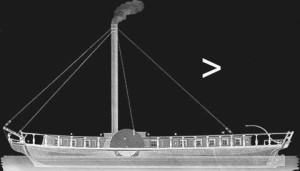
This is the last of the long out-of-print Victorian classics of Clyde Steamer History that I have in my collection. Like the others I have presented over the years it contains a great deal of the lore that appears in later accounts, and like them, there are errors. However, any errors are readily overlooked as the booklet provides an atmospheric background to the Clyde in the 1880s. I had always assumed that Senex Afloat was the work of Robert Reid. However, Robert Reid died in 1865, well before the 1886 publication date of the present work. I would be interested to know if anyone can shine light on the author. The original booklet has no illustrations. I have chosen to illustrate this version with drawings, mainly from two sources. One source is the collection of Mr. Richard Hubbard of whom I have no information other than a mention in “Echoes of Old Clyde Paddle Wheels”. These are reputed to be contemporary and show many details of the early steamers. The second source for many of the later steamers are the drawings of Mr Alasdair MacFarlane from the Evening Citizen. These tend to have a better rendition of the dimensions of the steamers, if they lack some detail.—Valeman.
About Clyde Steamers, &c.
Introductory.—In the Hunterian Museum of Glasgow University is a model of the first practical working steam-engine, known as “Newcomen’s” engine, its inventor having been Thomas Newcomen, a Devonshire man. Attached to it is the following inscription:—“In 1765, James Watt, in working to repair this model, belonging to the Natural Philosophy Class in the University of Glasgow, made the discovery of a separate condenser, which has identified his name with that of the steam engine.” The year in question is therefore a landmark, and a notable one. One or two others may be briefly indicated. Twenty-two years later—that is to say, in 1787—Patrick Miller, Esq., of Dalswinton, Dumfrieshire, published an account of some experiments which, in conjunction with a Mr. Symington, a millwright, he had made on Dalswinton Loch, in the way of propelling boats, driven by manual and other powers. In this account Mr. Miller says:—“I have reason to believe that the power of the steam engine may be applied to work the wheels so as to give them quicker motion, and consequently to increase that of the ship. In the course of this summer I intend to make the experiment.” Accordingly, the experiment was made, and repeated, with moderate success, first on Dalswinton Loch, and next, on a larger and more ponderous scale, on the Forth and Clyde Canal, in a heavy barge furnished with an engine which, with some effort, had been put together at Carron Iron Works. Although a speed of from six to seven miles an hour was said to have been obtained on this latter occasion, the scheme was shortly afterwards abandoned by Mr. Miller.

Miller’s steamboat on Dalswinton Loch

Charlotte Dundas
In connection with Mr. Miller’s experiments there is a little incident worth preserving. Considerable interest then was taken by Mr. Cullen, of Edinburgh, afterwards Lord Cullen, who addressed an application to Messrs. Boulton & Watt, at Soho, Birmingham, the object of which was to engage that celebrated firm to a share in Mr. Miller’s undertaking. In a letter dated “Birmingham, 24th April, 1790,” James Watt replied to Mr. Cullen, stating that the firm declined to be associated in the scheme as partners with Mr. Miller, but that in their capacity as engineers they were ready to serve him, to the best of their abilities, at the customary prices of rotative engines. “We conceive,” he added, “that there may be considerable difficulty in making a steam-engine to work regularly in the open sea, on account of the undulatory motion of the vessel affecting the engine by the vis inertiæ of the matter; however, this we shall endeavour to obviate as far as we can.” It was not to be that Watt himself should live to see the day, but probably some of the Soho apprentices lived to see the engines of Robert Napier bearing themselves without a falter through the “undulations” of a winter Atlantic.
Again, twenty-two years later on, occurs another landmark, and, in the present connection, the most notable of all. In the Greenock Advertiser, of 15th August, 1812, appeared an advertisement running as follows:—
“Steam Passage-Boat, The ‘Comet,’ Between, Glasgow, Greenock, and Helensburgh, For Passengers only.—The Subscriber having, at much expense, fitted up a handsome Vessel to ply upon the River Clyde, between Glasgow and Greenock—to sail by the power of Wind, Air, and Steam—he intends that the Vessel shall leave the Broomielaw on Tuesdays, Thursdays, and Saturdays, about mid-day, or at such hour thereafter as may answer from the state of the tide; and to leave Greenock on Mondays, Wednesdays, and Fridays, in the morning, to suit the tide.—The elegance, comfort, safety and speed of this Vessel require only,” &c., &c.
The fares were announced as being 4/- in the cabin, and 3/- in the steerage; and the announcement was signed—“Henry Bell, the Baths, Helensburgh.”

Comet (1812)
The “Comet”—which was built in the yard of J. & C. Wood, ship-builders, Port-Glasgow—proving an unquestionable success, the same builders, within the next year or two, turned out, to various orders, four others, of gradually increasing proportions, both as to measurement and engine-power. They were named, respectively, the “Glasgow,” the “Morning Star,” the “Elizabeth,” and the “Caledonia.” The first-named was contracted for by a small company of Greenock and Glasgow gentlemen. The fitting of the engine on board of her was superinteded by Henry Bell, but, proving a failure, it was replaced by one constructed by Mr. James Cook, engineer, Tradeston, whose nephew, the veteran Mr. Robert Cook—now crowning “a youth of labour with an age of ease” in well-earned retirement at Pollokshields—must be, we should say without any hesitation, the “father” of the engineering trade in Glasgow. The “Morning Star” was built for Mr. John Robertson, engineer, and the “Elizabeth” for Mr. John Thomson, smith, both of Gorbals, Glasgow. The “Caledonia”—which was of 200 tons burthen, and 32 horse-power—was purchased by James Watt, jun., of Soho, for the purposes of scientific experiment. Her comparatively rude machinery was replaced by two engines of 14 horse-power each, manufactured at Soho, and the observations made upon her performances suggested many useful improvements in the structure and arrangements of marine engines. So rapid was the progress made by this new departure in navigation, introduced by Bell, that only four years after the launching of the “Comet” (1812), upwards of thirty steamers had been built on the Clyde, of which fifteen were then plying on their native river, the rest having been sent to London, Ireland, and other places. An interesting bit of detail is the following:—
List of Steamboats plying on the Clyde in July, 1816; according to the order in which they were built:—


Argyle (1814)

Princess Charlotte (1814)
The fares were as follows:—

A guide-book of the period enables us to supplement these somewhat dry statistics with a few descriptive touches.
“These vessels,” says the writer, “sail regularly for Post-Glasgow, Greenock, Gourock, Helensburgh, Rothesay, Largs, and Inveraray. Occasionally they go as far as Ardrossan, the Troon, Irvine, and Ayr. Sometimes they make a tour among the small islands and lakes in the Firth, giving time to the passengers to go on shore at different places to enjoy the romantic scenery. The hours of departure vary with the state of the tide. As a cheap, expeditious, safe, and agreeable mode of travelling, they certainly take the precedency of every other. They are fitted up in the most elegant and commodious manner. Besides a fore-cabin, sufficiently commodious, they have a very large and splendid after-cabin. Round it is a stuffed marone or hair-cloth seat in the middle two large mahogany tea tables, with chairs; the windows tastefully decorated with marone curtains and gilt cornices; the vacant space at the top of the room fitted up with small libraries and elegant mirrors. The greatest attention is paid to the comfort of passengers, and all kinds of refreshments may be had on board.”
Ten years after the above was written, a historian of these matters states that there were then “upwards of seventy steam vessels belonging to the Clyde, and upwards of fifty belonging to the Mersey; a great proportion of the entire number having been supplied by the dockyards of the former river.” This was in 1826, or not long before the date at which the personal reminiscences hereinafter contained begin.
The Rothesay Route.—From the beginning of the steamboat passenger traffic on the Clyde, by much the most popular route has been that between Glasgow and Rothesay. It was natural enough that it should be so. In the earlier days, when the watering places which now dot the mouths of the lochs and the Cowal shore had as yet no existence, its only competitor as a summer resort for the sea-air seeking citizens, between Kempock Point and the far-distant Saltcoats, was Largs. With all due deference to the latter and its surroundings, their natural attractions—were comparison unavoidable—must take rank second to those of Rothesay and vicinity; whilst in other respects, as, for instance, in re “the comforts of the Sautmarket,” the Ayrshire town could do no more than hold its own—if that—against the ancient royal burgh, the capital of the beautiful island of Bute. Again, as regards the attractions of the voyage to either, the superiority of the scenery on the northern over that of the southern shores of the Firth is undeniable. Very nearly, if not quite, the earliest passenger steamer that we remember was the “Bangor Castle,” of which, we should say, no one on the hither side of sixty can have any personal recollection. She plied on the route of which we are now speaking, and was followed on it, in succession, by the “Arran,” “Windsor,” and “Rothesay” Castles. The last-named of these was transferred to the Mersey, and, on a pleasure trip out south from that river, was wrecked in the Straits of Beaumaris, with considerable loss of life. The other two continued to carry on the trade, and shortly afterwards their owners, the “Castles Company,” extended their route up Loch Fyne to Ardrishaig and Inveraray.

Arran Castle (1830)

Windsor Castle (1832)
Meanwhile, they were assailed in their operations by several small adventurers. One of these started against them the “St. Mun,” at that time considered to be the crack steamer of the Clyde, doing the voyage from Glasgow to Ardrishaig in from twelve to fourteen hours. The steamers in this trade were not of the dimensions of those we are accustomed to now on the Clyde. They ranged form 80 to 100 feet long, whilst, owing to the engines and paddle-boxes being placed at about one-third the distance from the bow, and two-thirds from the stern of the vessel, their moving power was all forward, and their appearance, generally, somewhat in keeping with that of our grandmothers’, at the period when the waist of their dress was immediately under the armpits. Other opponents of the Castle Company on the Rothesay station were the “Superb” and “Ewing,” the latter of which was afterwards degraded to the rank of a tug-boat, and called the “James Ewing.” For her part, the “Superb” was transferred, by-and-by, to another sphere of usefulness, namely the Glasgow and Helensburgh route. Jogging along in this way, it sometimes happened that, under the influence of keen competition, the fares were merely nominal; sometimes, indeed, passages absolutely free, until the inevitable result was arrived at, by the weakest going to the wall.
The Glasgow steamboat quay of those days, it may be mentioned, terminated at the foot of York Street, where there was a lighthouse. It was amusing, in its way, to watch in the mornings the “touts” flying about to get hold of the passengers, and “run them in” to the boats which they severally represented, whilst a man at the stern of each craft kept on blowing a tin horn, to attract attention to it. Between 1830 and 1835, which is, roughly, the period of which we presently speak, the average passage between Glasgow and Greenock occupied four hours; and between Glasgow and Rothesay, seven hours. The steamers were not announced as “returning in the evening,” but on the following day. The normal fares were, to Greenock, 2/6 and 1/6; and to Rothesay, 4/- and 2/6. There were no “return” tickets. These are an institution of more modern date.
Amongst later assailants of the Castle Company, was a new combination, who had for their boats the “Maid of Bute” and the “Isle of Bute,” commanded by Captains Johnston and McKinley, respectively, both of whom had been formerly in the employ of the Company whom they were now sailing in opposition to. These two steamers made a big stride—in fact, they may be said to have made the first big stride—in the way of speed. Their run was from Glasgow to Greenock, Gourock, and thence to Rothesay direct—not “looking” at the Cowal shore at all—and they did it in four hours. Between them they were able to give a thrice-a-day service between Glasgow and Rothesay, leaving the Broomielaw at 6 a.m., at 11.30 a.m., and again at 4 p.m.; and, as was natural, they commanded a large share of public patronage. This opposition had the effect of waking up the Castle Company a bit, and they began to get new boats built. None of these, however, showed anything very superior in point of speed.

Maid of Bute (1835)
Then came the first of a series of similar events which, between them, have tended to alter much the complexion of the passenger traffic between Glasgow and the Coast since the days to which we have been referring. This was the opening, in 1842, of the railway between Glasgow and Greenock. Seeing at once the importance to them of a coast connection, one of the first things the directors of the Railway Company did was acquire from the owners the steamers “Maid of Bute” and “Isle of Bute,” for their own special service, outward from Greenock, in which they continued till 1845. Moreover, the Railway Company had also acquired for the same service, in 1844, the “Pioneer”—built by Messrs. Barr & McNab, Paisley, from drawings by Alexander Denny, of Dumbarton, then draughtsman to that firm—and in the year following (1845), the “Petrel,” by the same builders. On their parts, the Castle Company brought out about this time the “Cardiff” and “Craignish” Castles (built by Caird & Co., Greenock), and the “Edinburgh Castle” (built by Todd & McGregor, Partick.) Notwithstanding, however, the amount of money spent in this way by the competing companies (the Railway and the “Castles”), neither party seemed to have been satisfied with the result, because by-and-by the boats of both came into the possession of Mr. John Burns. He, apparently, did not find them to answer his notions, any more than they had done for his predecessors in their proprietorship, for he speedily disposed of them again to private parties, who wrought them on their own account, with a fair amount of satisfaction to the public, and of profit to themselves. The “Pioneer,” as many readers may be aware, is still to the fore under the same name, carrying Her Majesty’s mails daily between Oban and Tobermory; whilst the “Edinburgh Castle,” now known as the “Glengarry,” carries tourists during the season through the Caledonian Canal, between Banavie and Inverness.

Pioneer (1844)

Petrel (1845)

Craignish Castle (1844)

Edinburgh Castle (1844)
On the disposal of the boats by Mr. Burns, as just mentioned, the passenger trade of the Clyde seems gradually to have drifted into the hands of such specimens of “the fittest” for carrying it out as Captains William Buchanan, Williamson, and McLean, with the accommodation provided by whom the public has had, on the whole, little or no reason to feel dissatisfied. One of the best-known steamer names on the Clyde for the last thirty years is, of course, the “Eagle.” The original was built by Denny, of Dumbarton, in 1852. She was sailed at first by the late Captain Richard Price, who was noted in those days for making the most successful runs (in point of speed, that is,) from Glasgow to Rothesay, et vice versa. About the end of 1852, or beginning of 1853, she was acquired by Captain William Buchanan, who sailed her himself on the route in question. Associated with the captain as partners in the vessel, were Mr. John Cook, brassfounder, Glasgow, and Mr. Alexander Williamson—long known previous to that in the Largs connection—who officiated as steward on board. Matters seemed to prosper with the owners, when, all at once, the public learned that the steamer had been sold to agents of the Government of the Confederate States of America, for blockade running purposes, during the Civil War which had then broken out. In this special line of business she proved for a time very successful, until finally coming to grief in its pursuit. In due time she was replaced on the Clyde by another “Eagle,” the fine boat which now, under the management of Captain Buchanan, so satisfactorily takes her part on the Rothesay route, and occasionally on the station between Ardrossan and Arran.

Eagle (1852)

Mail (1860)
Amongst other boats we remember of on the Rothesay route were three, named respectively, the “Citizen,” the “Mail,” and “Sir Colin Campbell.” The first of these was built by Mr. John Barr, boiler-maker, Clyde Street, Anderston. The “Mail,” which followed, was a superior vessel in every respect, making the run between Glasgow and Rothesay, calling at all the ports, in the same time as it is now done, namely, about four hours. The “Sir Colin Campbell” was a reversible boat, i.e., she was sharp at both ends, skiff-like, so that she could sail up or down without having to be turned. It was on her paddle-box that we recognized for the first time, in the capacity of commander, the well-known Captain Alexander McLean. Somehow she did not become a favourite with the travellers on this route. It might have been owing, in part at least, to her unique and outré-seeming style of construction—we do not know. This we do know, that in the course of a year or two she disappeared from the waters of the Clyde. It was then that Captain McLean, together with his brother, so well known as “Homish,” assumed the proprietorship of the “Vulcan” —the commencement of his career as an owner. In those days of keen competition on the river, speed was everything, or nearly so, and to meet this demand, Captain McLean had another boat built for him by Messrs. Napier & McIntyre. She was called the “Neptune,” and her peculiarity was an unusually small paddle-wheel, which revolved very rapidly. She certainly did go through the water: so much so, indeed, that Captain McLean, who is himself a very quiet, steady-goer, seemed almost frightened at his new acquisition. At least, we have heard him say that he never spent a comfortable day on board of her. The brothers McLean afterwards concentrated their energies on the “Vulcan,” together with the “Marquis of Bute” which was built for, and the “Athole,” which was acquired by them.

Vulcan (1854)

Neptune (1861)

Athole (1866)
In course of stringing together a work of detail, such as this to a certain extent is—and of by-gone details, too—many things which had been forgotten at the right moment occur to the memory afterwards, when the point where they might have more suitable have appeared has been passed. An example of this, just at present, is the case of Captain Alexander Williamson, already named, merely through his connection as partner for a time with Captain Buchanan. But, in or out of order, a little more must be said now. On the dissolution of the co-partnery in question, he bought from Captain McKellar, of the Helensburgh route, the steamer “Sultan,” which had so managed to maintain her youthful appearance, that she might pass any day for a new boat. To this he added the “Sultana,” and a thoroughly crack river steamer she turned out to be. The some two or three years later on, he added to these a boat of heavier build called the “Viceroy.” Conjointly known amongst the wags of the river as “The Turkish Fleet,” all three have done yeoman’s service for the Clyde passengers, and, to all appearance, are able to continue doing it for many years to come.

Sultan (1861)

Sultana (1868)

Viceroy (1875)
The West Highland Line.—No record, however brief or general, of the steamboat passenger traffic of the Clyde which omitted special reference to the far-famed “West Highland” fleet, of which Mr. David MacBrayne is now the proprietor, would be admissible as of any value or authority whatever. This live, we may observe in the first place, did not start into existence fully equipped. Previous to its inception the trade to the West Highlands—such as it was—had been conducted by Messrs. Thomson & M’Connell, along with Messrs. G. & J. Burns. When the revolution already referred to as affected by the opening of the Glasgow and Greenock railway took place, a re-arrangement of matters was deemed necessary by some steamboat proprietors who thought that to continue working as before would prove to be a game not worth the candle. Accordingly, as already so far indicated, the whole of the Castles Company’s fleet, together with some other boats which we may term Bashi-Bazouks—off one year and on another—were acquired by the Messrs. Burns. They thus came into possession of the “Pilot,” the “Petrel,” the “Pioneer,” and all the “Castles,” and therby obtained a virtual monopoly of the passenger traffic along the whole of the north, or Cowal, shores of the Firth—having also acquired the interest in that trade formerly held by Thomson & M’Connell. The latter firm, some short time previous to this, had bought from Mr. Robert Napier the (for those days) fine steamer “Shandon,” which that gentleman had built on “spec.” The purchasers put her on the route to carry H.M. Mails between Glasgow and Ardrishaig. As in doing so the vessel did not call either at Rothesay or at Tarbert on Loch Fyne, she was able to make the double run, out and in, in about twelve hours. This new arrangement, however, only lasted long enough to convince the owners that it would not answer to keep it up. Then as just stated, ensued the sale of all the boats by the Messrs. Burns to several different parties, most of whom had been working then in the employment of that firm. The “Craignish” and “Cardiff” Castles were thus disposed of to a Mr. Johnston (son of the late harbourmaster of Glasgow), whilst the “Shandon,” the “Merlin” (ex-“Queen of Beauty”), the “Pioneer,” and the “Dolphin,” found their way into the hands of an entirely new Company, the partners in which had also been in the employment of the Messrs. Burns. This new connection was the one destined to become so famous under the firm of David Hutcheson & Co.—the members being that gentleman himself, his brother, Mr. Alex. Hutcheson, and Mr. David MacBrayne. This was in 1851—the year of the first “Great Exhibition” in Hyde Park—and in the following year the firm made a notable stride forward in the launching of the “Mountaineer,” the first of what may be called the ornate boats, and the nucleus of the present magnificent line of fast mail and passenger steamers to, and running in, the West Highlands. She has sailed in the Company’s service ever since, and seems to-day to be as good a boat as ever. During the summer months, moreover, she is one of the hardest workers in the fleet, making—under the command of Captain Donald McCallum—two journeys daily up and down the long Loch Linnhe, between Oban and Corpach, in connection with the Caledonian Canal route, and carrying the mails.

Shandon (1839)

Mountaineer (1852)
It will be in the recollection of many persons that the “Mountaineer” was succeeded on the Glasgow and Ardrishaig route by the first “Iona,” and went round to take up the station between Crinan and Fort-William. The “Iona” No. 1 remained on the Ardrishaig station until 1862, when she was bought (like “Eagle” No.1) by the Confederates to run the blockade. In setting out to cross the Atlantic, however, she foundered in the Bristol Channel, and was thus lost for ever. In the following year, the first grand “saloon” boat was started in her place, being “Iona” No. 2, which was on the Ardrishaig route for no more than two months when she also was sold, and to the same purchasers. Her career was as ill-fated as, and more brief than, that of her predecessor. She did not get even so far on her way to the Confederacy as her predecessor had got. In fact she never cleared the mouth of the Clyde. Having, as it were, just got steam up for the voyage, she was run down by a big screw-steamer, the “Chanticleer,” built to go to China, off Kempock Point, and at the bottom there it is believed she remains to this day. A professional diver once went down and inspected her. He reported her to be in a very good condition, but so deeply and firmly imbedded in the sane that it would be impossible to get her up. Next year saw the launching of the present, and improved, “Iona,” third of the name, and which for the last three or fours seasons has so well fulfilled the daily service either way between Crinan and Fort-William. Further operations, all tending to enhance the growing repute of the firm of David Hutcheson & Co., were the supercession of the old horse-drawn track-boat on the Crinan Canal by the neat little screw-steamer “Linnet”—the renting of the island of Staffa and the erection of facilities for making the inspection of Fingal’s Cave practicable in all but the worst of weathers—the acquisition of the Islay steamer and traffic—the establishment of such an excellent service between the east and west of Scotland, via the Caledonian Canal—the purchase of the steamer plying on Loch Awe between Ford and the other end of the loch; as also the institution of the periodical tourist trips to Loch Skavaig in Skye and Gairloch in Ross-shire.

Iona (1855)

Iona (1863)
The construction of one of the most notable vessels of the firm renders advisable a word or two of introduction. On 6th July, 1877, a new sensation was created amongst those interested in the passenger traffic of the Clyde; and thereby hangs a tale. On that day the “Lord of the Isles,” which had been built for an independent Company for the route between Wemyss Bay and Inveraray, made her first run. Notwithstanding that the weather that summer was of the most inclement character almost throughout, and the late period of the season at which the vessel was put on, she turned out at its close to have been financially, as well as in point of speed, a great success. And this it was which led to the building of the most magnificent passenger steamer on any river in the world—need we name the “Columba.” Built and engined by Messrs. J. & G. Thomson, Clydebank, she was started in the summer of 1878. Her success was undoubted from the beginning; and every season she continues to ply in her vocation to the admiration of tourists from every quarter of the globe. She is, in fact, a floating palace of steel. As has been said, a trip in the “Columba” has but one possible drawback, namely, that it may cause the person making it to be over fastidious in the matter of steamboat accommodation for the remainder of his natural life. In December of 1880, Mr. David Hutcheson died, and soon afterwards his brother Alexander retired from business, leaving Mr. David MacBrayne sole partner of the firm. Under his single guidance the management of the fleet of steamers of which we write is something unique in its way. Like the “Village Blacksmith” of Longfellow, “week in week out, from morn till night”—or at least till well on in the afternoon, he is ever at work, either within the office at Glasgow or scouring about from one point in his vast system to another, and seems to be quite competent, physically and mentally, for all that rests upon his shoulders. Such men are exceptions.

Lord of the Isles (1877)
Columba (1878)
Largs, Millport, and Arran.—For a few years subsequent to 1830, the steamboat arrangements on the south-side of the Firth were marked by much the same shifting, uncertain, almost chaotic character we have referred to as prevailing at times on the opposite shore. Amongst the vessels of those days which we can recall were the “Hero,” the “James Dennistoun,” and the “Nimrod”—which went to Ayr, returning on the following day. To these were added the “Victor” and the “Venus,” owned by Captain McKellar and his son, both favourably known to the travelling public; and brother and nephew, respectively, of Captain McKellar of the Helensburgh station. Later still, there came on the field a new competitor for patronage, on this route, of a somewhat formidable character. This was none other than Mr. Young, plumber in Glasgow, and father of Captain Robert Young, of the “Lord of the Isles.” He placed on the station, first, the “Lady Kelburne,” under the command of Captain Houston, with whom was associated as steward, Mr. Thomas Kennedy. Then followed the “Lady Brisbane” (now the “Balmoral”), and for a couple of years, or thereby, these two boats carried everything before them in point of speed. It occurred to some one the idea of a coalition, which being carried out, the interests of the McKellars and Mr. Young were united into one Company. As was to be expected from such a combination, the partners made the trade in this quarter their own; and, moreover, extending their operations beyond Largs and Millport, they started a steamer which left Glasgow every lawful day at 2 p.m., for Brodick and Lamlash, returning to Glasgow on the following morning. This special service to Arran seems to have been, practically, left to them by the Castles Company, which had hitherto maintained a nominal connection with the island, by sending a steamer there at those intervals, elastic of arrangement, known as “now and then.” The Arran boat was under the command of the younger McKellar—Captain John—and her steward was Mr. Graham, afterwards hotel-keeper, St. Enoch Square, in the premises now known as “His Lordship’s Larder”; and, later still, predecessor of Mr. Stark, at the well-known restaurant in Queen Street, Glasgow. In course of this co-partnery, the steamers “Jupiter” and “Juno” were built, enabling the Company to extend their Arran operations, by placing a boat on from Glasgow every morning, whilst continuing the 2 p.m. run.

Victor (1836)

Lady Brisbane (1842)

Lady Kelburne (1843)

Venus (1852) affords an opportunity to compare artistic styles

Venus (1852)

Jupiter (1856)

Juno (1860)
Notwithstanding the efficiency of such a service, the mails of the island continued to be dispatched, as of old, via Ardrossan. They were taken over from the latter in a small steamer called the “Isle of Arran,” which was superseded by another called the “Earl of Arran,” commanded by Captain John Blackeney. In the summer of 1850, it was, this boat met with an accident, in consequence of which she had to go into dock for repairs, and, in the interim, Her Majesty’s mails had to be transported over her route by a sailing boat. We remember well the arrival of this craft at Brodick on one occasion, when, through adverse weather, there had been no communication with the mainland for three days preceding. While sitting on the shore at the old pier, we were startled by the appearance, coming into the bay, of the boat in question, which, in virtue of being on Government service, carried Her Majesty’s pennant at the mast-head, whilst, stuck in the bows, was a bugler, who, at the top of his blowing powers, was discoursing “A Life on the Ocean Wave.” All these arrangements were changed shortly after the time we have been speaking of, by the Duke of Hamilton’s causing to be built for the Arran mail service a first-class steamer, called the “Lady Mary.” Under the command of Captain Brown, and in connection with the Glasgow and South-Western Railway, this vessel sailed in the summer season twice daily, between Arran and Ardrossan. After five years of this service she gave place to another fine boat, also built to his Grace’s commission, called the “Heather Bell.” The latter, after having been on the station for, as nearly as may be, the same length of time as her predecessor, touched a rock at Ardrossan one day in starting on the outward trip. Although considerably damaged, she got over to Brodick Bay, where they beached her, and landed the passengers on the shore. This incident seemed to have set the Duke a-thinking. Probably he reasoned within himself that to continue carrying passengers, with the penalties attaching in case of any serious accident, was a risk which it was hardly worth his while to run. Anyway, the result of his cogitations was that he thereupon abandoned interference with the service for good and all.

The Lady Mary (1868)

Heather Bell (1872)
It was under these circumstances that our old friend Captain William Buchanan came to the front on the Ardrossan and Arran route, in connection with the Glasgow and South-Western Railway. This was in 1874, and from then until now he has held the trade. It should be added that, knowing, as he does by this time, that the citizens of Glasgow like occasionally to sniff the strong sea-breezes, he manages to cater for this healthy longing in very agreeable fashion. Twice-a-week during the summer season, with one or other of his good steamers, he makes special trips, out from Ardrossan to Ailsa Craig, or to Campbeltown—or it may be up to Rothesay, but all arranged that they shall not in the least interfere with arrangements under which he is bound for the service of the Railway Company.
Wemyss Bay.—When the Wemyss Bay Railway was opened it was evident that the directors of the Company laboured under a delusion, which was soon, however, to be disagreeably dispelled. This was that not only were they qualified to run trains, but that they were able to run steamboats as well. Accordingly they had three vessels built for their own special service, which were called respectively, the “Kyles,” the “Bute,” and the “Largs.” The two first-named were handsome “saloon” steamers, after the fashion of Mr. MacBrayne’s, but on a smaller scale. The “Largs,” for her part, was regarded as the “winter” boat, and, whilst continuing to run, was probably the most serviceable boat of the lot to her owners. Like other adventurers, ignorant of the “ins and outs” of this particular trade, the Railway Company turned their eyes to Loch Fyne, as a happy hunting ground, notwithstanding the misfortunes which had befallen those who had gone before them in the same direction, and of which they must, or ought to, have been cognisant. One boat they started to run, in connection with the train arriving in the morning, from Wemyss Bay to Ardrishaig, calling at all the intervening ports; and another, leaving in the afternoon on the same route, and returning from Ardrishaig next morning. Of course these operations were short-lived, but those who can recall them will remember also that the waste of energy and capital which went on whilst they lasted, was something pitiable to se. Both boats were handicapped and over-headed from the very outset by the West Highland steamers, the upshot being that the end of their first season saw also the end of the Wemyss Bay Steamboat Company. The Wemyss Bay Railway Company then found themselves in extremis, and after applying in vain to one and another of the favourite Rothesay companies to take up the trade, they, in a good hour for themselves, fell into the hands of Captain Alexander Campbell, who, along with his father-in-law, the late Captain Gillies, of Largs, conducted the traffic in boats of their own, under an engagement with the Railway Company.
Their steamers were the “Argyll” and the “Victory”—both of which had been built for Captain Duncan Stewart, now many years deceased, and sailed in his interests on the Rothesay route. In addition to these two boats, they had built for them a crack steamer called the “Lady Gertrude,” which came to grief one stormy day when, missing the pier at Toward Point, she was driven upon the rocks. The catastrophe was a conclusive one, as, if we mistake not, the entire salvage consisted of the boiler only. To succeed this unfortunate, was built the “Adela,” which continues to be a favourite boat to this day. Subsequently to the death of his father-in-law and partner, Captain Campbell acquired the “Bonnie Doon” (built up at Ru’glen by “Tommy” Seath), also still in service; and this season (1886) he proposes adding to the fleet a grand new saloon steamer.

Bute (1866)

Largs (1864)

Argyle (1866)

Victory (1864)

Adela (1877)

Bonnie Doon (1876)
Helensburgh and Gareloch.—The Helensburgh steamboat traffic had always a somewhat chequered and fitful career; the steamers, for the most part, passing in their time through many hands. Amongst the earlier of their number were the “Sovereign” and the “Superb.” Each and all of them seemed to have a hankering for trying the Rothesay trade, and each and all of them that did have a try thereat achieved only failure, owing to the powerful hold on that route which the Castles Company had acquired and maintained. At last Captain McKellar, already mentioned, took up the Helensburgh station, and managed to make it a successful trade; and, although afflicted now and then with an opposition, sometimes from one quarter, sometimes from another, he was able to hold his own against all comers. One of the first of his boats was the “Royal Tar,” which was painted a light green, and had what was unique on the Clyde then, a straight up and down cutwater. She was followed by a whole fleet of green boats, as will be well in the recollection of those who can look back for from thirty to thirty-five years. As had happened to so many of their sister craft on the southside of the Firth, however, the opening of a railway line running down by the river side, speedily rendered their running unremunerative.

Sovereign (1845)
Helensburgh was unfortunately situated as regards accessibility before the formation of the railway, owing to the existence in the river channel of that huge sand-bank which extends from Dunbarton Castle down to Craigendoran. In consequence of this obstruction, all steamers from Glasgow for the Gareloch side had to go round by Greenock, which, practically, made Helensburgh as far distant from Glasgow as Kirn is. Such state of matters is all changed now by the operations of the North British Railway Company in that quarter. They have built a handsome pier and harbour at Craigendoran, from which steamers, in direct connection with the trains arriving there, enable passengers to reach Garelochhead in one-and-a-half hours from Glasgow. These steamers, the “Gareloch,” the “Dandie Dinmont,” and others which ply to different points on the Firth, are all well-appointed boats, on board of which the public have no reason to complain of their wants not being attended to. Moreover, by the recent opening of the underground railway, passengers from Glasgow are enabled to reach Helensburgh in thirty-five minutes and Garelochhead in seventy-five minutes from the centre of the city.

Gareloch (1872)

Dandie Dinmont (1866)
Loch Long and Holy Loch.—A little way beyond the mouth of the Gareloch, on the same side of the Firth, we come upon the ground traversed by the well-known fleet belonging to Captain Robert Campbell, who sails in connection with the railway at Prince’s pier to and from Kilcreggan, Cove, Blairmore, Ardenadam, and Kilmun. These boats have always had a large share of public patronage, or —in point of fact —had a monopoly of it in this quarter.
The monopoly was not grudged them , however, in consequence of the admirable manner in which they were conducted by the at once genial and brusque owner. His boats, to begin with, were the “Express”—which afterwards went round to the Firth of Forth, and the “Vesta,” which had long been on another route, and whose career terminated not long ago by her being accidentally burned to the water’s edge on the Holy Loch. He also acquired the “Balmoral” (nee “Lady Brisbane”)—also from another station; and then he made a big step ahead by having the “Benmore” built for him.

Express (1854)

Vesta (1853)
In consequence of some difficulties into which he fell, Captain Campbell, a short time ago, disposed of the whole of his fleet to Captain Wm. Buchanan. After a short hiatus, extending over two or three months, he made a fresh start by acquiring, from Barclay, Curle & Co., the “Meg Merrilees,” and causing to be built, at Paisley, the “Waverley” a vessel of about the same size. With these boats he continues to serve the public in as satisfactory a manner; and, still to appearance a young man, we hope he may long continue to flourish.

Waverley 1885
Lochgoilhead.—One of the oldest lines of passenger traffic on the Clyde is that served by the Lochgoil Steamboat Company. Their first boat was called the “St. Catherine’s,” after the little place of that name on the eastern shore of Loch Fyne. The route was early made a connection with Inveraray by mans of coaches running through Hell’s Glen. These coaches, by the way, were under the management of the late John Campbell, so well known by his tales for travellers who sat beside him on the box —Munchausenisms, they were sometimes styled by those of little faith. The “St. Catherine’s” was commanded by Captain Graham, very commonly called “Paddy” Graham, the reason why we cannot tell, seeing that never within our knowledge did he exhibit any traces of the Emerald Isle about him in speech or demeanour. She was succeeded by the “Lochgoil” or the “Lochlong,” we forget which, and afterwards by a smart steamer called the “Breadalbane,” with Captain Graham still on the paddle-box. The “Breadalbane” was succeeded by other steamers, for which the names Lochgoil and Lochlong were again used. By means of the second steamer an afternoon service from Glasgow to Lochgoilhead was opened up, the communication previous to this having been only once daily either way, that is, leaving Glasgow at 7 a.m., and returning at about 4 p.m. to 5 p.m.

Loch Goil (1835)

Loch Long (1842)

Breadalbane (1847)

Loch Goil (1853)

Loch Long (1859)
It may not, by-the-by, be generally known, or it may have been forgotten, that this boat, namely, the one returning to the Broomielaw at the time mentioned, was the pioneer of the cheap Saturday afternoon excursions from Glasgow to Bowling and back for sixpence, and which turned out such an unmistakeable success. At the outset she seemed to be the only one of the river steamers which had spare time at her disposal for the purpose of these trips; but the public so caught on to the idea of them that the others soon found, or made, time to follow suit.
Some Clyde Skippers, &c.—One of the earliest steamboat commanders we can distinctly recall, was Captain Johnston, of the “Maid of Bute.” He might be taken as the type and exemplar of the good old-fashioned Clyde skipper; with his fine frilled shirt, spotless white waistcoat, and his most urbane and polite bearing to all his passengers. There was a smack of ancient courtesy about the manner in which he used to announce to his cabin passengers—“Ladies and gentlemen, we are now collecting the passage money.” A somewhat unusual penchant for a seaman, he was exceedingly partial to “sport” with the gun, and he was the first to introduce rabbits into the island of Bute, simply on purpose that he might improve his spare hours ashore in shooting them. Then there was his sturdy-looking brother commander of the “Isle of Bute,” Captain Shields, more reticent in manner, but a man who knew his business backwards, as the saying is; and Captain John Campbell, of the “Castle” Company’s steamers, his robust figure always enveloped in a blue surtout, with a rose in the button-hole—a man to be remembered. One more typical specimen was Captain Neil McGill, who came a little later on the field than the others. He was a man with a great many friends, and a ruling idea; the latter being that the bridge paddle-box of a river steamer was much beneath his merits and capabilities. These, he appeared to fancy, would have been more fittingly bestowed in a command such as that of the Channel Fleet.
Another worthy skipper of our acquaintance was Captain Blackeney, of the Ardrossan and Arran station. He hailed from the Emerald Isle, and his manners were a specimen of Irish politeness at its best. His attention to passengers who sailed with him—to ladies more particularly—was marked and deferential to a degree. It may surprise some who remember him in their earlier days that the good old man survived until what might be called the other day; dying at Saltcoats, where he had for long lived in retirement, so recently as about November or December, 1884. To the last he retained and exhibited that urbanity of manner which in his days of activity had won him golden opinions from so many persons.
Of Captain William Buchanan, still with us, hale and hearty, little need here be said. He has been on the whole, we incline to think, the most successful river steamboat proprietor we have had on the Clyde for a good many years. In addition to the fleet taken over from Captain Robert Campbell, already referred to, he is at present owner of the “Eagle,” the “Scotia,” the “Brodick Castle,” and the “Elaine.” He is an established favourite amongst a wide circle of influential friends, as is shown by the fact that his boats are chartered for a day, either before the season has fully commenced, or after it is over for a year, for the pleasure trips of various Friendly Societies, such as the “Anderson Weavers,” etc. On these occasions he is generally on board himself, but as a guest, merely, not interfering with the sailing of the steamer. Captain Buchanan has now occupied the paddle-box of one or other of the steamers during a period of some thirty-five years; and we trust that he may long continue to cater for the transit accommodation of the public as well as he has done in the past.
Another well-known and well-liked man is Captain Alexander McLean, of the “Marquis of Bute.” When he, together with his brother (so popular as “Homish”), first became steamboat proprietors, they sailed their own boat, the “Vulcan.” Next, the “Marquis of Bute” was built for them; and then, by purchase from the Glasgow and South-Western Railway Company, they acquired the “Athole.” Captain McLean has been a most successful man, and deservedly so. From the position of an ordinary deck-hand on board the Largs steamers, which was how he commenced his career on the Clyde, he has, inter alia, become proprietor of the house and grounds of Glen Dermot, on the Craigmore side of Bute. To this maybe added that the captain is an enthusiastic Volunteer, his corps being the Argyllshire Artillery, as also a prominent member of the Glasgow Cowal Society, to which he gives the use of one of his steamers for the annual “outing,” free of any expense. As if this were not sufficient for the shore-going energy of the man, he has also filled in turn the positions of town councillor, junior bailie, and senior bailie of Rothesay. Indeed, it is his own fault that he has not ere this occupied a higher position still. It is to be hoped, however, that his modesty in this matter may be overcome; and that we may yet have the pleasure of hailing the worthy skipper as Provost McLean, of the ancient and royal burgh of Rothesay.
Few figures on the paddle-box or bridge are more “kenspeckle” to travellers on the Clyde than that of Captain Robert Young. The position of a skipper seems to have been an early object of ambition with him, and his first command was a little steamer which he had built for him called the “Gourock,” which plied between Glasgow and the saut-water resort so named; but, if we remember aright, did not venture further on in the direction of the raging main. She was really so little, compared with the average steamer of her day, that to see the tall and erect form of her commander dominating from the paddle-box almost outraged one’s sense of proportion. Shortly after this time, a new steamboat company was started, their steamers being the “Kelpie” and the “Spunkie” —fine, spacious, comfortable vessels both. The former, under Captain Dugald Weir, was put on the Rothesay, and the latter on the Largs, Millport, and Arran route, under the command of Captain Young, who continued to sail her until she departed from the Clyde for good and all. The “Kelpie” also left these waters, being transferred, together with her Captain, to those of the Shannon; which, as the song tells us is “full of fish,” and flows by “Limerick the Beautiful.” Here Captain Weir remained until incapacitated by advancing years from holding any command. The he came back to Glasgow, and took up his abode in a parlour and bed-room at the Broomielaw, where his single solace in retirement was to sit at the window the live-long day and watch the steamers gliding up and down. But to return to Captain Young. His next appointment was to the “Hero,” on the Rothesay route. This recalls a circumstance which, as it was accidently omitted in the chapter under that heading, shall be given here. Some two or three years previous to the period we speak of, the steamer “Rothesay Castle” had reverted to her original owners, Caird & Co., Greenock, who sailed her on the Rothesay route on their own account, having at the same time an engagement with the railway company to take outward from Greenock passengers by the train from Glasgow, leaving there at 4 p.m. This service being well conducted, they retained in undisturbed possession, until Captain Young came on the field with the “Hero,” boldly challenging the superiority of the “Rothesay Castle” by starting from the Broomielaw at almost the same time with her. Caird & Co. resented this action on the part of this new rival, and resolved that she must be run off the station at all hazards. Hence the competition waxed keen and keener, and so it happened—not much wonder either—that the interests of the passengers appeared at times to be deemed a quite secondary consideration in the race. By and by the climax came. The train down from Glasgow, on one occasion, did not arrive at Greenock on time. The rival steamers were both at the pier waiting for her. With Captain Young, of course, this was a matter of choice; he could do as he liked. Not so the other captain, owing to his engagement with the railway company. At last the “Hero” made off; and, although the train passengers had not as yet put in any appearance, the other captain followed suit to have a race with her. One can fancy the feelings of the train people when they did get down to the quay and found there was no boat to take them on to Dunoon or Rothesay, where the dinners—for which they would be thoroughly ready—were timed to be on the table at the usual hour of the boat’s arrival. Unfortunately for the “Rothesay Castle,” two of the passengers thus short-shipped happened to be the late Sheriffs Steel and Strathern, respectively, of Glasgow. These were rather awkward customers to have to do with when putout; and the result was that they raised an action of law, which terminated in either the railway company or the steamboat owners, we forgot which, being amerced in damages. Another result was that the “Rothesay Castle’s” railway arrangement was terminated, and her place in connection with the 4 p.m. train taken up for the remainder of the season by the “Hero.” In 1859, Captain Young in the “Spunkie,” started that route which has since been so well wrought by several parties—notably by the last of them, with the “Ivanhoe.” We refer to the run between Glasgow and Arran, via Rothesay and Kilchattan Bay. Of his several commands since, the most important was that of the “Lord of the Isles,” incidentally referred to in our chapter on the West Highland Line.
The skippers on that line, by the way, may be briefly noticed together. The premier station thereon has always been that between Glasgow and Ardrishaig, and consequently, the steamer on that route has always been commanded by the Commodore of the fleet. It says a great deal for both employers and employed, that so few changes have taken place in the personel of the latter since the establishment of this West Highland line. On the Ardrishaig station, the first name that occurs to us on the list of skippers is that of Captain John McCallum, who, if we mistake not, is either the oldest, or very nearly so, in the Company’s service; and remains in it to this day as commander of the daily mail steamer in the Sound of Mull. To him followed Captain McGown, erewhile in charge that easiest going of all locomotives, the old “Dunoon Castle.” After giving satisfaction alike to his employers and to the public for a few years, he retired from the service, and was succeeded by Captain John McGaw. The latter was a robust and kindly-hearted man, but rather inclined to be rather brusque in his manner with strangers. In the meantime, poor fellow, he is laid aside by ill-health; and Captain Angus Campbell has for the present succeeded to his position, and therein gives that amount of satisfaction to travellers along this route, which all his predecessors have managed to give. On the service beyond the Crinan Canal, the skipper of the “Chevalier” naturally calls for our next attention. This is Captain J. McMillan, who prior to the present season, was her skilled and attentive mate. Sailing with the “Iona” in the most responsible rôle of pilot is—the G.O.M., shall we call him?—that is to say, the grand old mariner, Donald Leitch. Pre-eminently a worthy is Donald; who is, and feels, so closely identified with the vessel in which he has sailed since she was launched, that he has been heard to say that he would rather have his own face skratched than that anyone should skratch or scrape an inch of paint off the dear old “Iona.” On the route from Oban to Staffa and Iona there has for years been as little change as on any of the others, in the personel of the officers. It will suffice, therefore, merely to mention the names of Captains John McCallum, Donald McCallum, and Duncan Campbell; and of that most good-natured and affable of second officers, Charles McCulloch, who retired from the service some three years ago to become harbour-master at Oban. The last named of these commanders, the much lamented Duncan Campbell, died at his house in Glasgow only a few months ago. The Skye route has only been added to the regular sailings of this company within a comparatively short period of years. Associated with it are the names of Captain Angus Campbell—under whose direction was laid down the wooden track from the margin of Loch Skavaig up to Coruisk; and Captain Baxter, senior officer of the service in the Hebrides. The latter we had the pleasure of meeting with for the first time only about two years ago. He is a man of a fine, lively disposition; and, like all his co-mates in the service, of most obliging manner. There is a gnarled old oak—grown somewhere about the woods of Ayrshire—who does second duty on board the Skye steamer. That in this, his vocation, he is thoroughly efficient, may be believed from the simple fact of his being there; but, apart from this, the tourist who manages to get in tow with him will find him “worth all the money” for his fund of grim, old-fashioned, and genuinely Scotch (Lowland) humour.
It is almost a piece of supererogation to note that steamers so completely equipped in all other respects as those of the MacBrayne line, are not found deficient in that important department—in so far as the comfort of passengers are concerned—namely, the cuisine arrangements. Any one who has looked into the dining—saloon of the “Columba” cannot have failed to be impressed with the admirable manner in which the creature comforts are dispensed by the presiding genius there, Mr. Colin Turner, and his numerous and capable staff. You can breakfast when you please, dine, or have tea, when you please; but in any case, you are always found in the best material, dispensed with taste and promptitude, at charges considerable under what is known as “hotel prices.” Mr. Turner’s father, before him, was an excellent specimen of the first-class steward of those days. He was connected chiefly with the old Loch Fyne route, under the regime of the “Castles Company,” sailing with the well-known Captain Donald Currie in, successively, the “Tarbert Castle,” the “Inverary Castle,” and the “Duntroon Castle.” The last-named, by-the-by, was certainly the best boat the Company ever had in their service. Although built for the Loch Fyne trade, she was a match for the fastest river steamer of her day. This was shown once when, on a certain Fast-day, she made a special excursion trip from Glasgow to Rothesay, thence round Ailsa Craig, and returning to Glasgow in the evening. On her way down the river she was challenged by the “Lady Brisbane”—at that time acknowledged to be the champion of the Clyde for speed. The result was a regular, thorough good race all the way to the Cloch, where the routes of the two vessels diverged. As to their respective performances, it could not be said that there was a quarter of a mile per hour difference between the speed of the two, so that it was a very close tussle. It so happened that on returning in the evening, the two encountered each other again, and had a race all the way up to Glasgow, with precisely the same result as that of the morning. As stated elsewhere, the “Castles Company,” by-and-bye, disposed of their steamers, and the Loch Fyne trade was taken up by the firm of David Roxburgh & Co. They only, however, acquired one boat of that Company’s, namely, the “Inverary Castle.” The “Mary Jane” was bought form Sir James Matheson of the Lewis, and a third steamer, and a capital one, they had built for them, and named it “The Duke of Argyll.” The trade was continued by the firm in question until the death of some of the partners; than it was acquired by David Hutcheson & Co., with whom it remained, and as all men know, is now carried on by their worthy successor.
On the routes of the West Highland line beyond the Crinan Canal —that is to say, from Crinan to Oban and Fort-William—and on the Staffa and Iona steamers, the steward arrangements have been for years in the thoroughly competent hands of the Messrs. Lang —father and son. Mr. Lang, senior, is now by a long way the patriarch of the clan of Clyde steamboat stewards still surviving, having last year, or the year before it might be, celebrated his jubilee year in the service. We ourselves sailed with him in the old “Dolphin” more than forty years ago. He has of late devoted himself mainly to looking after the “Staffa” boat, whilst the “Ions” is “bossed” in this department to perfection by the junior partner, the so well-known and courteous “Alick.”
The oldest, or rather the earliest, steward within our own rememberance was James Wylie, of the “Bangor Castle,” afore-mentioned. Previous to this he had been steward of another steamer called the “Postboy,” on board of which it had on one or two occasions been his duty to wait upon a passenger rather well known as Edmund Kean, when that gentleman was going down from the old Queen Street theatre here to play for a few nights at Greenock. Wylie was rather proud of his acquaintanceship with the little great tragedian—who was wont to ensconce himself in the steward’s cabin during the whole of the passage—and discoursed freely of his experiences of the latter. He had a public house in Greenock, in which town he died many years ago.
Perhaps the smartest and triggest steward that ever attended to the comforts of a company on board any vessel sailing on the Clyde was Mr. Thomas Kennedy, associated in our rememberance with the “Lady Kelburne,” under the command of Captain Houston. “Tom” was always smart and smiling. It was said that he used to get through three pairs of white trousers per day, and changes of linen to correspond. In general, and unvarying affability it may be safely said that he had no equal, in his own department, in the river service. His son, James Kennedy, became a marine engineer, in which capacity he has been all over the world, and been a wonderfully successful man. He occupies a fine house called Lorne Villa, at Millport; and, inter alia, is commodore of the local regatta there.
“Homish” McLean —already mentioned as partner, at the outset, with his brother, Captain A. McLean—was a character in his way. Some good jokes are widely current regarding him, in most of which there is doubtless a fair degree of truth, and one or two of which have been utilized by Mr. William Black, in his novel of “White Wings.” For example: one morning, coming up from Rothesay, the fore cabin, even at that early hour, was pretty well filled with customers, and Homish was overheard sending up a message to his brother, the skipper, to go at half-speed only, as he had “a fine lot” down stairs, and the tickets were not all collected yet. Another story told of him is that, desiring a certain article of clothing for use at his work on board, he went to an outfitter’s, and asked to be supplied with a “pair o’ troosers for a steamboat.” One more:—he had got dinner below pretty well over one day, and the weather being very warm, he came up on deck to get a breath of fresh air. There he was seen, standing at the top of the companion stair, silently watching a drove of cattle that were cooling themselves in the flood hard by Lord Blantyre’s policies at Erskine. At last he was heard to give vent to his contemplations on the scene in these words—“I wush I wass a stot this day.”
By way of wind-up to these rambling reminiscences, let us recall the biggest, busiest day ever seen on the Clyde, so far as steamboat traffic is concerned. The date was 16th August, 1847 —getting on for forty years ago now. Her Majesty the Queen, accompanied by Prince Albert and some of their children, had been on a visit to Ireland; and it was arranged that on leaving there she should make a short cruise on the West of Scotland coast. On the day in question, the royal yacht “Victoria and Albert,” was to steam up the Firth of Clyde as far as Dumbarton Castle, one of the fortresses in Scotland which are bound to be kept garissoned in terms of the Articles of Union with England. On purpose to meet her, there went down from Glasgow that morning the most numerous turnout of steamers ever seen at once on the waters of the Clyde, from the biggest Liverpool or Dublin boat to the tiniest tug, all covered, alow and aloft, with bunting, and carrying bands of music by the score. Unfortunately, the royal yacht was detained by fog, and did not get up that day farther than Loch Ryan. The commodore of the fleet of Clyde boats which had “come out for to see” their sovereign, and who was on board the “Monarch”—one of the Helensburgh green boats—went out as far as Garroch Head on Bute, whence, seeing no symptoms of her appearance, he reluctantly gave the signal to disperse. We ourselves, in the “Petrel,” went down as far as Ailsa Craig, as also did one of two other more pushing craft—notably the “Lady Kelburne,” built, as was our own boat, by Barr & McNab, of Paisley. Immediately on leaving Lamlash, outward bound, we had observed that there was a friendly race on foot between the two boats; and, during the whole twenty miles between Whiting Bay and the Craig, it could hardly be said that the one had the advantage over the other in regard of speed. What little there might have been was in favour of the “Petrel,” which passed her competitor whilst rounding the Craig, in a fair and square, honourable race. These two were followed by the “Lady Brisbane,” the “Pioneer,” and the “Countess of Eglinton.” These also, were all built by the same firm, the draughtsman of all being Alexander Denny. And it may be safely said that this little squadron of five, natives of Paisley, carried the palm in point of speed at that time against all comers on the Clyde. The one we were in, the “Petrel,” made the run from Ailsa Craig to the mid-quay at Greenock in three hours fifty minutes, a performance which, to the best of our knowledge, has never been beaten. On our arrival at Greenock, Captain Colin Gillies announced to us that, in view of the respectable sum of passage-money we had each paid (10/6), if we chose to come again the following morning he would pledge his word that he would take us all out to meet the Queen, free of any further charge. Getting up to Glasgow, we were met by Captain McArthur, than general manager to the Messrs. Burns, who at once endorsed Captain Gillies’s promise in this matter.
Next morning, accordingly, found most of us once more onboard the “Petrel,” and eager for the fray. There was no mistake this time. The Queen did come, and her vessel was closely hunted by the host of floating excursionists as ever was poor Reynard by the pack. Landing at Dumbarton, Her Majesty was shown over the Castle, and then steamed on downwards past Port-Glasgow, Greenock, Gourock, and then struck across the Firth to Loch Long—with the hounds in full cry. Here it went all the way up to Arrochar, where, swinging round, it set off again, having a peep in Lochgoil in the by-going. Into the open Firth again, the course was made for Rothesay Bay. Here the royal squadron came to anchor for the night; and it was on this occasion that a boat, manned by two or three local (and loyal) fishermen pulled out to the “Victoria and Albert,” and, seeing the Prince Consort on deck, enjoying his evening cigar, the spokesman of their number called out to him, “A say Ahl-bert—Ahl-bert—show us the Duke o’ Rosa.” They had learned that the young heir-apparent, then in his sixth year, was on board at the time, and, as one of his titles is “Duke of Rothesay,” they imagined that with complete propriety they might request that he be produced for their inspection. Next day the royal party proceeded in the “tender” steamer “Fairy” through the Kyles of Bute, and up Loch Fyne to Inveraray, to make a call on the Duke of Argyll. Meanwhile, the “Victoria and Albert” was sent round the Mull of Kintyre, with orders to wait for them at Crinan, to which, after leaving Inveraray Castle, they proceeded, via Ardrishaig and the Crinan Canal, whence she proceeded northward in the big yacht. Hence the now so well-known round came to be called the “Royal Route.” We have thus seen Her Majesty away from the portals of the Clyde; her further journeyings on this occasion have been told by herself.
We feel constrained to observe in conclusion that, considering that it is now between seventy and eighty years since the introduction of steam navigation on the Clyde, the number of accidents of a disastrous kind attending it has been comparatively few. We can call to mind but three which may be properly termed noteworthy. The first, and by far the most fearful, occurred in the month of October, 1825, when the “Comet” (second of that name), in returning from the Highlands, was run down off Kempock Point by another steamer, outward bound, called the “Ayr,” involving the loss of nearly a hundred lives. A great many of the victims of this catastrophe were buried in the “auld kirk-yard” at the east end of Gourock. A stone put up to their memory states, if we remember rightly, that somewhere about forty bodies were laid there; and a willow tree planted over the spot can be plainly seen at this day by the passenger between Greenock and Gourock, by the tramway cars. The second fatality occurred just ten years later, when, on 24th July, 1835, a steamer called the “Earl Grey,” whilst on her voyage upward from Dunoon, burst her boiler at Greenock quay and several persons were killed on the spot. The third was another of the same, occurring some six or seven years later, when the “Telegraph,” a boat, which, to compete so far with the Greenock Railway, had been fitted with a high-pressure engine, exploded at the old Helensburgh quay, causing considerable loss of life. These, so far as we remember, constitute what might be called the “black list” of the Clyde.
===================
Note.—The following are some distinguishing makes by which Clyde steamers are identified at a distance:-
West Highland Line.—Red funnel.
Capt. Buchanan’s and Capt. Williamson’s Boats.—Black funnel, with white stripe near to the top.
Lochgoilhead Boats, and Lord of the Isles.—Red funnel till near the top, where black and white bands alternate.
Capt. A. Campbell’s and Capt. R. Campbell’s Boats.—White funnel, which gives them a yacht-like appearance.
Finis
July 2, 2026
Another great read full of fascinating detail from a period of Clyde Steamer history which I for one find particularly interesting.
I’m currently making my way through, for the third time, my battered old copy of Hugh MacDonald’s “Days at the Coast” which also has much of interest to the steamer historian.
July 2, 2026
Jim: Days at the Coast is one of my favorite books. I have more than half a dozen copies of different editions, from the early pamphlets of the individual excursions to the editions with engravings published around 1860. I’ve also been privileged to acquire a couple of copies of the Annan edition with photographs from the later 1860s. My original intention for this website was to visit the resorts with historical photographs but I got side-tracked by the steamers. Graham
July 2, 2026
I love the flowery Victorian prose, why use one word when ten will do!
July 12, 2026
This is a great read. I’m studying the history of the development of Millport and I’m interested in the representation of the town in the “Lady Kelburne, (1843)” illustration. It’s stylised but it’s an interesting image and I’ll have fun seeing if it ties in with the land registers of the period. Is this an image from the Hubbard collection and do you know if there are any other images of Millport in the collection? Thank you.
July 12, 2026
I’m pretty sure this picture is not from the Hubbard collection but is a photograph of a contemporary painting of the steamer that appears in James Williamson’s “The Clyde Passenger Steamer,” that was published in the early 1900s. There are a few old engravings and photographs on Millport in the article on the town.