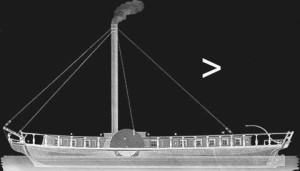
In Part 1, the origins and development of the Castle steamers over the first decade were traced. By the end of 1826, the four steamers, Rothsay Castle, Inverary Castle, Toward Castle, and Dunoon Castle, while owned as separate companies, acted in consort to control the routes from Glasgow to Rothesay, thence to Loch Fyne, Inveraray, and Arran. The tourist traffic to the western highlands and islands in summer was particularly remunerative, but it was the reliable, year-round service with both goods and passengers that endeared the steamers to the residents of Cowal, Rothesay and Lochfyneside. The steamers were strongly built with deep draughts, that in the late 1830s still required them to sail with an eye on the tide to sail up and down the narrow River Clyde. With their tall black funnels with a white band, the steamers inspired confidence.
The winter schedule of the Castle steamers was maintained into the new year, 1827.
“Days of sailing altered.—The Royal Mail Steam Packets, Dunoon Castle, Captain Johnston; Inverary Castle, Captain Thomson; Rothesay Castle, Captain Brown; Toward Castle, Captain M‘Coll.—The Dunoon Castle will sail from the Broomielaw for Inverary, on Tuesday morning, the 2d January, and on Friday morning, the 5th January—calling at Port-Glasgow, Greenock, Gourock, Dunoon, Rothesay, Tarbert, and Lochgilphead, and return to Glasgow on Wednesday and Saturday. The Toward Castle will sail for Lochgilphead, on Thursday morning, the 4th January, and Saturday morning, the 6th of January—calling at Port-Glasgow, Greenock, Gourock, Dunoon, Rothesay, and Tarbert, and will return to Glasgow on Friday and Monday. The above packets will continue to sail regularly, as above, till farther notice, and to and from Rothesay daily. Hours of sailing will be seen on the boards.
“One of the Packets sails from Rothesay for Greenock every Sunday morning, at half-past eight o’clock, with the Mail, and leaves Greenock for Rothsay same day, at eleven o’clock forenoon.—Glasgow, 30th Dec., 1826 —Glasgow Herald, January 1, 1827
A severe gale hit the west of Scotland on the night of January 8, 1827, and the Rothesay Castle, that had taken over from the roster of the Dunoon Castle, was blown onto the river dyke above Renfrew Ferry. The Glasgow Chronicle also reported that the Maid of Morven and Countess of Glasgow that went down the river later, managed to get as far as Dunglass but it took them six hours to do so and they abandoned their trips.
“During the whole of Monday night, and the greater part of Tuesday, it blew a very severe gale from the West and from the WNW., accompanied with heavy showers of sleet and snow. The Rothesay Castle steam-boat, in going down the river on Tuesday, when above Renfrew Ferry, was fairly turned by the fury of the wind, and laid across the stream, when she struck on the dyke, damaged her bottom, and filled with water. We have not as yet heard any disastrous news from the coast.”—Glasgow Herald, January 12, 1827
The alternative routes to Inveraray got underway in the early season.
“Regular conveyance to and from Inverary by Lochgoilhead, and to and from Lochlomond by Arrochar.—The St George and St Catherine steam boats will continue to ply to and from Lochgoilhead every Tuesday, Thursday, and Saturday, until Monday the 11th June, when they will commence plying daily; and on Monday next the 28th inst., they will commence plying to and from Arrochar daily. After Monday next, at all times when practicable, the hour for leaving Glasgow for Lochgoilhead will be six, and for Arrochar seven o’clock morning. The car for the conveyance of passengers between Lochgoilhead and St. Catherine’s continues to run as usual. As formerly, travellers will have an opportunity of visiting in succession the beautiful scenery of Lochlomond and Lochlong, by leaving Glasgow in the morning by the steam boat for Arrochar and joining the steam boat on Lochlomond at Tarbet, or by going by Lochlomond in the morning, and returning by the steam boat from Arrochar in the afternoon.—Glasgow, 22nd May, 1827”—Glasgow Herald, May 25, 1827
The trip was accomplished in seven hours at a cost, including coach and ferry, of 7s. 6d. For those willing to walk from Lochgoilhead to St Catherine’s, it was 5s. 6d. (cabin) or 3s. 6d. (steerage).
The Maid of Islay steamboats were also back on station at the beginning of April.
“Isla, Staffa, and Skye.—The steampackets Maid of Islay No. I and No. II continue to ply for the season between Glasgow, Tarbert, Islay, Staffa, Iona, and Skye. (These packets exchange passengers and goods at Tarbert.) No. I sails with passengers and goods from Glasgow every Tuesday morning for Isla, Staffa and Iona, and every Thursday morning for Portree, Skye and the intermediate ports of Oban, Tobermory, Isle Oronsay &c. No. II leaves West Tarbert on Tuesday afternoon, arriving at Islay same night, and returns on Thursday, when she receives the passengers and goods for Skye &c., reaching Oban that night, Tobermory Friday forenoon, and Portree in Skye same evening. Passengers leaving Islay on Thursday will be in Glasgow that night or early the following morning.—Those leaving Skye on Monday arrive in Glasgow Tuesday night or Wednesday morning. No. I leaves Glasgow every Saturday for Rothesay, returning on Monday morning, and regularly calls at Greenock and Rothesay in going to and returning from Tarbert. The comfortable accommodation on board these packets, No. II being fitted up with beds, their powerful engines and great speed, being already so well known to the public, do not now require particular notice. Goods for these conveyances must be regularly entered at the Packet Office, No. 8 ,York Street, Broomielaw. For further information application may be made to Mr. Thomas Arrol, 91, Prince’s Street, Edinburgh, or to the agents here, Alexander Graham, 82, Maxwell Street; John Laird, 8, York Street.—Glasgow, May 30th, 1827.
“N.B.—passengers for Iona and Staffa on Tuesday morning, will get back to Glasgow on Thursday night or Friday morning.”—Glasgow Herald, June 15, 1827
There was nary a skipped beat in the paddle wheels of the Castle steamers. They continued with their regular schedule.
“At Glasgow, for Inverary & the Island of Arran.—The Royal Mail Steam Packets, Dunoon Castle, Captain Johnston; Inverary Castle, Captain Thomson; Rothesay Castle, Captain Brown; Toward Castle, Captain M‘Coll.—The above packets will sail regularly as under: for Inverary and to call at Port-Glasgow, Greenock, Gourock, Dunoon, Rothesay, Tarbert, and Lochgilphead, the Rothesay Castle, on Tuesday morning 17th July; on Thursday morning 19th July; on Saturday morning 21st July; the Dunoon Castle, on Wednesday morning 18th July; on Friday morning 20th July; on Monday morning 23rd July. For Brodick, Island of Arran and to call at Port-Glasgow, Greenock, Gourock, Dunoon, and Rothesay, the Toward Castle, on Tuesday morning 17th July; the Inverary Castle, on Thursday morning 19th July; on Saturday morning 21st July.
“Pleasure trip to the Craig of Ailsa.—The Toward Castle, will sail from the Broomielaw on Wednesday morning the 18th July, at ten o’clock, for Rothesay, calling at the usual places, and will remain at Rothesay that night, and on Thursday morning the 19th July, at six o’clock, she will sail from Rothesay for the Craig of Ailsa, calling at Brodick and Lamlash, Island of Arran; from thence she will proceed to the Craig, where she will remain for some time, in order that passengers may have an opportunity of viewing the great natural curiosity, and return on to Rothesay in the evening, and to Glasgow on Friday. Hours of sailing will be seen on the boards. The above packets are appointed to sail every lawful day to and from Glasgow for Inverary and every Tuesday, Thursday, and Saturday, for Arran, leaving Arran for Glasgow every Wednesday, Friday, and Monday.
“One of the Packets sails from Rothesay for Greenock every Sunday morning, at half-past eight o’clock, with the Mail, and leaves Greenock for Rothsay same day, at eleven o’clock forenoon.—Glasgow, 14th July, 1827.”—Glasgow Herald, July 16, 1827
The George Canning had been sailing to Inveraray in 1826, but in 1827, was limited to Rothesay, together with the James Ewing. The latter steamer, however, helped develop a new connection. The eminent engineer, David Napier, brought out a plan to connect his business interests with the Loch Lomond steamers, and a new route to Inveraray by Loch Eck, where Napier had purchased the estate of Glenshellish. He had also begun to purchase land along the north shore of the Holy Loch to feu, and develop a stone pier at KIlmun where steamboats could berth at most states of the tide. With a new steamer, Euphrosyne, on Loch Lomond, Aglaia on Loch Eck, and the old Loch Lomond steamer, Marion, renamed Thalia, connecting Strachur and St Catherine’s on Loch Fyne with Inveraray; these three “Graces” joined a new and fast steamer, Venus, providing the Holy Loch connection from Glasgow. In June, he purchased the Ewing to run as consort to the Venus.
“Economical and expeditious tour to the western lakes.—The Venus or Ewing steam packets will commence sailing on Thursday the 14th current from Glasgow at 6 o’clock morning and 2 o’clock afternoon, every lawful day; for Port Glasgow, Greenock, Gourock, Holy Loch, Dunoon, and Rothesay; from Rothesay at 8 morning and 3 o’clock afternoon, for Glasgow, calling at the same places in returning.
“To Inverary, via Loch Eck.—The Venus or Ewing’s passengers for Inverary, having been landed at Kilmun, they will be conveyed by jaunting cars to Loch Eck, where the Aglaia, steamer, will be in waiting to carry them to Strachur, from whence the Thalia will convey them across Loch Fine, and land them at Inverary about 1 o’clock afternoon and 9 o’clock evening.
“From Inverary, via Loch Eck.—Passengers for Glasgow will leave Inverary at 5 morning, and 12 noon, by the Thalia for Strachur, from whence they will be conveyed by the line before mentioned, and arrive in Glasgow about 1o’clock afternoon and 8 o’clock evening.
“Cabin fares to and from Inverary, including cars and all other charges, 7s. 6d. Those who choose to walk the short distance at each end of Loch Eck, 5s. 6d; Steerage, including cars and all other charges 4s. 6d.; Walkers, 3s. 6d. This is performed without landing in small boats, it being all done by steamers.
“To Inverary, via Lochlomond.—Passengers by the Venus or Ewing for Loch Lomond or Inverary will be landed at Dunglass and conveyed from there by coaches in waiting to Balloch, from which the Euphrosyne steamer will start at 9 o’clock morning, and visit the most interesting scenery along the lake.—Those wishing to proceed to Inverary will be landed at Tarbet; and from thence a carriage will convey them through Glencroe to Cairndow, and the Thalia steamer on Loch Fine will land them at Inverary about 7 o’clock evening. Such as may wish to visit the celebrated Trosachs will be landed at Inversnaid, which is but a few miles distant from Loch Katrine.
“From Inverary via Lochlomond.—The Thalia steamer will leave Inverary at 8 o’clock morning for Cairndow, from whence passengers will proceed by the above line of conveyances, reversing the order of the route, and arrive in Glasgow about 8 o’clock evening.
“Passage from Glasgow to any of the landing places on Lochlomond, including coach from Dunglass to Balloch by Bonhill; Cabin 5s.; Steerage and outside of coach, 3s.; and after the 1st of July a coach will also run from Dunglass to Balloch by Dumbarton. To or from Inverary, including coaches 12s.
“Loch Lomond, via Lochlong, or vice versa.—The passengers per Euphrosyne, on Lochlong will be landed at Tarbet, then proceed to Arrochar, where the St George or St Catherine will convey them to Glasgow, or passengers may sail by St George or St Catherine via Lochlong and return to Glasgow by the Euphrosyne, on Lochlomond, &c. Cabin 7s.; steerage 5s.
“Breakfasts, dinners, and other refreshments, will be had on board the steamers. By these arrangements it is expected that passengers will be conveyed to Inverary and Lochlomond by Venus and the Graces in a more elegant and economical manner than formerly. The packets responsible for passengers’ luggage if entered at the office. The Apollo, a similar vessel to the Venus, will in a short time take the place of the Ewing, when this line of packets will be complete. Places may be secured and every information given at the offices of the subscriber, at Glasgow, Greenock, and Inverary.—Robert Sanderson, Manager, Steam Packet Office, foot of Washington Street, Broomielaw.—Glasgow 6th June 1827.”—Glasgow Herald, June 16, 1827
The new Venus was the feature of the season and set a new standard for speed and passenger comfort on the Clyde.
“The Venus Steam Packet.—The number of steam-boats now engaged in carrying passengers from Glasgow to the different ports on the Clyde and Western Lakes, has increased of late with such rapidity, as to create surprise at their being all able to obtain such a share of employment as to make them profitable for their owners. Upon the whole, however, we have good reason to believe that there are very few boats of any reputation for good sailing or accommodation, that have not been able not only to clear the expenses, but to realise a moderate profit for the proprietors. To accomplish this, the greatest exertions are used to render the accommodations of the new boats as much superior possible to their predecessors or opponents, and finding out voyages which have not hitherto been made, or shortening by superior management or a greater power of engine, the time occupied in performing those which are more common. In the year 1812 there was but one steam boat connected with the Clyde,—in the present year the number exceeds 70, and several are at present building. For some time past the public have had their attention called to new route to Inverary by Loch Eck, a beautiful fresh water lake, on the road from Holy Loch to Strachur on Loch Fine; and from the well known grandeur of the scenery on the route, high hopes have been entertained of the success of the undertaking. Thursday se’ennight being the first day of sailing on that route, the Venus started with the passengers from the Broomielaw at six o’clock morning. The Venus is a new boat of a large size, and fitted up in a style of splendour superior to any steam-boat cabin we have seen on the Clyde, except that of the United Kingdom, the plan of which appears to have been followed in the fitting up of the Venus. The stern lights have a beautiful effect; they are of stained glass, from the manufactory of Mr Cairney of Glasgow who has for some time past been carrying on this art, and has succeeded in bringing it a degree of perfection, which does him the highest credit. The cabin seats are covered with rich coloured moreen, the pannels with silk of the same colour; and altogether the furnishings are of the best description. In one point of view, however, the cabin of the Venus is unique, and reflects great credit on the taste of the proprietor. In the centre, and near the stern end of the cabin, stand what appears to be an oblong table, covered to the ground on the four sides with silk of the same colour, and radiated in the same manner as that which cover the pannels. While the passengers were engaged in discussing the probable uses to which it might he applied, they were agreeably interrupted in the midst of their conjectures by practical demonstration of its use. It is very fine toned barrel organ, fitted up so as to be wrought by steam. The shaft which communicates the motion being carried below the cabin floor, the sound seems to be produced by magic, and have a most delightful effect. The wonder of the passengers at the unexpected music was heightened by their inability to discover the cause, which was soon dissipated, however, by the politeness of Capt. Hall. The accommodations of the stewards’ department are in a style of elegance which would do honour to any first rate Inn, and the refreshments are of the best description; and in every department of the vessel the comfort of the passengers appears to have been particularly attended to. At the Holy Loch, the passengers were put on board another steam boat, which landed them at Kilmun, from whence they were forwarded in cars to the foot of Loch Eck, where the Aglaia was in waiting to convey them through the Loch. The road from Kilmun to Loch Eck has been made, we are informed, by the Road Trustees in that district, expressly for the purpose of expediting the conveyance of passengers by this route; and the road from Loch Eck to Strachur is in excellent order. The Loch is about 8 or 9 miles long, and the passage is performed in an hour. The boat on the Loch is built of iron, and draws only 21 inches of water. She not as yet finished, but men are kept constantly at work, and in a short time she will be a very neat vessel. The scenery in passing through Loch Eck is of the wildest description. After reaching the head of the loch, cars are in waiting to convey the passengers to Strachur on Lochfine, where the Thalia is ready to convey them to Inverary. The time occupied in conveying the passengers from Kilmun to Inverary, is about four hours; and the whole passage from Glasgow is performed in about seven hours and a half. We observe that a new and elegant Inn has been opened in Inverary by Mr Walker, lately from the Black Bull Glasgow, the accommodations of which are greatly superior to what are generally to be met with in a Highland Inn. The increased intercourse with that quarter rendered the establishment of such an Inn a desideratum, and we doubt not it will prove service to all parties.”—Inverness Courier June 27, 1827
This new tourist route must have had an impact on the dividend paid to shareholders of the Castle steamers. At the end of the summer season on the Clyde, the Toward Castle was placed on the Belfast station. Perhaps an indication that every effort was required to increase revenue.
“For Greenock and Glasgow, the beautiful steam-packet Toward Castle, Captain Johnston, will sail from Belfast every Wednesday and Saturday, and from Glasgow every Tuesday and Friday, till further notice. Fares, Cabin, 10s.; Steerage, 5s.; Deck, 2s. 6d. Hours of sailing to be seen on the notice boards.—James Cramsie, 61, Waring-street.—Belfast, Sept. 17, 1827.”—Belfast Commercial Chronicle, September 17, 1827.
“At Glasgow for Inverary, the Island of Arran, and Belfast.— The Royal Mail Steam Packets, Dunoon Castle, Captain Johnston; Inverary Castle, Captain Thomson; Rothesay Castle, Captain Brown; Toward Castle, Captain M‘Coll.—The above packets will sail regularly as under: For Inverary and to call at Port-Glasgow, Greenock, Gourock, Dunoon, Rothesay, Tarbert, and Lochgilphead, the Rothesay Castle, on Tuesday morning, 2d October; on Thursday, morning, 4th October; on Saturday morning, 6th October; the Dunoon Castle, on Wednesday morning, 3rd October; on Friday morning, 5th October; on Monday morning 8th October. For Brodick, Island of Arran, and to call at Port-Glasgow, Greenock, Gourock, Dunoon, and Rothesay, the Inverary Castle, on Tuesday morning ,2nd October. The hours of sailing will be been on the boards. For Belfast, and to call at Greenock, the Toward Castle, on Tuesday forenoon,2d October, at twelve o’clock. The above packets are appointed to sail every lawful day to and from Glasgow for Inverary, and for Arran every Tuesday, and for Belfast every Tuesday and Friday.—Glasgow 29th September 1827.”—Glasgow Herald, September 28, 1827
At the end of October, the Rothsay Castle was involved in a serious accident with the Dublin packet, Erin.
“Thursday forenoon, about ten o’clock, the Rothesay Castle steam-packet sailed from the Broomielaw with upwards of one hundred passengers.—When she had got about six or seven miles down the river, the large steam-vessel Erin, of Dublin, came in sight, and it was understood the necessary preparations were made by both pilots to steer clear of each other; but by one of those unfortunate circumstances which will sometimes occur in a narrow channel, even when the greatest care is taken, the vessels came into dreadful collision, to the infinite alarm of the passengers that crowded the deck of the Rothesay Castle, the greater part of whom instantly made a simultaneous rush save themselves by leaping on board of the Erin. About twenty of them succeeded in doing this, as the Rothesay slowly passed under the side of the other vessel after the shock; but the piper of the Rothesay Castle, and a boy, in attempting save themselves in this, way, unfortunately fell overboard. We are glad however to learn, that by the united exertions of the stearn-vessels, who instantly lowered both of their boats, they were happily rescued from their perilous situation.—The Rothesay Castle was so very materially damaged that she was obliged to put into dock in Dumbarton to repair. The Erin has also been partially injured.”—Glasgow Herald, November 2, 1827
Later reports revealed the courage of Captain Mackenzie on board the Rothesay Castle who used all his influence to calm the passengers on board, and a machine maker, by the name of Watson, who took care of the engine after the engineer had left it.
The Castle Company had forestalled the opposition for another year and proceeded with their regular schedule in January 1828. Captain M‘Coll left the company and it was the Toward Castle that was left without a master until near the end of the month when Captain Stewart was engaged. Captain Brown had taken over command of the Rothesay Castle. She was the oldest member of the fleet but had been greatly improved earlier in the decade.
Of the opposition steamers, the Maid of Islay I and Maid of Islay II continued the connections through East and West Tarbert respectively. The Lochgoil route to Inveraray also continued to attract custom. It was developments on the new route by Loch Eck that presented the greatest change and challenge. If Mr Napier’s new route to Inverary had proved less successful than hoped for in its first year, his new steamer, Venus, met with much public approbation. In the spring, the Venus was sold, and the promised new Apollo was not forthcoming, leaving the James Ewing to carry on the service alone. Throughout the summer season, she left the Broomielaw at eight o’clock in the morning for Kilmun, Dunoon, and Rothesay, returning from Rothesay at three o’clock in the afternoon with the same calls, collecting the passengers who had left Inveraray in the morning. It should be noted that sailing on the Ewing to Rothesay by way of Kilmun took 5 hours, compared with sailing on the Canning or the Castle steamers that accomplished the journey half an hour more quickly. On land, the carriage accommodation at each end of Loch Eck was improved, and more time allowed for those who wished to walk. It seems clear that Napier was more than willing to adjust and improve the service for the longer view; providing stone quays to avoid the often tricky practice of landing from a steamboat in small boats, and building an Inn at Kilmun.
The general absence of piers on the Clyde was a serious obstacle to the development of traffic. Rothesay had a quay, as had Tarbert on Loch Fyne, and Inveraray had a stone jetty, but Dunoon, then a growing destination of summer resort, had no pier, though a stone quay was built at Hunter’s Quay in 1828. With no quay or pier, the slow, and often hazardous process of landing passengers by boat greatly increased the time taken by the steamers to reach their destinations. This was a particular problem along Bullwood and the Cowal coast south of Dunoon where feuing was taking place and multiple stops might be requested, not just at the recognized ferries.
In June, 1828, the Rothsay Castle was offered for sale. She was the oldest steamer in the fleet, and although she had been modernized, with new building on the horizon, she was the logical choice to sell. Apparently, a suitable offer was not forthcoming and she continued to sail for the Castle Company.
“Steam-packet for sale.—The Royal Mail Steam-Packet Rothesay Castle, will be exposed to public sale within the Lyceum Rooms, Glasgow, on Wednesday the 6th day of August next, at 2 o’clock p.m., unless previously disposed of by private bargain. This well known steam packet which has hitherto been employed in carrying the Mail, and conveying passengers betwixt Glasgow and Rothsay, in the island of Bute, and ports adjacent, is superior in strength and workmanship of hull, as well as in fast sailing, to any plying on the Clyde. She is 75 tons burthen, exclusive of engines and machinery; her length from the fore part of the main stem to the after-part of the stern post aloft, is 98 feet; her breadth of beam upwards of 16 feet; and her depth of hold 9 feet 2½ inches; she is schooner rigged, and propelled by an engine of 55 horses power. If wished, the cabin furniture, and whole plenishing of the vessel, conform to inventory, may be included in the sale. Intending purchasers will lodge their offers with Mr. Alexr. Ure, writer, 26 Glassford Street, of whom farther particulars may be had.—Glasgow, 20th June, 1828.”—Glasgow Herald, June 23, 1828
Amid discussion of the acceleration of the Royal Mail in the country at large, there was an interesting letter in the newspapers critical of the mail service to Rothesay, and pointing out that the large deep-hulled vessels employed by the Castle Company were still dependent on the tides to sail from Glasgow, and their practice of stopping at the various ferries, meant that the hour of arrival of the mail could not be predicted with any certainty.
“Rothsay.—(From a Correspondent.) The ancient burgh of Rothsay, at one time a Royal residence, and now the acknowledged Montpelier of Scotland to asthmatic and nervous invalids, has, within these few years past, greatly increased in trade, wealth, and population; and its beautiful shores have become decorated with elegant and commodious buildings. The advantage of possessing a commodious harbour and quay affords facilities in landing not to be obtained at any of the other watering places, and Rothsay is now a place of resort in winter as well as summer, not only for the population of Glasgow and its vicinity, but for that of all parts of the country, including the east coast. Families from England and Ireland not unfrequently take up their residence here. In such circumstances whatever promotes its general interests may be held to be a matter of public concern.—For this reason I hope you will allow me the privilege of suggesting, through your columns, the following improvement in its Post Office arrangements. The mail is at present brought from Glasgow to Rothsay in steam packets, calculated for the whole trade all the way round to Inverary, and these necessarily having great depth of water, can only leave Glasgow at certain times of the tide; and, having a multitude of affairs to attend to besides, many stoppages occur in their progress, and much irregularity in the times of their arrival and departure.—It is quite impossible to guess the day before, whether the mail will arrive at in the morning, or at 7 in the evening, or at any other of the intermediate hours; and, as few like to commit themselves to the pursuits of the day till this is known, there are often many sendings and much anxiety and disappointment produced before intelligence is obtained. That there are vessels so constructed as to be able to carry the mail from Glasgow to Rothsay at all times of the tide, and at all seasons of the year is not to be doubted.* Such vessels, by limiting their stoppages to a few central places, could easily and regularly complete their voyage within four hours. Suppose two such vessels were obtained, one to leave Glasgow every morning at six or seven o’clock with the mail, and the other to follow at 10 or 11 to bring it back at two or three o’clock, and with no other stoppages than the following—the 1st at Renfrew or Cart Water, the 2d at Dunglass or Dumbarton, the 3d at Greenock, and the 4th at Dunoon, the following advantages would be procured.—1st. The public in Rothsay would at all times have their letters at 9 or 10 o’clock, and have from that time till two or three to dispose of their intelligence. The letters obtained would include all English, Irish, and Scotch intelligence, and the letters dispatched would be the same evening delivered at Glasgow, or, when requisite, dispatched by the different mails which then leave Glasgow. In other words, the people of Rothsay would have as good an arrangement for their mail, as any community in their circumstances could possibly desire to obtain. 2d. Having two packets would insure against accidents from stoppages, and at the same time serve the public at large much better that at present. The first packet could, in summer, immediately return to Glasgow, and be back in Rothsay the same night, and the second could return to Glasgow that night and be in Rothsay with the mail next morning. So that passengers might leave Rothsay by the morning boat, and be in Edinburgh at one or two o’clock of the same day—or leave Edinburgh in the morning, and be in Rothsay at the same hour, to a certainty. In winter, though only two trips could be made, the advantage would remain. 3d. These packets and those places which profit stoppages, might continue to enjoy their advantages by means of the other boats; the plan proposed being only laid down for the main packets, which would of course be entitled to a higher rate of fare. The general order of trade would therefore remain as it is, having only this improvement superadded. Government, I believe, allows £120 per annum for carrying the mail. This, with the honour and advantage of carrying the mail, would form a sufficient inducement for proprietors of steam boats to forego the stoppages, and hazard their capital in this public service. Even in the intermediate places, the communication with the stoppage stations might be so improved to make them partakers the common advantage. If a boat were dispatched from Rothsay to Castle-Toward the instant the mail arrived, not only would persons there have their letters sooner, but the danger and difficulty of stoppages in the open sea would be avoided.
“*Perhaps the St George and St Catherine, two of the best river boats we have, might be obtained for this purpose, or exchange their course with those who carry the mail at present.”—Edinburgh Evening Courant, October 23, 1828
The final months of the year saw some damage to a number of steamers, including the Rothsay Castle, in fog.
“Yesterday, the fog was so dense on the Clyde that only one or two of the steamers were able to perform their trips to and from Greenock, and many of them have sustained damage by running on the dykes and shoals in the river. In the afternoon about 18 streamers were either aground, or moored in different parts of the river, finding it almost impossible to proceed. The Clarence which sailed from Glasgow at 12 mid-day was forced to lie to at Dunglass, having received some trifling damage in her paddles; and the St George which sailed from Glasgow at 7 o’clock yesterday morning, arrived in Greenock at one o’clock this morning. The Rothsay Castle ran on a dyke near Erskine ferry; and the Waverley ran aground on Gemmel’s Point near Greenock at 3 o’clock afternoon, and is lying high and dry: and as the tides are falling at present, it is feared she will receive considerable damage ere she is got off.’—Glasgow Chronicle, October 29, 1828
In November, it was the turn of the Inverary Castle to find herself in a collision.
“On Thursday evening between seven and eight o’clock, the Inverary Castle and Maid of Morven steamers came into collision with each other, on the Clyde, between Gourock and Greenock. The accident had nearly been attended with fatal consequences, although no blame can be imputed to either of their crews, who were, as usual, both attentively on the look-out. Both their lights were visible, and, before nearing, they were ringing their bells to warn each other of their approach, but, by some mistake, the Inverary, which was going down the river, in order to avoid the other, veered across, and, by so doing, hid the lantern at the bows by the figure-head, when the Maid of Morven, mistaking the light which issued from the cabin windows for the lantern, plied straight onward, in consequence of which her bow penetrated into the steerage of the other, before the paddle-box, and cut her down nearly to the copper. Their engines were instantly stopped, and they afterwards proceeded to Greenock without any other casualty.”—Edinburgh Evening Courant, November 19, 1828
The collision evoked correspondence on the efficacy of navigation lights on steamboats at night.
“Steam-boats.—A scientific gentleman, who has paid much attention to every thing connected with navigation, thus writes us:—“It is not at all surprising that there has been another collision of steamboats in your waters, notwithstanding each had a light. To me, one light has ever appeared to be little or no protection whatever against such accidents. Two are necessary: the one forward, the other more aft, as well as more elevated; and in order to render mistakes nearly impossible, I would have the foremost and lowest light of a different colour from the main one.”—Glasgow Herald, November 17, 1828
The violence of the collision was such that some of the crew of the Maid of Morven were thrown onto the deck of the Inverary Castle. The latter was back in service by the following Tuesday, November 20.
On December 15th, 1828, there was a murder that took place on the Toward Castle on its journey from Lochgilphead to Glasgow. In the wake of the publicity given to the “West Port Murders” in Edinburgh, and the Irish nationality of the accused, this became sensationalized.

Toward Castle
“On Monday se’ennight, an affair occurred on board the Toward Castle steam boat, which was attended with fatal consequences. The vessel was on its way from Lochgilphead to Glasgow, and among its passengers were two Highlandmen of the name of Lamont, who were on their way to Glasgow, to make purchases to a considerable amount. At Tarbert, an Irishman, accompanied by two women, went on board, and proceeded along with it to Glasgow. In the course of the passage they produced some whisky, and invited the two men to drink with them, which they did for some time; and by the time the boat had reached Renfrew ferry, one of the Lamonts, whose name is Robert, was very much intoxicated, and fell asleep. His companion, from some circumstances which took place, began to suspect that he had been robbed, and communicated his fears to Captain Stewart, who instantly went below to examine the matter. He found the man in a state of insensibility, and beside him was lying an open pocket-book, with no money in it, and only a few letters. He immediately went on deck, where the Irishman and the women at that time were, and insisted that they had robbed Lamont, and threatened to have them searched if they did not give up the money. After being hardly pressed, the Irishman at last gave up a pocket. book, containing £19 and some odd shillings. On arriving at the Broomielaw, the party were properly searched, and on their persons were found two empty bottles, one of which had contained laudanum. Surgical aid was got in behalf of Lamont, who was still lying in the greatest distress, and the stomach pump was applied to free him of the deleterious liquid which it was evident had been given him; but in spite of the exertions of the several surgeons who were present, he died at an early hour yesterday morning. The Irishman and the two women have of course been committed to jail. The deceased was a native of the island of Mull.—Glasgow Chronicle of Wednesday.
“In our last notice was given of the death of Robert Lamont, on board the Toward Castle steam boat, under circumstances which left scarcely any room to doubt that he had been poisoned by the persons who were taken imo custody. An examination has since that time been going forward, the result of which has not yet been properly ascertained. One fact has been elicited, which places the characters of the prisoners in a more horrible and suspicious light than was at first anticipated. A respectable change house keeper in the Bridgegate has positively sworn that one of the prisoners, who calls himself Smith, is one of the individuals who came into his shop in the month of October, along with a woman and another man, and afterwards went out with the woman, leaving the man behind, who shortly after died. This circumstance, it will be recollected, was noticed in our paper at the time, as also the fact that laudanum was extracted from the man’s stomach after his death, by means of Juke’s pump. The name of one of the women, who is, according to Stewart’s information, called Smith, corresponds with the name of a woman who was apprehended some time ago, as having been in company with a man who died from the effects of laudanum in a tavern in Trongate, but was dismissed from want of evidence. She has not, however, been identified by the people of the tavern. It will be recollected, that a considerable time ago a man from Glasgow met with his death in a similar way in Edinburgh, in a spirit cellar, where he had been taken by some persons, immediately after alighting from the coach. Suspicion having arisen that that murder had been committed by the prisoners, an order has been sent to Edinburgh, for the attendance of the spirit dealer in whose house it was committed. All these circumstances would make it appear that there has existed a gang which travelled the country for the horrible purpose of first poisoning and then robbing such unfortunate individuals as came within their murderous fangs. That the persons who have just been apprehended are part of this gang of cold blooded miscreants, there are many reasons to believe —Glasgow Chronicle of Friday.”—Inverness Journal, December 26, 1828
A full account of the trial is given in a separate article.
In January,1829, David Napier announced a renewed effort to popularize his route to Inveraray, by way of Loch Eck, in the shape of a novel addition.
“It is intended, in the course of the ensuing summer, to run a steam carriage for passengers from near Dunoon upon the Holy Loch in the Frith of Clyde; to Loch Eck in Cowal, on which a steam vessel already plies; and another steam carriage from the father extremity of that Loch to Strachur, on the banks of Loch Fyne, distant four miles from Inverary. The consequence of this new establishment will be, that it will be quite practicable for a person leaving Edinburgh, and availing himself of the steam navigation on the Clyde, from Glasgow to Greenock, to reach Inverary in the space of 10, or the utmost 11, hours. This is the greatest improvement we have yet heard of in modern travelling. The construction of the two carriages has commenced, under the superintendence of the ingenious Mr. David Napier, engineer, Glasgow.”—Glasgow Herald, January 23, 1829
Despite the competition between the rival vessels, there was general adherence to the agreement on fares. From the Broomielaw to Rothesay cost 2/- in the cabin and 1/- in steerage, much reduced from the previous decade. However, around this time, the steamboats opposing the Castle monopoly on the Rothesay station introduced the practice of selling Tickets for the season to families taking a villa on the coast. This allowed Papa to travel to the city on business during the week, while Mama and the weans spent time at the watering place, enjoying the fresh sea breezes. It also allowed parcels to be sent by the steamers; perhaps hampers of food or clean clothes, from the servants left in the house in Glasgow. These parcels could be picked up or dropped off at the steamboat office. The inclusion of letters in the parcels was frowned upon but generally tolerated.
For the Castle Company, the new year brought the departure of Captain Brown, leaving the Rothsay Castle to advertise for a master and steward in March. Captain Adam was appointed in April. The Company also matched the opposition with its own season Ticket scheme, and the advantage that these could be used on any of the four Castle steamers.
“Regular conveyance to Inverary every Tuesday and Saturday, Lochgilphead every Thursday, and Arran once-a-fortnight, weather permitting.—At Glasgow, the Royal Mail Steam Packets, Dunoon Castle, Captain Johnston; Inverary Castle, Captain Thomson; Rothesay Castle, ———; Toward Castle, Captain Stewart.—The above packets will sail as under—calling at Port-Glasgow, Greenock, Gourock, Dunoon, Rothesay, Tarbert, and Lochgilphead, the Inverary Castle, on Tuesday morning, 31st March for Inveraray; on Thursday, morning, 2d April, for Lochgilphead; on Saturday morning, 4th April, for Inverary. For Brodick & Lamlash, Island of Arran, the Dunoon Castle, on Wednesday morning, the 1st April. Hours of sailing will be seen on the boards.
“The above packets will sail from Glasgow for Inverary every Tuesday and Saturday, and every Thursday for Lochgilphead (only); and also from Glasgow for Arran, once a fortnight, viz. Wednesday (weather permitting); and to and from Rothesay daily.
“One of the packets sails from Rothesay for Greenock every Sunday morning, at half past eight o’clock, with the Mail; and leaves Greenock for Rothesay same day at eleven o’clock forenoon.
“Notice.—Families frequenting the watering places to which these vessels ply will be supplied with tickets on terms as low as any other vessel going that way, and they will have the liberty of sailing in any of the four Castles.
“After Saturday the 4th April, the above vessels will sail three times a-week to Inverary, viz. every Tuesday, Thursday, and Saturday.—James M‘Intosh, 99 Main Street, Gorbals.
“N.B.—The steward’s department of the Rothesay, Inverary, and Dunoon Castle steam-packets, to be farmed out for the year, commencing 1st May next. Offers, accompanied with unexceptionable guarantees, to be lodged with Mr. Ure, the Company’s Secretary, 26 Glassford Street, on or before the 15th April.—Glasgow, 28th March, 1829.”—Glasgow Herald, March 30, 1829
The Dunoon Castle, on her way down river on May 6th struck an anchor near Dunglass. The passengers were immediately got out, but the ship filled with water and sank. She was raised and repaired in time to sail to Arran on May 12th.
“Regular conveyance to Inverary every lawful day, and Arran every Tuesday and Saturday.—At Glasgow, the Royal Mail Steam Packets, Dunoon Castle, Captain Johnston; Inverary Castle, Captain Thomson; Rothesay Castle, Captain Adam; Toward Castle, Captain Stewart.—The above packets will sail as under—calling at Port-Glasgow, Greenock, Gourock, Dunoon, Rothesay, Tarbert, and Lochgilphead, the Toward Castle, on Tuesday morning, May 12; the Inverary Castle, on Wednesday, morning, May 13; the Toward Castle, on Thursday morning, May 14; the Inverary Castle, on Friday, morning, May 15; the Toward Castle, on Saturday morning, May 16; the Inverary Castle, on Monday, morning, May 18. For Brodick & Lamlash, Island of Arran, the Dunoon Castle, on Tuesday morning, May 12; the Dunoon Castle, on Saturday morning, May 16. Hours of sailing will be been on the boards. One of the above packets sails from Glasgow to Inverary, and one sails from Inverary to Glasgow, every lawful day; and from Glasgow to Arran every Tuesday and Saturday, leaving for Glasgow every Wednesday and Monday; and to and from Rothesay daily.—One of the packets sails from Rothesay for Greenock every Sunday morning, at half past eight o’clock, with the Mail; and leaves Greenock for Rothesay same day at eleven o’clock forenoon.—Notice.—Families frequenting the watering places to which these vessels ply will be supplied with Tickets on terms as low as any other vessel going that way, and they will have the liberty of sailing in any of the four Castles.—Tickets to be had only of Mr David M‘Donald, Jeweler, No.134, Trongate.—James M‘Intosh, 99 Main Street, Gorbals.—Glasgow, 9th May, 1829.”—Glasgow Herald, May 11, 1829
The Maid of Islay, No. 2, began service at the beginning of April but for much of the following month had to rely on the Castle steamers for the connection with Glasgow as the Maid of Islay, No. 1 was under repair. She returned to service later in the month.
“Islay and Skye.—The steam packets Maid of Islay, No. 1 and 2, commenced On Tuesday 28th April, to ply for the season between Glasgow. Tarbert, Islay, and Skye, going to Portree every Thursday. Those packets carry their goods under deck, and exchange at Tarbert. No. I. leaves Glasgow every Tuesday morning with goods and passengers for Islay, Thursday morning for Skye. No. II. leaves West Tarbert for Islay on receiving passengers, returning on Thursday; when on again exchanging with No. I. she proceeds to Skye, calling at Oban, Tobermory &c., and returning on Tuesday, the passengers reaching Glasgow following morning . No.I. calls at all times in passing to and from Tarbert at Greenock, Dunoon, and Rothsay, and on Saturday goes no further than Rothsay, returning on Monday.—Agents for packets, Mr. Thomas Arrol, 91 Prince’s Street, Edinburgh; here, Mr. Alexander Graham, 82, Maxwell Street, and Mr. John Gemmill, No. 18, York Street, at whose Office all goods must be entered before eight o’clock of the evening preceding No. I. sailing. The owners will not be responsible for any package unless so entered.—Glasgow, 29th May, 1829.
“N.B.—Families frequenting the coast for the summer season will be carried on same terms as last year, which renders unnecessary the purchase of tickets.”—Glasgow Herald, May 29, 1829
There appears to have been some underhand practices associated with the season Ticket pricing, and a halt was called on their sale at the end of May until a new agreement could be reached.
“Notice.—The proprietors of steam-boats plying with passengers on the River Clyde have resolved not to sell Tickets after this date; and the respective captains have been furnished with a new table of fares, to which passengers will please conform, without prejudice to the Tickets already issued being used.—Glasgow, 28th May, 1829.”—Glasgow Herald, May 31, 1829
In December 1828, the Loch Lomond steamboat Lady of the Lake that had been in opposition to David Napier’s Euphrosyne was offered for sale. She was brought down the Leven and had been sailing to Dumbarton when she was advertised for sale again in March with an upset price of just £700. Ultimately, it was David Napier who purchased and refitted her to sail on the Clyde. She had been built in 1825 by Messrs William Denny & Son, Dumbarton, and was 82¼ feet long by 15½ feet broad and 7½ feet in depth. Her powerful engine had been constructed by David Napier’s cousin, Robert Napier, Glasgow. Early in the year, David Napier also had Messrs Wood & Ritchie, Port Glasgow produce the Loch Eck, 81¾ feet long, by 12½ feet in breadth and 7 feet in depth, for which David Napier supplied an engine of 30 h.p. In addition, a small steamer, Kilmun, was produced by Messrs Wood, Port Glasgow, just 60 feet long and 12 feet broad with a 20 h.p. engine.
On June 1, the Loch Eck route to Inveraray was revamped with this new fleet of steamboats. They were faster than the Castle steamers, had shallower draft, and so could sail on a regular schedule without worrying about the tide or the state of the river. Napier had also provided a stone quay at Kilmun so that passengers could disembark without the use of small boats.
“On the 1st June, the Locheck, Ewing, Kilmun, and Lady of the Lake steamers, will commence to sail for Greenock, Gourock, Kilmun, and Dunoon every day at eight o’clock morning, eleven forenoon, two afternoon, and six afternoon.—For Rothesay, every day, at eight o’clock morning, and two afternoon.—For Inverary by Loch Eck, every morning at eight o’clock.
“As part of the road is found to be too soft for the steam coach, it will not run for this season the whole distance between Locheck and Strachur, but will accompany the other conveyances several miles of the road, for those who choose to prefer that mode of conveyance. At Kilmun there is now a substantial quay built, where passengers can land at all times. Houses to let, and ground to feu, with liberty of fishing in the rivers Echaig, Chur, and Locheck. Apply to the masters of the Kilmun steamers. These boats do not go to Helensburgh as formerly advertised. Those persons who have purchased tickets for Helensburgh will be taken there by any of the boats going to that quarter.—Glasgow 28th May 1829.”—Glasgow Herald, May 31, 1829
A similar advertisement of May 19th had included Helensburgh as a destination, but the proposal was subsequently dropped.
The Locheck and Ewing sailed to Rothesay, calling at Kilmun and Dunoon; the Lady of the Lake sailed to Kilmun and Dunoon, and the Kilmun sailed to Kilmun.
This represented a major encroachment into the Castle Company’s territory. As contemporary guidebooks noted; not only was this a faster route to Inveraray, reaching the town in six or seven hours from the Broomielaw, compared with eleven or twelve hours, with the numerous stops along the way by the Castle steamers, but the difficulties of landing in small boats had been obviated, something particularly notable for female and more timorous passengers. There were four steamers daily to the Holy Loch and Dunoon, and two to Rothesay, all leaving at regular times, regardless of the tide.
The Lochgoil route to Inveraray was also competitive, and quicker than sailing through the Kyles of Bute and up Loch Fyne.
“Inverary, Lochlomond, &c.—The St George or St Catherine steam boat is now plying daily between Lochgoilhead and Glasgow with passengers to and from Inverary, leaving Glasgow at seven o’clock morning, and returning in the afternoon the coach runs betwixt Lochgoilhead and St Catherines as usual; and on the 1st of June a steam boat will be stationed on the ferry between Inverary and St Catherines, which will make this chain of conveyances in every respect complete. By this route, the journey betwixt Glasgow and Inverary is generally accomplished within seven hours. On Monday next, the 25th instant, one of the boats will commence plying daily between Glasgow and Arrochar, with passengers to and from the steam boat on Lochlomond, leaving Glasgow at six o’clock morning, and returning in the afternoon.—Glasgow, 20th May, 1829”—Glasgow Herald, May 22, 1829
The new year saw the introduction of two new steamers on the Rothesay station.
The Superb appeared in April, 1830. She was built by Messrs James Lang, Dumbarton, and was 103¾ feet long by 15½ feet in breadth and 8¼ feet in molded depth. She likely had an engine by David Napier. Her owner was Captain William McKenzie, Glasgow, who had been one of the early masters of the pioneering Comet of 1812, and had found subsequent employment with Dr. Stevenson’s steamers. The Superb was designed for the Rothesay station, and became part of the consortium that opposed the Castle monopoly.

Arran Castle
The Arran Castle was produced by Messrs Wood & Ritchie, Port Glasgow, and had been launched in December,1829, for Messrs William Watson & Co., (Arran Castle Steam Packet Co), Glasgow. She was 103¾ feet in length by 16 feet in breadth, and 8¾ feet in depth, and was equipped with an engine of 50 hp supplied by Messrs Robert Napier.
In March, the Napier consortium advertised their fares for the season and the Tickets for unlimited travel between Glasgow and Rothesay. The Belfast steamer, Belfast, was added to provide a sailing to Brodick and Lamlash, directly opposing the Castle steamers, and the new Superb had joined as an additional Rothesay steamer.
“For Brodick, Lamlash, Belfast, and Rothesay.—The Belfast will continue to sail from Glasgow for Belfast every Tuesday until the 1st of April, after which she will sail every Tuesday and Friday, when she will call at Brodick and Lamlash, both going and returning.
“To Brodick and Lamlash, cabin 5s., deck 3s. The Belfast also takes passengers to and from Greenock and Glasgow at the same rate as the Locheck and Ewing, which is now 1s., cabin, and 6d. steerage, and to Kilmun, Dunoon, and Rothsay, cabin 2s., steerage 1s., or a ticket to any port betwixt Glasgow and Rothesay, to the 1st November, £2 0 0; to the 1st August £1 10 0; for any single month £0 10 0. Children under 14 years of age when accompanied with those having tickets are charged nothing. Those purchasing tickets will be entitled to sail in the Locheck, Ewing, Kilmun, Lady of the Lake, Belfast, and Superb, as often as they please during the currency of the Ticket.—The Superb is a new vessel, built expressly for the Rothesay trade, which is expected to sail very fast.
“N.B.—All these boats, with the exception of the Belfast, can sail at all states of the tide. For Tickets, apply to the masters on board, or to John Gemmill, Agent,18 York Street.—Glasgow 5th March 1830.”—Glasgow Herald, March 8, 1830
The Castle steamers, under the management of John Laird, also advertised the same season Ticket prices, offering conveyance by the new Arran Castle, and the Dunoon, Toward, Inverary, and Rothsay Castles. The fares to Brodick and Lamlash were: cabin, 5s., steerage 3s.; and to Dunoon and Rothesay, cabin, 2s., steerage 1s., the same as those in their rivals.
The promotion of sailing to Arran by the Belfast steamer was heralded by the superior seagoing qualities of the larger vessel.
“Belfast, for Greenock, Arran, & Belfast, every Tuesday and Friday.—The Belfast is the handsomest and fastest steamer on the station, and what is of more importance, she has never refused her day of sailing from either side; being the only steamer that has crossed the Irish Channel regularly, between Greenock and Belfast, for a whole winter, without having once turned tail to the storms, or put into port from any cause. Her internal accommodation is superior to most others, the sleeping apartments being more subdivided, and in each there is a water closet, and wash hand basin.
“Passengers going to Arran, will find this a superior mode of conveyance to the river boats that sometimes venture out so far.—John Gemmill, Agent, 18, York Street.—Glasgow 19th April 1830.”—Glasgow Herald, April 23, 1830
The rebuff from the Castle Company made its own point.
“Regular conveyance to Inverary three times a-week, and to Arran every Tuesday and Saturday.—The Royal Mail Steam Packets will, after the 1st of May, sail from Glasgow for Inverary every Tuesday, Thursday, and Saturday, calling at Port-Glasgow, Greenock, Gourock, Dunoon, Rothesay, Tarbert, Lochgilphead, and returned to Glasgow every Monday, Wednesday, and Friday. For Brodick and Lamlash, Island of Arran, every Tuesday and Saturday, from Glasgow, and return from Arran every Wednesday and Monday.—As these vessels go no farther than Arran, passengers may be assured of being landed in daylight, without incurring the risk of landing in boats at night (which is very dangerous), or of being carried on to Ireland, as has been done by the steamers on the Belfast station. These superior vessels carry passengers to all the different places, as cheap as any boats on the Clyde. Hours of sailing to be seen on the boards.
“One of these packets sails from Rothesay for Greenock every more Sunday morning, at half-past eight o’clock, and leaves Greenock for Rothesay at eleven forenoon with the Mail. Goods for Rothesay, Tarbert, Lochgilphead, Inverary, Islay, and Skye, if sent to the Company’s office, 240, Broomielaw, will be forwarded by the Castle steamers.—John Laird, Manager—Royal Mail Castle Company’s Office, Glasgow, 22nd April, 1830.
“N.B. As the Steward’s Department of these vessels is farmed out, the Company will not be responsible for any debts that may be contracted by the Steward.”—Glasgow April 26, 1830
On March 9, 1830, the steam-boat, Maid of Morven, sailing to Glasgow from Inverness, capsized when moored overnight at Oban. The passengers had left the vessel overnight and were in accommodation on shore but their goods on board were destroyed. The following day, they made their way to Lochgilphead, and returned to Glasgow on the Inverary Castle.
“Wreck of the Maid of Morven Steam-boat.—It is with deep regret that we have to announce the wreck of the Maid of Morven steam-boat, which left Inverness on Monday, the 8th instant, for Glasgow by the Caledonian canal. The following extract from a letter, with which we have been favoured, describes the accident, which we are happy to observe has been confined to loss of property:—“We arrived safe at Oban about four o’clock on Tuesday afternoon, and, going ashore, remained there all night. The boat was quite close to the quay and when the tide receded and the waters left her, the boat had overbalanced with the weight of goods on board, and the water rushed in. All the goods on deck were washed off by the tide, and the luggage soaked with water. No lives were lost, nor any person hurt. The accident occurred about twelve o’clock at night and we knew nothing of it till six next morning. When we came out, to our great surprise, the boat was underwater. Our trunks were picked up at sea about half a mile out. In this dilemma we got a horse and cart to convey us to Lochgilphead, a distance of forty-eight miles. The weather was dreadfully stormy, and we had wind and rain all the road. We reached Lochgilphead on Thursday, at three o’clock, and entering on board the Inverary Castle steam-boat, reached Glasgow, after a very coarse passage on Friday evening .” Another letter received from a passenger says—“Mostly every person on board lost what things they had, and I, among the rest, could not get any of my things out.” We are sorry to add, that the cargo was extensive and valuable.”—Inverness Courier, March 16, 1830
The regular sailings of the Maid of Islay No. 1, and Maid of Islay No 2. continued as in previous years, as did those of the Lochgoil steamers St. George and St Catherine.
Although the new steamers, Superb and Arran Castle were not generally in close competition, at least one opportunity to match them was recorded. The circumstances are not noted, and one might suspect some bias on the part of the correspondent, but there is little doubt that the rivalry was keen.
“Steam boats.—The spirit of competition which we formerly noticed as existing among the steam-boats, is not confined to the question of low fares, but is extending itself to the building and equipping of new vessels. We lately noticed the starting of the Superb, certainly one of the finest of the new vessels on the river, and last week another new one, the Arran Castle, was started under favourable circumstances. A correspondent informs us that on Saturday the latter vessel had an opportunity of trying her speed with the Superb. The vessels, he says, left Greenock one minute from each other, the Superb having the start, and the Arran Castle reached Dunoon eight minutes before her. Such races ought scarcely to be encouraged, from the danger which might possibly arise from the too heavy loading of the valves, but they show that there is a spirit of improvement abroad among steam-boat builders and proprietors which may lead to useful results. So strongly have the steam-boat owners become imbued by the spirit of opposition, that vessels may be occasionally seen at the Broomielaw such an announcement as—Passengers taken for a trifle—Glasgow Chronicle.”—Daily Advertiser, May 17, 1830
In August, 1830, the Loch Eck was sold to Liverpool owners to serve on the Liverpool to Egremont ferry service. This left the much smaller Kilmun and the Ewing to sustain the remainder of the season on the Kilmun station.
Towards the middle of December,1830, the Rothsay Castle was also sold to owners in Liverpool; to sail on the exposed waters to Beaumaris, Menai Bridge, Bangor and Carnarvon. She had been advertised for sale since the previous year, and with the new Arran Castle, was surplus to the Company’s requirements. Her time on the North Wales coast was short, however, as she was wrecked on Dutchman Bank in the early hours of August 18th, 1831, with much loss of life.

Wreck of the Rothsay Castle
In September, 1830, the Whigs under Lord Earl Grey had formed the new Westminster Government, and in his first budget, the Chancellor of the Exchequer, Lord Althorp, introduced a proposal for a steamboat tax. The unmodified proposal was for a tax of 1/- for each passenger on short journeys, and for longer journeys, 2/-. There was considerable opposition, as the following account makes clear, and ultimately the proposal was not acted upon, but it served to cause considerable consternation among steamboat owners.
“Thursday, February 17, 1831.—Steam-Boats. Mr O’Brien would take that opportunity entreating the Noble Lord not to persevere in his proposed tax upon passengers in steam-boats. It was, in his opinion one of the worst taxes that could have been proposed.
“Mr Hume said, there were 30 or 40 steam-boats in the Clyde, and by means of these the whole western coast of Scotland had become active. The Noble Lord’s tax would destroy all this. Now that they had by means of steamboats brought Edinburgh and Dublin within 44 miles of them—(hear and laughter)—he meant within 44 hours’ journey of them, we might judge of the benefit of such a means of conveyance, and consequently of the impolicy of the proposed tax.
“Mr Fergusson said, that all the industry the west of Scotland was supported by steam-boats, and that this tax would be most prejudicial to the inhabitants of that part of the empire.
“Mr Sadler said, that although Scotland only had been alluded to, he must protest against the proposed tax on the part of the people of Ireland. This tax would effectually prevent the progress of the Irish labourer into this country.
“Several other members expressed opinions in opposition to the proposed tax.
“The Chancellor of the Exchequer said, the tax upon passengers in steam-boats was objected to as being contrary to principle. Why, so was almost every tax. It was hardly possible to point out one tax which did not militate against some principle. With regard to this tax, however, he must say, that while every mode of land-carriage was taxed, he did not think that a tax, in some way modified, on the rival mode of carrying passengers, was not improper. (Hear, hear.) He said, “in some way modified,” because, after receiving more particular information upon the subject, he might find that he had not modified it on the best possible scale. (Cheers.)
“Mr Alderman Wood said that he thought that Scotland should be exempted from such a tax as this. Therefore, when it should come to be proposed, he now gave notice that he would move that Scotland should be exempt from it. As it would be necessary to find a substitute for the deficiency which would arise from that exemption, he would propose to supply it in this way. Scotland had at present a drawback allowed her to the amount of £200,000 upon malt.—That was a complete robbery on the country, for the malt was never used. He gave notice, therefore, that when the Noble Lord brought forward his resolution for the imposition of this tax, he (Alderman Wood) would move that Scotland be exempt from it, and that as a substitute no drawback shall be allowed hereafter to Scotland on malt.
“Sir G. Clerk said that he would second the motion of which the worthy Alderman had given notice, for exempting Scotland from the tax upon steam packets, and also for taking off the drawback allowed there on malt, when they should brought forward.—Adjourned half-past eleven.”
Whether it was the result of reduced dividends due to the competition from the opposition steamers, or the ongoing financial uncertainty, the management of the Castle steamers had received a message: the situation was not sustainable. With the exception of the new Arran Castle, the remaining steamers were offered for public sale. While the Dunoon Castle was built as recently as 1826, the Inverary Castle was over ten years old, and the Toward Castle just two years her junior.
The impending sale of the three steamers also prompted notification to the Post Office that their mail contracts should be terminated “in consequence of the great loss they have sustained by a ruinous opposition on the Clyde.” The Post Office surveyor adopted a wait-and-see attitude, depending on the outcome of the sale.
“Valuable steam vessels for sale.—On Wednesday the 26th day of Jan. ensuing, at one o’clock in the afternoon, there will be exposed to public sale, within the The Lyceum Rooms, Nelson-street, Glasgow, the following well-known steam vessels; the Inverary Castle, of 70 tons register, the Toward Castle, of 79 tons register, and the Dunoon Castle, of 100 tons register; all exclusive of spaces allowed for the machinery.
“These Vessels, which are remarkable for their speed, have been employed for a considerable time in the trade betwixt Glasgow and Inverary, and in carrying the Mail. The vessels are comparatively new, are each propelled by a powerful engine, built upon the most approved principle, with copper boiler, and flues of the best construction—are all in a good state of repair both as regards the hull and machinery—and are well found and commodiously fitted up for passengers.
“In order to insure a sale, the vessels are to be exposed at remarkably low upset prices; and, as they are adapted for almost any trade, such an opportunity is seldom offered for investment in that description of property.
“The Certificates of Registry and inventories of the vessels will be seen by applying to Mr. John Laird, the Company’s Manager, at the Company’s Office, No. 240, Broomielaw, and Mr. Laird will also give inspection of the vessels. The Articles of Sale will be found in the hands of Mr. George Young, Writer, No. 10, Stockwell-place, who will inform as to farther particulars.—Glasgow, 20th Dec. 1830.—Glasgow Herald, January 24, 1831—Gore’s Liverpool General Advertiser, December 30, 1830
Some newspapers suggested that the sale was due to the impending taxation.
“Effects of taxation.—In the Lyceum Rooms, Glasgow, on Wednesday, three steamboats, the Inverary Castle, Toward Castle, and Dunoon Castle, steamboats, were offered for sale, by public roup, but with the exception of the latter, which was knocked down at the upset price, £2000, none of the others met with an offer.”—The Scotsman, February 26, 1831
The newer Dunoon Castle was purchased by those associated with the Arran Castle, and the remaining vessels, the Inverary Castle, and the Toward Castle, were again offered for sale on Wednesday the 9th March. The Toward Castle was the only one to attract interest. She was the largest of the two, and was sold to Messrs J. & A. Gairdner, Belfast, who lengthened her and placed her on the Glasgow to Belfast station. The luckless Inverary Castle remained unsold.
Further attempts were made to sell the Inverary Castle as a new vessel was anticipated.
“Upset price farther reduced.—Valuable steam vessel for sale.—There will be exposed to public sale within the Lyceum Rooms, Nelson Street, Glasgow, on Wednesday the 27th day of April current, at two o’clock afternoon, the well-known steam vessel Inverary Castle of Glasgow. The vessel is of the burthen of 70 tons, exclusive of the space allowed for the machinery—is propelled by a powerful steam engine, with copper boiler and flues, and the vessel and machinery are in a good state of repair. The vessel may be seen at Port-Glasgow, where she now lyes. The certificates of registry, with an inventory of the appurtenances of the vessel, as well as the articles of sale, will be seen in the hands of Mr. George Young, writer, No.10, Stockwell Place, who will inform as to farther particulars.—Glasgow, 8th April, 1831.”—Glasgow Herald, April 11, 1831
For the competition, there were also developments. The little steamer, Kilmun, that had been sailing from Glasgow to Kilmun, was sold to owners in Paisley. She reappeared, renamed Gleniffer, sailing from Paisley, down the Cart, to Largs and occasionally to other destinations.
Mr. David Napier had the steamer Saint Mun built by Messrs William Denny & Son, Dumbarton. She was 114¼ feet in length by 14¾ feet in breadth, and 8¼ depth, and powered by a 60 h.p. engine supplied by Napier.
A further new steamer, the Rothsay, also joined the consortium against the Castle steamers. Built for Captain John M‘Kinnon by Messrs James Lang, Dumbarton, she was 96 feet in length, by 16 feet, by 11¼ feet in molded depth, and powered by a 60 h.p. engine supplied by Messrs David Napier. She was designed to compete on the Rothesay station, and like the Superb of the previous year, was reported to be fast.
A rift had taken place between the owners of the Maid of Islay, No. 2, and those of Maid of Islay, No. 1. There were times when the No. 1 was unavailable, and the No. 2 had to rely on the Castle steamer to bring goods and passengers to Tarbert. This incurred considerable delays to the schedule. Even when No. 1 was available, there were delays in trans-shipping goods, and the owners of No. 2 found a solution.—In the new arrangement, goods were to be sent a day ahead of the sailing of No.2, and the Ewing was converted to carry the goods under hatches. Passengers would sail on the Superb or Rothsay on Tuesdays and Thursdays to be transferred to No.2 which would now sail at the designated hour of 4 p.m. While the conversion of the Ewing was undertaken, the new Saint Mun took up her place on the Kilmun station.
To take command of the St. Mun, Napier brought in Captain John Hunter who had been in charge of the George Canning.
“The new steamer—Saint Mun, the fastest in the Kingdom, until the 18th of April will sail as announced on the boards; after which she will sail every forenoon at ¼ past 10 o’clock, and every evening at 6 o’clock, for Greenock, Gourock, Dunoon, and Kilmun. The Saint Mun is of the largest class, which admits of her accommodation being more capacious and airy than any on the Clyde.
“For Tarbert, Lochgilphead, and Islay. The Saint Mun will take the place of the Ewing until she gets holds fitted up for carrying goods under deck, after which she will sail with goods and passengers for the above places every Monday, Wednesday, and Friday, and the Superb (until a fellow of the Saint Mun shall be built expressly for that trade) every Tuesday, Thursday, and Saturday; by this arrangement the goods for the Islay Steam Packet are sent the day before the passengers, which will enable them to get on without being detained as formerly.
“For Islay, apply to Alex Graham, 82, Maxwell Street, or to John Gemmill, 18, York Street; and to the latter for goods going to and from Lochgilphead, Tarbert, Rothesay, and Greenock; at each of these places responsible agents shall be appointed to take charge of them.
“N.B.—Permission to fish on the Echaig or Locheck to be had at Kilmun Inn, as formerly.—Glasgow, 4th April, 1831.”—Glasgow Herald, April 8, 1831
The new arrangement effectively excluded passengers and goods arriving by the Castle steamers, and the Maid of Islay No.1.
“Islay and Skye.—The Maid of Islay, Ewing, Superb, and Rothsay.—The steam packet Maid of Islay, No. 2, will commence plying from West Tarbert with goods & passengers to Islay and Skye, on Tuesday the 26th current, in connection with the steamers Ewing, Superb and Rothsay, from Glasgow. By one of these boats, the Islay goods will be forwarded to Tarbert every Monday morning, the Skye goods every Wednesday morning, and the passengers on the following days, where they will have no detention farther than the time that may be taken up in carting their personal luggage from the one boat to the other.
“The Glasgow boats being so constructed as to sail at any time of the tide, half-past 7 o’clock in the morning is fixed for their sailing, invariably, from the Broomielaw; and the Maid of Islay, No. 2, will sail in like manner from West Tarbert, at 4 o’clock afternoon every Tuesday for Islay, and every Thursday for Skye, calling at Crinan, Oban, Tobermory and Arisaig, till farther notice.
“Goods, (the freight of which will be moderate, if shipped by the above boats) must be regularly entered at the Office of John Gemmill, 18, York Street, to whom, or to the subscriber, application may be made for farther particulars.—Alexr. Graham, 82, Maxwell Street.—Glasgow ,12th April, 1831.”—Glasgow Herald, April 15, 1831
As in previous years, season Tickets were made available for the steamers in the consortium.
“Steam sailing at 10s. per month, by the St. Mun, Rothesay, Superb, Ewing, and Lady of the Lake, to and from Glasgow, Port-Glasgow, Greenock, Helensburgh, Gourock, Kilmun, Dunoon, Rothesay, Tarbet, and Lochgilphead.
“The Lady of the Lake will be stationed, after the 1st of June, between Greenock and Helensburgh, sailing to suit, as near as possible, the passing of the other boats to and from Glasgow. Single fare between Glasgow and Helensburgh the same as at present to Dunoon—1s 6d. Cabin, and 1s. Steerage.
“The holders of a monthly Ticket are entitled to sail in all the above-mentioned boats, and to all the places, as often as they please during the currency of their Tickets. Three of these boats, the St. Mun, Rothesay, and Superb, are the fastest on the river; and, before next season, another still faster will be added to the list, without any addition to the fare. Apply to John Gemmill, 8 York Street.—26th May 1831.”—Glasgow Herald, May 27, 1831
The summer schedule for Napier’s Loch Eck route was announced a few days later, featuring the Saint Mun sailing to Kilmun.
“For Inverary via Kilmun and Locheck, by the new steamer St. Mun, commence the 1st of June, from Glasgow every morning at 10 o’clock. By this route passengers arrive at Inverary about six o’clock, varying a few minutes within or over, as the tide is for or against. Fares.—from Glasgow to Inverary; cabin 5s., steerage 2s.—from Greenock to Inverary; cabin 4s., steerage 1s 6d.
“N.B.—These fares include the three steamboats from Glasgow to Inverary. Coaches will be in waiting to carry those who do not choose to walk the short distance at both ends of Locheck. Fare on the coach at either end 1s. As many prefer this short and romantic route to Inverary on account of the pleasant variety they have in walking through the beautiful vallies of the Chur and Echaig, instead of going the long way by sea, ample time is allowed to pedestrians in the hour fixed above, for their arrival in Glasgow.—May 1831.”—Glasgow Herald, May 30, 1831
The steamboat on the Strachur to Inverary part of the journey was advertised as the Oscar the erstwhile Lochgoil steamer. It would seem that she also provided the connection between Inverary and St. Catherine’s.
The Maid of Islay, No. 2, also presented the timings of the sailing in conjunction with the Ewing and Superb.
“Islay and Skye Steam Packet, Maid of Islay, No 2, continues to ply weekly with goods and passengers from West Tarbert to Islay and Skye, in connection with the steamers Ewing, Superb, and Rothsay, from Glasgow. By the Ewing carrying her goods under deck, the Islay goods will be forwarded every Monday morning, and the Skye goods every Wednesday morning, at half-past seven o’clock. The Superb sails from the Broomielaw with the passengers for Islay every Tuesday morning, and with the passengers for Skye every Thursday morning at six o’clock, returning the same day from Tarbert to Glasgow on Tuesday with the Skye passengers that leave Portree on Monday morning, and on Thursday with the Islay passengers that leave Port Askaig in the morning.
“The Maid of Islay, No. 2, sails invariably from West Tarbert at 4 o’clock in the afternoon, on Tuesday, for Islay, and on Thursday for Skye, calling at Crinan, Oban, Tobermory, and Arisaig, till farther notice.
“As these arrangements are made for the convenience of passengers, by doing away with the detention that in former years took place at Tarbert, shippers are requested to have their goods sent by the Ewing, which will ensure them getting on the day following to their destination. Goods to be entered at the office of John Gemmill, 8, York Street, Broomielaw; to whom, or to the subscriber, application may be made for farther particulars.—Alex. Graham, 82, Maxwell Street.
“N.B.—As the Maid of Islay, No. 2, has no connection with any other boat than those above advertised, and as the freight of goods from Tarbert to Islay and Skye, carried by other boats will be charged the full rates from Glasgow, shippers will find it to their advantage to ship by the boats in connection.”—Glasgow Herald, May 30, 1831
The early season for the Castle Company began with the reduced fleet of three steamers. They continued with the mail contract.
“Regular conveyance to Inverary three times a-week, and to Arran every Tuesday and Saturday.—The Royal Mail Steam Packets will, after the 1st of May, sail from Glasgow for Inverary every Tuesday, Thursday, and Saturday, calling at Port-Glasgow, Greenock, Gourock, Dunoon, Rothesay, Tarbert, Lochgilphead, and returned to Glasgow every Monday, Wednesday, and Friday. For Brodick and Lamlash, Island of Arran, every Tuesday and Saturday, from Glasgow, and return from Arran every Wednesday and Monday.—As these vessels go no farther than Arran, passengers may be assured of being landed in daylight, without incurring the risk of landing in boats at night (which is very dangerous), or of being carried on to Ireland, as has been done by the steamers on the Belfast station. These superior vessels carry passengers to all the different places, as cheap as any boats on the Clyde. Hours of sailing to be seen on the boards.
“One of these packets sails from Rothesay for Greenock every Sunday morning, at half-past eight o’clock, and leaves Greenock for Rothesay at eleven forenoon with the Mail. Goods for Rothesay, Tarbert, Lochgilphead, Inverary, Islay, and Skye, if sent to the Company’s office, 240, Broomielaw, will be forwarded by the Castle steamers.—John Laird, Manager—Royal Mail Castle Company’s Office, Glasgow, 22nd April, 1830.
“N.B. As the Steward’s Department of these vessels is farmed out, the Company will not be responsible for any debts that may be contracted by the Steward.”—Glasgow April 26, 1830
The route to Inveraray by way of Lochgoilhead maintained its popularity, even with the competition from the Loch Eck route..
“Inverary, Lochgoilhead &c., by the St Catherine steam boat, which plies daily between Glasgow and Lochgoilhead; a coach between Lochgoilhead and St Catherine’s, and a steam boat on the ferry between St Catherine’s and Inverary, passengers are conveyed from Glasgow to Inverary every morning, as follows:—On Tuesday, Wednesday, Thursday, and Friday, at seven o’clock; on Saturday at six o’clock; and on Monday at an hour to be seen on the boards. From Inverary to Glasgow every forenoon, at an hour to suit the tide in the Clyde, so as to make the passage as expeditious as possible. By this route the journey is generally accomplished within seven hours. The St Catherine also sails every Saturday afternoon from Glasgow to Gourock, Ardentinny and Lochgoilhead, returning early on Monday morning.—Glasgow, 8th June, 1831.”—Glasgow Herald, June 10, 1831
Sailings to Inveraray by the Castle Company continued to be offered only on three days a week.
“Royal Mail Steam Packets.—Arran Castle, Capt. Johnston; Dunoon Castle, Capt. Thomson; Inverary Castle, Capt. Barr.—From Glasgow to Greenock, Dunoon, Rothsay, Tarbert, Lochgilphead, Inverary, Arran, and intermediate places.—One of these packets will sail to Rothesay every day about half-past seven morning, and another will sail about one afternoon; and from Rothesay to Glasgow about seven morning, and three afternoon. On Saturday there will be four departures to Rothesay, two morning and two afternoon—the same on Monday from Rothesay to Glasgow; The packets, as usual, calling at all the intermediate places. The particular hours of sailing will be seen on the boards.
“On Tuesday, Thursday, and Saturday morning, a packet sails to Inverary calling at Rothesay, Tarbert, Lochgilphead, and intermediate places—and from Inverary to Glasgow on Monday, Wednesday, and Friday morning, calling as above. Hours on the boards.
“On Wednesday and Saturday about one o’clock p.m., the Arran Castle departs for Arran calling at Rothesay, Brodick and Lamlash, and from Arran to Glasgow early on Monday and Thursday morning.
“On Sunday morning at half-past eight o’clock, one of the packets sails from Rothesay to Greenock, and returns from Greenock to Rothesay, at eleven o’clock, with the mail.
“The public being thus assured of a morning and afternoon departure every lawful day to and from Rothesay and intermediate places, and of frequent, and, as far as practicable, regular departures to the other ports on the Clyde and Lochfine, visited by the packets, the Proprietors confidently anticipate the support and preference which the established reputation of these steam packets, and the well-known experience and attention of their Captains, have hitherto obtained for them.
“Goods and parcels received at the Company’s Office, No. 240, Broomielaw, and forwarded on very moderate terms to the various places visited by the packets.—The Company do not hold themselves responsible to any extent for the safe conveyance of these goods and parcels, unless their nature and value are previously specified, and an insurance effected accordingly.—A. Macindoe, Manager.—Glasgow, 14th June, 1831.
An addendum appeared a few days later,
“N.B.—Passengers arriving by the morning coaches from Edinburgh, may daily reach Rothesay in time for dinner, and Arran, twice a week, about eight o’clock p.m.”—Glasgow Herald, June 17, 1831
The Maid of Islay, No. 1, after repairs, was finally able to sail in the middle of June. The advertisement reflects the dismay at having lost the key connection that had been the main justification for the vessel for the previous few years.
“The well known Steam Packet Maid of Islay, No 1.—The arrangements for her having been completed she will during the year continued to leave the Broomielaw every Tuesday & Thursday morning for Rothesay, Tarbet, and Lochgilphead, with goods and passengers as formerly, carrying on Tuesday and Thursday goods and passengers for the Islay and Skye by Maid of Islay, No. 2. There being no vessels on these days sailing for Lochfine that can carry goods under deck, the public will use the security and comfort by this conveyance.
“Goods (charged on the same terms as the other boats although they cannot offer the same protection) are required to be regularly entered at the office of Mr. Malcolm M‘Donald, No.3, York Street, to whom further reference is made, and no responsibility will attach for goods lost unless so entered, and receipt obtained.
“N.B.—No fixed arrangement is yet made for Saturday. Particulars &c., for that day will be seen on the boards.—Glasgow, 18th June 1831.
“The owners of the Maid of Islay, No. I, in consequence of a notice given in the newspapers that goods shipped by this steamer as hitherto, to be forwarded to Islay and Skye, will no longer be received on board the Maid of Islay, No.2, feel themselves called upon to appraise the public, that this attempt at establishing an unwarrantable monopoly cannot have received the sanction either of Lord M‘Donald or of Mr. Campbell of Shawfield M.P., as the proprietors of No. 2, from being adverse to their interest and contrary to their principles, whilst at the same time it is equally an infringement of the independence of their tenantry, as a violation of the law. The owners of No. 1, on the legal authority, state, that No.2, as a common advertising carrier, is bound as customary to receive all goods and passengers offering without regard to the means of intermediate conveyance. Such was the invariable practice for the last five years, during which period No. 1 and No. 2 acted together, and that practice exists at this moment with the Dunoon Castle.
“This new Buonapartean arrangement is so much at variance with the interest and degrading to the judgment and feelings of those who ship by No. 2, that the owners of No. 1, whose enterprise chiefly established the trade, confidently claim for themselves the support of a spirited and independent public in putting down a system tending to invade their just rights, and obviously leading to tyranny, insult, and oppression. Goods will still be conveyed for No. 2 in terms of advertisement.”—Glasgow Herald, June 20, 1831
As the 1831 season progressed and began to wind down, it appears that David Napier was able to sustain the Kilmun route to Inverary and the service for the Maid of Islay, No. 2, with his own steamers, Saint Mun and James Ewing. The Rothesay steamers that had attached themselves to the opposition consortium found it necessary to continue to advertise. Trade for the owner of a single steamer like the Superb or the Rothsay may not have been sufficient to support the mortgage on the vessel.
“The Superb steamer continues to ply regularly between Glasgow and Rothesay. From and after the 18th current, she will sail from Glasgow for Greenock, Gourock, Dunoon, and Rothesay, every morning at half past seven o’clock, and return in the evening, leaving Rothesay at one, Dunoon at two, and Greenock at three o’clock, every afternoon.—Glasgow, 10th Sept.,1831.”—Glasgow Herald, September 12, 1831
Other routes, however carried on as usual.
“Regular conveyance to Inverary by Lochgoilhead.—The St. Catherine steam boat will continue to sail veery day to and from Lochgoilhead, until Saturday the 29th October current; but after that date she will only sail to and from Lochgoilhead on Tuesdays, Thursdays, and Saturdays, and to Greenock every day during the winter season as formerly.
“For sale.—The wreck of the Oscar steam boat, as at present lying in two fathoms water at the Baron Point of Rosneath, viz., the hull, boiler, and engine of eighteen horse-power.—Apply to Hector Macdonald, 36, Buchanan Street.—Glasgow, 21st Oct., 1831.”—Glasgow Herald, October 21, 1831
The little Oscar that had been used on the Strachur ferry to Inveraray had met her demise. She was replaced by the Cupid.
Just before Christmas, 1831, cholera, that had been circulating in the far east and in Russia for a year or two, finally reached Britain. It quickly moved to Edinburgh, but in February and March, when it struck Glasgow, overcrowded and in the throes of the early industrial revolution, it took hold, and threatened the whole of the West of Scotland.
The old year ended with extensive fog on the river that halted river traffic.
“The dense fog on the river prevented all intercourse with the places situate on the Clyde depending on steam navigation. A number of steamers started from the Broomielaw in the morning, but none of them reached Greenock except the Sultan, the others either having ran aground or come to anchor at various places in the river. None of the outward boats arrived at Greenock, a proof that the fog was as dense below as about Glasgow. The Eclipse from Belfast, ran ashore betwixt Greenock and Gourock. This morning none of the boats left the Broomielaw, but at midday the Belfast sailed, but, we learn did not get far down. The London mail to-night was an hour behind her time.”—Glasgow Chronicle, December 29, 1831
At the end of January, 1832, there was a somewhat mysterious note in a Glasgow paper indicating that some changes in steamboat ownership were afoot. Dr Stevenson had a reputation for purchasing vessels at bargain prices and using them to advantage or selling them on for profit. He owned the George Canning on the Rothesay trade, and became owner of the Superb, retaining her previous owner, Captain M‘Kenzie, as her master until he sold her to owners in Belfast in August.
“Steam boat trade.—Within these few days there have been several important transfers made in the steam boat property, in which it is said Dr Stevenson has become an extensive proprietor. One or two new companies of owners are about to be formed, and prospects are entertained at the Broomielaw of a spirited and vigorous opposition being got up early in the spring, to compete in some of the Clyde stations, as well as in the Glasgow and Inverness steam-boat trade.—Glasgow Paper.”—Inverness Journal, January 27, 1832
In the meantime, the threat from the spread of cholera became more serious and a focus was placed on steam boat traffic.
“Extract of a letter from J. Dixon Esq., M.P. to the Lord Provost of Glasgow, dated London, 30th Jan.:—“At the request of Lord Auckland, I attended the Board of Health this morning, and had a long interview with the gentlemen composing it. Anxiety and alarm was manifested lest the cholera morbus, reaching Glasgow, should extend to Ireland and the out-ports of England, by means of the rapid communication by steam navigation. They spoke of putting Glasgow, and all the other parts of the Clyde, under quarantine. I opposed this, as being fraught with consequences of the most injurious nature to the manufacturing trade of Glasgow and neighborhood, that it would compel the shipping to resort to Liverpool, and thus endanger the existence of the manufacturing population, and most assuredly aggravate the disease. Lord Auckland then requested that I would return in the afternoon for the purpose of having an interview with Lord Lansdown and himself, which I did, and the result is, that their lordships have suggested that the magistrates should endeavour to establish some kind of medical surveillance over the passengers by the steamboats, so as to prevent or retard the spread of this dreadful disease.” Orders have been issued to all the steam boat masters plying on the Clyde, not to allow any vagrants, bone-gatherers, &c., to come on board any of the vessels; also to be very careful of what goods are put on board. So strict is the quarantine regulations, that a vessel which came through the canal and touched at Greenock, was immediately ordered off to the quarantine station, Holyloch.”—Glasgow Herald, February 6, 1832
The Castle steamers were affected. Sailing to Loch Fyne was restricted in February and March and did not start again until the middle of April, about the same time as the Arran sailings recommenced. It should be noted that while the initial impact of cholera in February and March had caused considerable fear and panic, by April, the public had become somewhat inured to the epidemic, despite its increased virulence, particularly on the lower classes of society.
“The Dunoon Castle having to undergo extensive repairs in her machinery, will not ply to Lochfine till March.—Glasgow, 31st Jan., 1832.”—Glasgow Herald, February 3, 1832
“The Dunoon Castle will sail from Glasgow for Greenock, Dunoon, Rothsay, Tarbert, & Lochgilphead, every Tuesday, Thursday, & Saturday mornings, and to Inverary, every Saturday morning, till farther notice. The hours of sailing are regularly notified upon the boards.—Glasgow, 13th April, 1832.”—Glasgow Herald, April 13, 1832
“The Arran Castle, sails from Glasgow for Rothesay every lawful day at one o’clock, and returns from Rothesay every morning at seven o’clock. She will sail for Brodick and Lamlash, Isle of Arran, every Wednesday and Saturday, at one o’clock, and return from Arran every Monday and Thursday morning, till farther notice.—Glasgow, 14th April, 1832.”—Glasgow Herald, April 16, 1832
At the beginning of March, and in the wake of the scandals of Burke and Hare, the disappearance and rapid death of seemingly healthy individuals brought fears that the medical profession was performing experiments on those who became sick, and sparked riots in Greenock and Paisley.
There was a significant drop off in traffic in the early months of the epidemic.
“Steam Boats.—Owing to the great alarm occasioned by the appearance of cholera in Glasgow, and its vicinity, travelling by the steam boats, has nearly ceased. It is common for the steamers to arrive at, and depart from, the Broomielaw with three or four passengers on board. The passage is often performed to and from Greenock without a single stoppage at a ferry. We are sorry to learn that a number of the steamers intend laying up next week, as the enormous dues levied at the Broomielaw often exceed the money collected on the passage.”—Northern Whig, March 5, 1832
During this downturn in business, the ownership and management of the Castle steamers were reorganized. A new entity, the Castle Steam Packet Company was formed to take over the three remaining Castle steamers. No longer were the steamers to be owned by individual companies, but the ships were owned jointly by the new Company. The Trustees were John Watson and Alexander King, merchants, and Alexander Miller, broker, of Glasgow, Kirkman Finlay, James Ewing, merchants, and Robert Thom, cotton-spinner, of Rothesay. A further notable change was the absence of Captain James Johnstone, who now moved to the opposition ranks, in charge of a new steamer, Earl Grey.
“Steam boats for passengers sail from the Broomielaw to all parts in the Frith, and round the coast. Boards, announcing the destination and hour of departure, may be seen at the Post-Office, Cross, below the Piazza of the Exchange, entry to St. Enoch Square, North side of the Royal Exchange, Queen Street, and foot of Stockwell and Jamaica Streets. The boats depart exactly at the hour appointed on the Boards.—Castle Steam Packet.—Archibald M‘Indoe, 23, Anderston Quay.”
The Castle steamers were advertised under their new ownership early in May.
“The Dunoon Castle Royal Mail Steam Packet, sails every Monday, Wednesday, & Friday morning, from Inverary at four o’clock, from Lochgilphead at seven, from Tarbert at half-past eight, from Rothsay about noon, and from Dunoon about one o’clock afternoon, for Greenock and Glasgow. And sails every Tuesday, Thursday, and Saturday morning from Glasgow, as the tide permits, at the hours to be advertised on the boards, for Greenock, Gourock, Dunoon, Rothesay, Tarbet, Lochgilphead, and Inverary. (till further notice weather permitting.) Goods are regularly forwarded to all the ports above named, and also to Arran by one of the Company’s vessels, if delivered at No. 23, Anderson Quay.—Castle Steam Packet Co.’s Office, 23, Anderson Quay, Glasgow, 10th May 1832.”—Glasgow Herald, May 11, 1832
A new steamer, the Windsor Castle, was launched for the Castle Steam Packet Company by Messrs John Wood, Port-Glasgow. She was 110 feet in length and powered by a single cylinder engine of 52 h.p., supplied by Messrs Robert Napier, Camlachie.

Windsor Castle
“Windsor Castle Steam-Packet.—On Thursday a fine steam vessel, which has received this name, had a trial sail, to and from Rothesay, and fully proved herself one of the quickest sailing packets on the Clyde. The time consumed in the voyage between Glasgow and Rothesay, including stoppages at Greenock and Dunoon, was little more than four hours, though both wind and tide were against her. We understand that she has been built by Mr. Wood of Port-Glasgow, and Mr. Robert Napier of Glasgow, for the Glasgow Castle Steam Packet Co., and is intended as a consort to the Arran Castle, to ply betwixt Glasgow and Rothesay. Her interior accommodations, particularly the ladies’ cabin, are excellent—indeed we may say, for elegance and comfort, unequalled on the Clyde. One decided improvement merits especial notice—most other steamers have coloured or common glass in their cabins, with low seats, and the consequence is, that passengers when below see not a vestige of the magnificent scenery amidst which they are sailing—the cabins of the Windsor Castle on the other hand, have the finest plate glass in the windows, and the seats are so much raised as to enable passengers to enjoy every prospect around them without the least trouble. The airy, easy, and elegant stair descent to the main cabins is also worthy of particular commendation. In short, we have never seen a more commodious and beautiful steam packet; we trust that her spirited proprietors will find her a profitable one, and not the less so, that they have placed her under the charge of Capt. Johnstone, one of the oldest and best Captains on the Clyde, and entrusted the steward’s department to Mr Jackson, late of the Greenock, whose admirable management is a theme of praise to everyone who has participated in the good cheer of his table.”—Scots Times, June 2, 1832
The Arran Castle and Windsor Castle maintained the important Rothesay sailings while the Dunoon Castle sailed for Inveraray three times a week and the Inverary Castle was available either to sail to Arran or to cover while one of the newer steamers was on the Arran station.
“Royal Mail Packets.—Windsor Castle, Arran Castle, Dunoon Castle, Inverary Castle.—These well known steamers are now appointed to sail as follows, till further notice: —The Windsor Castle or Arran Castle, for Greenock, Gourock, Dunoon and Rothesay, every lawful day, at six morning, twelve noon, and five afternoon, returning from Rothesay to Glasgow about the same hours.
“For Arran.—Every Wednesday and Saturday, at twelve noon, leaving Arran for Glasgow every Monday and Thursday, at eight o’clock morning.
“From Greenock for Glasgow and Rothesay.—Every lawful day, about eight morning, and two and seven afternoon.
“The Dunoon Castle, for Greenock, Rothesay, Tarbert, Lochgilphead and Inverary,—Tuesday, Thursday, and Saturday morning, as near half past seven o’clock morning as tide will permit.—See the Boards. And from Inverary to Glasgow, at six o’clock morning, on Monday. Wednesday, and Friday, calling at all the intermediate places. No departures from Glasgow on Monday morning, nor from Rothesay on Wednesday and Saturday evenings.
“The mid-day and evening hours of sailing have been fixed with a particular view to the accommodation of families and men of business in and around Glasgow, and of travellers from Edinburgh and the South by the morning and mid-day coaches.
“Goods and Parcels forwarded to the foregoing and intermediate places, if left at the Castle Co.’s Store and Office, 23, Anderston Quay, Broomielaw.—Glasgow, 14th June, 1832.
“N.B.—The Proprietors will not hold themselves liable for the consequences of detention caused by accident, nor responsible for goods and passengers’ luggage, unless the freight be paid and a receipt granted.”—Glasgow Herald, June 15, 1832
The Rothesay and Arran connections were adjusted in July.
“Hours of sailing altered.—The Arran Castle, or Windsor Castle, sails from Glasgow for Greenock, Gourock, Dunoon, and Rothesay every lawful day, at a quarter-past 12 noon and half-past 4 afternoon; and for Arran every Wednesday and Saturday, at a quarter-past 12 noon, till farther notice.”—Glasgow Herald, July 20, 1832
For the opposition steamers, the Maid of Islay, No. 2, began sailing in April.
“Islay and Skye Steam Packets.—Maid of Islay, No 2, will commence plying from West Tarbert to Islay and the Isle of Skye, with goods and passengers, in connection with the steamers Ewing and St. Mun from Glasgow, as formerly. On Thursday the 26th current, she will sail for Portree, calling at Oban, Tobermory, and Isle Oronsay; and continue throughout the season to sail every Thursday for Skye, and every Tuesday for Islay.
“Hours of sailing from Glasgow to be seen on the boards. Goods require to be forwarded the previous days, and to be entered at the office of John Gemmell, 8, York Street; to whom, or to the subscriber, application may be made for farther particulars.—Alex. Graham, 82, Maxwell Street.”—Glasgow Herald, April 16, 1832
The Maid of Islay, No. 1, also began service in April.
“For Islay, Skye, and Inverary, the steamer, Maid of Islay, No. 1, has commenced plying between Glasgow, Greenock, Gourock, Dunoon, Rothesay, Tarbert, Lochgilphead, and Inverary. She leaves Glasgow every Monday, Wednesday, and Friday, returning the following days. On Monday and Wednesday and she carries goods for the Maid of Islay, No. 2, for Islay and Skye. The character of this vessel being now so well established, as to comfort for passengers, and security for goods, from being carried in a large hold, nothing on this subject need now be stated to the public. Goods (charged on the same terms as the other boats, who only carry them on deck) are required to be regularly entered at the Office, No. 3, York Street. No responsibility will attach for goods lost, unless entered and receipt obtained from the Agent.—Glasgow 30th April 1832.”—Glasgow Herald, April 30, 1832
The Lochgoilhead route to Inverary was also advertised.
“Inverary, Lochgoilhead, &c.—The St Catherine steam boat, will, on Monday the 4th June, commence to ply every lawful day to and from Lochgoilhead, conveying passengers between Glasgow and Inverary as formerly. Hour of starting from Glasgow 7 o’clock, and from Inverary 9 o’clock morning.”—Glasgow Herald, May 25, 1832
At the end of June, David Napier’s new steamer, the Earl Grey, entered service. She was built by Messrs Robert Duncan, Cartsdyke, Greenock, and was 114 feet in length by 16 feet in breadth and 8½ feet in depth. David Napier supplied the two-cylinder engine of 64 h.p.
“Steamers to Rothsay, Arran, Tarbert, Inverary, and Helensburgh.—To Dunoon, Rothsay and Arran.—To Rothsay every afternoon at one o’clock, by the new steamer Earl Grey, Captain Johnstone; and to Arran every Thursday and Saturday, at the same hour, returning from Rothsay every morning at seven o’clock.
“To Tarbert and Lochgilphead.—To Tarbert by the St Mun steamer, Capt. Hunter, every Tuesday and Thursday morning at five o’clock;—on Tuesdays with goods and passengers for Islay, and on Thursdays with goods and passengers for Skye, returning same day from Tarbert at 1half past one o’clock afternoon. To Lochgilphead every Saturday morning, at an hour to be seen on the boards, returning on Monday from Lochgilphead about six, and from Tarbert about seven o’clock morning.
“To Inverary by Kilmun & Locheck, every morning from nine till half past nine o’clock, by the St Mun or Ewing steamer—and to Helensburgh and Kilmun every evening.”—Glasgow Herald, June 13, 1832
On the morning of August 20, 1832, Napier’s new Earl Grey, lying over Sunday in Brodick Bay, caught fire and was scuttled to prevent her total loss.
“Earl Grey Steam Boat.—Between one and two o’clock Monday morning, while the steamer Earl Grey was riding at anchor in Brodick Bay, Island of Arran she was discovered to be on fire. The fire had got so complete hold of her, and was so impetuous in its ramifications, that every effort on the part of the crew to arrest its progress was wholly unavailing; and to prevent the vessel from being totally consumed, they sunk her in between six and seven fathoms water. There were no lives lost. It supposed the fire originated somewhere about the boiler. The captain and crew arrived in the evening at Glasgow.”— Glasgow Herald, August 24, 1832
“Earl Grey Scuttled. —The Earl Grey steam-boat took fire on Monday morning at Brodick. It being found impossible save her from the flames, she was scuttled, and sunk in five fathoms of water. Some of the stores and cabin furniture have been saved.”
“The Earl Grey, Brodick Bay, Arran, 28th August, 1832.—I was more sorry than surprised, on my arrival here some days ago, to find Earl Grey in a sinking state. The Earl, with the whole of the crew, were for a length of time between fire and water, and little imagined that the sparks their own hands had (innocently as they supposed) ignited, were to burst out into so destructive a flame. But so it has happened—the Cabin, it has been destroyed—no longer is the pilot able to steer the vessel through impending storms—the safety valves proved useless—and those bulwarks that were once the glorious protection of the Earl, have now mouldered into ashes. It has been supposed by some that the Earl may again be righted; this, however, is not probable, considering the injuries that have been sustained in endeavouring to save by water what must have perished by fire. The Earl’s career was short but popular, and all held in esteem, powers, which, in the hour of danger, proved of but little avail. It was an impression illustrative of the mutability of human affairs, to see the beautiful machinery, modelled on the latest principles of improvement and reform, in a few hours reduced to total inability, and the Earl towed into dock by sheer physical force, there to undergo the repairs necessary for so long an exposure to the action of inflammatory principles.—(From a Correspondent of the Glasgow Courier.)”—Albion and the Star, September 4, 1832
As the season was winding down, services were being discontinued.
“The public are respectfully informed that after Saturday the 13th September curt., the Royal Mail Steam Packet Dunoon Castle, Capt. Currie, will discontinue plying between Glasgow and Inverary more than once a week, which will be every Saturday from Glasgow, and every Monday from Inverary. The Dunoon Castle will still continue to ply, as usual, three times a-week between Glasgow, Greenock, Gourock, Dunoon, Rothesay, Tarbert, and Lochgilphead, leaving Glasgow every Tuesday, Thursday, and Saturday, and Lochgilphead every Monday, Wednesday, and Friday. Hours of sailing to be seen on the boards.—John Anderson, Manager, Castle Steam Packet Office, 23, Anderson Quay, Glasgow, 8th September 1832”—Glasgow Herald, September 10, 1832.
By November, the scourge of cholera had passed, though there were still occasional, isolated cases. 1832 had been a difficult year for all concerned, but 1833 promised a new start.
“All the watering places on the coast promise to be well attended this season. The prime houses have been taken at Largs, Rothesay is likely to be well filled, and Dunoon and its neighbourhood have the most flattering prospect of being crowded. The new buildings in the latter place are beyond all precedent, and the mildness and salubrity of the climate, the beauty of the scenery, and the ready access to its shores, are inducements of no ordinary kind to the wealthy citizen and his family.”—Scots Times, April 30, 1833
The contrast in how the Castle Company had fared with respect to their rivals is best illustrated by their advertisements for season Tickets in April.
“Royal Mail Steam Packets.—Windsor Castle, Captain Thomson; Dunoon Castle, Captain Currie; Arran Castle, Captain Barr; Inverary Castle, Captain Cansdell.—The public are respectfully informed that the above well-known steam packets will immediately commence plying for the season between Glasgow, Greenock, Gourock, Dunoon, Rothesay, Arran, and Lochfine. In order to accommodate the public, and suit the convenience of visitors to these watering places, the Castles’ Company have made arrangements for three departures from Glasgow, and the same from Rothesay every lawful day; but on every alternate day there will be four departures from each of these places, besides a conveyance to Arran every Wednesday and Saturday, returning on Monday and Thursday, and to Lochfine every Tuesday, Thursday, and Saturday, returning on Monday, Wednesday, and Friday. The hours of sailing in the morning and afternoon will be regulated so as to accommodate gentlemen in business, whilst the convenience of families will be studied in the forenoon and mid-day departures.
“All these Packets have recently undergone extensive improvements both in their machinery and accommodations; and from the tried experience and well known abilities of the respective masters and stewards, the public may rely on every attention being paid to their comfort and convenience, and on every facility being afforded to the shipping and landing of whatever luggage they may have occasion to carry with them.
“From and after the 1st of May next, the Company will be ready to dispose of Tickets, granting the privilege of sailing in any of their Packets, between Glasgow and Rothesay, and all intermediate ports, at the under-mentioned rates:— For one Month, 10s.; For the half season (ending 31st July} 25s.; For the whole season (ending 31st Oct.) 42s. {Not Transferable}. Tickets to be procured at the Company’s Office only.
“Proprietors of season, or half season Tickets, are respectfully informed that all parcels or baskets (left with any of the agents or boatmen of the Co., at the different watering places), and addressed to them in Glasgow, will be carried free of all expense to their Office, at the Broomielaw, where they may remain till called for; or if required they will be sent to any place in town by the Company’s porters, at a small charge, to be regulated by a book kept in the office; a copy of which each of the porters shall carry along with him, and no extra charge beyond what is marked in the Manager’s book.
“N.B.—Passengers’ luggage will be at their own risk, but all goods specially entered carried at the Company’s risk, at a moderate charge. The hours of sailing to be seen on the boards.—John Anderson, Manager. Castles’ Steam Packet Office, Broomielaw.—Glasgow, April 18, 1833”—Glasgow Herald, April 22, 1833
The opposition could offer Tickets, but there is a distinct lack of information on which boats would be associated with the sailings.
“The Subscriber continues to sell sailing Tickets to Greenock, Gourock, Kilmun, Dunoon, and Rothesay, at the same rate he has been doing for the last three years, viz., ten shillings per month, or forty shillings the season. He intends this season to have four departures from Glasgow, and four from Rothesay, daily, and some of the shorter distances, five and six. These numerous trips will make it frequently unavoidable sailing at the same time with other boats. In these instances he will endeavour to send a faster boat than any other going to the same place; and as be intends having more boats in the trade than any other Company, the additional boats will be sailed at late and early hours to accommodate those who cannot embrace the other opportunities. With regard to basket carrying &c., he will do his utmost not to be outdone by any other Company.
“Every Wednesday and Saturday for Inverary by Lochfine. Every Tuesday, Thursday, and Saturday, for Arran. After the 6th May one of the morning boats will take passengers for Arrochar, which will be announced on the boards—John Gemmill, 8, York Street.—Glasgow, 22d April, 1833.”—Scots Times, April 23, 1833
The Lochgoilhead route continued, albeit with an absence when the St. Catherine required overhaul.
“Inverary, Lochgoilhead, &c.—The conveyance between Glasgow and Inverary, by Lochgoilhead, will be unavoidably suspended for a few days after Tuesday next, as the St. Catherine steam boat requires to be painted. Due notice will be given when the boat is ready, and she will then commence plying every day to Lochgoilhead for the summer season.—Glasgow, 4th May, 1833.”—Glasgow Herald, May 6, 1833
“Inverary, Lochgoilhead, &c.—The St Catherine steam boat will resume plying on Tuesday next, the 14th inst.; and after that date she will, during the summer season, sail from Glasgow to Lochgoilhead, every morning at 7 o’clock, returning in the afternoon, and conveying passengers between Glasgow and Inverary, as formerly.—Glasgow, 10th May, 1833.”—Glasgow Herald, May 10, 1833
“Inverary, Lochgoilhead, &c.—The St Catherine steam boat will, after Saturday next, the 2d of November, only ply to and from Lochgoilhead, (conveying passengers between Inverary and Glasgow, as usual,) on Tuesdays, Thursdays, and Saturdays, during the winter season. The St. Catherine will continue to sail to Greenock every morning, at seven o’clock, returning in the afternoon.—26th October, 1833.”—Glasgow Herald, October 28, 1833
Inverary Castle had a narrow escape from collision in fog at the beginning of October.
“Steam-Boat accident.—An unfortunate accident occurred on Wednesday morning last, on the river. We are informed by a passenger who was on board the Inverary Castle that about half-past seven on Wednesday morning a thick fog set in, so that objects could not be seen at a short distance. Captain Currie, the master of that steamer, very prudently reduced his speed three-fourths, and kept constantly ringing his bell. At North-bar, the Leven steamer came up with the Inverary Castle, and not content with keeping in her course, passed the Inverary at rapid speed. In an instant after passing, she was enveloped in the obscurity of the fog, and by another moment, a dreadful crash was heard. She had come in contact with the Ailsa Craig, and was soon discovered with the bow of the Ailsa across her quarter, and her upper works cut through to the water edge.—The screaming of the terrified women, and the uncertainty whether she would immediately sink, made the scene most appalling. When the Inverary Castle left, the people of the Leven were clambering into the Ailsa in all directions. In a few minutes the fog became less dense, and the Leven was seen making for the bank to run on shore a little above Erskine-ferry, opposite to where she had struck. Our informant describes Capt. Currie’s conduct on this occasion as entitled to the highest praise; being marked by extreme caution, attention, and skill. Some of his passengers were anxious that he should come to an anchor; but he did not think the situation eligible for that, and preferred moving on at an easy rate. The Ailsa Craig was not going on at full speed, and the impression on board the Inverary was, that she was not to blame for the collision. Since writing the above, we learn that the Leven has been able to proceed to Dumbarton, and that no serious accident occurred to any of the passengers. —Greenock Intelligencer.”—Scotsman, October 12, 1833
Towards the end of the year, the Largs, dating from 1822, and displaced from the Largs station where she had been a stablemate of the old Albion, tried her hand on the Lochgilphead route.
“Conveyance between Glasgow and Lochgilphead.—The Largs steam boat, Capt. Niven, will commence upon Monday the 4th November next, to ply three times a week between Glasgow and Lochgilphead, calling at Greenock, Gourock, Dunoon, and Rothesay, on the Mondays, Wednesdays, and Fridays; returns to Glasgow on the Tuesdays, Thursdays, and Saturdays. The hours of sailing will be seen on the notice boards. The Largs is in a thorough state of repair, and in point of speed and accommodation is equal to any vessel on the Clyde, and is provided with excellent holds to carry the goods under deck.—Wm. MacIntyre, Agent, Broomielaw.—Glasgow 30th October 1833.”—Glasgow Herald, November 1, 1833
At the beginning of February in the new year, the Maid of Islay (No. 1) was offered for sale.
“For sale.—The well-known steamer Maid of Islay, being on deck 100 feet 5 inches—in breadth, above main wales, 15 feet 11 inches—depth of hold 9 feet, 74 1-94th registered tons, and propelled by an engine of 50 horse power. This vessel was last year on the trade betwixt this and Belfast, and would answer well for going round the Mull of Cantyre as a trader.—Apply to Claud Girdwood & Co.—Glasgow, 1st Feb., 1834.—Glasgow Herald, February 8, 1834
A new steamer named Kilmun, was anticipated in the guidebooks for David Napier’s Kilmun and Rothesay service in 1833. The hull was constructed by Messrs John Wood, Port-Glasgow, and provided with an engine of novel design by Napier’s own works. However, she failed to appear, likely because she did not perform as expected, and after attempts to resolve the issues, she was fitted with an engine of 70 h.p. of a more conventional design. The new Kilmun was 119¾ feet in length, 15½ feet in breadth, and 8½ feet in depth. She was designed to be fast, and it was announced that in the future, Renfrew would be her only stop on the river. With the Earl Grey rebuilt, and the new Kilmun, David Napier was again in the ascendancy.
“The Kilmun and Earl Grey will commence on Friday the 13th current, to ply three times a-day to and from Greenock, Gourock, Kilmun, Kirn, Dunoon, and Rothesay, leaving Glasgow at ¼ past 7, ½ past 10, and ¼ past 5; and Rothesay at 6, 12 and 4 o’clock.
“The St. Munn, for Tarbert and Islay, every Tuesday morning; for Skye, every Thursday morning at 5; and for Rothesay every Friday and Saturday at 2 o’clock afternoon.
“Any deviation from these hours which may be afterwards found necessary, will be seen on the boards.
“From the size and speed of the Kilmun, it will be inconvenient stopping at the various ferries on the River, independent of the loss of time to passengers going to a distance; therefore, to prevent any mistake, neither the Kilmun nor Earl Grey will, in future, stop at any of the ferries but Renfrew, for the accommodation of passengers to and from Paisley.
“A coach from Kilmun to Lochfine, is in preparation to start on the 13th which will be announced in a separate advertisement when it is expected that passengers by this route will reach Inverary in 5 hours from Glasgow.—Glasgow, 2d June, 1834.”—Glasgow Herald, June 6, 1834
From the advertisements, it would appear the steam carriage had been laid aside, and the Aglaia steamboat on Loch Eck had been laid up, in favour of coach and horse transportation between Kilmun and Loch Fyne.
“The Kilmun, or Earl Grey, for Renfrew, Greenock, Gourock, Kilmun, Kirn, Dunoon, and Rothesay, every morning at six, and every forenoon at half-past ten; and for Renfrew, Greenock, Gourock, Dunoon, Kirn, Hunter’s Quay, and Kilmun, every afternoon at half-past four o’clock.
“The St. Mun, for Tarbert and Islay, every Tuesday morning—for Tarbert and Skye, every Thursday morning at five o’clock, returning in the evening—and for Greenock, Gourock, Dunoon, and Rothesay, every Friday and Saturday, at two o’clock afternoon.
“For Inverary by Kilmun, every morning at six.—By this route passengers arrive at Inverary sooner than by any other.”—Glasgow Herald, July 4, 1834
Running coach and steamers to a tight schedule must have been a very attractive proposition for tourists with limited time to view all the sights.
“New beautiful expeditious and cheap route to Inverary, by the Kilmun and Earl Grey steamers, and coach from Kilmun to St Catherines. The Kilmun and Earl Grey leave the Broomielaw alternately every morning at six o’clock, for Kilmun, from which an elegant stagecoach, with four horses, starts immediately on the arrival of the steamer with passengers for Inverary.
“The coach leaves St. Catherines at two o’clock p.m., with passengers for Kilmun, to be in time for the steamer which leaves Kilmun for Glasgow, at five o’clock.
“By this route, passengers arrive at Inverary shortly after 12 o’clock noon, being two hours sooner than by the shortest way hitherto established; and tourists from Glasgow, Paisley, Greenock, &c., during the short absence of two days, can spend twenty-four hours at Inverary, advantages which no other route affords, and which never have been before within the reach of the public. The drive from Kilmun to St Catherines cannot be surpassed, (if it be equalled), by any drive of the equal length in Scotland, for the beauty and magnificence of the scenery.”—Glasgow Herald, August 11, 1834
There was another new venture aimed at the Loch Fyne trade. The Nimrod sported a Captain who was another defection from the Castle Company. As usual, the advertisements anticipated the arrival.
“Steam conveyance.—The new and elegantly fitted up steamer Nimrod, Captain Currie, built by John Wood, Port-Glasgow—engines by Caird & Co., Greenock, expected to be equal to any on the Clyde for quick sailing, will commence plying, about the end of this month, to the following places, calling at the intermediate ports, leaving Glasgow for Lochgilphead Mondays and Fridays—Inverary on Wednesdays, early in the morning, returning to Glasgow from Lochgilphead Tuesdays and Saturdays—Inverary on Thursdays, leaving early in the Morning.
“N.B.—The Nimrod’s accommodation for dry-goods under hatches, will be found equal, if not superior, to any on the station.—Glasgow, 2d April, 1834.”—Glasgow Herald, April 4, 1834

Nimrod
Nimrod appeared on the river in May.
“New steamer.—Another powerful and beautiful steamer, the Nimrod, intended for the Glasgow and Inverary trade, has lately made its appearance on the Clyde, and affords another illustration of the excellence of the Clyde fitted-up engines. The engines and boilers for this packet are from the works of Messrs Caird. and Co. Greenock; and we understand that several improvements, of a valuable description, have been introduced, for the first time, into the machinery, and have proved highly satisfactory. From present indications, it appears that the improvements in the steam engine, for the propelling of vessels, are yet in their infancy, for not a boat is now either repaired or built, but some new and successful improvement, calculated to increase speed, save fuel, and diminish the disagreeable motion of the vessels, caused by the working of the, engine, is introduced. It has been remarked, that the new steamers for river traffic, fitted out this season, have been all successful with their various improvements; but to give a proof of how much is often hazarded in these experiments, we may mention that last year one of our steamers lost the whole summer in experimenting, and was obliged to be fitted up in the old style. In the case of the Nimrod, a new species of valves, on the old construction, were in readiness in case the new ones did not succeed The Nimrod is to be commanded by Captain Currie, late of the Dunoon Castle, and this powerful vessel will add another to the already numerous steamers plying on the Inverary station, and which have opened an extensive trade with the interior of the West Highlands, and brought into action capital and industry that would otherwise have lain dormant.—Glasgow Free Press.”—Caledonian Mercury, May 24, 1834
In June the Nimrod began sailing to Rothesay.
“The new, splendid, and powerful steamer Nimrod, N. Currie, Commander, (late of the Dunoon Castle,) will sail from Glasgow for Greenock, Gourock, Dunoon, and Rothesay, every afternoon at 2 o’clock; and from Rothesay for Glasgow, calling at the intermediate ports, every morning at 7 o’clock, with passengers and goods. The steamer has elegant accommodations for passengers, and large holds for cargo, which will be taken at moderate rates. Goods and parcels will be received at the office, and put on board without any charge for forwarding. Apply to Agents, at 72, Broomielaw Quay,—Hamilton and Brother.”—Glasgow Herald, June 6, 1834
However, by the beginning of July, she was sailing to Ayr, with John Anderson of the Castles Steam-Packet Office as her Glasgow Agent. One can only speculate what might have occurred in the meantime.
The Largs continued to sail for Loch Fyne, now under the command of Captain Taylor who moved from the Ewing that no longer was advertised and was presumably laid-up awaiting sale. Her erstwhile consort, George Canning, had been sold to merchants in Jersey in 1833.
“Regular conveyance from Glasgow to Inverary, direct.—The steam packet Largs, Captain Taylor, will sail from Glasgow every Wednesday morning at six o’clock, for Inverary and will return on the Thursday morning for Glasgow, calling at all the intermediate ports, going and returning. From the well-known speed of the Largs, and the obliging disposition of her Captain and crew, passengers will find this to be a most comfortable conveyance. Wm. MacIntyre, Agent.—Glasgow, June, 1834.”—Glasgow herald June 20, 1834
The old Albion of 1816, that had partnered Largs on the Millport trade, began sailing to Rothesay, under command of Captain M‘Kenzie, who had had long associations with Dr. Stevenson. Her fares were the lowest on the river.
“The Albion steamer, Captain M‘Kenzie, will commence plying daily betwixt Glasgow and Rothsay, calling at the intermediate places, on Wednesday next, 10th current, leaving Glasgow in the morning, and returning in the evening. Fares to Port-Glasgow, Greenock, Gourock, Dunoon, and Rothsay, steerage, 6d.; cabin, 1s. Hours of sailing to be seen on the boards.—July 4th, 1834.”—Glasgow Herald, July 7, 1834
Despite these new competitors, the Castle Company continued, unabated, with their regular sailings.
“Castles Company’s Royal Mail Steam Packets.—Windsor Castle, Captain Thomson; Arran Castle, Captain Barr; Dunoon Castle, Captain Currie; Inverary Castle, Captain Dawson, continue to ply regularly between Glasgow, Greenock, Gourock, Dunoon, Rothesay, Lochfine, and Arran.
“The Windsor, or Arran, leaves Rothesay for Glasgow every lawful day, at half-past five and nine o’clock morning. The Dunoon every Monday, Wednesday, and Friday, about eleven forenoon. The Windsor, or Arran, leaves Glasgow for Rothesay at one and four o’clock every afternoon. The Dunoon leaves Glasgow for Tarbert and Lochgilphead every Tuesday, Thursday, and Saturday, at five morning, returning to Glasgow the following days. On Saturdays she proceeds to Inverary.
“The Windsor, or Arran, sails from Glasgow for Brodick and Lamlash, Island of Arran, every Wednesday and Saturday, at one afternoon.—John Anderson, Manager. Castles Steam-Packet Office, Broomielaw, Glasgow, June 18th, 1834”—Glasgow Herald, June 20, 1834
Crime, particularly theft, was an ongoing problem on the steamboats.
“Another Leap into the Clyde —Tuesday afternoon, while the Arran Castle steam packet was on her way from Glasgow to Greenock and Rothesay, an individual of suspicious appearance went down to the cabin, and in some way or other extracted from the Captain’s store-room a small parcel, addressed for Rothesay. Two gentlemen seeing him come up out of the cabin with his intended booty under his coat, suspecting all was not right, accosted him; and one of them taking the parcel from its concealment, read the direction, and was astonished to find it directed to an intimate acquaintance of his own. He immediately gave information to Captain Barr, who ordered the individual to the fore part of the vessel, from which, when nearly opposite the West Ferry, he leaped overboard, showing to the astonished passengers that he was completely master of the watery element. The Captain, determined that former precedents should be no law with him, stopped the vessel, lowered the small boat, and set out in pursuit, but before reaching him he had landed. Having lost one of his shoes in the water he threw off the other, and, for the purpose removing all impediments in the way of escape, commenced to strip off his coat, but when half off, owing to its wetness, it stuck, and would neither come off nor draw on again. There he remained completely laced up, literally in a strait jacket, until his pursuers had pounced upon, and, with the assistance of another individual from the shore, with great difficulty got him on board, where he was retained in custody until the steamer reached our quay, when he was safely delivered over to the Police. —Greenock Intelligencer.”—Inverness Courier, July 23, 1834
It is worthwhile to briefly review the developments that had taken place in the steamers taking tourists to the West Highlands and Islands. In addition to the Maid of Islay, there were two main enterprises engaged in conveying passengers from Glasgow to Oban and beyond by way of the Crinan Canal. The steamers were necessarily small, to fit the locks on the Canal, and this had contributed to the popularity of the more substantial Maid of Islay’s success and she was not so constrained.
Under the agency of Mr Colin M‘Kenzie, the Inverness, built in 1832 for the Glasgow and Inverness station, sailed from the Broomielaw for Oban on Monday mornings, arriving at her destination by the following morning, while the new Rob Roy, built in 1834, sailed from Inverness for Glasgow, meeting the Inverness at Oban. On Tuesday, the Rob Roy continued to Glasgow, arriving in the evening, while the Inverness offered a tour to Tobermory, Staffa and Iona, returning to Oban in the evening. On Wednesday, the Rob Roy sailed from the Broomielaw to Inverness, arriving at Oban by the following morning where passengers could, on Thursday, either sail on the Inverness to Tobermory, Staffa and Iona or proceed to Inverness on the Rob Roy. Once a fortnight, the Rob Roy continued to Cromarty and Invergordon. On Friday, the Inverness returned to Glasgow from Tobermory.
Under the agency of Archibald M‘Eachern, the Maid of Morven, built in 1826, sailed from the Broomielaw on Mondays for Inverness, arriving at Oban by the following morning, while her consort, the Staffa, built in 1832, left Inverness for Glasgow on Monday, meeting Maid of Morven at Oban. The Highlander, dating from 1821, also sailed from the Broomielaw for Portree, on Mondays, reaching Oban the following morning. The return journeys began on Thursdays, again meeting at Oban on the Friday mornings. At Oban, the Glenalbyn, new in 1834, and too large for the Crinan Canal, took passengers from the three other steamers for Tobermory, Staffa and Iona on Tuesdays and Fridays, returning to Oban in the evening. With sufficient passengers, her Captain could be engaged to visit other destinations, including Spar Cave in Skye
In August, the Crinan Canal was closed, and the West Highland steamers connected at Oban with passengers and goods brought from Glasgow to Loch Fyne by the Largs and Dunoon Castle.
September saw the introduction of yet another vessel sailing for Lochgilphead.
“For Lochgilphead, calling at Greenock, Gourock, and Tarbert.—The steamer Chieftain, every Monday, Wednesday, and Friday, with passengers and goods. This steamer is offered for sale at a moderate rate; sails well, and has large holds for cargo. Or her engine, of 35 horses power, will be sold separately.—Apply to Mr. Miller, Argyll House, Robertson Street; or Hamilton & Brother, 72 Broomielaw Quay, Glasgow.”—Glasgow Herald, September 8, 1834.
The Chieftain had been built at Greenock for the Belfast station as Irish Chieftain in 1826, and did not last long sailing to Lochgilphead. Her large wooden hull, 145½ feet by 24½ feet was fitted with new engines by Messrs David Napier, and in July 1836, he became her owner, offering a pleasure cruise on board to his feuars on the Holy Loch before her sale to Commercial Steam Packet Company, London to cruise in the Mediterranean.
“Pleasure voyage.—Chieftain steam-ship—This vessel is one of the largest in Britain, containing one hundred sleeping berths, and has engines of two hundred horse power. The Chieftain is about to start around the north of Scotland to Leith and London, and proceeds thence to Lisbon, Gibraltar, Genoa, Civita Vecchia, Naples, Messina, &c. From Messina to the Syrian coast her course is to be regulated by circumstances. The proprietor of this powerful vessel, David Napier Esq., previous to setting out on this voyage, issued a general invitation to the feuars and visitors at Kilmun to a pleasure sail in the Chieftain. It had been proposed to proceed to the rock of Ailsa, but on reaching Pladda Light, it was thought preferable to sail around the island of Arran. The course of the vessel was along the Cowal shore, and the Eastern sides of Bute and Arran, visiting Brodick and Lamlash Bay. Having passed Pladda rock, she returned by the sound of Kilbrannan, taking a passing glance at Loch Ranza and its ancient castle, the hunting seat of one of our Scottish Kings.—Glasgow Courier.”—Perthshire Courier, August 4, 1836.
On the last day of 1834, David Napier’s powerful steamboat, Kilmun, was involved in a fatal accident at the Dunglass ferry.
“Lamentable Accident—Twelve Lives Lost.—Yesterday afternoon, about four o’clock, as the Kilmun steamer was passing Dunglass, on her way to the Broomielaw, the ferry-boat was observed making towards her, with, it was said, sixteen passengers on board. After the boatman had, as usual, got hold of the rope, the captain, fearing, by the force of the wind, be would be driven on the dyke in that neighbourhood, cried to let go, and, at the same moment, ordering the steam to he put on, the surge of the paddles caused the boat to swamp, and as far as could be ascertained when our accounts left, only four out of the sixteen persons were saved! The Kilmun was left on the dyke, the passengers being brought to the Broomielaw by the St. Katherine. Among the drowned were two respectable females, said to be sisters; a young man who was saved lost his father and mother, and the ferryman has also perished. At the time of the accident the wind blew a perfect hurricane; and the Kilmun was detained, before the St. Katherine came to her aid, for nearly an hour in a very disagreeable dilemma. She struck several times on the dyke; and it is supposed that during this period she unshipped her rudder.—Glasgow Courier.”—Leeds Times January 10, 1835
Another account.
“The late accident on the Clyde—The following we believe to be a very correct account of the accident we cursorily noticed in our last. On Wednesday afternoon, the Kilmun steam boat sailed from Greenock; and during all the time, till she neared Dunglass it had blown very hard, so much so that the Captain had determined to take in no passengers from any small boat on the way. As she came near this station, however, there came a lull, and seeing a boat pretty far out from the shore, apparently well filled with passengers, he thought it was a pity to leave them, and with all convenient speed gave orders, to take off the steam, when the boat came alongside, and was, fastened as is usual, with the line. While the passengers were in the act, of coming on board, a sudden gust of wind, described by a passenger “as if it had blown from a funnel,” struck the steamer, and there was a general cry from the passengers that she was going on the dyke, and to give her a turn a-head. At this instant, as we have been informed, the Captain, seeing that his vessel was actually going on the dyke, called to the ferryman to let go the line, and, thinking the order had been complied with, gave the word for a turn a-head. The attention of the Captain was here withdrawn for a moment from the ferry boat to his own vessel, which no exertions could save from running on the dyke, and he then observed that the boat had been upset, from seeing a great number of hats and bonnets drifting away with the current. At this instant, a gentleman leaped from the steam boat and saved, a woman (who was afterwards carried to a farm house and completely recovered), and the boat of the Kilmun was lowered, but they only saw one man, who sunk before they could reach him; indeed, all the sufferers, who are stated to be ten or eleven in number, were carried so rapidly off by the ebb tide, and the fresh of the river, that nothing whatever could be done for them. After the accident, one or two persons, who were found hanging by the cross bars of the cabin windows, were safely got on board.—Glasgow Argus,”—Caledonian Mercury, January 10, 1835
The master was charged with culpable homicide, and acquitted, but the incident served to underline the dangers of transferring passengers between a ferry and steamer in blustery conditions.
However, the trials and tribulations of Mr Napier’s steamers were not at an end. At six o’clock on Friday afternoon, 24th July, 1835, while the Earl Grey steamboat was in the process of leaving Greenock to proceed to Glasgow, the boiler burst in a tremendous explosion. Six people were killed and fifteen injured, some of whom succumbed later.
“Blowing up of the Earl Grey steamer. (From the Greenock Intelligencer of Saturday.)—Yesterday evening, a few minutes before six o’clock, a dreadful accident took place, occasioned by the bursting of the boiler of the Earl Grey steamer, while she was lying at the Steam-boat Quay, on her way from Dunoon to Glasgow.—The Earl Grey had been moored at the Quay about fifteen minutes and was just on the point of starting, the bell having been rung, when an explosion happened of so dreadful a nature that the boiler was rent completely round, the roof forced up into a perpendicular position, the upper flues driven into the cabin, and the lower part of the boiler and under flues removed from their situation, blowing the deck completely off from the funnel to within 8 or 9 feet from the stern. The unfortunate persons who were standing on that part of the deck were blown into the air; two of these, Mr. Hugh Watson, shoemaker, Dunoon, and Angus Wilkie, of Tarbet, belonging to the vessel, fell upon the Quay, both of whom died immediately after; the rest fell into the sea. The water from the boiler was thrown nearly to the west end of the Steam-boat Quay, over the shed, on board two vessels, the Jean and the Rebecca; the rope which fastened the steamer’s stern to the Quay was blown on the top of the shed, also camp stools, large pieces of wood, &c. A part of the boiler, 6 or 8 feet square, was driven by the force of the steam a distance of 100 feet and upwards. A great number of persons standing on the Quay were much injured by the scalding water, and by pieces of coal, wood &c., falling on them. It is impossible at present to state the precise number of the sufferers by this dreadful occurrence, as it is believed that some of those thrown into the water have not been found. The steward of the vessel informs us, that before the accident he counted 27 persons on the quarter deck, and considers that there were about 40 persons on board at the time of the explosion. The following are the names, as far as has been ascertained, of the persons who have lost their lives:—
“Miss Stevenson, George Street, Glasgow. Angus Wilkie, one of the men of the vessel, belonging to Tarbet. Mr. Morrison, clothier, Greenock. Mrs. Smith, Tradeston, Glasgow. Mr. Hugh Watson, shoemaker, Dunoon. A gentleman, apparently about 46 years of age, who had been taken on board the Clarence steamer, died on the passage to Glasgow.
“Persons severely injured. Mr. Robert Mitchell, from Aberdeen, wounded on the head, and scalded on different parts of the body, but not dangerously. Mr. John Wilson, spirit-merchant, Paisley, scalded over the whole body, and several bruises. Capt. James M‘Intosh, of Rothesay, compound fracture of the left leg and scalded. Daniel Munro, son of Mr. Munro, banker, Glasgow, scalded on head, face and shoulders. —M‘Kellar, son of Capt. M‘Kellar, of the steamer Sultan, scalded over the whole body. James M‘Nie, step-son of Mr Wyse, grocer, Greenock, severely scalded. Mr. Thomas Carmichael, merchant, Greenock, ankle dislocated, and head much cut. —Orr, son of Mr. E. Orr, mason, Shaw Street, Greenock, cut severely in the cheek, and scalded from head to foot. Duncan M‘Kay, aged 11 years, scalded on the back, head, legs, hands, &c. Donald M‘Kay, aged 8 years, scalded on the face head, and shoulders. Mary M‘Kay, slightly scalded on the face, and cut on the forehead. The three M‘Kays above mentioned are of the same family, and reside in Broad Closs, Greenock. Mrs. Clark, Mile End, near Glasgow, scalded on the legs, with severe contusions on the head. Mrs. Dr. Mitchell of Glasgow, scalded and bruised in the face, but doing well. Mr. Moncrieff, cut in the head, and Mrs. Moncreiff, scalded and bruised; both doing well.
“Persons slightly injured. Mr. Thomas Lang, wool merchant, Greenock, injured on the leg by a piece of coal. Mr. Gumprecht and his son, scalded. Mrs. Cassels of Glasgow, slightly scalded. Miss Forrester, Wellington Street, Glasgow, scalded on the shoulders and heels. Mrs. Waters, Greenock, contusion of the shoulder. Mr. Taylor, of the Ship Bank, Glasgow, scalded on the face and head, slightly. Mr. and Mrs. Curtis, Trongate, Glasgow, scalded. Mr. Matthew King, of Port-Glasgow, and his wife, slightly injured. Mr Harkness, spirit-dealer, East Quay Lane, struck on the left leg with a piece of coal while on the Quay and knocked down. On recovering himself he lept on board the vessel and rendered assistance to a number of persons who were in great danger. He then went into the cabin and assisted two ladies into a boat alongside. Mr Innes, Port-Dundas, Glasgow, scalded in the face, hands, and different parts of the body. Mr. James Farquar, vintner, Vennel, slightly scalded.
“The Steward of the Earl Grey while standing on the paddle-box was knocked overboard by a large piece of coal, but got out little injured. Excepting the Steward and the seaman Wilkie, who was killed, no other person connected with the vessel was hurt. The young lady Miss Stevenson, whom we have before mentioned, had gone on board the vessel accompanied by her sister and a young gentleman, a few minutes before the accident took place. The young man had gone forward to the bow, leaving the two young ladies standing abaft the funnel, at the moment the explosion occurred. When the steam and smoke had cleared away, he discerned on the the Misses Stevenson in the water at a considerable distance from the vessel, and although an indifferent swimmer, he plunged overboard and saved her. The corpse of the other sister was got out of the water an hour and a half after the accident, by the boats which were employed in trauling, but no other body has as yet been found, although exertions under the directions of the Provost and Magistrates were used till a late hour last night and during part of this morning. Mr. Matthew King of Port-Glasgow, who, with Mrs. King, was blownoverboard, saved himself by clinging to a block attached to a rope which hung over the vessel’s side. While in this situation he saw Mrs. King floating; he immediately got hold of her, and while supporting himself with one hand and holding his wife with the other, some person seized hold of the rope Mr. King was clinging to, and nearly pulled it from his hand. Mr. King with great difficulty got him to desist until a boat came to their assistance and rescued them just in time, as Mr. King had become completely exhausted. R. Hugh Watson, who is mentioned among those killed, was on deck at the time of the explosion, the force of which blew him and Angus Wilkie, who was loosing the stern line at the moment, a great height into the air. They both fell on the quay, and the bruises they received from this, together with the effects of the steam and scalding water, caused almost instant death in both cases. The body of Wilkie was sent this morning to his friends in Tarbert, by the St. Mun steamboat.
“Mr. Peter Somerville of Glasgow, one of the passengers, who saved himself by his singular activity and presence of mind, described to us in the following manner the circumstances connected with the blowing-up of the vessels as far as his own observation had extended. He had gone on board the Earl Grey at Gourock with the intention of proceeding to Glasgow, and on the vessel’s arrival at Greenock he had stepped ashore for a few minutes. On his return to the quay he found the steamer preparing to start, and he went on board and descended to the cabin just as the vessel was about to leave the port. On entering the cabin he found only one individual in it—a gentleman who was sittig, apparently asleep, at the end of the cabin nearest the engine. Mr. Somerville was surprised at perceiving the cabin to be full of steam, and becoming apprehensive that something was wrong he proceeded to the farthest end, where he only had time to lay down his hat and umbrella when a hissing noise which he heard convinced him that an explosion was about to take place, and he sprung instantly out of one of the cabin windows, breaking the glass, a pane about fourteen inches square. Instantaneously as this was done the explosion occurred before his legs were quite out of the window, and his feet were scalded by the hot water or steam rushing into the cabin. Fortunately Mr. Somerville succeeded in catching hold of an iron rod projecting from the stern, by which he hung until the stern-boat had been lowered, when he was drawn up to the deck of the vessel. While thus hanging by the steamer’s stern, Mr. Somerville looked down into the water, in which he thinks he observed about thirty persons, many of whom appeared to have been hurt by the explosion, and were streaming with blood. He saw six or seven couples clinging to each other, as if resolved to be saved or lost together. On being hauled up on the stern Mr. Somerville found that the greater part of the deck which now remained—namely, a few feet at the stern—he observed an old gentleman, evidently hurt, and a lady of apparently about forty years of age, who was either dead or had swooned. All the other cabin passengers appeared to have been blown off the deck by the violence of the explosion.
“Mrs. John Clarke, jun., Mile-end, Glasgow, was slightly scalded in the face and legs. She was thrown into the sea a considerable distance, and must have been high up in the air as she was quite conscious that in falling she was driven with considerable force under water. When she came to the surface there was a man struggling near her, with his face much mutilated and bleeding. She thought every moment he would have laid hold of her, and carried her down. She was at last rescued, when nearly exhausted, by a man in a small boat. When taken to the George Inn, she so far recovered as to be enabled to proceed to Glasgow with two friends in a post-chaise, and is now doing well.
“Mr. James Paterson, of Glasgow, who had just passed across from the quarter deck to the paddle-box to speak to a friend on the quay, although in a very exposed situation, escaped with only a slight blow on the elbow from a piece of the material thrown up, while his friend at a considerable distance on shore had his leg broke.
“The quay at which the vessel was lying at the time of the accident was in an incredibly short time crowded by persons of all descriptions,—the alarm having been spread by the people running to call medical assistance, and by the appearance of the young man M‘Nie running home-ward along the streets, with only a rug thrown round his body, his clothes having been torn off in order to relieve him from garments which were completely saturated with the hot water from the boiler. The excitement was also much increased by the wounded sufferers being borne along the streets to the Infirmary and various other places. The steam-boat quay, about seven o’clock, presented a scene of horror happily never before witnessed here,—mangled and bleeding bodies carried to places where aid could be administered—the boats employed in trauling for the bodies rowing backwards and forwards, anxiously watched by the spectators whenever the men aboard hauled up the creepers, to which in almost every case, were hanging pieces of clothes, shirts, handkerchiefs, &c. But the most fearful spectacle of all was the vessel herself—the roof of the ponderous boiler poised in mid-air, over which the funnel lay crushed and broken—the uptorn decks exposing the cabin, into which the upper flues of the boiler had forced their way; while hats and portions of male and female attire were strewed around, telling too truly of the fearful destruction that had taken place. It may, be consoling to the friends of those who were injured to know that every thing which humanity and skill could devise was done to alleviate the agonies of the unhappy sufferers.
“Great praise is due to the medical gentlemen of this town for the activity and zeal they displayed in rendering assistance; and it is but justice to mention that Dr. M‘Naught, of Helensburgh, who was on board the Clarence steamer, which was lying at the quay at the time of the accident, was the first to give assistance to those who were hurt, and that his active exertions in relieving the sufferings of the injured excited the admiration of all present. We understand that, before returning to Helensburgh, he left his address at the Tontine Inn, with instructions to the landlord to attend to the wants of some of the sufferers who were left there, and that he would be accountable for any expense which might be incurred.”—Glasgow Herald, July 27, 1835.
The engineer of the Earl Grey was suspected of having overloaded the safety valve, and was charged with culpable homicide. However, evidence presented in his trial pointed out problems associated with the design and functioning of the valves and led to his acquittal.
Whatever the outcome of the trial, it did not matter for the future of the fleet of David Napier. By the end of July, the steamers were put up for sale. Napier, it was said, was deeply affected by the loss of life involving his steamers and decided to move his operations to the Thames. His Lancefield works were taken over, and he attempted to sell his estate near Loch Eck, although this was retained till his death. The lands on the north side of the Holy Loch were also retained and Napier subsequently built a pier at Strone to accommodate those in the eastern part of his holdings.
“Steamers for sale.—To be disposed of by public roup, within the subscribers’ Sale Rooms, No. 164, Trongate, Glasgow, on Wednesday the 19th day of August, 1835, at two o’clock afternoon, if not previously sold by private bargain. The steamboats Kilmun, Saint Mun, Cupid, a small iron steamer lying in the River Eachaig, and the wreck of the Earl Grey. The latter, prior to the late unfortunate accident of the boiler bursting, while lying at Greenock, was the fastest boat in this country. Since that melancholy circumstance it is supposed by some that her superior speed was owing to a higher pressure of steam than that of other boats—that is not the fact. When the vessel was going, the pressure of steam was on an average not more than one-half of what is used by other boats on the river. Any person desirous of following out the trade can refit her at little more than the expense of a new boiler, she having lately undergone a thorough repair, or if a purchaser choose, shall be refitted and sold, warranted to outsail any boat on the Clyde with one-half of the pressure of steam that any competing boat that will be brought against her will use at the time. The purchaser of the Kilmun will have the exclusive use of the Quay at Kilmun, on paying the interest of its cost and keeping it in repair. A purchaser of all the boats, if desirous, may have two years time to pay up the whole price.—Barclay and Skirving.”—Glasgow Herald, July 31, 1835
The Saga of the Castle steamers will be continued in Part 3
September 5, 2026
A lot of time and effort must go into producing these articles especially the ones concerning the very early history of the steamers which I find particularly fascinating – who knew the early steamer era had it’s own version of the covid “lockdown”!
Thanks for taking the time to do this.