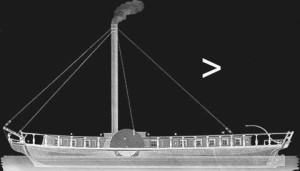
In Part 3, the Castle Steam-Packet Company sold off most their wooden steamer fleet, and replaced them with new iron steamers. There was new competition from the Bute Steam Packet Company on the Rothesay station and the Argyle on the Loch Fyne route. The loss of the Tarbert Castle in a storm left the company vulnerable, and the Arran connections were again discontinued. The lucrative trade through Tarbert to the west highlands and islands by the Maid of Islay was curtailed by the new route pioneered by the Brenda, and then the Shandon, connecting with a track-boat on the Crinan Canal. The imminent opening of the Greenock Railway posed a threat to the Clyde steam-boat services from Glasgow.

If there seemed to be some optimism for the coming year among the owners and patrons of Bute Steam Packet Company and the Glasgow, Dunoon, and Kilmun Steam Boat Company, there was feeling of gloom surrounding the Castle Steam Packet Company. Not only was there the coming of the Greenock Railway to contend with, but a further new competitor was advertised for the Loch Fyne trade. The Sir William Wallace, previously sailing to Ayr, was seeking new employment, a casualty of the opening of the Ayr Railway, and an omen for the steamboat owners who sailed by way of Greenock.
“New steamer to Tarbert, Lochgilphead, &c.—The public are respectfully informed that the fast-sailing steamer Sir William Wallace will commence plying on the above station and intermediate places, from Glasgow, about the middle of February, to suit the days of sailing of the Maid of Islay steamer.—25th January, 1841.”—Glasgow Herald, January, 1841
“Lochfine steamers.—Sir William Wallace or Robert Burns.—One of the above well-known and powerful steamers will, on Monday, 1st March, commence plying to Tarbert and Lochgilphead, and every Wednesday, Friday, and Monday thereafter, continue plying to the same places, calling at all intermediate ports, till farther notice. From the known sailing qualities of these vessels, shippers and passengers may rely on a speedy and comfortable conveyance. The days and hours of sailing will be—From Glasgow, every Monday, Wednesday, and Friday, at 6 o’clock morning. From Lochgilphead, every Tuesday, Thursday, and Saturday, at the same hour. For farther particulars, apply in Glasgow, to Mr. James Paul, Office-box, Broomielaw; in Tarbert, to Mr. John M‘Larty, merchant; in Lochgilphead, to Mr. Blackwood, Ardrishaig.—Glasgow, 24th February, 1841.”—Glasgow Herald, February 26, 1841
There was much cause for concern for the Castle Company. New competition and the coming of the Railway were bad enough. Compounding the picture was a general downturn in trade in the West of Scotland. Glasgow, Greenock, and Paisley were especially hard hit. The Castle Company responded as it had previously done when the winds of the economy alarmed shareholders; the steamers were put up for sale, allowing the more nervous investors to recoup some of their investment and others to bring in fresh capital and ideas.
“Steam Packets for Sale.—To be sold by public roup, within the Royal Exchange Sale Rooms, Glasgow, on Thursday, the 11th February, 1841, at two o’clock afternoon, if not previously disposed of by private bargain, the whole of the steam packets belonging to the Glasgow Castle Steam Packet Company, viz.:—Windsor Castle, of 89 tons burthen; built in 1838; Rothesay Castle, of 84 tons burthen; built in 1837; Inverary Castle, of 110 tons burthen; built in 1839; Dunoon Castle, of 100 tons burthen; built in 1826, and thoroughly overhauled and repaired last season; Arran Castle, of 100 tons burthen; built in 1830. The first three packets are constructed of iron, according to the most approved models, and are now the quickest and most commodious on the Clyde; the remaining two are constructed of wood. The whole have plied on the Lochfine and Bute stations, and are too well known to require any further description here.—The Company are ready to treat for a sale of any of the packets privately. Particulars will be given by Mr John Anderson, Castle Company’s Office, Broomielaw; Mr John Kerr, Writer, 7, South Hanover Street.—Glasgow, 22d January, 1841.
“N.B.—For the accommodation of the public, the Packets will continue to ply until a sale is effected; and the same attention will be paid to their efficiency and comfort that has hitherto given so much satisfaction.”—Glasgow Herald, February 1, 1841
The first sale brought no buyers, and immediately a second sale was organized with a reduced upset price.
“Upset price reduced.—Steam Packets for Sale.—To be sold by public roup, within the Royal Exchange Sale Rooms, Glasgow, on Thursday, the 25th February, 1841, at two o’clock afternoon, if not previously disposed of by private bargain, the whole of the steam packets belonging to the Glasgow Castle Steam Packet Company, viz.—Windsor Castle, of 89 tons burthen; built in 1838; Rothesay Castle, of 84 tons burthen; built in 1837; Inverary Castle, of 110 tons burthen; built in 1839; Dunoon Castle, of 100 tons burthen; built in 1826, and thoroughly overhauled and repaired last season; Arran Castle, of 100 tons burthen; built in 1830. The first three packets are constructed of iron, according to the most approved models, and are now the quickest and most commodious on the Clyde; the remaining two are constructed of wood. The whole have plied on the Lochfine and Bute stations, and are too well known to require any further description here.—The Company are ready to treat for a sale of any of the packets privately. Particulars will be given by Mr John Anderson, Castle Company’s Office, Broomielaw; Mr John Kerr, Writer, 7, South Hanover Street.—Glasgow, 11th February, 1841.
“N.B.—For the accommodation of the public, the Packets will continue to ply until a sale is effected; and the same attention will be paid to their efficiency and comfort that has hitherto given so much satisfaction.”—Glasgow Herald, February 15, 1841
Again there was no sale and the upset price was reduced to £7000 in March, at which point a consortium of new owners was successful. The new principal owners were William Campbell of Tullichewan, James Hunter of Hafton, and John Watson, of Glasgow.
Acts for the construction of railways from Glasgow to Ayr and Greenock had been passed by Parliament on July 15th, 1837. The Glasgow, Paisley, Kilmarnock & Ayr, and the Glasgow, Paisley & Greenock Railways shared a track to Paisley, and while the line to Ayr was opened on August 12, 1840, construction of a tunnel through hard whinstone at Bishopton delayed the opening of the line to Greenock until March 30, 1841.
In addition to goods traffic, the main attraction of the line to Greenock was the lucrative passenger trade for the Clyde resorts; and beyond, to the highlands and islands, Ireland, and to Liverpool. An obvious requirement was cooperation with the steamboat owners who would facilitate the onward journey of the passengers to their final destinations. As the railway neared completion, overtures were made to various steamboat owners to run their vessels to connect at Greenock with the trains. The results from the Irish and Liverpool steamer owners were mostly positive, but from the Clyde passenger steamboat owners, they were disappointing.
Almost all of the Clyde steamboats sailed to and from Glasgow, and the railway posed a threat to the steamboat trade on the busy Glasgow to Greenock station. Indeed, as was pointed out at the time, the Railway’s success depended upon driving the steamboat traffic from the river, and having them concentrate their services in connection with the Railway at Greenock. Naturally, the steamboat owners were defensive, and resistant to change. The new regime of the Castle Company would have no truck with the Railway.
For a steamboat owner who chose to cooperate with the Railway, co-ordination with the trains when calling at Greenock on their way down river was problematic. Typically, a steamer in 1840 took roughly two hours to sail from the Broomielaw to Greenock. The train took one hour, and so a traveller to Rothesay could save a valuable hour on the journey by taking the train to Greenock and transferring to a river steamer for the rest of the journey. While trains were not susceptible to tides and the vagaries of wind and weather, the steamboats were. With the tide, it might take an hour and three-quarters for a steamboat to reach Greenock, but if the tide were against, it might take two and a quarter hours. Since the steamboats left the Broomielaw at set times, there was likely to be a mis-match in timing with the trains at Greenock. Should a steamboat arrive early, it would have to wait at Greenock for the connection, incurring the wrath of loyal passengers who had sailed down the river in the steamboat that was now delayed. If it arrived late, there would be complaints from the railway travellers, and if it left Greenock early without the railway travellers—it would be time for a letter of complaint to the editor of the Herald, or some other local paper. Of course, on sailings to Glasgow, schedules were much less dependent on the tides, and some coordination might be more easily executed.
The railway really required a steamer service that began and ended at Greenock to meet the trains. Some steamboat owners were willing to call at Greenock on their way up and down river. Those most disposed to work with the Railway were the Dumbarton steamers, that had no direct competition with the Railway on the north bank of the Clyde, and saw opportunities in extending sailings for the tourist route to Arrochar and Loch Lomond, and the Lochgoil Company with connections through Lochgoilhead, as they could now advertise a faster journey to Inverary.
To open the line and provide through services, the G.P.&G. Railway chartered three steamers at a total per diem cost of £27; the Flambeau, for the Greenock, Dunoon, and Rothesay service at a daily cost of £17, and the two Dumbarton steamboats, Maid of Leven and Vale of Leven, sailing between Helensburgh and Roseneath in connection with the trains at Greenock. The Flambeau was scheduled to make three double journeys between Greenock and Rothesay. There was an early morning run from Garelochhead connecting with the 8.30 a.m. up-train, and the 6 p.m. down-train offered a connection to Garelochhead. It is likely that these were taken by one of the Dumbarton steamers berthing overnight at Garelochhead as the regular Gareloch steamers eschewed cooperation with the Railway, and the Railway offered through tickets.

Vale of Leven
As an example of the lengths that the steam-boat owners went to, in order to preserve their revenue, Messrs Napier’s Garelochhead steamer Superb, on her early Monday morning run, avoided a call at Greenock. Departing form Garelochhead half-an-hour later, and calling at Greenock, would have allowed passengers an arrival at Glasgow about the same time as the steamer arrived starting at half-past six.
“The steamer Superb will leave Gareloch head on Monday 7th, at half-past six o’clock morning, Helensburgh at half-past seven a.m., direct for Glasgow, not calling at Greenock or Port-Glasgow, and will continue at that hour every Monday morning until farther notice.—Glasgow 4th June, 1841.”—Glasgow Herald, June 4, 1841

Superb
There were nine trains in each direction each day.
“Glasgow, Paisley, and Greenock Railway.—The public are respectfully informed that this railway is now open for the conveyance of passengers and parcels. The trains will run at the following hours till further notice:—From Glasgow.—down.—8 a.m., *9 a.m., 10 a.m., 12 noon, *2 p.m., 4 p.m., *5 p.m., 6 p.m., 8 p.m. From Greenock.—up.—half-past 8 a.m., *half-past 9 a.m., half-past 10 a.m., *half-past 12 p.m., half-past 1 p.m., half-past 3 p.m., *half-past 4 p.m., half-past 6 p.m., half-past 8 p.m. No trains on Sundays. The trains marked* stop at the Houston and Bishopton stations. All the trains stop at Paisley and Port-Glasgow stations.
“Down trains.—Steam-boats or Omnibuses depart from Greenock (weather permitting) for the undermentioned places on the arrival of the trains, which leave Glasgow at the hours specified below:—Gourock and Ashton.—At 9 a.m., 10 a.m., 12 noon, 2 p.m., 4 p.m., 5 p.m.; Helensburgh and Roseneath.—8 a.m., 10 a.m., 12 noon, 4 p.m., 6 p.m.; Gareloch-head.—6 p.m.; Dunoon.—8 a.m., 12 noon, 4 p.m.; Rothesay.—8 a.m., 12 noon, 4 p.m.
“Up trains.—Steam-boats or Omnibuses arrive (weather permitting) from the undermentioned places for the trains, which leave Greenock at the hours specified below:—Gourock and Ashton.—At 8.30 a.m., 10.30 a.m., 12.30 p.m., 1.30 p.m., 3.30 p.m., 4.30 p.m.; Helensburgh and Roseneath.—8.30 a.m., 10.30 a.m., 12.30 p.m., 3.30 p.m., 6.30 p.m.; Gareloch-head.—8.30 a.m.; Dunoon.—8.30 a.m., 12.30 p.m., 4.30 p.m.; Rothesay.—8.30 a.m., 12.30 p.m., 4.30 p.m.
“Passengers by the 8 o’clock a.m. down train, can join the Lochgoil boat to Inverary at Greenock. Other arrangements are in progress and will be advertised shortly. Children under 10 years of age free; from 10 to 14 half price. Luggage will be conveyed free, and transferred to and from the boats without any additional expense. Passengers are requested to look after their own luggage as the Company will not be responsible for it, unless booked and paid for. Passengers to and from Liverpool, Dublin, Belfast, &c., will save two hours by taking the railway to and from Greenock. It is particularly requested that passengers in going to and from the steam-boats will use all expedition, in order that the regularity of the communication may not be interfered with. Time by railway, between Glasgow and Greenock till further notice, one hour; and the clocks will be set by the Tron Church, Glasgow, and the Mid Parish Church, Greenock. Passengers at the intermediate stations should arrive five minutes before the train may be expected. For fares and rates of parcels, see hand-bills. Preparations are making for the conveyance of goods at an early day. The servants of the Railway Company are strictly prohibited from receiving any gratuity on pain of dismissal. No smoking allowed in the trains or at the stations. Any complaints, if addressed to the Secretary, will be immediately attended to.—By order of the Directors, Mark Huish, Secretary.—5th April 1841.”—Railway Times, April 17, 1841
The chartered steamers allowed the Railway Company to offer through tickets to and from the resorts, and shopkeepers in Rothesay, Dunoon, and Helensburgh were recruited to sell tickets.

Gourock was connected by omnibus that met each train. For the Largs and Millport connections, the M‘Kellar steamers Victor and Warrior were recruited.
In May, the River Trust opened new accommodation near Glasgow Bridge for the steamers most affected by the Railways. The old steamboat wharf was a mile down-river from the city center, and this new wharf improved the steamboats’ competitiveness. Passengers intending to travel by the Railway had to cross the River Clyde close by the new wharf to reach the Railway Terminus on Bridge Street. Notably, the Dumbarton steamers were excluded from the new quay, mainly because they did not pay harbour dues, the result of an agreement between the Burghs. Additionally, the Loch Fyne steamers, including the Dunoon Castle, continued to sail from the old wharf, often referred to as the “foot of the quay”.
“River steamers.—The under-mentioned river steamers (for the conveyance of passengers) start daily from the New Wharf at Glasgow Bridge, precisely at the hours specified on the boards.
“N.B.—The time to be taken in future from St Enoch’s Clock.—Reduced fares.—To and from Greenock—Cabin, 1s.; Steerage, 6d.
“Steamers.—Rothesay Castle, Windsor Castle, Arran Castle, Lochgoil, Warrior, Victor, British Queen, Royal Tar, Sultan, Superb, Luna, Earl Grey.—Glasgow, 14th May, 1841.”—Glasgow Herald, May 21, 1841
The Railway made some inroads with the Bute Steam Packet Company. The Maid of Bute required significant repairs in the early months of the year, running into the month of May. The Isle of Bute began railway connections while Maid of Bute maintained the sailings between Glasgow and Rothesay that were essential for the commercial life of her patrons in the Island town.

Isle of Bute at Hunter’s Quay 1841
“Notice.—The Bute Steam Packet Company most respectfully acquaint their friends and the public, that the steam packet which leaves Glasgow for Rothesay at half-past two o’clock, will cease plying after Tuesday the 30th current. The Company’s sailing arrangements for the season will be made known in a future advertisement.—John Semple, Manager.—Rothesay, 27th March, 1841.”—Glasgow Herald, March 29, 1841
“The Bute Steam Packet Company most respectfully acquaint their friends and the public, that the Maid of Bute steam-packet, being nearly completed in her repairs, is expected to be ready to resume the station on Friday, the 7th of May. The hours of sailing to and from Rothesay, calling at Greenock, Gourock, and Dunoon, will be as under, till further notice. From Rothesay, at ½-past 8 a.m.; From Glasgow, at ½-past 2 p.m. Goods and parcels will be received at the Company’s Shipping Box, at the steamer, and must be there half an hour before the time of sailing. The Company will not be responsible for goods and parcels, unless regularly entered.—Jn. Semple, Manager.—Rothesay, 29th April, 1841.”—Glasgow Herald, April 30, 1841
In May, with the Maid of Bute now in service, the Isle of Bute took up two round trip sailings between Greenock, Dunoon and Rothesay for the Railway. The Maid of Bute also advertised a connection with the Railway at Greenock on her morning sailing from Rothesay to Glasgow. Together with the Flambeau, the Railway had then five trains that connected to Dunoon and Rothesay each day. The Bute Steam Packet Company’s steamers were apparently not under charter, and were allowed 1s. from the combined fare for each cabin passenger between Rothesay and Greenock.
“The Royal Mail Steam Packet Maid of Bute, Captain Johnston, will commence to sail to and from Rothesay, calling at Greenock, Gourock, and Dunoon, on Wednesday first, the 12th current, at ½-past 2 o’clock. Hours of sailing, till further notice, will be as under:—From Rothesay, at ½-past 8 a.m.; From Glasgow, at ½-past 2 p.m. Passengers leaving Rothesay by the Maid at ½-past 8, will be in time for the railway train leaving Greenock at ½-past 10.—John Semple, Manager. Rothesay, 7th May, 1841.”—Glasgow Herald, May 10, 1841
“In consequence of some alteration to be made in the Maid of Bute steam packet, she will cease plying for a day or two, on after Monday first, the 20th current.—Jn. Semple, Manager.—Rothesay, 19th May, 1841”—Glasgow Herald, May 21, 1841
She was back sailing on the 27th May.
At the beginning of July, the Flambeau developed a problem and both Isle of Bute and Maid of Bute sailed from Greenock to and from Dunoon and Rothesay twice daily, connecting with the Railway. It was the middle of the month before the Flambeau was able to resume sailing, and Isle of Bute and Maid of Bute returned to their normal schedule.
“Glasgow Paisley and Greenock Railway.—Change in the Gourock, Dunoon, and Rothesay sailings.—Notice is hereby given, that in consequence of the Flambeau steamer requiring repairs, she will be laid up on Monday next the 5th inst., for a short time, and during that period, the following alterations will take place in the sailings for the trains:—Up trains, 8.30, 10.30, 1.30, 6.30.—Down trains, 8, 12, 4, 6. The hours formerly advertised for Isle of Bute are for the present cancelled. No boat to and from Kilmun at 10 a.m. and 1.30 p.m.; nor to Gourock at 5 p.m., till further notice.—By Order, Mark Huish, Secretary,—July 1st, 1841.”— Glasgow Herald, July 2, 1841
“Glasgow, Paisley, and Greenock Railway.—The Isle of Bute steam-boat for Rothesay and Dunoon.—On and after Monday the 19th instant, the Isle of Bute steam-boat will sail to and from Rothesay and Dunoon, in connection with the trains which leave at the following hours, viz:—Up trains from Greenock, ½-past 9; ½-past 4: down trains from Glasgow 10; 5.”—Glasgow Herald, July 23, 1841
There were further opportunities for the Railway provided by Dumbarton steamers, bringing connections with Arrochar and Kilmun.
“Conveyance to and from Kilmun and Arrochar.—The comfortable and swift-sailing steamers the Dumbarton Castle, or Prince Albert, sail from Glasgow (from the lower end of the quay), every day, at 4 afternoon, for Dumbarton and Greenock, and from there at 7 (or on the arrival of the passengers from the 6 o’clock down train), for Kilmun, Lazarette, and Arrochar. Sails from Arrochar, every morning at half-past 7; from Kilmun at half-past 9, calling the Lazarette, for Greenock (in time for the half-past 10 up train), and from thence for Dumbarton and Glasgow. These steamers will, on and after Monday, sail from Dumbarton for Glasgow, at 12 noon in place of half-past 12, and also at the other hours as formerly.—2d July, 1841.”—Glasgow Herald, July 2, 1841
The little wooden pier at Sandbank had fallen into disrepair, and passengers for the south shore of the Holy Loch were generally landed at Lazarette.
At the end of the July, the Railway was able to offer the following connections: —“Passengers by the 8 o’clock morning down-train can join the Lochgoil steam-boat to Inverary at Greenock, and by the 9 o’clock down-train can proceed to Lochlomond by Arrochar; and by the 6 o’clock afternoon down-train to Kilmun and Arrochar. The Warrior and Victor, will take the Largs station. The Maid of Bute, and the Isle of Bute, will take passengers from the Railway in addition to the Flambeau. The Maid of Leven, or Vale of Leven, will take all the hours to Helensburgh and Roseneath, calling at Helensburgh both in going and returning.”
The Maid of Bute provided the connection from Rothesay, Dunoon, and Gourock, for the 8.30 a.m. up-train, and the 4 p.m. down-train. The Isle of Bute and Flambeau made five single journeys, alternating overnight berthing at either Rothesay or Greenock.
Greenock Railway station was a few minute’s walk (300 yards) from the Steam-boat Quay, reached through the disreputable East Quay Lane. Passengers were requested to make their way expeditiously to avoid interrupting the schedules:—“It is particularly requested that passengers, in going to and from the steamboats, will use all convenient expedition, that the regularity of the communication may not be interfered with. The companies whose steam-boats run in connection with the railway are pledged to use every exertion to keep their time.” A cart was provided for luggage:—“Luggage will be conveyed free and transferred to and from the river boats without any additional expense but at the risk of the owners.”
At the beginning of the year, a new steamer had begun to sail on the Kilmun and Dunoon station. This was the Luna, built of iron in 1837 by Messrs James & William Napier, Glasgow. She was 116½ feet in length, 14½feet in breadth, 3½ feet in depth and was powered by a 45 h.p. steeple engine. She had a tubular boiler that gave her an unusual appearance for the era with her funnel forward of the paddle boxes. She had been sailing to Helensburgh and the Gareloch, but was now transferred to the Kilmun station.

Luna
“Notice.—The steamer Luna will commence on Monday first, to sail from Glasgow every morning at ten o’clock, for Greenock, Gourock, Kilmun, and Dunoon. She will leave the Dunoon at half-past three o’clock, on her return to Glasgow.—February 23, 1841.”—Glasgow Herald, February 26, 1841
The Earl Grey was placed in direct opposition at her established hour, and Luna switched to sail from Glasgow in the afternoon.
“Summer hours.—The Earl Grey has now commenced to run for the season, or till further notice. Leaves the Broomielaw every forenoon at 10 o’clock for Greenock, Gourock, Dunoon, and Kilmun, and returns in the evening by the same route, leaving Kilmun at half-past 3, Dunoon at 4, and Greenock at 5.—James Smith, Manager.—Glasgow, 19th March, 1841.”—Glasgow Herald, March 19, 1841
“Summer hours.—Earl Grey sails from the new wharf, at the head of the quay, every lawful day, at ten o’clock forenoon, for Greenock, Gourock, Dunoon, Kirn, Hunter’s quay, and Kilmun, returning by the same route in the afternoon—leaving Kilmun at half-past three, Dunoon at four, Gourock at half-past four, and Greenock at five o’clock. And on and after the 5th June, will leave the new wharf every Saturday evening (or till further notice, which will be seen on the boards), at or about eight o’clock, for Kilmun, returning early on Monday mornings.—James Smith, Manager.—Glasgow, 2d June, 1841.”—Glasgow Herald, June 4, 1841
Luna provided an early Monday morning run from Kilmun where she sailed from Gourock direct for Glasgow, by-passing Greenock. It is perhaps surprising that the Railway had its first down service of the day at 8 a.m., and its first up-service at 8.30 a.m. too late to provide connections with the early morning steamers to Loch Fyne, and the early Monday morning steamers from the coast.
“Notice.—The steamer Luna will leave Glasgow every afternoon at 5 o’clock for Greenock, Gourock, Dunoon, and Kilmun, and from Kilmun every morning about half-past 8 o’clock, calling at all the above places, (except upon Mondays, when she will leave at 5 o’clock, not touching at Greenock), and will commence plying on the above station today (Friday), and continue to do so until further notice.—Glasgow, June 4, 1841.”—Glasgow Herald, June 4, 1841
Later, in July, Luna was making two trips daily to and from Glasgow, Dunoon, and Kilmun.
“Notice.—Swift and cheap sailing.—The steamer Luna continues to sail for Greenock and Gourock every morning at ten o’clock, and every afternoon at half-past four; and leaves Gourock for Glasgow every forenoon about one o’clock, and every evening at seven, except Saturdays, when she leaves Glasgow at half-past four afternoon, for Greenock, Gourock, and Kilmun, and returns upon the Monday mornings for Glasgow, at about half-past five o’clock, till further notice.—Glasgow, July 1, 1841.”—Glasgow Herald, July 2, 1841
“Pleasure trips.—Cheap and swift sailing.—The steamer Luna leaves Glasgow every morning at 10 o’clock for Greenock, Gourock, Dunoon, and Kilmun, and returns in the evening for Glasgow, excepting Saturdays, when she leaves Glasgow at 10 o’clock morning, and 5 o’clock in the afternoon, for the above places, and returns on the Monday mornings for Glasgow, till further notice.”—Glasgow Herald, July 9, 1841
The route to Inveraray by Lochgoilhead continued to prove popular, with increasing activity as the season progressed.
“Inverary via Lochgoilhead.—The steamer Lochgoil, Captain Graham, sails for Greenock every morning at 7 o’clock, and on Tuesdays, Thursdays, and Saturdays, proceeds on to Lochgoilhead with passengers for Inverary. The Lochgoil leaves Greenock for Glasgow every afternoon at 3 o’clock. Reduced fares.—On and after Wednesday next—to and from Greenock, cabin 1s; steerage 6d.—Glasgow, 22d March 1841.”—Glasgow Herald, March 22, 1841
On April 2d, it was announced that she would begin sailing for Lochgoil daily, the next week.
“Inverary via Lochgoilhead.—The Lochgoil steamer, plying between Glasgow and Lochgoilhead, and the Argyll steamer from St.Catherines to Inverary, will both discontinue plying on Monday next, the 3d of May, for about eight days, to undergo some repairs. And intimation will be given in the newspapers of the precise day they will resume plying.—Glasgow, 28th April, 1841.”—Glasgow Herald, April 30, 1841
On May 8th, it was announced that the normal service would resume on May 10th.
Competition on the Loch Fyne services included the new sailing by Sir William Wallace, although this was interrupted for a short period in May.
“Notice.—Lochfine steamer.—The public is respectfully informed that the Sir William Wallace will, for a few days, discontinue plying, on account of some alterations being about to be made on her. Due notice will be given of her future sailing to the above station.—Glasgow, 21st May, 1841.”—Glasgow Herald, May 21, 1841

Shandon
The Shandon, sailing direct to Ardrishaig, on Tuesdays and Fridays, did call at Greenock though too early for a railway connection, and on Wednesdays and Saturdays, she sailed for Greenock, Rothesay, Lochgilphead, and Inverary, connecting with the 10 o’clock down-train from Glasgow, and the half-past 12 o’clock, (Mondays), and half-past 2 o’clock (Thursdays) up-train to Glasgow, on her return.
“Summer arrangements.—Expeditious steam conveyance to Islay, Oban, Tobermory, Portree, and Stornoway, Fort-William, and Inverness, Staffa, and Iona. Lochgilphead and Inverary.—Toward Castle, Captain MacDonald; Shandon, Captain Maclean; Brenda, Captain Mackillop; Staffa, Captain Nicole. For Lochgilphead, direct with passengers for Oban, Fort-William and Inverness, Tobermory, Portree, and Stornoway. (No goods taken.)—Shandon, Tuesday 11th May, and every Tuesday and Friday thereafter, at 5 morning. The Brenda will convey passengers from the Crinan Canal to Fort-William putting the Skye passengers aboard the Toward Castle at Oban. This season passengers may depend that no delay will take place at either end of the Crinan Canal upon which the proprietors have placed an additional track boat, whereby the confusion and delay in removing from the one boat to the other will be completely obviated.
“For Rothesay, Lochgilphead, and Inverary.—Shandon, Saturday 8th May, and every Wednesday and Saturday thereafter, at 8 morning. She will wait at Greenock the arrival of the 10 o’clock railway train from Glasgow. From Inverary, calling at intermediate places—Shandon, Monday, 10th May, and every Monday thereafter at 5 o’clock, and every Thursday thereafter, at 7 o’clock morning. The Shandon is entirely reserved for passengers, and will be neither detained with the landing of goods and cattle at the different shipping places, nor annoyed by the inconveniences that generally accompany them. It is expected that the Shandon will be in time, on the Mondays, for the half-past 12, and on Thursdays, for the half-past two o’clock train for Greenock.
“Passengers leaving by the Shandon, on Tuesday and Friday morning will arrive at Oban, Fort-William and Tobermory, same evening, and at Inverness, Portree, and Stornoway on the afternoon of the day following. The route to Islay is the most direct from the Clyde. The Shandon, from her speed and non-detention, will take passengers to Inverary in about nine hours.”—Glasgow Herald, April 23, 1841
Shandon did not provide a connection to Islay. The service mentioned in the advertisement was Thomson & MacConnell’s Toward Castle sailing round the Mull of Kintyre to Islay. The Campbeltown Company also provided sailings round the Mull to Islay, and had done so for many years.
The Castle Company maintained their connection at Tarbert with the Maid of Islay.
“Conveyance by steam, between Glasgow and Islay, twice-a-week.—On and after the 25th current, one of the Castle Company’s Steam Packets will leave Glasgow every Tuesday and Saturday morning, at six o’clock, with passengers for Islay, who will be conveyed through the same day from West Tarbert, by the steam packet Maid of Islay.
“The Maid of Islay will leave Islay every Tuesday and Friday morning, at four o’clock, for West Tarbert, and the passengers will immediately be conveyed to Glasgow by one of the Castle Company’s steamers. All goods for Islay must be forwarded to the Castle Company’s Office, Broomielaw, upon Thursdays and Saturdays so as to be sent to Tarbert on Mondays and Fridays, otherwise they will be detained a trip. The freight of all goods shipped for places between Glasgow and Inverary, and vice versa, except for Dunoon, Rothesay, Tarbert, Lochgilphead, and Inverary, must be paid previous to shipment, otherwise they cannot be taken. Passengers are requested to take charge of their own luggage, as the proprietors will not be responsible for any article whatever, unless booked and signed for previous to shipment.—Jno. M‘Arthur Manager, Castle Company’s Office, Glasgow, 19th May, 1841.”—Glasgow Herald, May 21, 1841
The summer schedule was conducted by four steamers. Presumably the Arran Castle was laid-up. There were no connections to Arran.
“Royal Mail Steam Packets.—Windsor Castle, Rothesay Castle, Inverary Castle, Dunoon Castle.—The Glasgow Castle Steam Packet Company respectfully announce that, on and after Wednesday, the 10th current, their sailing arrangements are intended to be as follows:— From Glasgow.—At 6 o’clock morning for Lochfine; at 1 o’clock afternoon for Rothesay; at 4 o’clock afternoon for Rothesay. From Rothesay.—At 6 o’clock morning for Glasgow; at ½-past 9 o’clock forenoon for Glasgow; about 12 o’clock noon for Glasgow. The whole of the Company’s Packets sailing to and from Rothesay, touch, as usual, at Greenock, Gourock, and Dunoon. In the meantime, the Dunoon Castle does not call at Rothesay going and returning from Lochfine.
“From Glasgow to Inverary.—Every Wednesday and Saturday, at 6 o’clock morning.
“From Glasgow to Islay.—Every Tuesday and Saturday morning, at 6 o’clock. Passengers will be conveyed to Islay same days by the Maid of Islay steamer.
“From Islay to Glasgow.—The Maid of Islay leaves Islay every Tuesday and Friday morning at 4 o’clock. Passengers will be conveyed to Glasgow same days by one of the above steamers.
“Passengers are requested to take charge of their own luggage, as the proprietors will not be responsible for any article whatever, unless booked and signed for previous to shipment.—John M‘Arthur, Manager.—Castle Steam Packet Office, Broomielaw, 14th June, 1841.”—Glasgow Herald, June 14, 1841
As the year wore on, some of the steamers that had been involved with railway connections, returned to their usual routes, when their charters had ended or traffic had diminished.
“The steamers Dumbarton Castle, or Prince Albert, will continue sailing (until further notice) from Glasgow at 4 afternoon, for Dumbarton, Greenock, and Kilmun, but on Monday first, ceases sailing for Arrochar in the evenings, except on Saturdays, and returns on the Monday mornings. The Maid, or Vale of Leven, continues sailing from Glasgow at 7 morning, for Dumbarton and Arrochar, and returns in the evening.—September 3, 1841.”—Glasgow Herald, September 3, 1841
“The steamers Vale, or Maid, of Leven continue sailing every day, from Greenock, at 3 afternoon, for Kilmun, Ardentinny, and Arrochar; and from Arrochar every morning at 7 o’clock, for Kilmun and Greenock, until Monday the 25th instant, when they will cease plying for the season. The steamer sails early for Kilmun on Wednesday first, and on Thursday will be off the station.—18th October, 1841.”—Glasgow Herald, October 18, 1841
“Notice.—Change of hours.—The Maid of Bute Royal Mail Steam Packet will sail on and after Thursday first, the 21st current at 2 o’clock p.m., for Greenock, Gourock, Dunoon, and Rothesay.—Jno. Semple, Manager.—Rothesay, 15th October, 1841.”—Glasgow Herald, October 18, 1841
“Steam communication to Greenock, Rothesay, Dunoon, Tarbert, Lochgilphead, and Inverary, Islay, Oban, Tobermory, and Skye.—The Shandon will not leave Lochgilphead for Glasgow on Wednesday, 20th, or Monday, 25th, nor Glasgow for Inverary on Saturday, 23d current; but will leave Campbelton for Inverary on Wednesday, 20th, at 7 a.m., and Inverary for Campbelton on the morning of Saturday, 23d.
“The steamer Shandon will leave the lower end of the Broomielaw every Tuesday and Saturday at 9 a.m. for Greenock, Dunoon, Rothesay, Tarbert, and Lochgilphead, and on the Saturdays will proceed to Inverary. She will leave Inverary on her return every Monday at 6, and Lochgilphead every Monday and Wednesday at 8 morning—Thomson and MacConnell, 15, Jamaica Street.—Glasgow, October, 1841.”—Glasgow Herald, October 18, 1841
The Castle Company also wound down their services.
“The Inveraray Castle will leave Glasgow on Thursday the 23d current, at 6 o’clock morning, for Inverary. Also, the Dunoon Castle on Friday the 24th, calling at all the intermediate ports, returning to Glasgow the following mornings.—John M‘Arthur, Manager.—Castle Steam Packet Office, Glasgow, Sept. 16, 1841.”—Glasgow Herald, September 17, 1841
“Winter hours.—Till further notice, one of the Castle Company’s steamers will leave Glasgow every morning for Lochfine at half-past six o’clock; and for Rothesay at one o’clock afternoon—these vessels returning the following day.—John M‘Arthur, Manager.—Castle Steam Packet Office, Broomielaw, 21st October, 1841.”—Glasgow Herald, October 22, 1841
“Notice.—The public are hereby respectfully informed that (until further notice) the Maid of Islay steamer will not carry cattle of any description from Tarbert to Islay.—John M‘Donald, Maid of Islay Steam Packet Office, 18th November, 1841.”—Glasgow Herald, November 26, 1841
“Notice.—The Dunoon Castle Steam Packet will discontinue plying to Inverary on Wednesdays, until further notice.—John M‘Arthur, Manager.—Castle Steam Packet Office, Glasgow, 9th Dec., 1841.”—Glasgow Herald, December 10, 1841
Although the Railway was deemed a practical success in its first year, when it took over half of the passenger traffic between Glasgow and Greenock, it was accomplished at a cost that had both management and shareholders asking questions about the steam-boat operations. This was brought to the public’s attention in the half-annual report showing dropping revenues, and reflected in a half-yearly dividend of just 2s. 6d. on a £25 share.
The chartering of vessels had proved expensive, justified as an attempt to pressure the steam-boat owners to cooperate with the Railway. This had not generally happened, and worse, some of the cooperating steam-boat owners had engaged in duplicitous practices by arranging their starting times from Largs, Millport or Garelochhead to deposit passengers at Greenock 45 minutes, rather than 15 minutes, before the advertised train, and then sailing express for Glasgow Bridge, thus negating much of the time advantage of the train journey. It must be admitted that on a wet Monday morning with a long week of work ahead, the comforts of the Cabin with breakfast available, would have some appeal.
The problem was that the Railway Company had no powers to run steam-boats. The steam-boat charters were charged to the Railway’s capital account, and the little revenue they generated, was recouped to that account. A complaint to the Board of Trade was made by the steam-boat owners asserting that the conduct of the Railway Company was illegal, contrary to public policy, and injurious to public interest. The Board of Trade declined to intervene, and replied that these points were insufficiently established. They felt that in this instance, the employment of steam-boats to forward passengers was not incidental to the Railway’s main interest, and was a public convenience. Further, that any loss was sustained by the public, and those of a certain class were experiencing lower fares than formerly.
The new year saw changes. A separate entity, controlled by a number of the Railway Directors, and called the Railway Steam Packet Company, purchased the Royal Victoria for Helensburgh and the Gareloch service, and the Bute Steam Packet Company’s vessel Isle of Bute to run from Greenock to Gourock, Dunoon, and Rothesay. All these destinations connected with the 8.30 a.m. up-train, and the 4 p.m. down-train. The down-trains at 8 a.m., 12 noon, 4 p.m., and 5 p.m., connected with steamers for Gourock, Dunoon and Rothesay; the 8 a.m., 10 a.m., 12 noon, and 4 p.m., connected with Helensburgh. The noon connection continued to Row and Roseneath. Steamers from Rothesay, Dunoon, and Gourock met the up-trains at 8.30 a.m., 10.30 a.m., 1.30 p.m., and 6.30 p.m.; and from Helensburgh at 8.30 a.m., 10.30 a.m., 12.30 p.m., and 3.30 p.m. The 3.30 p.m. connection was the return from Roseneath.
Knowing that they had to compete with the steam-boats, from its inception, the Railway Company had deliberately used a very low fare structure. The fares were among the lowest in Britain, 1.8d per mile for the first-class, 1.2d for the second-class. Third-class fares were not originally offered, as the per-passenger tax then in place made this economically unfeasible. However, the Railway Passenger Duty Act of 1842 changed the tax from a per-passenger to a percentage of gross passenger receipts, and third-class carriages that were stanhopes or standups were offered. Carriages for the other first- and second-classes were similar to those on comparable lines and equipped with seats.
When third class was introduced, the fare between Glasgow, and Greenock, Gourock or Helensburgh, was 6d; and between Glasgow, Row, Gareloch Head, Dunoon and Rothesay, was 9d. Third-class fares were not available on the 10.30 a.m. up-train, nor the 4 p.m. down-train. Some of the other through fares were also lowered. The First-class and Cabin fare to Rothesay from Glasgow was reduced to 2s. 9d.
To meet the expenses of the steamboats, a certain proportion of the receipts was excluded in the weekly and half-yearly accounts of traffic, and, according to one of the directors involved, this sum was sufficient to meet their costs.
The discarded Flambeau, was advertised for sale at the end of her charter. There does not seem to have been much interest in her purchase, perhaps the result of the depressed economic conditions at the time.
“For sale.—The fine fast-going steamer Flambeau. From improvements recently made on the machinery, her speed has been increased, and she is now in first-rate order. Apply to Caird & Co.—Greenock, 21st April, 1842.”—Glasgow Herald, April 22, 1842
The Maid of Bute had continued to serve Rothesay from Glasgow with passengers and goods for the merchants of the island town, while Isle of Bute served the railway with two round-trip sailings between Greenock and Gourock, Dunoon and Rothesay.
“The Bute Steam Packet Company most respectfully acquaint their friends and the public, that the Maid of Bute Royal Mail Steam Packet will commence plying to and from Rothesay and Glasgow, calling at Greenock, Gourock, and Dunoon, on Monday first, the 21st curt., at the undermentioned hours, till further notice:— From Glasgow, every day at half-past 2 o’clock p.m. From Rothesay, every day at 6 o’clock a.m.
“The Company will not hold themselves responsible for goods or parcels, unless regularly entered at the Company’s Shipping-Box, Steamboat Wharf.—John Semple, Manager.—Rothesay, 16th March, 1842.”—Glasgow Herald, March 18, 1842
With the new arrangements in April, her sailings were timed to connect with the Railway at Greenock.
“For Rothesay, calling at Greenock, Gourock, and Dunoon.—The Maid of Bute, Royal Mail Steamer, sails as under, till further notice:—From Rothesay, every morning, at ½-past 8. From Glasgow, every afternoon, at ½-past 2.—John Semple, Manager.—Rothesay, 23d April, 1842.
“N.B.—The Maid of Bute carries the passengers for the up-railway train which leaves Greenock at ½-past 10 a.m.; and also those by the down-train which leaves Glasgow at 4 p.m.”—Glasgow Herald, March 18, 1842
At the end of the summer season, the Maid of Bute’s sailings were curtailed.
“Notice.—The Maid of Bute steamer will, on and after Monday the 26th instant, sail for Rothesay every day at half-past 2 o’clock, till further notice.—John Semple, Manager.—23d September, 1842.”—Glasgow Herald, September 23, 1842
“Notice.—The Maid of Bute Royal Mail Steam Packet will cease plying to and from Rothesay on and after Tuesday the 1st of November, at ½-past two o’clock—John Semple, Manager.”—Glasgow Herald, October 24, 1842
“Notice.—The Maid of Bute Royal Mail Steam Packet will cease plying to and from Rothesay on and after Tuesday the 1st of November, till the 1st of December, on which day she will resume the station, at one o’clock p.m.—John Semple, Manager.”—Glasgow Herald, October 31, 1842
“Notice.—The Maid of Bute steamer sails every day for Rothesay, calling at Greenock, Gourock, and Dunoon, from the Steam Boat Wharf, Glasgow Harbour at 3 o’clock p.m.—Jno Semple, Manager.—1st December, 1842.
“Goods intended for Rothesay should be sent down by half-past 12.”—Glasgow Herald, December 9, 1842
The Castle Company was reconstituted in April 1842, and staged a revival of sorts, placing an order for a new iron steamer. They also revived the Arran sailings, and maintained the connection with the Maid of Islay. The name was changed to the Glasgow Castle Steam Packet Company, with principals Alexander Stuthers Finlay, Merchant, Glasgow; William Campbell of Tullichewan, James Hunter of Hafton, and John Watson, Merchant, Glasgow.
“Notice.—On and after Wednesday the 30th March, the Rothesay Castle steamer will sail from Glasgow every morning, until further notice, at half-past 9 o’clock, for Greenock, “Gourock, Dunoon, and Rothesay; returning from Rothesay at half-past 3 o’clock, and from Dunoon at half-past 4 o’clock afternoon. By this arrangement passengers will have an opportunity of viewing the different watering places, and return to Glasgow in the evening.—John MacArthur, Manager, Castle Steam-Packet Office.—26th March, 1842.”—Glasgow Herald, March 28, 1842
In May, the Rothesay sailings increased, and the Arran connection was reinstituted, two days each week.
“Notice.—On or about the 7th of May, one of the Castle Company’s steamers will sail for Greenock, Gourock, Dunoon, and Rothesay, at 4 o’clock afternoon. The one o’clock steamer will proceed to Arran on Wednesday the 11th May, and every Wednesday and Saturday thereafter, till further notice.—John MacArthur, Manager.—29th April, 1842.”—Glasgow Herald, May 2, 1842
A fuller advertisement of the schedule appeared a week later.
“Steam communication to Greenock, Gourock, Dunoon, and Rothesay, Tarbert, Lochgilphead, Inverary, Arran, and Islay.—On and after Tuesday the 10th instant, one of the Castle Company’s steamers will sail from Glasgow for Greenock, Gourock, Dunoon, and Rothesay, every day at 6 o’clock morning, *½-past 9 morning, 1 o’clock afternoon, 4 o’clock afternoon.
“*The ½-past 9 o’clock will proceed to Port-Bannatyne, with families and luggage, every Tuesday and Thursday.
“From Glasgow to Tarbert & Lochgilphead, every morning at 6 o’clock. From Glasgow to Inverary, every Tuesday, Wednesday, Thursday, and Saturday, at 6 o’clock morning. From Glasgow for Brodick and Lamlash, on the 11th instant, and every Wednesday and Saturday thereafter, at 1 o’clock afternoon. From Glasgow to Port-Askaig, Islay, every Tuesday and Friday, at 6 o’clock morning. Passengers arrive in Islay same evening. From Port-Askaig, Islay, to Glasgow, on Friday, 13th inst., and every Tuesday and Friday thereafter, at 4 o’clock morning, arriving in Glasgow same evening. Hours of departure from the above ports for Glasgow will be seen on the respective Ticket Boards.
“Pleasure parties will be conveyed to any of the above ports on moderate terms. Apply to the Captains on board.—John MacArthur, Manager, Castle Company’s Office.—7th May, 1842.”—Glasgow Herald, May 9, 1842
The full summer schedule came out in June. The steerage fare between Glasgow and Rothesay had been dropped to 6d., as a third-class and steerage fare of 9d. had been introduced by the Railway.
“Steam communication by the Glasgow Castle Steam Packet Company’s Royal Mail Steam-Packets.—The Castle Company’s steamers will sail from Glasgow for Greenock, Gourock, Dunoon, and Rothesay, every day at 6 o’clock morning, ½-past 9 morning, 1 o’clock afternoon, 4 o’clock afternoon.—Reduced fares to any of the above ports, Steerage, 6d.
“From Glasgow to Tarbert & Lochgilphead, every morning at 6 o’clock. From Glasgow to Inverary, every Tuesday, Wednesday, Thursday, and Saturday, at 6 o’clock morning. From Glasgow for Brodick and Lamlash, every Wednesday and Saturday, at 1 o’clock afternoon. From Glasgow to Port-Askaig, Islay, every Tuesday and Friday, at 6 o’clock morning. Passengers arrive in Islay same evening. From Port-Askaig, Islay, to Glasgow, every Tuesday and Friday, at 4 o’clock morning, arriving in Glasgow same evening. Hours of departure from the above ports for Glasgow will be seen on the respective Ticket Boards.
“Pleasure parties will be conveyed to any of the above ports on moderate terms. Apply to the Captains on board.—John MacArthur, Manager, Castle Company’s Office.—4th June, 1842.”—Glasgow Herald, June 17, 1842
“The steamer Maid of Islay will leave West Tarbert on Friday the 31st, and Saturday the 1st instant, upon the arrival of the Castle steamer from Glasgow, with passengers who may have to attend the market to be held at Port Ellen on the Monday following.—John MacArthur, Manager.—Castle Company’s Office.—21st June, 1842.”—Glasgow Herald, June 24, 1842
For their new iron steamer, the Castle Company had gone to Messrs Anderson & Gilmour, Govan. The Duntroon Castle was 140 feet in length by 21 feet in breadth and 5½ feet in depth, and powered by a steeple engine of 130 h.p. She joined the Castle fleet in July, and was available to take an excursion to Ailsa Craig.

Duntroon Castle
“Grand aquatic tour to Ailsa Craig.—On Thursday first, July 21, the inelegant new and commodious Royal Mail Steam-Packet Duntroon Castle will sail from Glasgow Bridge, at half-past five o’clock morning, on a pleasure excursion to Greenock, Gourock, Dunoon, and Rothesay, thence direct to Ailsa Craig. The power and speed of this fine new steamer is very superior; and this is perhaps the most splendid coasting tour that can be accomplished in one day—furnishing extended and varied scenery of no common interest—commanding a grand view of the coasts of Argyll, Ayr, and Bute, the promontories of Cumbraes, the Isle of Arran, Pladda Lighthouse, and the interesting prospect of the Atlantic in the distance. The steamer will remain at the Craig a short time, in order to allow the tourists an opportunity of viewing this stupendous work of nature, when she will return to Glasgow, calling at Rothesay, Dunoon, and Greenock. Fares for the whole day’s excursion, Cabin, 5s.; Steerage, 3s.—John MacArthur, Manager.—Castle Company’s Office.—Glasgow, 16th July, 1842.”—Glasgow Herald, July 18, 1842
These special excursions meant that scheduled services experienced minor disruptions.
“Notice.—On Saturday the 16th instant, the Castle Steam Packet Company will have no steamer from Rothesay for Glasgow at half-past 9 o’clock morning, or from Glasgow for Rothesay at 4 o’clock afternoon.—Glasgow, 14th July, 1842.”—Glasgow Herald, July 15,1842
Further fare reductions were introduced if passenger numbers decreased; competing with the Railway as actively as possible.
“Fares farther reduced at by the Castle Company’s Steam Packets.—On and after this day until further notice, the Castle Company’s steamers sail from Glasgow for Rothesay every day at 6 o’clock morning, at half-past 9 o’clock morning, at 1 o’clock afternoon, at 4 o’clock afternoon. Fares to or from Greenock, Gourock, and Dunoon, Cabin 1s.; Steerage 6d. Fares to or from Rothesay, Cabin 1s. 6d.; Steerage 6d.—John MacArthur, Manager.—Castle Company’s Office.—25th July, 1842.”—Glasgow Herald, July 25, 1842
With the new Duntroon Castle in place, the old Dunoon Castle was reduced to cargo duties, though still carrying passengers, sailing from the Lower Quay at 7 a.m.
“Notice.—The steamer Dunoon Castle will sail from the Lower Quay, Glasgow, on Thursday the 4th instant, and every Monday and Thursday thereafter, until further notice, at 7 o’clock morning, with goods and passengers, for Greenock, Gourock, Dunoon, Rothesay, Tarbert, Lochgilphead, and Inverary.—John MacArthur, Manager.—Castle Company’s Office.—Glasgow, 30th July, 1842.
Two days later, the advertisement added the note.
“N.B.—All descriptions of goods will be conveyed by her to the above ports on the most moderate terms.”—Glasgow Herald, August 1, 1842
Frequent changes in the fares occasionally brought an unplanned boon for passengers. For a short period, the cabin fare to Rothesay was mistakenly advertised at 1s.
“Steam communication by the Glasgow Castle Steam Packet Company’s Royal Mail Steam-Packets.—From Glasgow for Greenock, Gourock, Dunoon, and Rothesay, every day at 6 o’clock morning, ½-past 9 morning, 1 o’clock afternoon, 4 o’clock afternoon.—Reduced fares.—Fares to Dunoon, Cabin 1s.; Steerage, 6d. Fares to Rothesay, Cabin 1s. 6d. (and not 1s., as stated in our last); Steerage, 6d.
“From Glasgow to Tarbert & Lochgilphead, every morning at 6 o’clock. From Glasgow to Inverary, every Tuesday, Wednesday, Thursday, and Saturday, at 6 o’clock morning. From Glasgow for Brodick and Lamlash, every Wednesday and Saturday, at 1 o’clock afternoon. From Glasgow to Port-Askaig, Islay, every Tuesday and Friday, at 6 o’clock morning. Passengers arrive in Islay same evening. From Port-Askaig, Islay, to Glasgow, every Tuesday and Friday, at 4 o’clock morning, arriving in Glasgow same evening.
“The Dunoon Castle sails every Tuesday and Thursday morning, at 7 o’clock, for Lochfine, calling at all the intermediate ports.—John MacArthur, Manager, Castle Company’s Office.—August, 1842.”—Glasgow Herald, August 15, 1842
The approaching end of the season signalled schedule changes.
“Notice.—One of the Castle Company’s steamers will, until further notice, leave Rothesay, every Monday morning, at 6 o’clock, and every Tuesday, Wednesday, Thursday, Friday, and Saturday morning, at 7 o’clock.—Castle Steam Packet Office, 25 Anderston Quay, Glasgow, 9th Sept., 1842.”—Glasgow Herald, September 9, 1842
“Notice.—On and after Monday the 19th instant, one of the Castle Company’s steamers will sail from Glasgow Bridge for Rothesay, every day, until further notice, at half-past 3 o’clock afternoon, instead of 4 o’clock, as at present.—John MacArthur, Manager, Castle Company’s Office, Glasgow, 15th September, 1842.”—Glasgow Herald, September 15, 1842
As the season progressed, services wound down. The last trip to Arran was in early October, and the winter schedule provided a morning and afternoon sailing to Rothesay.
“Notice.—None of the Castle Company’s steamers will proceed to Arran on Wednesday first, the 5th instant, but on Saturday will sail from Glasgow at 1 o’clock afternoon, for the last trip of the season.—John MacArthur, Manager.—Castle Company’s Office.—Glasgow, 1st October, 1842.”—Glasgow Herald, October 3, 1842
“Winter sailing arrangements, till further notice.—On and after the 10th instant, the Castle Company’s Steam Packets’ sailing from Glasgow will be as follows, viz.:—For Greenock, Gourock, Dunoon, and Rothesay, every day at half-past 6 o’clock morning; every day at 1 o’clock afternoon. For Tarbert and Lochgilphead, every day at half-past 6 o’clock morning. For Inveraray, every Wednesday and Saturday, every day at ½-past 6 o’clock morning. From Glasgow for Islay, every Tuesday at half-past 6 o’clock morning. Passengers will be conveyed to Islay early on the following day by the Maid of Islay steamer. From Islay to Glasgow, every Thursday, at 9 o’clock morning. Passengers will be conveyed to Glasgow early on the following morning.
“N.B.—For the accommodation of those who have to attend the County Ball at Inverary, on Wednesday the 12th instant, the Duntroon Castle will proceed to Inverary on Tuesday the 11th, and one of the Castle Company’s steamers will leave Inverary for Glasgow on Saturday the 15th, at an hour to suit the parties returning from the Ball, calling at all the intermediate ports.—John MacArthur, Manager.—Castle Company’s Office.—Glasgow, 6th October, 1842.”—Glasgow Herald, October 7, 1842
“Notice.—The new steamer Duntroon Castle sails from Glasgow every Saturday Morning, at ½-past 6 o’clock, for Inverary, returning on Mondays. The Wednesday boat to the above place has discontinued.—John MacArthur, Manager.—Castle Office, 26 Anderston Quay, Nov. 3, 1842.”—Glasgow Herald, November 4, 1842
The alternative route to Inveraray, by Lochgoilhead, also received a new steamer, the Lochlong. Built of iron by Messrs W. Craig & Co, Glasgow, the Lochlong was 131 feet in length by 16½ feet in breadth and 8¼ feet in depth, and powered by a 75 h.p. single cylinder engine.

Lochlong
This allowed two sailings a day from Glasgow.
“Inverary via Lochgoilhead.—The fine new steamer Lochlong, Captain Graham, sails from Glasgow Bridge every morning at 7 o’clock, for Greenock, Gourock, Ardentinny, and Lochgoilhead, with passengers for Inverary. The Lochgoil, Captain M‘Kenzie, recommenced plying on the same station on Saturday last, leaving Glasgow Bridge every afternoon at ½-past 12. A coach awaits the arrival of each of these steamers at Lochgoilhead to convey passengers to Inverary, thus forming two daily conveyances from Glasgow. The Lochgoil leaves Lochgoilhead every morning at 6 o’clock; and the Lochlong every afternoon at ½-past 12. Passengers for Glasgow, by the Lochlong, will leave Inverary at ½-past 9 o’clock a.m., as at present.—Glasgow, 27th June, 1842.”—Glasgow Herald, June 27, 1842
The two-steamer service did not last long beyond the peak of the season.
“Inverary by Lochgoilhead.—On Monday and Tuesday next, the Lochgoil steamer will not sail from Glasgow for Lochgoilhead, nor will she sail from Lochgoilhead on Tuesday and Wednesday mornings for Glasgow. On Wednesday, she will sail from Glasgow at half-past twelve, for Lochgoilhead, returning next morning and will continue on the station till the forenoon of Monday the 15th current, after returning from Lochgoilhead, when she will cease playing till further notice. The Lochlong continues to sail every day between Glasgow and Lochgoilhead, carrying passengers to and from Inverary—the hour from Glasgow being 7 o’clock, and from Inverary ¼-past 6.—Glasgow, 5th August, 1842.”—Glasgow Herald, August 1, 1842
The Lochlong continued through the remainder of the year.
“Inverary via Lochgoilhead.—The fine new steamer Lochlong, Captain Graham, continues to sail from Glasgow Bridge every morning at 7 o’clock, with passengers for Inveraray, leaving Lochgoilhead, for Glasgow, every day about one quarter before 12 noon, and Greenock at 2 o’clock afternoon.
“The steamer Argyll leaves Inverary every morning at a quarter past 9 o’clock, with passengers for Glasgow. The Lochgoil has now ceased plying on this station till further notice.—Glasgow, 15th August, 1842.”—Glasgow Herald, August 15, 1842
“Inverary, by Lochgoilhead.—After Tuesday next, the 22d instant, the Lochgoil or Lochlong steamers, will ply to and from Greenock, Ardentinny, and Lochgoilhead, on Tuesdays, Thursdays, and Saturdays, conveying passengers between Glasgow and Inveraray. The hour of sailing from Glasgow Bridge will continue to be seven, and from Inverary a quarter after nine o’clock morning.—Glasgow, 17th Nov., 1842.”—Glasgow Herald, November 21, 1842
On the Dunoon and Kilmun station, the Luna sailed through the winter months, sailing from Glasgow at 10 o’clock in the morning. The Holy Loch and Gareloch were some of the earliest parts of the Clyde to be populated with summer villas, and in the season Dunoon and Kilmun generated busy traffic.
“Notice.—The steamer Luna will resume her station in a few days, leaving Glasgow at 10 o’clock, for Greenock, Gourock, Dunoon, and Kilmun, and return in the evening.”—Glasgow Herald, February 11, 1842
“Notice.—Steamer Luna will leave Glasgow every morning at 10 o’clock, as usual, for Greenock, Gourock, Dunoon, and Kilmun, when the passengers will have an opportunity of viewing any of these watering-places for about two hours, and will leave Kilmun at half-past 3 o’clock, returning by the above places, from Dunoon about 4 o’clock, Gourock about half-past 4, and Greenock at 5.”—Glasgow Herald, March 25, 1842
There was a new competitor on the Holy Loch station, the Shandon; though on Tuesday and Fridays, she was engaged in sailing to Ardrishaig.
“Steam to Dunoon and Kilmun.—The steamer Shandon will commence plying to Dunoon and Kilmun on Monday, 18th April, leaving the New Wharf, Glasgow Bridge, every Monday, Wednesday, Thursday, and Saturday, at 9 o’clock morning, and every Saturday at 6 o’clock evening. She will leave Kilmun on the above days at 2 o’clock afternoon.—Thomson & MacConnell, 15, Jamaica Street.—Glasgow April 1842.”—Glasgow Herald, April 8, 1842
“Steam to Greenock, Gourock, Dunoon and Kilmun.—The steamer Shandon leaves the Broomielaw, every Monday, Wednesday, Thursday, and Saturday, at 9 o’clock morning, and every Saturday at 6 o’clock evening. She leaves Kilmun on those days at 2 o’clock afternoon. On the Tuesdays and Fridays she leaves the Broomielaw at 5 o’clock morning, for Lochgilphead, returning same afternoon.—Thomson & MacConnell, 15, Jamaica Street.—Glasgow, 6th May, 1842.”—Glasgow Herald, April 6, 1842
In the middle of May, the Dumbarton Steamers began to offer railway connections from Dunoon and Kilmun as part of their Arrochar service.
“Regular conveyance to Dumbarton, Dunoon, Kilmun, and Arrochar.—The steamers Maid of Leven or Vale of Leven, commence, for the season, on Monday the 16th May—sailing from Glasgow (from the lower quay) at seven morning, for Dumbarton (with passengers for Lochlomond) and from thence for Greenock, Dunoon, Ardentinny, and Arrochar; and returns from Arrochar at three afternoon, calling at the above places.
“One of the above steamers commences sailing from Kilmun on Monday first, at half-past eight morning, for Greenock, Dumbarton, and Glasgow; and from Glasgow, at two afternoon, for Dumbarton and Greenock (where she waits the railway train from Glasgow at four), and proceeds to Kilmun. Sails for Ardentinny and Arrochar every Saturday afternoon, and returns on the Monday mornings at six o’clock, until the middle of June, when they will sail for Arrochar every evening.
“The Vale of Leven sails from Glasgow on Saturday first, at two p.m., for Dumbarton, Greenock, and Kilmun.—11th May, 1842.”—Glasgow Herald, May 13, 1842
At the end of May, Luna was joined by the Earl Grey to coordinate a morning and afternoon sailing from Glasgow
“Steam to Kilmun.—The steamers Earl Grey and Luna will ply, in conjunction, to Greenock, Gourock, Dunoon, and Kilmun, from Glasgow, at 10 forenoon, ½-past 4 afternoon; from Kilmun, at ½-past 7 morning, and ½-past 3 afternoon. Steerage fare to Dunoon, 6d.
“N.B.—The Luna is getting painted in the meantime, and will start in a day or two, of which due notice will be given.”—Glasgow Herald, May 31, 1842
“Change of Hours.—Earl Grey will, on the 12th current, sail from the Broomielaw at half-past two o’clock afternoon, instead of six, and continue till further notice.—Glasgow, August 10, 1842.”—Glasgow Herald, August 15, 1842.
Late in the summer, the Earl Grey began sailing to connect with the Railway in a limited fashion.
“The Earl Grey steamer will, on and after Wednesday the 7th current, leave Kilmun for Glasgow at ½-past nine o’clock morning, calling at Dunoon, Gourock, and Greenock. On Mondays she will sail from Kilmun at 7 o’clock morning, with passengers for Greenock going to the ½-past 8 o’clock a.m. train for Glasgow, returning from Greenock direct to Kilmun, and starting again for Glasgow at ½-past nine morning, her usual hour; leaving Glasgow every day at ½-past three; waiting the arrival of the train at Greenock which leaves Glasgow at 5 o’clock, and proceeding to Dunoon and Kilmun. Fares to Kilmun, Cabin, 1s.; Steerage, 6d. Due intimation will be given on any alteration of hours taking place.—Glasgow, 5th September, 1842.”—Glasgow Herald, September 5, 1842
However, as the season ended, Earl Grey was put up for sale. She was broken up, leaving Luna to sail on in the winter months.
“Steam-boat for sale.—To be sold by auction, in the Exchange Sale Room, here, on Wednesday the 5th October next at one o’clock afternoon, if not previously disposed of.—The Steam-boat Earl Grey, at present lying at the Broomielaw. She is 64 tons register, 111 feet in length, and has two engines of 35 horses’ power each. For particulars apply to Messrs Smith & Rodger, Broomielaw, or Mr. George Ord, 96, Virginia Street.—Glasgow, 21st September, 1842.”—Glasgow Herald, September 23, 1842
“Cheap sailing.—The Luna steamer sails every day for Gourock, Dunoon, and Kilmun, calling at Port-Glasgow and Greenock. Steerage fare on and after Saturday, for passengers going direct to or from Greenock or Port-Glasgow, and Glasgow, threepence.
“N.B.—Fares as formerly for intermediate and all other stations, until further notice. Passengers have the advantage of comfortable fires on board.—Glasgow, September 23, 1842.”—Glasgow Herald, September 30, 1842
As mentioned above, the Shandon was employed from May to October on her express sailings direct from Glasgow to Ardrishaig, and back on Tuesdays and Fridays with passengers for the West Highlands.
“Summer arrangements, commencing Friday, 6th May.—Steam communication to Islay, Oban, Fort-William, and Inverness, Tobermory, and Skye, Staffa, and Iona, Dunoon and Kilmun.—Foyle, Captain M‘Killop; Toward Castle, Captain MacDonald; Shandon, Captain MacLean; Brenda, Captain M‘Killop; Staffa, Captain Nicol.—For Lochgilphead, carrying passengers for Oban, Fort-William and Inverness, on Tuesdays and Fridays, and for Tobermory and Portree, on the Tuesdays only. (No goods taken.)—Shandon, every Tuesday and Friday, at 5 morning. Passengers will be taken through the Crinan Canal, as on former seasons, with the swift track boats, and with steamers, from the Canal to Oban, Fort-William, and Tobermory, same days; and to Inverness and Portree on the afternoon of the day following. The Shandon will, on no pretence, stop at any of the ferries to land or receive passengers.
“From Glasgow, for Gourock, Dunoon, and Kilmun.—Shandon, every Monday, Wednesday, Thursday, and Saturday, at 9 o’clock morning; and every Saturday, at 6 o’clock evening. From Kilmun on the above days, at 2 p.m.
“The above arrangements will cease on Friday, 7th October, when the Shandon and Brenda will be withdrawn from their station.—Thomson & MacConnell, 13 Jamaica Street.—Glasgow, 1842.”—Glasgow Herald, April 29, 1842
On one of these runs on May 17th, she ran down a ferry-boat at Fulton’s Quay, also known as Park’s Quay, with two fatalities; Mr. Robert Henderson, and an unnamed servant. The Henderson family were strict sabbatarians, and took an active role against Sunday steam-boats in the following decade.
“A boat run down by a steamer on the Clyde —Two lives lost.—On Tuesday night a very serious and fatal accident took place on the Clyde, at Fulton’s-wharf. The steam packet Windsor Castle, while on her passage down, was in the act of landing passengers at that place, and had got them put into a small boat, which was sculled by one oar only, when the steam packet Shandon, in coming up, ran foul of the boat and capsized her. There were four passengers in the boat, viz., Mr. Robert Henderson, drysalter, and his brother; Dr. King, and a female cook in the service of Mr. Henderson. Mr. Robert Henderson was almost immediately picked up, but unhappily all means used to restore animation proved unavailing. The cook never once rose above the water after the lamentable accident, and thus two lives were lost: Mr. Henderson’s brother and Dr. King were providentially saved. The captain of the Shandon stopped and backed immediately on seeing the boat coming from the Windsor Castle, but it was impossible to see it in time to prevent the accident owing to the curve in the river at that part, and the Windsor Castle, at the time of landing the passengers, was lying at an angle. We are informed that the passengers exculpate the captain of the Shandon from any blame in the matter, as he was on the paddle-box at the moment, and did everything in his power to prevent the sad catastrophe by stopping and backing the engines.”—Glasgow Argus, May 18, 1842.
Robert Maclean, master of the Shandon, was charged with culpable homicide, and a number of other offences, but when the case went to trial in September, the Advocate-Deputy stopped the proceedings once it was established that the Shandon had stopped her engines 50 yards from the small boat, and the boatman, Peter Campbell, was entangled with the lady’s trunks and had not got his oar out to propel the ferry-boat.
“Falkirk Tryst.—For Oban and Mull.—The steamer Shandon, to accommodate parties attending the above market, will leave the Broomielaw for Lochgilphead on Friday first, 14th current, at 5 o’clock morning. The steamer Staffa will be waiting at Crinan to convey parties who leave by the Shandon to Oban and Mull.—Thomson & MacConnell, 13 Jamaica Street.—Glasgow, 10th October, 1842.”—Glasgow Herald, October 10, 1842
At the end of 1842, the Railway Steam Packet Company stuck a toe in the water requesting tenders for two new steam-boats for railway connections.
“Steam boats.—The Railway Steam-Packet Company (whose boats ply in connection with the Greenock Railway) are prepared to receive tenders for the building, fitting up with engines, and completely equipping for sea, three steamers of the following descriptions:—One boat of 80 horse-power, with room for 40 tons of goods under hatches. One boat of 30 horse-power, for passengers. One boat of 25 horse-power, for passengers. The tenders to be for either iron or wooden boats, and the boats must be ready by 1st April, 1843. The Company are prepared to treat with parties who have boats of the above description for sale. Farther particulars may be known by application to James Oughterson, Esq., Greenock.—Greenock, 1st October, 1842.”—Glasgow Herald, October 3, 1842
“Notice.—The public is informed that on and after Thursday next, the 17th inst., the Railway Steam Packet Company’s steamer Royal Victoria will cease to ply for a few days, in order to undergo repairs.—Greenock, 12th November, 1842”—Glasgow Herald, November 14, 1842
Although it is not clear what grew from this advertisement, the intention was clear. A leader in the Glasgow Argus focused attention on a letter from the Chairman of the Glasgow, Paisley, and Greenock Railway Company, calling for broad support from shareholders to expand the efforts of the Railway Steam Packet Company.
“The Glasgow and Greenock Railway and the River Clyde.—We request attention to the following circular, which has been issued to the shareholders of the Glasgow, Paisley, and Greenock Railway Company. The River Clyde Trustees, who ought to be the guardians of the important trust committed to them, should yet take warning, and cease from plunging the River Trust still deeper into debt, which certain of the Trustees, it is said, are still inclined to do. By Acts of Parliament worse than useless—jury trials, law charges, purchasing an old cotton mill and other works, and buying water-side ground at above 30s. per square yard—which ground was declared by the Supreme Courts in Scotland, and by the House of Peers, to be the property of the River Trust—the Clyde Trustees have contrived, in a year or two, to double the whole debt of the Trust, without as yet effecting any apparent improvement on the River and Harbour: — Sir,—Finding that the existing Steam-boat Companies would not work with the railway, certain parties interested in the prosperity of the Greenock Railway established a Steam-boat Company, to work in conjunction with the trains, shortly after the opening of the line. These boats have continued to ply to the present time, and have brought to the railway, during the last season, upwards of 90,000 passengers. They now feel entitled to call upon the other shareholders to assist in carrying out this advantageous arrangement to a greater extent. It is ascertained that there are about 300,000 passengers per annum carried in boats to places beyond Greenock, and it is evident that, if there were more boats on the river in the railway interest, a larger proportion of passengers would resort to the railway, because the two boats cannot work to the 30 watering-places below Greenock, and meet the trains also. It is also necessary to check the system, which has been pursued so injuriously to the railway during the last summer, of making the traffic in the competing boats below Greenock, pay for the loss in opposing the railway between Greenock and Glasgow. Several of the shareholders having called upon me, and stated their willingness to contribute in any way towards establishing a thoroughly efficient connection between the railway and the river, as originally contemplated, I have inquired into the circumstances, and, after a careful consideration of our peculiar position, I am of opinion that the clearest and most satisfactory footing, as regards the shareholders, on which the matter could be placed, will be—That the shareholders shall allow a sum amounting in the whole to 15s. per share on the old or whole shares they hold, to be deducted from the dividends declared from time to time. The sum thus raised will form a fund which will protect the owners of the first boats from risk of loss—a protection to which they are entitled, from the severe competition to which they will be exposed in diverting the passenger traffic from its former course. The subscribers to this fund will, of course, be in no way whatever implicated in the affairs of the steam-boats; and the amount of their subscriptions is the extent of the risk they incur in taking the most effectual means of enhancing the value of their property to a probably much greater amount. With the other Directors and shareholders, whose sentiments have been ascertained, I believe that one-third of the proprietary are willing to contribute to a fund on the foregoing principle. They will not, however, consent to any further steps being taken, unless a general feeling in its favour is manifested by the shareholders. I have, therefore, to request that you will fill up and return the annexed Form in course of post; and beg to express, in conclusion, my conviction of the importance to the shareholders of adopting the measure.—Robert D. Ker, Chairman.—Greenock, 23rd December, 1842.”—Glasgow Argus, December 29, 1842
From the shareholders, there were favourable indications for the development of steam-boat ownership. However, the Railway Steam Packet Company moved ahead cautiously. Rather than ordering new steamers, they purchased Maid of Bute, as consort for the Isle of Bute, on the Gourock, Dunoon, and Rothesay station and chartered the Dumbarton steamer Dumbuck, as consort for Royal Victoria, for Helensburgh and the Gareloch.

Dumbuck
This enabled five daily train connections with Dunoon and Rothesay, five with Helensburgh, and three with Garelochhead for the 1843 timetable.
“Down trains.—Steam-boats at the present advertised to depart from Greenock for the undermentioned places (weather permitting), on the arrival of the trains which leave Glasgow at the hours specified below:—Gourock, Dunoon, and Rothesay.—At 8 a.m., 10 a.m., 12 noon, 4 p.m., 5 p.m.; Helensburgh.—8 a.m., 10 a.m., 12 noon, 4 p.m., 5 p.m.; Row and Roseneath.—10 a.m., 12 noon, 4 p.m., 5 p.m.; Gareloch-head.—10 a.m., 4 p.m., 5 p.m.
“Up trains.—Steam-boats are at present advertised to arrive from the undermentioned places (weather permitting), for the trains which leave Greenock at the hours specified below:—Rothesay, Dunoon, and Gourock.—At 8.30 a.m., 9.30 a.m., 1.30 p.m., 3.30 p.m., 5.30 p.m.; Helensburgh.—8.30 a.m., 9.30 a.m., 10.30 a.m., 12.30 p.m., 3.30 p.m., 5.30 p.m.; Roseneath and Row.—8.30 a.m., 9.30 a.m., 12.30 p.m., 3.30 p.m., 5.30 p.m.; Gareloch-head.—8.30 a.m., 9.30 a.m., 5.30 p.m.
“Arrangements are in progress to afford regular communication with Largs, Millport and Kilmun. Fares.—Between Glasgow and Greenock—First Class, 2s. 6d.; Second Class, 1s. 6d.; Third Class, 6d.”
At some point during the summer of 1843, the Railway Company entered into an arrangement with the Helensburgh and Gareloch steamers. A correspondent to the Railway Times related what transpired.
“There are three boats plying daily between Glasgow and Helensburgh and the Gareloch, which places lie immediately opposite Greenock—the Clyde being here about 4 miles wide. The proprietors of these boats agreed to bring passengers to three trains going from Greenock to Glasgow, and to take passengers at Greenock from three trains arriving at Greenock from Glasgow, selling railway tickets on board, and giving the same accommodation to the public as the boat then plying between the Gareloch, Helensburgh, and Greenock, in connection with the trains, provided that boat were withdrawn. Instead. however, of arriving at Greenock 10 minutes before the starting of the trains, as that boat did, they have, since it was withdrawn, arrived from half an hour to an hour before that time. They then put out their railway passengers, and make for Glasgow as fast as they can, getting by this means so much start of the trains, and the railway passengers being left to kick their heels at Greenock for the half-hour or hour until the train leaves. Now, this is clearly acting with bad faith; but it is satisfactory to state that the trains, notwithstanding this mode of running, have arrived in Glasgow from an hour to an hour and a half before the boats, showing how futile it is in the boats to attempt to compete in point of speed with the railway; but the annoyance of the delay, described above, at Greenock has driven many railway passengers away.”—Railway Times, March 16, 1844
It would appear that it was the Dumbuck that was withdrawn rather than Royal Victoria which presumably continued as the Helensburgh ferry. The Dumbuck was offered for sale, though still under contract with the Railway, and presumably was back in business when the arrangement with the Gareloch boats fell through.
“Steamer for sale.—The fast-sailing steamer Dumbuck, now plying in connection with the Glasgow and Greenock Railway, to Helensburgh and Gareloch-head, where she is engaged till the end of October. The Dumbuck sails well, and is of a light draught of water, and well adapted for a ferry or shallow river.—Apply to the Master, on board.—July, 1843.”—Glasgow Herald, July 3, 1843
The steamer Flambeau, discarded after her railway charter in 1841, had been advertised for sale throughout 1842, and again in the early months of 1843. After a brief attempt to compete on the Rothesay route, she was placed as consort to the Luna on the Dunoon and Kilmun station. The steamers provided railway connections.
“By Sale, By Auction.—The steamer Flambeau, within the Tontine Inn, here on Wednesday the 12th April next, at two o’clock, if not previously disposed of by private bargain. The Flambeau is a beautiful steamer, well known as a very fast-going boat. Length of keel 140 feet, breadth of bean 20 feet, depth of hold 10 feet, register tonnage 179 tons. One engine of 80 horses power. The vessel is in fine order, with cabin furniture complete. For particulars, apply to Caird & Co.—Greenock, 25th March, 1843.”—Glasgow Herald, March 31, 1843
“The swift and splendid steamer Flambeau, James Turner, Master, will commence plying on Tuesday the 9th instant, between Glasgow and Rothesay, calling at Gourock, and Dunoon, leaving Glasgow every morning at ½-past 10 o’clock, and returning from Rothesay at 4 o’clock afternoon.—Glasgow, 8th May, 1843.”—Glasgow Herald, May 8, 1843
Luna and Flambeau were advertised together at the end of May.
“Glasgow, Dunoon, and Kilmun Steam Packets.—The swift and comfortable steamers Flambeau and Luna, sail to and from the above places, from this date, and till further notice, at the following hours:—From Glasgow, at ½-past 6 morning, 10 forenoon, 3 afternoon, 6 evening. From Kilmun, at 5 morning, 10 forenoon, ½-past 1 afternoon, and 6 evening.
“Passengers leaving by the 4 o’clock train, will be in time to join the boat which leaves at 3, and by the 7 o’clock evening train, will join the boat which leaves at 6. The boat which leaves Kilmun for Glasgow will land passengers at Greenock, to be conveyed by trains which wait its arrival.—Glasgow, 28th May, 1843.”—Glasgow Herald, May 29, 1843
However, something went amiss, and the Flambeau stopped her Greenock railway connection in June.
“Notice.—On Friday and Saturday first, the 16th and 17th inst., the swift and commodious steamer Flambeau will leave Glasgow Bridge at her usual hour, 3 o’clock afternoon, but on these two occasions will sail direct for Gourock, Dunoon and Kilmun; so that passengers intending to go down by the 4 o’clock train, to join the Flambeau at Greenock, will please observe this arrangement. The passage will be made very quickly; and it is hoped this may meet with the approval and support of the residenters at the above watering places. Dinner, wines, and spirits, of the best quality, is to be had on board.—Glasgow, 14th June, 1843.”—Glasgow Herald, June 16, 1843
To speed her passage, and try to compete with the Railway, she ran direct from Glasgow to Gourock without stopping at any intermediate ferries.
“Notice.—The Flambeau sails on Saturday the 24th, at 3 afternoon, for Gourock, Dunoon, and Kilmun; and passengers will please observe that on that occasion, she will not call at the ferries or at Greenock. By this arrangement the passage will be made in very little more time than by the Railway and Steamer in connection.—Glasgow, June, 1843.”—Glasgow Herald, June 23, 1843
It might well have been that whoever had purchased Flambeau had her heavily mortgaged to Messrs Caird & Co., and was struggling to make a payment. It was typical of the period that an owner would purchase a steamer with a down payment and the balance payable in three months, or in instalments over a year or even two, hoping that the boat might earn enough to make the payment. It would appear that the bill for the Flambeau was due at the beginning of July. However, such desperate tactics were to no avail, and she ceased sailing on June 26th, reverting to her old owners. The old Lochgoil took her place, reviving the connection with the four o’clock train at Greenock.
“Glasgow and Kilmun steamer.—The swift and regular steamer Luna, Capt. A Laing, sails as usual every forenoon at 10, and every evening at 6, calling at Greenock, Gourock, and Dunoon. The Flambeau ceases plying to-day, but arrangements are now being made to supply her place, of which due intimation will be given.—Glasgow, 26th June, 1843.”—Glasgow June 26, 1843
“Glasgow, Dunoon, and Kilmun.—The steamer Lochgoil leaves Glasgow every day at half-past two afternoon, awaiting at Greenock the arrival of passengers by the four o’clock train. Leaves Kilmun every morning at eight, with passengers for the half-past nine up-train—Glasgow, 30th June, 1843.”—Glasgow Herald, June 30, 1843
“Cheap pleasure sailing.—The steamer Lochgoil, on and after Tuesday the 4th July, will start from Glasgow Bridge at 9 o’clock morning, for Greenock, Gourock, Dunoon, Kilmun, and Ardenteenie, where she will remain sufficient time to allow passengers to visit the beauties of the place, and return in the evening. Fares—Cabin, one shilling; Steerage, sixpence.—Glasgow, 3d July, 1843.”—Glasgow Herald, July 3, 1843
“Holy Loch Regatta.—The steamer Luna will, on Saturday next, the 16th instant, sail from Glasgow Bridge for Greenock, Gourock, Dunoon, and Kilmun, at nine, instead of, as usual, ten o’clock morning, remaining there sufficient time to allow passengers to witness the various sports of the day, and return again in the evening. Fares of the whole day’s sailing, Cabin, two shillings; Steerage, one shilling.—Glasgow, 12th September, 1843.”—Glasgow Herald, September 15, 1843
In the early part of 1843, the Lochgoil was on the route to Inverary by Lochgoilhead, sailing one day a week, increasing to three days a week, and then in April to a daily schedule, when the new Lochlong was brought into service.
“Inverary by Lochgoilhead.—The Lochgoil or Lochlong steamer, conveying passengers from Glasgow to Inverary, will resume plying every lawful day, on Tuesday the 11th current, from Glasgow Bridge Wharf, at 7 o’clock morning, as usual.
“The Argyll steamer, on the ferry Pond, Inverary, to St. Catherines, will leave Inverary, every morning at a quarter past 9 o’clock.—Glasgow, 3d April, 1843”—Glasgow Herald, April 3, 1843
In June, the Lochlong was able to offer additional sailings in connection with the Railway at Greenock.
“Additional conveyances to Inverary via Lochgoilhead.—On and after Saturday next, 1st July, by the splendid new steamer Lochlong.—The Lochlong steamer, Capt. Graham, will sail for Lochgoilhead with Inverary passengers, calling at the usual intermediate ports, every Tuesday, Wednesday, Thursday, and Friday, at 7 o’clock morning, and every Saturday at 6 o’clock morning, from the Glasgow Bridge, and again at ½-past 4 every Saturday afternoon, for Lochgoilhead. On the Monday mornings she will sail from Greenock at 9 o’clock morning. Passengers to leave Glasgow by the railway train at 6 morning.
“She will also sail from Greenock for Lochgoilhead with Inverary passengers, every lawful day, except Saturday, at ½-past 1 afternoon. Passengers to leave Glasgow by the 12 o’clock railway train, thus affording two daily conveyances.
“From Inverary.—The Argyll will leave, with passengers for Lochlong every lawful day except Saturday at 9 o’clock morning and 1 o’clock afternoon, and every Saturday what 8 o’clock morning. The passengers leaving the 9 o’clock morning are conveyed by the Lochlong to Greenock only, where they will meet the railway trains for Glasgow. Those leaving at 1 o’clock afternoon, and also on the Saturday mornings, are conveyed by the vessel to Glasgow.
“Every Monday morning the Lochlong will leave Lochgoilhead for Greenock, at ½-past 6 o’clock, to overtake the ½-past 8 eight train for Glasgow.
“Pleasure parties going to Lochgoilhead, and returning the same day, are only charged the fare to Lochgoilhead, where they have the option of remaining for four hours, or returning immediately by the vessel
“A comfortable and commodious New Inn has just been opened at Lochgoilhead where travellers and tourists can have excellent accommodation.—Glasgow 26th June 1843.”—Glasgow Herald, June 26, 1843
The expanded arrangement ceased at the end of August.
“Alteration of the hour of sailing.—Inverary by Lochgoilhead.—The splendid new steamer Lochlong, Captain Graham, will, on and after Tuesday, 29th instant, sail from Glasgow Bridge Wharf every lawful morning at 7 o’clock, for Greenock, Gourock, Ardentinny, and Lochgoilhead, with passengers for Inverary, and will return to Glasgow in the afternoon, calling at the intermediate ports. The Argyll steamer will leave Inverary Quay, with passengers for the Lochlong, every morning at a quarter after 9 o’clock. A commodious and comfortable inn has lately been opened at Lochgoilhead, where travellers and tourists can have good accommodation.—Glasgow 21st August 1843.”—Glasgow Herald, August 21, 1843
Shandon sailed direct from Glasgow to Lochgilphead on Tuesdays and Fridays with passengers for the West Highlands and Islands.
“Summer arrangements, from Glasgow to Lochgilphead direct, with passengers only.—Shandon, every Tuesday and Friday, from Glasgow at 5, and from Greenock at 7 morning, with passengers for Oban, Fort-William, and Inverness, on both days; and for Tobermory and Portress on Tuesdays only. Passengers taken through the Crinan Canal, as on former seasons, by swift track boats, and by steamers from the Canal to Oban, Fort-William, and Tobermory, same days; and to Inverness and Portree on the afternoon of the day following. The Shandon will not stop at any of the ferries to land or receive passengers, except those to or from the North.—George & James Burns, 9, Buchanan Street, Glasgow.”—Glasgow Herald, June 12, 1843
On the remaining days of the week, she offered excursions to different destinations, rather than sailing to Kilmun as she had done the previous year.
“Pleasure sailing.—The steamer Shandon will on Saturday 3rd June, leave the Broomielaw at half-past seven o’clock morning, on a pleasure excursion to Loch Riddon, calling at Greenock, Helensburgh, Gourock, Dunoon, in her route both going and returning. She will run as far up Loch Riddon so as to give parties a view of Glendaruel. Fares, from Glasgow, going and returning, Cabin 4s.; Steerage 2s. 6d. Intermediate places, Cabinn 3s.; Steerage 2s.
“On Monday, 5th June, at half-past six o’clock morning she will proceed to Lochlong Head, calling at Helensburgh, Dunoon, and Ardenteenie, remaining at Arrochar a sufficient time for passengers to walk to Loch Lomond and back. Fares as above.
“On Saturday, 10th June, at half-past seven a.m., she will proceed to Brodick in Arran calling at Helensburgh, Gourock, and Dunoon and will lie at Arran for a considerable time, arriving in Greenock in time for the half-past seven o’clock train in the evening. Fares, from Glasgow to Arran and back to Greenock, Cabin 3s. 6d.; steerage 3s., intermediate fares same as formerly.
“On Monday, 12th June, she will leave the Broomielaw at half-past seven o’clock morning, and proceed through the Kyles of Bute, calling at Helensburgh, Gourock, and Dunoon. If the day be favorable she will sail round Bute. Fares as in first day’s trip.
“On Saturday 17th, and Monday, 19th June, at half-past seven a.m., she will repeat her Arran trip.—On Saturday, 24th June, at half-past seven a.m., she will repeat her Loch Riddon trip, and on Monday, 26th June, at half-past a.m., she will repeat her Lochlong trip.
“These trips will be repeated during the season, if encouragement is given, and a deduction in the fares will be allowed to families. The Shandon on her return on Saturday, 10th and 17th June, will only come as far as Greenock. If the weather be favourable, the Captain has it in his power to call at any place passengers may think worth seeing on the route.—Bills for the sailings in July will be ready at the office by the 20th of June, and suggestions from parties will be attended to if sent to the Captain or to the office, before that date.—Thomson & MacConnell, 15 Jamaica Street.—Glasgow, 15 May, 1843.”—Glasgow Herald, May 29, 1843
Meanwhile, the Castle Company maintained regular service with their six steamers. Two steamers alternated daily on the prestige six o’clock morning run to Tarbert, Lochgilphead, and Inverary, connecting at Tarbert on Mondays, Tuesdays, and Thursdays, with the Maid of Islay for Islay. There was also a one o’clock sailing for Tarbert and Lochgilphead, that was mainly a cargo run with passengers. Notably, this was the one sailing that advertised a railway connection. The other steamers sailed daily to and from Greenock, Gourock, Dunoon, and Rothesay. There was no sailing to Arran, except in excursions. The attempt to resurrect this route must not have proved remunerative.
“Summer arrangements of the Castle Company’s steamers.—On and after this date, until further notice, the steamers will sail as follows:—From Glasgow, for Greenock, Gourock, Dunoon, and Rothesay, every day, from foot of Broomielaw, at 6 o’clock morn., every day, from Glasgow Bridge at ½-past 9 o’clock morn., every day, from Glasgow Bridge at 1 o’clock after., every day, from Glasgow Bridge at 4 o’clock after.
“For Tarbert and Lochgilphead, every day, from foot of Broomielaw at 6 o’clock morning, *every day from Glasgow Bridge at 1 o’clock afternoon. *Passengers leaving Glasgow by the 2 o’clock railway train for Greenock, will overtake the 1 o’clock steamer for Dunoon, Rothesay, Tarbert, and Lochgilphead.
“For Inverary, every day, from foot of Broomielaw, at 6 o’clock morning. For Port-Askaig, Islay, by Tarbert, every Monday and Thursday, from foot of Broomielaw, at 6 o’clock morning. For Port-Ellen, Islay, by Tarbert, every Tuesday, from foot of Broomielaw, at 6 o’clock morning.
“For Glasgow, from Inverary, every day, about 6 o’clock morning; from Lochgilphead, every day, at a quarter before 5 o’clock morning, every day, about 8 o’clock morning; from Tarbert, every day, at a quarter before 6 o’clock morning, every day, about 9 o’clock morning.
“From Rothesay and Dunoon, four times a-day.—Hours of departure may be seen on the sailing boards at each of these ports; and the hours of sailing from Greenock may also be seen on the boards there. The early Monday morning boat calls only at Dunoon, Kirn, and Gourock, thence direct to Glasgow Bridge.
“From Port-Askaig, Islay, by Tarbert, every Tuesday and Saturday, about 5 o’clock morning. From Port-Ellen, Islay, by Tarbert, every Thursday, about 5 o’clock morning.—John MacArthur, Manager.—Castle Company’s Office, Glasgow, June 23, 1843.
“An elegant new Commercial and Family Hotel is now open at Ardrishaig, Lochgilphead.”—Glasgow Herald, July 3, 1843
In July, there was new competition on the Rothesay route. The engineering firm Messrs James & William Napier, built an iron paddle steamer to demonstrate their prowess in this department. The Engineer was 150 feet in length by 17½ feet in the beam with a steeple engine of 100 h.p., fed by four boilers, exhausting into two funnels, one fore, and one aft of the paddle boxes. Her trial trip was an ignominious introduction to the Firth when she collided with the Flambeau on her trial cruise then and broke down in Rothesay Bay.

Engineer
“Trial trip of the Engineer steamer.—The beautiful new steamer Engineer, Captain Chalmers, made her first trial trip on Monday last. The result showed her to be one of the swiftest vessels afloat; and but for an accident which occurred to part of the machinery, the trip would a have been in the highest degree successful. The vessel left the Broomielaw precisely at 10 minutes to seven a.m, with a large party of gentlemen on board, and gaily decorated with flags. The morning was dull and cloudy, with a stiff breeze, but on the whole, the weather was not unfavourable. Down the river we proceeded in gallant style, firing an occasional gun, and being greeted here and there with a hearty hazza. After passing Dumbarton Castle, with the town reposing under the smoke of its early fires, the morning began to look brighter, and we clipped our way through the widening basin of the Clyde, in a manner which showed that we were on board of no ordinary craft. At 25 minutes past eight we arrived at Greenock, having completed the distance of 23 miles in the short space of one hour and 35 minutes!
“After leaving Greenock, an exciting contest took place between the Engineer and Flambeau, the latter also a very rapid sailer. For some time we were exactly neck and neck, or rather bowsprit and bowsprit, the Flambeau keeping close alongside from having got into the draught of the Engineer. As neither would yield, the result was a collision and entanglement, which somewhat damaged both vessels. Having been busily engaged below at the moment, we could not tell which party was to blame. The Engineer, however, having shaken herself free, darted off with an air of triumph, the Flambeau giving chase for some time, but at length abandoning the contest, the distance between the two vessels being observed gradually to widen.
“The day was now wakening up. Streaks of blue sky were visible, and dashes of sunlight relieved the sombre hue of the mountains; while the waves rolled their white tops in sportive chase along the green bosom of the sea. Passing the Cloch Light-house close on our left, we directed our course toward Toward Point, and reached the bay of Rothesay exactly two hours and three-quarters after leaving Glasgow; thereby manifesting a degree of speed which has rarely been surpassed. After passing the mouth of Loch Striven, where we experienced a heavy jumble of sea, the cross head of the air pump broke, in consequence, it was believed, of the wingwale having been pressed in by the Flambeau. As this accident could not be immediately repaired, the steam was blown off, and, after lying at anchor for a short time, we were towed into Rothesay by one of the Castle steamers returning from Inverary. The Engineer was built by Mr William Napier, and is of an exceedingly handsome mould. She has four boilers and two funnels, and is constructed on a principle of the greatest safety. We understand she is intended to ply between Glasgow and Kilmun.—Glasgow Citizen.”—Caledonian Mercury, June 19, 1843
She was placed on the Rothesay station in July.
“The new and fast-sailing steamer Engineer, leaves Glasgow every morning at 10 o’clock for Greenock, Gourock, Kilmun, Dunoon, and Rothesay. On Saturday evenings she will leave Glasgow at about 8 o’clock for Greenock, Gourock, Dunoon and Rothesay. On Monday mornings she will leave Rothesay at ¼ to 6 o’clock, calling at Dunoon and Gourock only on her way up—thereby providing the public an opportunity of a direct conveyance to Glasgow.”—Glasgow Herald, July 28, 1843
At the end of August, her Saturday afternoon sailing was curtailed.
“Dunoon, Kilmun, and Rothesay.—The new and fast-sailing steamer Engineer, Capt. Chalmers, sails regularly from Glasgow Bridge, at 10 o’clock morning for Rothesay, returning in the evening, calling, both going and returning, at Greenock and Gourock.
“Notice.—On and after this date, the Engineer will cease plying, till further notice, on Saturday evenings to Rothesay; as also, from Rothesay early on the Monday mornings.—24th August, 1843.”—Glasgow Herald, August 25, 1843
The year for the Engineer ended badly in October when she failed to appear for a race against the Largs and Millport steamer Lady Kelburne, for a wager of £100.
For the Castle steamers, there were brief interruptions to the schedule to allow other duties.
“Notice.—The Castle steamer that leaves Rothesay at half-past 8 o’clock a.m., will be withdrawn upon Saturday the 15th current, but will resume that hour again on Monday the 17th instant. Also the steamer that leaves Glasgow Bridge at 4 o’clock will not sail till about half-past 7 o’clock p.m. for Greenock, Gourock, Dunoon, and Rothesay.—John MacArthur, Manager.— Glasgow, 14th July, 1843.”—Glasgow Herald, July 14, 1843
One of the other sailings undertaken was for the yacht club regattas.
“Royal Northern Yacht Club Regattas, at Rothesay, Saturday, Sept. 2; at Lochgilphead, Wednesday, Sept. 6.—The Glasgow Castle Steam Packet Company’s steamers sail as follows to accommodate parties who may wish to be present at the above sports:—On Saturday, 2d September, the Arran Castle will leave Glasgow Bridge at 7 o’clock morning, instead of half-past 9, her usual hour, for Rothesay, accompanying the yachts during the day, and returning to Glasgow in the evening, leaving Rothesay and 5 o’clock.
“On Tuesday, 5th, and Wednesday, 6th September, the steamer will sail for Lochgilphead each morning at 6, and at 1 o’clock afternoon.—On Wednesday the 6th, the Dunoon Castle will leave Inverary at 8 a.m., for Lochgilphead, accompanying the yachts on Lochfine during the day, and returning to Inverary in the evening.—On Thursday morning, the 7th, the Rothesay Castle will leave Ardrishaig at 6 o’clock, arriving in Greenock in time for the half-past 12 o’clock train for Glasgow; and another of the steamers leaves at 8 a.m.—Fares moderate.—see bills.—John MacArthur, Manager.—Castle Company’s Office, Glasgow, Aug. 31, 1843.”—Glasgow Herald, September 1, 1843
The Shandon also sailed for Ardrishaig on the Wednesday at 5 o’clock morning, returning the following day at 12 o’clock noon.
As the season came to a close, sailings were cut back, and the winter time-table introduced.
“Notice.—On and after Thursday the 5th October, the Castle Company’s steamer will discontinue plying from Glasgow to Greenock, Gourock, Dunoon, and Rothesay, at 4 o’clock afternoon.—John MacArthur, Manager.—Castle Company’s Office, Glasgow, 30th September, 1843.”—Glasgow Herald, October 2, 1843
“Notice.—Winter arrangements.—On and after Monday the 16th October, and until further notice, the Castle Company’s sailings will be as follows, viz.:—From Glasgow.—To Greenock, Gourock, Dunoon, & Rothesay, every day, at half-past 6 o’clock morning, every day, at 1 o’clock afternoon. To Tarbert and Lochgilphead, every day, at half-past 6 o’clock morning. To Inverary, every Wednesday and Saturday, at half-past 6 o’clock morning. To Portaskaig Islay, every Tuesday, at half-past 6 o’clock morning.—Passengers conveyed from West Tarbert by the Maid of Islay steamer early on Wednesday morning to Portaskaig. From Portaskaig, Islay, every Thursday morning at 9 o’clock, arriving in Glasgow on Friday.—John MacArthur, Manager.—23, Anderston Quay, Glasgow, 7th October, 1843.”—Glasgow Herald, October 9, 1843
“Notice.—On and after Tuesday the 12th instant, the steamer Arran Castle will sail from Glasgow for Rothesay at half-past 11 o’clock a.m., and every Tuesday, Thursday, and Saturday thereafter, at the same hour, returning from Rothesay to Glasgow every alternate lawful day at 10 o’clock a.m., calling at all the intermediate ports both going and returning.—John MacArthur, Manager.—Castle Company’s Office, Glasgow, 7th Dec., 1843.”—Glasgow Herald, December 8, 1843
There was a gloomy report from the Railway in September that was accompanied by strong resolve to provide the Railway Steam Packet Company with funds to have two steamers built. A summary of the shareholder’s meeting and concerns, from a corresponded who had attended the meeting, appeared in the Railway Times.
“You will observe that the matter of steamboats in connection with the railway was pointedly alluded to. It is a matter of the utmost importance to this railway, as the traffic between Glasgow and the watering-places is wonderfully great; and as many of the passengers travel daily, a quick and cheap conveyance is essential to their convenience.
“There have lately been put upon the river two of the fastest boats they know how to construct at Greenock, and the relative speed of the railway, and these boats has been fairly tested. The result is that the former gains from 1¼ hours to 1¾ hours on the boats, in circumstances most favourable to them. The Railway Company have this year at the busiest periods run trains through without stopping, but leaving carriages at Paisley, in 40 minutes. They can go quicker if necessary, but as Greenock is not the terminus for which passengers are making, unless there is a boat waiting for them at Greenock as fast as the best boats on the river, the advantages of the railway route are lost in the distance below Greenock by water, which varies from 6 to 30 miles, the principal places being about 20 miles from Greenock.
“Now, as there are 24 steam-boats plying to Glasgow and the watering-places, it does seem strange that none of them can work in connection with the railway and stop at Greenock; but so it is. When negotiations were going on this year with the Castle’s Company (the largest river Steam-packet Company, who have six boats plying to Rothesay and Loch Fyne) they would only engage to stop their oldest boat, averaging about 6 miles an hour, at Greenock. If they would have stopped one good boat, and plied to Glasgow with the other five, the Railway Company (I am told) would have come to terms.
“In a similar manner the Largs’ boats, which in competition with each other have been carrying to Glasgow from Largs (45 miles) for 3d., refused to carry the Railway Company’s third-class passengers from Greenock to Largs (22 miles) for 3d.
“The steam-boats are at present forcing the Railway Company, much against their will, to become steam-boat owners (indirectly, of course), and are at the same time raising an outcry against an alleged attempt on the Company’s part to establish a monopoly.
“They have now a fair chance; and any reasonable proposals they make, giving an earnest of their sincerity by engaging to stop a sufficient number of boats at Greenock for the public convenience, will, I have no doubt, be entertained. If they will not take this opportunity, the railway proprietors must, in self-defence, put on fast boats below Greenock, and they, the steam-boat people, will have themselves to thank for the consequences.
“The terms of the Railway Directors are and always have been these:—Stop a sufficient number of boats at Greenock for the public convenience; agree to charge a reasonable sum between Glasgow and an outport—not 3d. or 6d. for 40 miles, but 1s. or 1s. 3d., and charge less between Greenock and an outport than between Glasgow and the same place.
“It is perhaps necessary to explain that it is essential that a boat should stop at Greenock that is, should make Greenock her terminus, in order that she may work well with the railway, because the tide makes a difference of half an hour in her arrival at Greenock, and as she is obliged to leave Glasgow at a certain hour, she will be at Greenock either half an hour too soon for the arrival of the train, or half an hour too late every other week.
“Nothing need, we think, be added to the above to show that upon a judicious encouragement of steam-boats in connection with the railway, much of the Company’s future success will depend.
“One great drawback to the Company’s prosperity hitherto is to be found in the very discreditable fact that the third-class carriages, intended for the accommodation of the humbler classes are very generally occupied by those who are supposed to belong to a higher grade. We are told by a friend who knows them well, that no fewer that five Glasgow Baillies have recently been seen in the third-class carriages of this railway —nay, more, that parties of a standing like this scruple not to take out a third-class railway and a steerage steam-boat ticket for about sixpence—[the two go together]—and then make their way to the cabin or quarter deck of the vessel as if they were Somebodies!”—The Railway Times, September 23, 1843
There was strong encouragement from the shareholders for bold moves in building new boats and for raising the third-class fare. The Railway Company did indeed raise their fares for the third class to 1s., on October 9th, but offered alternative travel at the original price of 6d. in third-class wagons attached to light goods trains four time a day. There had been a reduction in third-class passenger numbers. The Railway Directors had assumed that the public, once attuned to the speed of the railway, would pay extra for the service, but the public had their say and reverted to the steam boats.
“Glasgow and Greenock Railway.—Mr Editor.—Such Is the humbug attending the Greenock Railway, and foolish advance of fares, after doing at a cheap rate all summer, that out of evil comes good. A fleet of new steamers are talked of, got up on the most approved of style, something really new. We have got the Water Witch, which steams down the river in two hours, and sometimes less, and also we have the Superb, now fitting up with “Chatterton’s Patent Paddle Floats,” this Is a new concern, which bids fair to add an additional speed to our already speedy boats, that our Railway will have hard work to stand its ground, and there is a rumour quite rife, that some are now to be put on the stocks, to do it in one and a half hours. Be this as it may, the public have got their eyes opened, and I have no doubt but they see the boats must be supported; the Railway folks have “let the cat out of the bag.” They thought they had finished the river boats, put down all opposition, and that the time was come when they could put out their horns—poor creatures, they were never more deceived, the spirit of opposition is such in Glasgow, that boat after boat will be put down, and everything will be done to show the Railway that they can, and will carry the poor as well as the rich, and at a cheap rate; and are now like wise men, reaping the harvest which the Railway have, in their pride, thrown them. Trusting this, through your valuable Journal, may enable them to pause and reflect, and to return to their old allegiance, and serve that useful body, of which I am one.—Public.”—Herapath’s Railway Journal, October 21, 1843
The Saga of the Castle Company will continue in Part 5.
October 4, 2026
Hi, great website. Thought you might appreciate the following: its a masterlist I created of archival resources relating to Ayr. Best wishes. https://docs.google.com/document/d/1EndU8p2jIT7R2UgqOvuL7zieUqWT-uRt0KzTVRXRciA/edit?usp=sharing
October 4, 2026
Thanks Joe: A lot to get into there. Graham