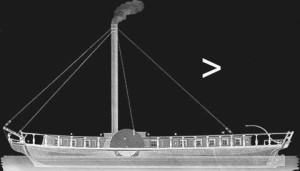
In Part 2, the reorganization of the Castle steamers into the Castle Steam-Packet Company was noted with the trials and tribulations the company sustained in the face of the cholera epidemic in 1832. The intense competition provided by the plans of David Napier ended when Napier sold his Clyde steamer fleet in 1835 after the boiler of his steamer Earl Grey exploded at Greenock.
In 1835, the Castle Steam-Packet Company could boast four steamers: Windsor Castle of 1832, Arran Castle of 1830, Dunoon Castle of 1826, and Inverary Castle of 1820, and continued to ply regularly between Glasgow, Greenock, Gourock, Dunoon, Rothesay, Loch Fyne, and Arran. Their major competitor for the Rothesay and Inveraray trade, David Napier, had offered his steamer fleet for sale, and future prospects for the Castle Company looked excellent.
“Steamers for sale.—To be disposed of by public roup, within the subscribers’ Sale Rooms, No. 164, Trongate, Glasgow, on Wednesday the 19th day of August, 1835, at two o’clock afternoon, if not previously sold by private bargain. The steamboats Kilmun, Saint Mun, Cupid, a small iron steamer lying in the River Eachaig, and the wreck of the Earl Grey. The latter, prior to the late unfortunate accident of the boiler bursting, while lying at Greenock, was the fastest boat in this country. Since that melancholy circumstance it is supposed by some that her superior speed was owing to a higher pressure of steam than that of other boats—that is not the fact. When the vessel was going, the pressure of steam was on an average not more than one-half of what is used by other boats on the river. Any person desirous of following out the trade can refit her at little more than the expense of a new boiler, she having lately undergone a thorough repair, or if a purchaser choose, shall be refitted and sold, warranted to outsail any boat on the Clyde with one-half of the pressure of steam that any competing boat that will be brought against her will use at the time. The purchaser of the Kilmun will have the exclusive use of the Quay at Kilmun, on paying the interest of its cost and keeping it in repair. A purchaser of all the boats, if desirous, may have two years time to pay up the whole price.—Barclay and Skirving.”—Glasgow Herald, July 31, 1835
Although the principal of the Napier fleet had taken himself out of the opposition to the Castle Company, the steamers passed into others’ hands. While the Loch Eck route was suspended, the Kilmun continued to sail between Glasgow and Kilmun, providing a service to the feuars there. Perhaps more importantly, two new enterprises had begun in opposition; one on the Rothesay route, and the other on the route to Loch Fyne.
In May, a new rival on the Rothesay station, the Bute Steam Packet Company, had announced that their steamer, Isle of Bute, would sail between Glasgow, Greenock, Gourock, and Rothesay, avoiding Dunoon and the Cowal shore. Stops at the numerous ferrying points along that part of the coast could add significantly to the time taken to reach Rothesay, the destination for a majority of the passengers. This was a local enterprise, and garnered a lot of support from the island inhabitants. The master of the new steamer was Captain James Johnstone, once the leading master of the Castle Company, a popular figure, and well known for his seamanship and courtesy to his passengers. It was a formidable counter to the Castle Company.
“The Isle of Bute, new steam packet, Capt. Johnstone, will commence plying in about ten days hence betwixt Glasgow and Rothesay direct, without calling at any of the intermediate places between Gourock and Rothesay. Hours of departure will be mentioned in a future advertisement.”—Glasgow Herald, May 8, 1835

Isle of Bute at Custon House Quay (Bartlett)
The Isle of Bute was a wooden vessel built by Messrs John Wood, Port-Glasgow, and supplied with an engine of 63 h.p. by Messrs Robert Napier, Camlachie. Her dimensions were 110 feet in length, 5¼ feet in breadth, and 7¾ feet in molded depth on a draft of 5 feet. A sister steamer was building with the same builders and engineers.
“For Rothesay direct, calling at Greenock and Gourock only, the Bute Steam Packet Co.’s fine swift new steamer Isle of Bute, Captain James Johnstone, of large dimensions and proportionate power, sails from Glasgow to Rothesay, every Monday, Wednesday, and Friday, at ½-past 11a.m., and every Tuesday, Thursday, and Saturday, at ¼-past 6 a.m. and ½-past 4 p.m. From Rothesay to Glasgow, every Monday, Wednesday, and Friday, at 6 a.m. and ½-past 3 p.m., every Tuesday, Thursday, and Saturday, at ½-past 10 a.m.
“The splendid and powerful new steamer Maid of Bute, now fitting up and nearly ready, will shortly join the Isle of Bute on this station, when a conveyance to Rothesay will be afforded of the most superior description. These fine steamers were built expressly to obviate an objection long complained of, by passengers for Rothesay being obliged to take the circuitous route along the Dunoon shore. Captain Johnstone has been long and well acquainted on this station; the steward’s department is conducted in the best manner and the Company trust that their endeavours to meet the wishes of the public will insure for them a share of public favour. Apply in Rothesay to Mr. John Semple; or here, to Hamilton & Brother, 240 Broomielaw Quay, Glasgow.—Glasgow 30th June 1835.”—Glasgow Herald, July 3, 1835
By sailing direct between Gourock and Rothesay, the steamer could complete three single journeys during the day. With the promised second steamer, three return journeys would be provided.
Regarding the Loch Fyne sailings, in January, the Largs and Albion were offered for sale. There was apparently no offer for the former, and she continued on the Loch Fyne station.
“Steam vessels for sale.—The fast sailing steamboat Largs, now plying betwixt Glasgow and Lochgilphead. The Largs was recently almost wholly renewed in her hull and machinery as well as in her cabins. The tonnage of the vessel is 103 91-94ths tons; her length 104 feet 4 inches; her depth of hold 10 feet, and her breadth 17 feet. The engine is of about 45 horse power, with every appurtenance in good working order. There are two excellent holds in the vessel for stowing goods, and her cabins are equal, both for excellence and accommodation, to those of any other vessel of a similar class on the Clyde.
“Also the steam-boat Albion, at present lying at the Broomielaw of Glasgow. The Albion is of the burthen of 68 87-94 tons, and she is propelled by an engine of about 32 horsepower, in good order; and the vessel may be put to work on a day’s notice. From the strength of the build of the vessel, and her great breadth in proportion to her length of beam, the Albion might be very advantageously applied to the carriage of goods.—Apply to Mr. James Whitelaw, Nos. 62 and 64, Glassford Street.—Glasgow 9th January 1835.”—Glasgow Herald, January 12, 1835
In May, and again in June, the upset price of the Largs was reduced. It should be noted that the Largs shared in the mail contract for Lochfyneside.
“Royal Mail Steam Vessel for Sale.—There will be sold by public roup, within the Exchange Sale Rooms, Glasgow, on Wednesday the 3d June ensuing, at two o’clock afternoon, if not previously disposed of by private bargain. The Royal Mail steam-vessel Largs, now employed in carrying goods and passengers, as well as the mail, between Glasgow and Lochgilphead. The Largs was recently almost wholly renewed in her hull and machinery, as well as in her cabins, and sails remarkably well. The tonnage of the vessel is 103 91-94ths tons; her length 104 feet 4 inches; her depth of hold 10 feet, and her breadth 17 feet. The engine is of about 50 horse power, with every appurtenance in good working order. There are two excellent holds in the vessel for stowing goods, and her cabins are equal, both for excellence and accommodation, to those of any other vessel of a similar class on the Clyde. Father particulars may be learned by applying to Mr. James Whitelaw, Nos. 62 and 64, Glassford Street. Mr. Whitelaw is also authorized to dispose of the vessel by private bargain, and to receive offers for her till the day of public sale.—Glasgow, May 15, 1835.”—Glasgow Herald, May 18, 1835
A month later she was advertised with the upset price reduced to £1200
In May, a new steamer, Dolphin, was placed on the Tarbert and Lochgilphead station, taking passengers and goods for the Maid of Islay. The Dolphin was built of wood in 1834 by Messrs James Lang, Dumbarton, and was 97 feet in length by 16½ feet in breadth with a depth of 8½ feet. Her engines of 42 h.p. came from Messrs Caird & Co., Greenock. Her principal owner was Robert Cochrane, a Paisley merchant on the Committee of the Union Provident Bank, and a Justice of the Peace.
“For Tarbert and Lochgilphead, calling at Greenock, Gourock, Dunoon, and Rothesay, the powerful and beautiful new steamer Dolphin, John Campbell, commander, sails every Monday, Wednesday, and Friday morning. Hours stated on the boards.
“On Mondays she will convey goods to the fine steamer Maid of Islay which sails every Tuesday from West Tarbert for Islay. Goods per Dolphin on Monday are certain of being landed in Islay on Tuesday. On Wednesday she will convey goods to the Maid of Islay which sails on Thursday for Portree in Skye, calling at Tobermory, Arisaig, Armadale, Isle Oronsay, Kylerea, Kyleakin, and Broadford. Goods leaving Glasgow per Dolphin on Wednesday will be landed at Oban on Thursday, and Portree and intermediate ports on Friday. The Dolphin has proved herself to be a superior sea boat, out-sailing any steamer on the station, and as it is resolved to keep her on the line, shippers are respectfully solicited to support her. Her accommodation for passengers are elegant, and not surpassed by any steamer from this port. The steward’s department is conducted in the best manner, and tourists will find her quite a superior conveyance.—Hamilton and Brother, 240 Broomielaw Quay, Glasgow.”—Glasgow Herald, May 25, 1835
Dolphin too, shared in the mail contract.
“For Inverary, on Wednesday first, (hour of sailing on the boards,) calling at Greenock, Gourock, Dunoon, Rothesay, Tarbert, and Lochgilphead. His Majesty’s Royal Mail Packet Dolphin, Captain John Campbell. This steamer is intended to sail for Inverary every Wednesday morning during the season; and every Monday, Wednesday, and Friday, for Lochgilphead, calling at the intermediate ports.—Hours stated on the boards.—Hamilton and Brother, 240 Broomielaw Quay, Glasgow.”—Glasgow Herald, June 22, 1835
On Saturdays, she sailed to Rothesay, returning to Glasgow on Monday morning.
“For Greenock, Gourock, Dunoon, and Rothesay,—the mail packet Dolphin, every Saturday evening at six.—Hamilton & Brother.”—Glasgow Herald, July 3, 1835
“For Lochgilphead, calling at Greenock, Gourock, Dunoon, and Rothesay, and Tarbet.—His Majesty’s Royal Mail Packet Dolphin, Capt. John Campbell, sails every Monday, Wednesday, and Friday morning with passengers and goods, and every Saturday evening, at six for Greenock, Gourock, Dunoon, Kirn, and Hunter’s Quay. Has elegant accommodation for passengers, and is the fastest packet on the station.—Hamilton & Brother, 240, Broomielaw Quay, Glasgow.
“Wanted.—A young lad who writes a fair hand, to whom a small salary will be given. Letters, stating expectations as to salary; (none else will be attended to) may be addressed to H.&B.”—Glasgow Herald, July 31, 1835
The Largs continued to serve Loch Fyne through the summer.
“For Tarbert and Lochgilphead, calling at Greenock, Gourock, Dunoon, Rothesay, and all the intermediate ports and ferries, the steam packet Largs, Capt. M‘Lean, will continue to ply regularly between Glasgow and these places, leaving the Broomielaw every Monday, Wednesday, and Friday at half past five o’clock morning, and returning the following day. The Largs carries all her cargo under hatches, has very roomy decks for the conveyance of cattle, and in every other accommodation is not surpassed by any vessel on the station. Goods for Islay will be forwarded every Monday morning, and for Skye every Wednesday morning, and if previously stored with the subscribers, will be put on board free of expense.—Apply to Drew & M‘Symon, 3, York Street, Glasgow.—31st July 1835.”—Glasgow Herald, July 31, 1835
A new steamer was also built for the Lochgoilhead route to Inverary. This was the Lochgoil, Constructed by Messrs Hunter & Dow, Glasgow 98¾ feet in length, by 14½ feet in breadth, and 8¾ feet in depth.

Lochgoil
“Inverary, Lochgoilhead, &c.,—The St. Catherine will, on Saturday next, the 23d inst., commence to ply daily to and from Lochgoilhead, conveying passengers between Glasgow and Inverary as usual. The new steamer Lochgoil is nearly completed, and due notice will be given in a future advertisement when these boats commence plying to both Lochgoilhead and Arrochar.”—Glasgow Herald, May 18, 1835
Meanwhile, the Castle Company responded to the threat of the Isle of Bute, by adding a new vessel, Edinburgh Castle, for the Rothesay route. Messrs Hunter & Dow, Glasgow, built the wooden hull, 117½ feet in length, by 16¾ feet in breadth and 10½ feet in depth. They also supplied her single cylinder engine of 75 h.p. Dunoon Castle, continued to occupy the Tarbert, Lochgilphead and Inverary sailings, while the old Inverary Castle introduced a new service from Ardrossan to Brodick, connecting twice a week with passengers brought to Rothesay. The three newer vessels, Arran Castle, Windsor Castle, and Edinburgh Castle, maintained the Rothesay station and included direct sailings between Rothesay and Glasgow, competing head-to-head with the Isle of Bute, in addition to the usual journeys that included Dunoon.
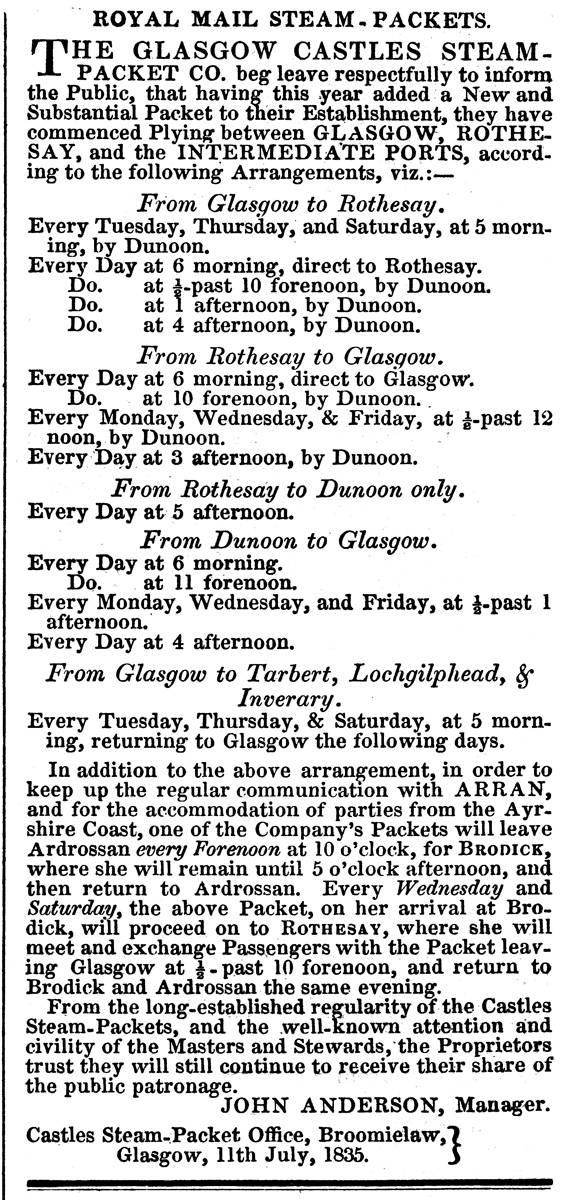
“Royal Mail Steam Packets.—The Glasgow Castles Steam-Packet Co. beg leave respectfully to inform the public, that having this year added a new and substantial packet to their establishment, they have commenced plying between Glasgow, Rothesay, and the intermediate ports, according to the following arrangements: viz.—
“From Glasgow to Rothesay.—Every Tuesday, Thursday, and Saturday, at 5 morning by Dunoon. Every day at 6 morning direct to Rothesay. Every day at half-past 10 forenoon by Dunoon. Every day at 1 afternoon by Dunoon. Every day at 4 afternoon by Dunoon.
“From Rothesay to Glasgow.—Every day direct to Glasgow at 6 morning. Every day by Dunoon at 10 forenoon. Every Monday, Wednesday, and Friday, by Dunoon at half-past 12 noon. Every day by Dunoon at 3 afternoon.
“From Rothesay to Dunoon only.—Every day at 5 afternoon.
“From Dunoon to Glasgow.—Every day at 6 morning. Every day at 11 forenoon. Every Monday, Wednesday, and Friday, at half-past 1 afternoon. Every day at 4 afternoon.
“From Glasgow to Tarbert, Lochgilphead, and Inverary.—Every Tuesday, Thursday, and Saturday, at 5 morning, returning to Glasgow the following days.
“In addition to the above arrangements, in order to keep up the regular communication with Arran, and for the accommodation of parties from the Ayrshire Coast, one of the Company’s Packets will leave Ardrossan every forenoon at ten o’clock for Brodick, where she will remain until five o’clock afternoon and then return to Ardrossan. Every Wednesday and Saturday, the above packet, on her arrival at Brodick will proceed on to Rothesay, where she will meet and exchange passengers with the packet leaving Glasgow at half-past ten forenoon, and return to Brodick and Ardrossan the same evening.
“From the long established regularity of the Castles Steam Packets, and the well known attention and civility of the masters and stewards, the proprietors trust they will continue to receive their share of public patronage.—John Anderson, Manager, Castles Steam-Packet Office, Broomielaw, Glasgow, 11th July, 1835.”—Glasgow Herald July 13, 1835
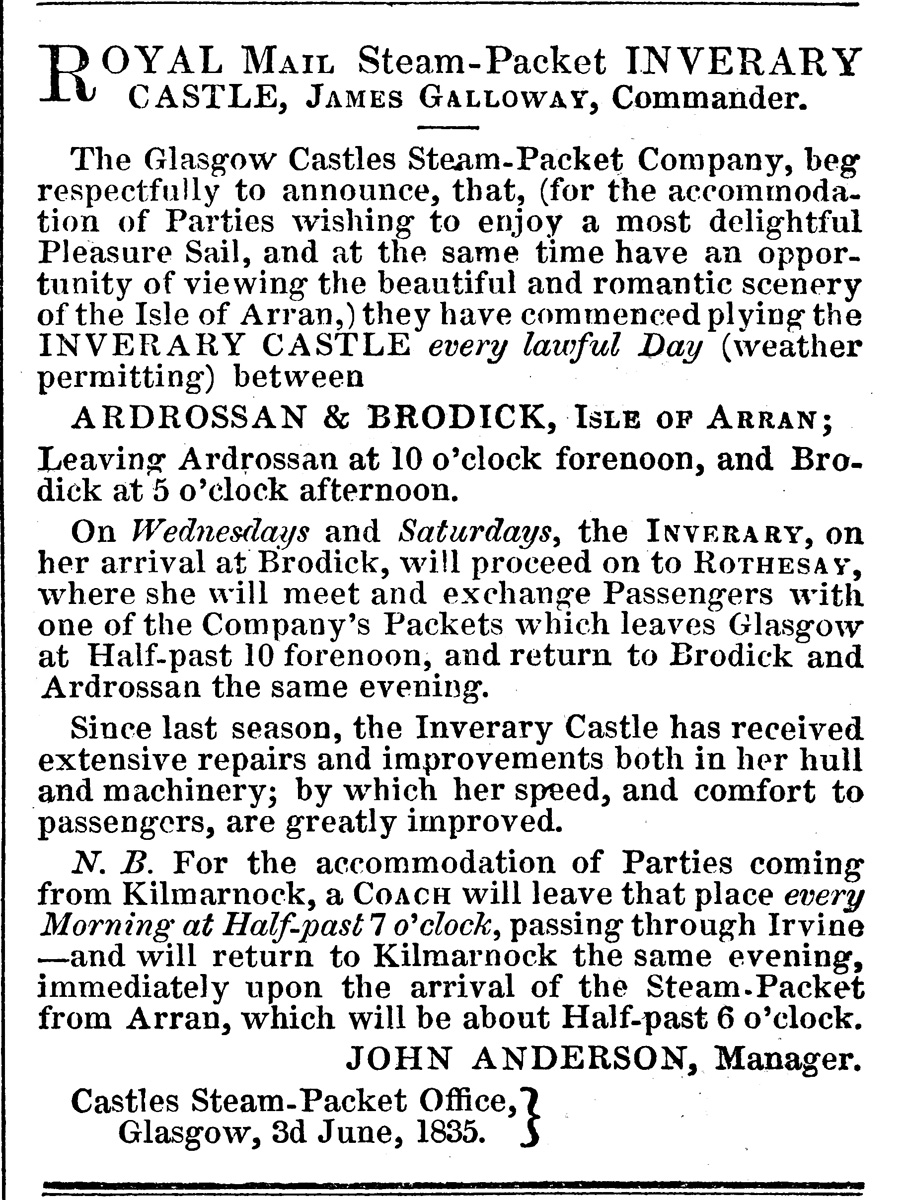
Ayrshire connections for Inverary Castle to Arran
Connections with the Cowal coast were much improved during the summer of 1835, when a pier, capable of use at all states of the tide, was opened at Dunoon. With the stone quays at Kilmun and Hunter’s Quay dating from the late 1820s, these encouraged feuing and the growth of the coastal communities. While Mr Napier’s steamers had served Kilmun and the Holy Loch, the Castle Company now had a call at Dunoon where passengers could be landed and embanked without ferry-boats.
Although the Castle steamers continued to provide the main service to the Cowal coast, Rothesay, and Loch Fyne, an important source of revenue was the sailings between Glasgow and Greenock. Competition on this route was intense. In September, the Arran Castle was involved in a serious accident with the Gareloch steamer Clarence.
“Steam-boat accident.—On Wednesday afternoon, about six o’clock, as the steamer Clarence was landing passengers at Port-Glasgow Quay, the Arran Castle, which had left Glasgow at the same hour, came in, and drove right against the starboard paddle-box of the Clarence, which she carried away, and caused great alarm to the female passengers on board both boats, who set up a loud cry. The Clarence was forced adrift, and carried away by the tide till she stuck fast upon a bank, and her passengers had to be landed in small boats. As there was good daylight at the time, and the weather was perfectly calm, it is difficult to account satisfactorily for the conduct of those on board the Arran Castle. The tide, it is true, was running pretty strong; but there was plenty of room at the quay both a-head and astern of the Clarence, to have berthed the Arran Castle without risk or damage. The whole case is a very proper subject of legal investigation, and we doubt not it will be fully inquired into. Instances of carelessness in the management of steam-boats are becoming too frequent, and the safety of human life imperatively requires that something should be done. The fore-cabin of the Arran Castle was on fire at three o’clock on Wednesday morning, while the vessel was in Rothesay Bay, but we have not heard the particulars.—Greenock Advertiser.”—Albion and Star, September 15, 1835
With the explosion of the Earl Grey, and public concern that it was the result of racing between the steamers, the Bute Steam Packet Company was careful to make sure they maintained the public’s trust.
“Isle of Bute Steam Packet.—The Bute Steam Packet Co. most respectfully informed the public that the Isle of Bute steam packet, in order to avoid any thing like competition with other steam boats sailing at the same hour, and to give greater confidence to the public, will leave Rothesay every Monday, Wednesday, and Friday morning, at a quarter before six o’clock, till further notice.”—Glasgow Herald, July 27, 1835
As the year wore on, the Maid of Bute failed to appear, and almost missed the entire season.
“The Bute Steam Packet Co.’s splendid and powerful steamer Isle of Bute—Commanded by Captain Johnston, will, in future, sail for Rothesay direct, every Monday, Wednesday, and Friday, at ¼ past 11 a.m., and every Tuesday, Thursday, and Saturday, at ¼ past 6 a.m., and ½ past 4 p.m.—The fine new steamer Maid of Bute, now nearly ready, will shortly join the Isle of Bute on the station.—Hamilton & Brother, 240 Broomielaw Quay, Glasgow, 31st July, 1835.”—Glasgow Herald, July 31, 1835
“Alteration in the hours of sailing.—Isle of Bute Steam-Packet direct to Rothesay.—The public are most respectfully informed that the above packet’s hours of sailing from Glasgow to Rothesay, on the afternoon of Tuesday, Thursday, and Saturday, till further notice, will be half-past three o’clock. The splendid and powerful new steamer Maid of Bute is now nearly ready to join the Isle of Bute on this station. Goods and parcels received at the Office, at any time, and put on board without any expense for forwarding or storage. .—Hamilton & Brother, 240, Broomielaw Quay, Glasgow.”—Glasgow Herald, August 28, 1835
The Maid of Bute did eventually appear in September.
“Isle of Bute and Maid of Bute Steam Packets, direct to and from Rothesay, calling at Greenock and Gourock. The Bute Steam Packet Company respectfully inform the public, that in consequence of the lateness of the season, the Isle of Bute steam packet will commence on Monday first, the 21st current, to make two trips only, and will sail from Glasgow to Rothesay every day at 2 o’clock p.m.; and from Rothesay to Glasgow every day at 7 o’clock a.m. As those packets go directly to Rothesay without calling at any of the stations on the Dunoon coast, the public will find this route greatly to accelerate the communication between Glasgow and Bute. Every information will be given by their Agents, Messrs Hamilton & Brother, Bute Steam Packet Co.’s Office, 240 Broomielaw Quay; or Jno. Semple, Manager, Rothesay.—Rothesay, 15th Sept., 1835.”—Glasgow Herald, September 21, 1835

Maid of Bute
The new Lochgoil on the Inveraray, by way of Lochgoilhead, route was proving popular. The old St Catherine was put up for sale at the end of the season.
“For Arrochar, with passengers to and from Lochlomond.—The St. Catherine steam boat will sail on Saturday first, at half-past one o’clock, and thereafter for a few weeks, every lawful day at half-past seven o’clock, returning to Glasgow in the evening. Passengers going by Lochlomond, on landing at Tarbert on their way up the loch, can return by Lochlong. The Lochgoil continues to ply for Lochgoilhead, with passengers to and from Inverary as usual, returning every afternoon.—Glasgow, 3d Sept., 1835.”—Glasgow Herald, September 4, 1835
“Steamer for sale.—The St Catherine steam-boat, well known on the Clyde, is for sale, by private bargain. Her dimensions are length of keel and fore rake 94 feet; breadth of beam 16 feet 4 inches; and depth of hold 8 feet 4 inches; with an engine of 34 horse power. The hull was built by John Wood & Company of Port-Glasgow. Offers in writing will be received by Forbes, Reddie & Forbes, writers, 14 Gordon Street.—Glasgow, 9th December, 1835.
Goods connections with the Maid of Islay were maintained by the Dolphin on Mondays, Wednesdays, and Fridays.
“Inverary Circuit Court.—His Majesty’s Mail Packet Dolphin, Captain John Campbell, sails for Inverary on Monday next, the 31st inst., at half-past five morning, calling at Greenock, Gourock, Dunoon, Rothesay, Tarbert, and Lochgilphead, and will sail for Inverary, calling at all the above places, on Wednesday the 2d September, at the same hour.—Hamilton & Brother, 240, Broomielaw Quay, Glasgow.”—Glasgow Herald, August 28, 1835
However, the St Mun competed with the Castle steamer, Dunoon Castle, on Tuesdays Thursdays, and Saturdays with both goods and passengers.
“For Islay and Skye.—The elegant and swift sailing steam packet Dunoon Castle, Captain Donald Currie, sails from Glasgow with goods and passengers for Tarbert, Lochgilphead, and Inverary, every Tuesday, Thursday, and Saturday, at five o’clock morning, returning to Glasgow the following days. The Dunoon Castle having very superior cabin and steerage accommodation, with roomy decks and a capacious hold for goods—takes the goods and passengers for Islay every Tuesday morning, and for Skye every Thursday morning. Goods for Islay or Skye received and stored at the Castles Steam Packet Company’s Stores, Steam-boat Quay (free of expense), and guaranteed to be forwarded on the above days from West Tarbert by the Maid of Islay, as soon as goods sent by the St. Mun, or any other vessel. Apply to John Anderson. Manager, Castles Steam Packet Company,—Glasgow, 15th August, 1835.”—Glasgow Herald, August 17, 1835
“The Maid of Islay Steam Packet will continue to ply from West Tarbert every Tuesday, leaving at 3 o’clock p.m. for Islay, and every Thursday at the same hour to Portree and intermediate ports. Goods will require to be at Tarbert a day prior to sailing, which will be regularly forwarded by whatever conveyance they may be brought to Tarbert.—Apply to Alex. Ferguson, Turner’s Court.—Glasgow, 15th Aug., 1835.”—Glasgow Herald, August 17, 1835
At the end of the year, the Dunoon Castle substituted for the Maid of Islay on the winter Tarbert to Islay route. The Arran Castle took over the normal Lochgilphead sailings of the Dunoon Castle during this period.
“Conveyance to Islay.—The Dunoon Castle will (until further notice) continued to ply regularly between Islay and West Tarbert, leaving West Tarbert for Port Askaig, every Wednesday morning at eight o’clock, returning on Thursday; and for Port Ellen, every second Friday, returning to West Tarbert on the following day. It being arranged that the Arran Castle sails from Glasgow in connection with the Dunoon. Goods or passengers going by the Arran Castle may depend upon a quick and direct conveyance to Islay. Apply to John Anderson, Manager, Castle Coy.’s Office; or Alex. Ferguson, Turner’s Court. Goods for Islay stored at the Castle Company’s Office, Steamboat Quay, Broomielaw, and put on board the Arran Castle, free of expense.—Glasgow, 3d December, 1835.”—Glasgow Herald, December 4, 1835
In January, the Inverary Castle was offered for sale by the Castle Company.
“Steam Packet for Sale.—The Glasgow Castles Steam Packet Company will expose by public sale the Inverary Castle steam packet, in the Sale Room of the New Exchange here, on Thursday the 18th day of February next at two o’clock afternoon, if not previously disposed of by private bargain. The Inverary Castle was built by Mr. John Wood of Port-Glasgow; her dimensions are length 90½ feet, breadth of beam 16 feet, depth of hold 9½ feet, draft of water about 6½ feet, and tonnage after deducting space for engine and boilers, 70 tons. Her engine, which is in good working order, is about 42 horsepower. Her boilers are in excellent condition, not having been in actual use more than eighteen months; they produce an abundant supply of steam with a reduced consumption of fuel; her inventory of stores and furniture is liberal, and all in good order; and as she has just discontinued plying, she could be started again at little or no expense, and as her draft of water renders her unsuitable for the Company’s trade, she will, to ensure a sale, be exposed at an extremely low upset price. Apply to the Master on board, at the Broomielaw; or to John Anderson, Manager, Castles Steam Packet Office, Glasgow—Glasgow, 22d January, 1836.”—Glasgow Herald, January 25, 1836
The Inverary Castle was sold to Mr. A. Barlas, who in April offered pleasure trips to Arrochar from Glasgow, before basing her at Oban from where she sailed to Staffa and Iona.
“Pleasure trip to Arrochar.—The Inverary Castle steamer will sail from the Broomielaw on each of Saturday and Monday, the 9th and 11th inst., at half-past six o’clock morning, calling at Greenock, Gourock, and Ardentinny, for Arrochar, and, after allowing time for passengers to view Loch-Lomond, will return the same evening.—Fare for the day’s sailing; cabin 3s., steerage 2s.—Glasgow, 7th April, 1836.”—Glasgow Herald, April 8, 1836
The St. Mun continued sailing to Tarbert and Lochgilphead in the early months of 1836, but by March, she was sailing to Ayr for Messrs A. Newlands, N. Currie, and J. Clark, as consort to the Nimrod.
“For Islay, Tarbert, and Lochgilphead, calling at Greenock, Gourock, Dunoon, Rothesay, and all the intermediate ports and ferries. The steam packets St. Mun, Capt. John Clarke, sails as above every Tuesday, Thursday, and Saturday, at half-past six o’clock morning, returning to Glasgow the following days. The St. Mun will receive goods for Islay all this day (Monday), and every Monday till nine o’clock evening. Apply to Mr. Alexr. Ferguson, 23, Turner’s Court.—Drew & M‘Symon, 3, York Street.—Glasgow, 11th Jan., 1836.”—Glasgow Herald, January 11, 1836
When David Napier sold his fleet of steamers in August 1835, the Kilmun was purchased by Dr. James Stevenson, and passed, together with the wreck of the Earl Grey to Messrs Alex Tennant, G. Ord, and Hugh Price. The new owners attempted to dispel the lingering cloud that hung over the two steamers regarding the use of higher boiler pressures to explain their remarkable performance. This end was largely achieved by the subsequent inquiry and acquittal of the Earl Grey’s engineer at trial.
“Kilmun steamer.—The Kilmun steamer having been lately purchased from Mr. Napier, the new proprietor thinks it right to acquaint the public that he pledges himself that in no instance will the Kilmun use a higher pressure of steam than what is regularly done by every vessel on the station. The proprietor also intimates that the River Trust are at liberty, at all times along with any number of engineers they may think proper to appoint, to examine the pressure of steam in the said vessel, when it will be incontestably proved that the pressure of steam in the Kilmun is less than what is used in the average of steam vessels on the river. Every attention will be paid to the comfort and convenience of the passengers.—Glasgow, 6th Aug., 1835.”—Glasgow Herald, August 10, 1835
By purchasing the Kilmun, the owners had exclusive access to Kilmun Quay. They had also purchased the Aglaia, and brought her down the River Eachaig. With the Kilmun and Earl Grey repaired, the new North British Steam Navigation Company under the management of Mr. Hugh Price, embarked on a service to Kilmun with coach connections to Strachur, and the Aglaia, now renamed Strachur, across Loch Fyne to Inveraray. A coach connection was also provided between Inveraray and Oban.
“North British Steam Navigation Company, Head Office, Madeira Court, Glasgow.—For Dunoon and Kilmun.—The Kilmun, Captain Wallace; the Earl Grey, Captain Ewing, will sail to and from, three times a day, calling at the intermediate ports. The hours will be seen on the boards.
“Passengers will, after the first week of June, have an opportunity of leaving Glasgow for Inverary, and Inverary for Glasgow, every morning by means of the steamers—a coach to and from Kilmun and Strachur—and the steamer to and from Strachur and Inverary. By these conveyances passengers will reach either destination by about mid-day. Early in June a coach will also be established between Inverary and Oban, from whence steamboats ply to Iona, Staffa, and Inverness.
Tickets for Greenock, Gourock, Kilmun and Dunoon, may be had by applying at Medeira Court, 263, Argyll Street.—Hugh Price, Manager, Madeira Court, Glasgow, 9th May, 1836.
The steamboat connection at Oban was the Inverary Castle.
“Regular conveyance from Oban to Staffa and Iona.—The Inverary Castle steamer will, after the 1st of June, commence, and continue throughout the season to ply, either daily or every second day as may be afterwards arranged, between the above places, calling at the usual places in the Sound of Mull, so as to afford a regular communication between the mainland and those islands, which are so justly objects of attraction to the tourist.
“The stated days and hours of departure and arrival will be announced in a future advertisement.
“In connection with the Inverary Castle, besides the steamers which usually call at Oban, there will be a regular line of communication by means of the Earl Grey and Kilmun steamers—one of which will leave Glasgow every morning at 6 o’clcok for Kilmun, from whence passengers will be conveyed by coaches to Strachur, and by a steamer across Lochfine to Inverary, and thence by a line of coaches to Oban, enabling passengers to perform an excursion from and back to Glasgow throughout the finest scenery in the West of Scotland and Western Coast, in the unprecedentedly short period of three or four days.—13th May, 1836.
“N.B.—The Inverary Castle will sail from the Broomielaw for Oban on Tuesday the 17th instant, at 12 o’clock noon.”—Glasgow Herald, May 16, 1836
The through service began on the first week of June.
“The steamers Kilmun and Earl Grey will continue to ply between Glasgow, Dunoon, and Kilmun, three times a-day, till further notice, calling at the intermediate ports. They leave Glasgow every day at half-past 6 and 10 morning, and 4 afternoon.
“A coach has commenced plying between Kilmun and Strachur—from the latter place a steamer will ply to and from Inverary, leaving there every morning about 6, with the passengers for Glasgow—passengers for Inverary will leave Glasgow every morning at half-past 6 for Kilmun, from whence the coach will leave about 10, passing along the beautiful banks of Loch Eck, and arriving at Strachur about noon, and Inverary about 1.
“A coach will start early in June from Inverary to Oban, from whence the steamer Inverary Castle will ply to Iona and Staffa, thus affording to travellers a cheap and expeditious mode of visiting the most beautiful and interesting scenery in Scotland.
“Tickets for Greenock, Gourock, Dunoon, and Kilmun, may be had by applying at the North British Steam Navigation Company’s Office, Madeira Court, 263 Argyll Street.—Hugh Price.—Glasgow June 2, 1836.”—Glasgow Herald, June 3, 1836
An additional tourist route was introduced for the steamer Strachur, by coach through Glencroe to link with the Lochlomond tour and allowing passengers by the Dumbarton steamers an opportunity to reach Inveraray.
“The steamer Strachur will leave Inverary for Cairndow on Monday the 18th July at 8 o’clock morning precisely, and continue to ply every lawful day thereafter during the season. At Cairndow a coach waits to convey passengers to Tarbet by Glencroe, to meet the Lochlomond steamer. Passengers taking this route leave Glasgow at half-past 6 o’clock morning, by the Vale of Leven or New Dumbarton steamers, and arrive at Inverary about 8 o’clock same evening. Passengers leaving Inverary, per Strachur steamer at 8 o’clock morning, will arrive at Glasgow, per same conveyance about 8 o’clock evening. Sufficient time allowed at Cairndow for breakfast, and Tarbet for dinner, after the arrival of the steamers, before the coach starts.—Tarbet,14th July, 1836.”—Glasgow Herald, July, 1836
The alternative route to Inverary, by Lochgoilhead, also saw a development and a new steam ferry between St Catherine’s and Inveraray on Loch Fyne.
“Inverary, Lochgoilhead, &c.—The Lochgoil will, on Tuesday next, the 10th instant, commence to ply daily to and from Lochgoilhead, conveying passengers between Glasgow ad Inverary, as usual. The Company have contracted for a new steam boat, to be placed on the ferry between Inverary and St. Catherine’s, which is expected will commence plying in the course of a few weeks.—6th May, 1836.”—Glasgow Herald, May 6, 1836
In July, the new ferry was introduced as the Argyll.
“Steam conveyance to and from Inverary by Lochgoilhead.—The steamer Lochgoil sails every morning for Lochgoilhead, with passengers for Inverary, as usual, at 7 o’clock, and the new steamer Argyll will leave Inverary Quay every lawful day or at 9 o’clock, with those passengers who prefer to walk across to Lochgoilhead, and the same steamer will leave Inverary with passengers for the coaches at a quarter before 10 o’clock. The said boat will wait the arrival of the passengers from Glasgow to convey them from St Catherine to Inverary. This line of communication between Glasgow and Inverary, by the establishment of the steam boat on the ferry, is rendered perfectly complete. The scenery is the most splendid, romantic, and mountainous, and at once a delightful route for the tourists and a pleasant and expeditious one for travellers.—Glasgow ,15th July, 1836.”—Glasgow Herald, July 18, 1836
With the sale of the Inverary Castle, the elderly lady of the Castle Company was now the Dunoon Castle, and she continued to sail on the Loch Fyne connection with the Maid of Islay that over the winter season maintained a weekly connection with Islay.
“Regular conveyance for goods and passengers to Islay and Skye the Dunoon Castle leaves Glasgow for Greenock, Rothesay, Tarbert, and Lochgilphead, every Tuesday, Thursday, and Saturday, at half-past six o’clock morning. Every Tuesday morning the Dunoon conveys the goods and passengers to Tarbert for the Maid of Islay for Islay. Every Thursday morning the Dunoon conveys the goods and passengers to Tarbert for the Maid of Islay for Oban, Tobermory, Broadford, and Portree and Skye. Every Saturday morning the Dunoon proceeds to Inverary, returning to Glasgow the following Monday. Every Wednesday morning the Dunoon leaves Lochgilphead at six o’clock, and Tarbert at eight o’clock, bringing to Glasgow the goods and passengers have Maid of Islay from Skye. Every Friday morning the Dunoon will leave Lochgilphead at six o’clock, and Tarbert at eight o’clock, bringing to Glasgow the goods and passengers per Maid of Islay from Islay. Goods for Islay or Skye carefully stored in the Castle Company’s Store, Broomielaw, and put on board the Dunoon free of expense. Fares and freight for the above places extremely moderate. Every information will be respectfully given by applying to John Anderson. Manager, Castle Co.; Alex. Ferguson, Turner’s Close; or John M‘Calman, Agent, Tarbert.—Castle Company’s Office.— Glasgow 1st April 1836 “—Glasgow Herald, April 1, 1836
The Castle Company also announced on the first of April that they were “building a new elegant and commodious packet, built expressly to run as a consort to the Dunoon Castle. It is expected that she will commence plying early in May when a daily service between Glasgow and Lochfine will commence.” The new steamer was an attempt to drive the competition from the Loch Fyne trade.
“Launch.—On Wednesday last Messrs. Wood and Mills launched, from their building-yard at Douglass, a new steam-packet named the Tarbert Castle, which is destined for the Glasgow and Lochfine trade.—Glasgow Constitutional.”—Public Ledger, April 27, 1836
The new wooden paddle steamer, built at the Littlemill yard of Messrs Wood & Mills, Dunglass, was 122¼ feet long by 19 feet in breadth and 10 feet depth. Her machinery was supplied by Messrs Murdoch, Aitken & Co., and was of 100 h.p. She was advertised in the middle of May in connection with the Maid of Islay, though the daily service to Loch Fyne had not yet commenced.
“Islay and Skye Steam Packet Maid of Islay.—The public is respectfully informed, that on Tuesday the 17th inst., the Maid of Islay steam-packet will commence her summer arrangements, by leaving West Tarbert for Islay, on that day, at 3 o’clock afternoon, returning from thence on Thursday morning at 4 o’clock. On the arrival of the passengers at Tarbert, they will immediately be conveyed to Glasgow by one of the Castle Company’s packets.
“On Thursday the 19th, the Maid of Islay will leave West Tarbert, at 3 o’clock afternoon, for Oban, Tobermory, and Skye, leaving Portree again for Tarbert on Monday at 4 o’clock morning. She will arrive at Tarbert early on Tuesday morning, and the passengers will immediately be conveyed to Glasgow by one of the Castle Company’s packets.
“The Dunoon or Tarbert Castle leaves Glasgow with the passengers for Islay, every Tuesday morning at half-past 5; and with the passengers for Oban. Tobermory, and Skye, every Thursday morning, at the same hour; but all goods for either of the above places must be sent to the Castle Company’s Store, Broomielaw, so as to be forwarded to West Tarbert the day before, viz., goods for Islay on Saturdays, and for Skye on Tuesdays, otherwise they will be detained a trip. The Maid of Islay will continue to ply to Islay and Skye weekly, according to the above arrangements. until further notice. Apply to—John M‘Donald, Agent, West Tarbert, John M‘Calman, Agent, East Tarbert; or here to John Anderson, Manager, Castle Steam Packet Office.— Glasgow, 9th May, 1836 “—Glasgow Herald, May 16, 1836
The Castle Company began their service to Arran in May. There was no longer a Castle Company connection with the Ayrshire coast; the Arran service was twice weekly by way of Rothesay.
“Regular steam conveyance to Arran.—The Edinburgh Castle steam packet sails from Glasgow for Arran on Thursday the 26th inst., at one o’clock afternoon, returning from Brodick the following morning at seven o’clock. It is intended that, during the summer, one of the Castle Company’s packets will leave Glasgow for Arran every Wednesday and Saturday, at one o’clock, returning on Thursday and Monday, at seven morning.—John Anderson, Manager, Castle’s Steam Packet Office, Glasgow, 21st May, 1836.”—Glasgow Herald, May 23, 1836
There was still the opportunity for mischief on the steamers.
“Narrow escape.—On Saturday last, the Edinburgh Castle steamer left Glasgow with a full cargo of passengers, principally composed of young people spending the fair. When the vessel arrived at Port Glasgow, the greatest ardor was displayed, in the spite of all remonstrances, to jump ashore even before the vessel had been fastened to the quay. In attempting this foolish feat, one of the young men fell into the river, and the utmost anxiety prevailed regarding him. One of the lads who takes charge of the ropes ashore instantly leaped in to his rescue, and succeeded after a narrow escape in being pressed to death against the quay, in bearing the drowning person to a place of safety. As the steamer was leaving by this time, a passenger, who had witnessed the spirited deed, bundled up a pound note, and attempted to throw it ashore to the individual who had saved the other, but unfortunately it was blown into the river. In an instant he was again in the water, but the people on board the Edinburgh Castle were gratified, as they left the shore, with hearing a loud cheer from the spectators of his activity on the quay, as he again mounted the steps with his prize in his hand.—Inverness Journal, July 29, 1836
With five steamers available, the Castle Company continued to provide a frequent service to Rothesay, strongly competing with the Bute Steam Packet Company’s vessels Isle of Bute and Maid of Bute.
“Direct sailing to and from Glasgow and Rothesay calling at Greenock and Gourock.—The Bute Steam Packet Company most respectfully informs the public that they have this year added to their establishment another new vessel, and that their packets, the Isle of Bute and Maid of Bute, will ply direct during the spring and summer months, till further notice, as follows:—From 21st March to 1st June.—From Glasgow every lawful day at half-past 7 o’clock morning and 2 afternoon.—From Rothesay at 7 o’clock morning and 2 afternoon. From 1st June to 1st September.—From Glasgow every lawful day at 6 o’clock morning, half-past 11 forenoon, and half-past 4 afternoon.—From Rothesay at 6 o’clock morning, 11 forenoon, and 4 afternoon. Parcels are received and forwarded, and every information given, at the Bute Steam Packet Company’s Office, 240, Broomielaw Quay; or here by Jn. Semple, Manager.—Rothesay, 7th March, 1836.
Later, the Company added:—“N.B. This Company will not hold themselves responsible for any parcels put on board these vessels, unless regularly entered at the respective offices.”—Glasgow Herald, March 11, 1836
The summer time-table provided three direct sailings each way between the Broomielaw and Rothesay, calling only at Greenock and Gourock.
“Direct sailing to and from Rothesay, per Isle of Bute & Maid of Bute steamers.—The Bute Steam Packet Company most respectfully inform the public, that on and after Wednesday, 1st June, there will be three departures daily, as under:—From Glasgow—at 5 o’clock morning, half-past 11 forenoon, and half-past 4 afternoon.—From Rothesay—at 6 morning, 11 forenoon, and 4 afternoon. Parcels are received and forwarded, and every information given, at the Bute Steam Packet Company’s Office, No. 18, Broomielaw Quay, by Alex. Shields; or here, by John Semple, Manager.—Rothesay, 26th May, 1836.”—Glasgow Herald, May 30, 1836
For the competition on the Loch Fyne station, the Largs was laid up and offered for sale at a slowly diminishing upset price in the early months of the year. The Dolphin continued, restricting her sailing to Rothesay in the early part of the year, then, beginning in June, to Tarbert.
“Pleasure sail on Thursday the 7th April. —The powerful new Mail Steamer the Dolphin, Capt. Campbell, will sail on Thursday the 7th instant, at half-past 5 morning, for Tarbert calling at Greenock, Gourock, Dunoon, and Rothesay, and return in the evening. Fares for the whole day’s excursion—cabin, 3s.—steerage 2s. Refreshments of all kinds to be had on board at moderate rates.—Hamilton & Brother, 240, Broomielaw Quay.”—Glasgow Herald, April, 1836
“Reduced fares, and direct and rapid conveyance to Lochfine.—His Majesty’s Mail Packet Dolphin, Capt. Kennedy, will sail on Wednesday next, the 1st June, at half-past 12 afternoon, for Tarbert, calling at Greenock, Gourock, and Dunoon; and continue to do so every day at the same hour (excepting Saturday), returning from Tarbert at an early hour every morning except Monday, calling at all the above places. Fares to Tarbert, cabin, 1s.; steerage, 6d. A more speedy conveyance to Lochfine has long been wanted, and to accomplish this with greater facility and comfort to passengers, the Dolphin will take passengers and their luggage only, carrying no goods; and by this means the detention occasioned by landing goods at so many different places will be avoided, and this, combined with not calling at Rothesay, will afford a conveyance to Lochfine hitherto unequalled.—Sails for Greenock and Gourock every Saturday evening at six.—cabin 1s.; steerage, 6d.—Hamilton & Brother, 240 Broomielaw Quay, Glasgow.”—Glasgow Herald, May 30, 1836
Despite a reduction in fares, she could not compete with the daily sailings of the Castle steamers, and in July, she was offered for sale.
“Steamer for sale.—To be sold within the Royal Exchange Sale Rooms, Glasgow, by public roup, on Wednesday the 27th day of July next at 2 o’clock afternoon, unless previously disposed of by private bargain. All and whole that fine steamer called the Dolphin, of Glasgow, of the burthen of 73 22-94th tons register, with her boats, float, machinery, boilers, furniture, materials, and haill apparelling and appurtinances; which steamer is of 56 horse power, and her machinery by Caird and Co. She is elegantly fitted up in main cabin, which is large and lofty. The gentlemen’s, ladies’, and dining cabins are handsome, and steerage commodious. Sails very fast on a light draft of water; 14 months old. Her hull is very strong—length 96 feet 9 inches; breadth (within the paddle boxes) 16 feet 4 inches; depth 8 feet 6 inches. For farther particulars, apply personally, or by letter post-paid, to Russell and Kerr, writers, 18, Glassford Street, Glasgow; or Hamilton & Brother, 240, Broomielaw Quay, Glasgow.”—Glasgow Herald, July 1, 1836
This fine steamer was sold to sail for the western isles.
As the season wound down, services were reduced.
“Hours of sailing altered to and from Rothesay.—The Isle of Bute, or Maid of Bute steam-packets, will commence on Wednesday first, the 7th September, to sail as under till further notice. From Glasgow, at 7 o’clock morning, and 3 o’clock afternoon. From Rothesay, at 7 o’clock morning, and 12 o’clock noon. For accommodation of those who may be desirous of arriving at Glasgow early on the Monday mornings, one of these packets will leave Rothesay at 6 o’clock. Parcels are received and forwarded, and every information given, by Alexr. Shields, Bute Steam-Packet Company’s Office, 18 Broomielaw; or here, by John Semple, Manager.—Rothesay, 3d Sept., 1836.”
The Castle Company ceased the Arran sailings in October.
“Steamers to Arran.—The public is respectfully informed that the Castle Steam Packet Company will cease plying their packets to and from Arran for the season, after Monday the 10th October. They will sail to Brodick and Lamlash, as usual, every Wednesday and Saturday until that date.—Glasgow, 28th Sept., 1836.”—Glasgow Herald, September 30, 1836
While undergoing repairs on Messrs Hunter & Dow’s slip, the Dunoon Castle caught fire.
“On Wednesday night, the Dunoon Castle steamer, undergoing repair at Hunter’s yard, nearly opposite Govan, in the Clyde, accidentally caught fire, when almost the whole of the interior of the vessel, from the quarter-deck forwards, was destroyed. The machinery was not in the vessel at the time. We understand that the steward had a good deal of property consumed.—Caledonian Mercury, October 29, 1836.
The new year saw the Castle Company in a stronger position than they had been for quite some time. They now had a virtual monopoly of the Loch Fyne trade. They were holding their own against the Bute Steam Packet Company vying for Rothesay. Growing traffic on the Cowal shore, as feuing developed, was also in their hands, although a new opposition steamer, Express, had appeared, sailing to Dunoon. More important, they had a new steamer building, a new venture with an iron hull.
The old Dunoon Castle continued to be the workhorse in the winter service to Loch Fyne. She would be paired with the Tarbert Castle to provide a daily service to Tarbert and Lochgilphead during the season.
“Regular conveyance twice a-week to and from Islay.—The Dunoon Castle steam-packet sails from Glasgow every Tuesday and Thursday mornings for Islay. The Islay steam packet will leave Port-Askaig every Tuesday and Thursday mornings for Glasgow. The above packets meet at Tarbert in the evenings, and goods and passengers forwarded to Islay and Glasgow early next morning. Arrangements are now made that in the course of next month passengers leaving Glasgow for Islay in the morning will arrive there the same evening. Also passengers leaving Islay in the morning will arrive in Glasgow same day about four in the afternoon.—John Anderson, Manager.—Castle Steam Packet Office.—Glasgow, 18th March, 1837.”—Glasgow Herald, March 20, 1837.
“Dunoon and Rothesay Steam Packets.—On Monday, the 24th April, and until further notice, the Edinburgh or Windsor Castle will leave Glasgow for Greenock, Gourock, Dunoon, and Rothesay, every afternoon at one and four o’clock.—John Anderson, Manager.—Castle Steam Packet Office.—Glasgow, 21st April, 1837.”—Glasgow Herald, April 24, 1837.
For their new steamer, the Castle Company had gone to Messrs Tod & McGregor, whose Mavisbank yard was by this time one of the most experienced in iron shipbuilding on the Clyde. The Rothesay Castle was 133¾ feet long by 17 feet breadth and 8½ feet in depth. Her single cylinder engine provided 90 horse-power.

Rothesay Castle
“New Castle Steamer.—Tuesday the trial sail of a splendid new steamer, built for the Castle Steam Packet Co., took place, and the result has demonstrated that the progress of improvement in propelling steam vessels has by no means being exhausted. This steamer, named the Rothesay Castle, left the Broomielaw on Monday morning shortly after the James Oswald and Kilmun, and very soon passed both, reaching Greenock in the short space of one hour and thirty-five minutes. She proceeded direct to Rothesay, where she arrived after a passage from Glasgow of two hours and fifty-five minutes. In the course of her return, she fell in with the Express and Brenda, and outsailed both; and in one word proved herself to be by far the quickest sailing steamer in the Clyde. She is commanded by Captain Dugald Thomson, one of the most skillful and attentive captains that ever managed a vessel; and was built by Messrs Todd and M‘Grigor. The Castle Company deserve the greatest praise for thus placing their vessel a-head of all others in point of speed, as they have long been in point of comfort and elegance.—Scots Times.”—Glasgow Herald, May, 1837
“Royal Mail Steam Packets.—Rothsay Castle, Tarbert Castle, Edinburgh Castle, Dunoon Castle, Windsor Castle, Arran Castle.—The Glasgow Castle Steam Packet Company respectfully announce that on and after Monday the 5th June, their sailing arrangements for the season will be as under:—From Glasgow at 6 morning, for Lochfine by Dunoon and Rothesay; ten forenoon, for Dunoon; ½-past ten for Rothesay and Port Bannatyne direct; one afternoon, for Rothesay by Dunoon, four afternoon, for Rothesay direct; ½-past five afternoon for Dunoon. From Rothesay at six morning, for Glasgow direct; nine morning, for Glasgow by Dunoon; one afternoon, for Glasgow by Dunoon; ½-past four afternoon, for Glasgow by Dunoon. From Dunoon for Glasgow, at six morning; ten forenoon; one afternoon; two afternoon; ½-past five. From Gourock for Glasgow, at ½-past six morning; seven morning; ½-past ten forenoon; ½-past one afternoon; ½-past two afternoon; six afternoon. From Glasgow to Arran every Wednesday and Saturday at one afternoon, returning to Glasgow every Monday and Thursday morning.—John Anderson, Manager, Castle, Steam Packet Office, Glasgow ,1st June, 1837”—Glasgow Herald, June 2, 1837
“Dunoon and Rothesay Steamers.—On and after the 19th instant, one of the Castle Company’s Packets will leave Rothesay for Dunoon, Greenock, and Glasgow, at eight instead of nine morning, and the packet leaving Glasgow for Rothesay, at four afternoon, will call at Dunoon as formerly.—John Anderson, Manager.—Glasgow, 16th June, 1837.”—Glasgow Herald, June 19, 1837.
The Bute Steam Packet Company provided a lively opposition for passengers to Rothesay.
“The Royal Mail Steam Packets Isle of Bute & Maid of Bute, direct to and from Glasgow and Rothesay will commence on Friday the 7th of April, to sail as under till further notice:—From Glasgow to Rothesay, every lawful day at 9 o’clock morning and 2 afternoon. From Rothesay to Glasgow, every lawful day at 7 o’clock morning and 3 afternoon. Goods and parcels received and forwarded, and every information given, by applying to A. Shields, Bute Steam Packet Company’s Office, 18, Steam Boat Quay; or here, to John Semple, Manager.—Rothesay, 28th March, 1837.”—Glasgow Herald, March 31, 1837
Later, they added a proviso regarding parcels. Theft was a considerable problem on the steam-boats.
“N.B.—This Company will not hold themselves responsible for any parcels put on board, unless regularly entered at either of the Company’s Offices.”—Glasgow Herald, April 3, 1837.
The summer schedule was curtailed from the previous year, offering only two return journeys each day. However, the Company introduced an omnibus to take passengers from the Trongate in Glasgow to the steamboat wharf that was at the time a considerable distance below the bridges.
“Direct sailing to and from Glasgow and Rothesay.—The Isle of Bute, or Maid of Bute Royal Mail Steam Packets will sail as follows, till further notice:—From Glasgow, every week day at half-past 11 o’clock forenoon, and half-past 4 o’clock afternoon. From Rothesay, every weekday at 7 o’clock morning, and 4 o’clock afternoon, except Monday, when the morning boat will sail at half-past 5 o’clock. Parcels are received and forwarded, and every information given, by Alexr. Shields, Bute Steam-Packet Company’s Office, 18 Broomielaw; or here, by John Semple, Manager.—Rothesay, 1st June, 1837.”—Glasgow Herald, June 2, 1837
“Hour of sailing altered to Rothesay from half-past 4 to half-past 3 afternoon.—In order to avoid as much as possible any striving with other steamers, as well as to accommodate the public by affording a greater diversity in the hours of sailing, the Bute Steam Packet Company respectfully inform the public that their packets, the Maid of Bute, Capt. Johnstone, Isle of Bute, Capt. Hunter, direct to and from Rothesay calling at Greenock and Gourock will sail as under till further notice.—From Glasgow, at half-past 11 o’clock forenoon, and half-past 3 o’clock afternoon. From Rothesay, at half-past 6 o’clock morning and at 4 o’clock afternoon. One of the company’s packets will leave Rothesay earlier on the Monday mornings. Hours of sailing to be seen on the boards. An omnibus will start every day from 78, Trongate, for the half-past 3 o’clock boat.—John Semple, Manager.—Rothesay, 12th June,1837.”—Glasgow Herald, 16th June, 1837
In 1837, the first signs of “Railway Mania” impacted the Clyde. In 1835, an Act of Parliament had authorized a railway between Paisley and Greenock, and the construction of a wharf at Renfrew. This initially horse-drawn railway opened in April, and the presence of the wharf accelerated the down-river journey. In July, 1837, an Act for the Glasgow, Paisley, and Greenock Railway was passed, much to the chagrin of the steam-boat owners who had a virtual monopoly of the traffic between Glasgow and Greenock.
The Lochgoilhead route to Inveraray continued in popularity.
“Conveyance between Glasgow and Inverary, by Lochgoilhead.—The fine steamer Lochgoil, Capt. Graham, will recommence plying on the above station on Wednesday first, and will continue to sail every Tuesday, Thursday, and Saturday morning at seven o’clock, for Greenock, Ardentinny, and Lochgoilhead;—and on Monday, Wednesday, and Friday mornings, at the same hour, for Greenock only. The Lochgoil will leave Greenock for Glasgow every afternoon at three o’clock.
“N.B.—The coach between Lochgoilhead and St Catherine’s, and the steamer Argyll, on the ferry to Inverary, will run as formerly.—Glasgow, 27th Feb., 1837.”—Glasgow Herald, February 27, 1837
However, the rival route by Kilmun and Loch Eck was withdrawn, despite the efforts to provide an ongoing coach to Oban and an associated connection to Staffa and Iona by the Inverary Castle. The Loch Fyne ferry, Strachur (ex Aglaia) was offered for sale in June and was purchased by Messrs Todd & Higgenbotham to connect workers between their cotton works at Springfield and their new soda works at Dalmuir.
“Steamboat for sale, by auction, if not previously disposed of by private contract. To be sold by public auction on Wednesday the 7th day of June next at two o’clock, in the Auction Rooms of Curlee & Railton, Sydney Court, No. 62, Argyll Street. The steam boat Strachur, as she now lies opposite the Humane Society House, above the Bridges. She is well adapted for a ferry or passage boat across rivers or arms of the sea, or for tracking vessels, having good accommodation for passengers and goods; she is iron-built, about 40 tons burden, and having lately undergone a thorough repair, is, with her machinery, in the best order, and ready for working at an hour’s notice. To ensure a sale, this vessel will be put up at the low upset price of £350.—For particulars, apply to Mr. Wm. Perry, No. 19, Cochran Street, who is empowered to conclude a private sale.—Glasgow, 26th May, 1837.”—Glasgow Herald, June 2, 1837
The Inverary Castle was withdrawn from Oban, and was sailing from the Broomielaw to Dunoon and Kilmun during the season, at the end of which she was offered for sale
“Cheap sailing.—The Inverary Castle steam-boat will sail every day, till further notice, from the Broomielaw for Greenock, Gourock, Dunoon, Hunter’s Quay, and Kilmun. Hours of sailing to be seen on the boards. Fares—cabin, 1s. 6d.; steerage, 1s.”—Glasgow Herald, July 15, 1837
“Steam-boat for sale.—To be sold by public roup, within the Royal Exchange Sale-rooms, Glasgow, on Thursday the 9th day of November, at 1 o’clock p.m., the steam-boat called the Inverary Castle, with her whole machinery and appurtenances, as she at present lies at the Broomielaw. For particulars apply to Mr. Allan Cuthbertson, accountant in Glasgow, Mr. John Kerr, writer, there; or to J. & J. Hamilton, writers, there, the latter of whom are in possession of the title deeds and articles of roup.— Glasgow 12th October 1837.”—Glasgow Herald, October 16, 1837
The Kilmun and Earl Grey continued sailing to the Holy Loch and Dunoon, maintaining their exclusive use of Kilmun quay by serving David Napier’s feuars.
“Kilmun or Earl Grey, steamers, have now commenced running for the season, or till further notice, leaving the Broomielaw every morning at seven, every forenoon at ten, and every afternoon at half-past four o’clock, calling at Greenock, Gourock, Dunoon, and Kilmun; and leaving Kilmun for Glasgow, every morning at a quarter to five, every forenoon half-past ten, and every afternoon half-past three o’clock, calling at Dunoon, Gourock, and Greenock.—Glasgow, 1st June, 1837.”—Glasgow Herald, June 9, 1837
A new wooden steamer had been launched at the end of 1836 from the yard of Messrs Robert Barclay, Stobcross, and was placed on the Broomielaw and Dunoon station at the end of April, with Messrs Hugh Price, her Captain Colin McGregor, and Mr Robert Watson as principal owners. She was 130½ feet in length by 16½ feet in breadth on a draft of 7 feet. She had received a 70 h.p. engine by Messrs Tod & McGregor, Glasgow, and was a fast and handy vessel.
“The fast sailing steamer Express, Captain Watson, will sail from Glasgow on and after this day (Friday), at three afternoon, for Greenock, Gourock, and Dunoon.—Leaving the Holy-Loch every morning at five, Dunoon at half-past five, Gourock at six, and Greenock at half-past six.—Glasgow, 28th April, 1837.”—Glasgow Herald, April 28th, 1837
In August, the Express reduced her fares to Dunoon, forcing the Castle Company to match.
“Reduced fares.—The public are respectfully informed, that in the steamer Express the reduction of fares is general—cabin, 1s 6d.; steerage, 1s.—alike to all, without distinction. The public have now an opportunity of shewing whether they wish to encourage competition or to support monopoly on the Dunoon and Rothesay line. The Express is equal in speed and comfort to any boat on the Clyde, and will be continued on the station. She leaves Glasgow every afternoon at 4.—August 25th, 1837.”—Glasgow Herald, August 25, 1837
“Reduction of fares by all the Castle Company’s Packets, to and from Glasgow, Gourock, and Dunoon: cabin—one and sixpence steerage; steerage—one shilling.—Glasgow 24th August, 1837.”—Glasgow Herald, August 25, 1837
The following year, the Express was sailing to Helensburgh and the Gareloch.
With a successful year behind the Rothesay Castle, and with the threat of a new competitor on the Loch Fyne station, the Castle Company returned to Messrs Tod and M‘Gregor for a sister vessel. As part payment, three of the Castle fleet were offered for sale.
“Steam-packets for sale.—The undermentioned well-known steam-packets, viz:—Edinburgh Castle, built in 1835; her length on deck is 117 feet; breadth of beam 17 feet ;103 86-94th tons register; has a side lever engine of 75 horse-power, and draws about 5 feet water. Windsor Castle, built in 1832; length on deck 110 feet; beam 16 feet; 80 8i-94th tons register; has a side lever engine of 55 horse-power, and draws about 4½ feet water. Arran Castle, built in 1830; length on deck 101 feet; beam 14 feet 8 inches; 71 tons register; has a side lever engine of 48 horse-power, and draws about 4½ feet water. The above packets are all built of British oak and coppered, are in the best possible condition both as regards hull and machinery, and are well known upon the Clyde for speed and elegant accommodation. They are well supplied with stores, and could be put upon any station without any expense whatever. For further particulars apply, if by letter post-paid, to Tod and M‘Grigor, engineers, Glasgow.—Glasgow, 10th November, 1837.”—General Advertiser, November 25, 1837
However, the first of the Castle steamers to be sold was the new Tarbert Castle, just two years old. She was purchased at the end of March by the Montrose and Forth Steam Navigation Company, and sailed for them successfully for a number of years.
“The Montrose and Forth Steam Navigation Company’s powerful steam vessel Tarbert Castle, arrived at Montrose from the Clyde on Saturday afternoon, having steamed thither in the very short space of 52½ hours! She began plying betwixt that port and the Forth, on Tuesday morning, under very auspicious circumstances, having on board, in addition to about 70 passengers, 56 tons of goods, 125 sheep, and four oxen.”—Caledonian Mercury, April 7, 1838
The hull for the new Castle steamer was launched later the same month by Messrs Hedderwick & Rankin, Glasgow, and Messrs Tod & M‘Gregor supplied a powerful steeple engine of 90 h.p. She was named Tarbert Castle, and destined, like her namesake, for the Loch Fyne trade. She was only just in time as an opposition steamer, the Argyle, had been launched in the middle of February, and was close to entering service.
“New steamer for Tarbert, Lochgilphead, and Inverary.—The public are respectfully informed that the splendid and powerful new steamer Argyll, being now almost completed, will be placed on the above station in the course of a few days, leaving Glasgow every Tuesday, Thursday, and Saturday mornings, and returning on the following days. The Argyll has been fitted up in a very superior and commodious manner, and her cabins finished in the most superb style. The power of her engines also is such as to ensure the greatest attainable speed. As the trade on this station hitherto has been exclusively monopolised by one Company, shippers as well as passengers will find it in their interest to encourage and support this superior steamer, which has been built expressly for this station.”—Glasgow Herald, April 6, 1838
The Argyle, or Argyll as she was better known, was a wooden steamer built by Messrs Robert Duncan, Greenock. Her dimensions were 118¾ feet length by 18½ feet breadth and 9¾ feet depth, and her machinery was supplied by Messrs Smith & Rodger, Glasgow.
“The public are respectfully informed that the splendid and powerful new steamer Argyll, Captain Wm. Ewing, has commenced plying between Glasgow and Inverary, calling at Greenock, Gourock, Dunoon, Rothesay, Tarbert, and Lochgilphead, leaving Glasgow every Tuesday, Thursday, and Saturday for Lochgilphead, and on Saturdays she will proceed to Inverary; and will return every Monday, Wednesday, and Friday. As the Argyll has been built expressly for this trade, with spacious accommodation for both goods and passengers, her proprietors confidently trust that she will meet with a fair share of support. For freight or passage, apply to H. Price, 251, Argyll Street.—Glasgow, 20th April, 1838.”—Glasgow Herald, April 20, 1838
Initially, the new Argyll was well placed to take much of the Maid of Islay trade from the aged Dunoon Castle. While daily conveyance of tourists and regular passengers to Inveraray was by Lochgoilhead, a route that was well supported and very well run, the weekly visits of the steamer from Glasgow were important for goods for the inhabitants and merchants of Inveraray and the other localities on Lochfyneside. Having competition of the route had the promise of reducing the freight on essentials brought in from Glasgow.
For tourists to Inveraray, the Lochgoilhead route ran throughout the year.
“Inverary, by Lochgoilhead.—The steamer Lochgoil will commence on Monday the 9th of April next to ply every lawful day to and from Lochgoilhead, conveying passengers between Glasgow and Inverary, as usual.—29th March, 1838”—Glasgow Herald, April 2, 1838
The Maid of Islay sailed to Islay in winter, but during the tourist season sailed to Skye, Staffa, and Iona, and other destinations on the western seaboard.
“Conveyance twice a-week between Glasgow and Islay.—The Maid of Islay steamer will, on and after Tuesday, the 25th instant, (till further notice,) sail from West Tarbert for Islay, every Tuesday and Thursday afternoon, returning every Thursday and Saturday morning. Passengers leaving Glasgow on Tuesday and Thursday morning with the Castle Company steamer will arrive in Islay the same evening; and passengers leaving Islay every Thursday and Saturday morning will be conveyed to Glasgow same day by one of the above Company’s steamers.—Hours of sailing to be seen on the boards. All heavy goods for Islay must be forwarded to Tarbert every Monday and Wednesday. Apply to Mr. Anderson, Castle Steam Packet Office, Glasgow; or to John M‘Donald, West Tarbert. 18th April, 1838.”—Glasgow Herald, April 20, 1838.
When the new Tarbert Castle, with her three masts and tall black funnel with a white band, was placed on the station in May, the Argyle reduced her fares.
“Reduced fares.—The new steamer Argyll sails from Glasgow to Greenock, Gourock, Dunoon, Rothesay, Tarbert, and Lochgilphead, every Tuesday, Thursday, and Saturday, at 6 o’clock morning; on the Saturdays she will proceed to Inverary, and will return on the intermediate days; thus allowing the traveller and pleasure parties an opportunity of seeing the beauties of Lochfine and the Kyles of Bute at a cheap rate.
“The owners of the Argyll feel much obliged for the decided preference given to their vessel. They will not put her passengers to the inconvenience of buying Tickets, but will take them at the same rate as those boats that do. Thus passengers will not be compelled to buy a dozen Tickets, or to go by any particular boat when it may not suit them. Fares.—To or from Dunoon, cabin 1s. 0d., steerage 1s. 0d.; to or from Rothesay, cabin 1s. 6d., steerage 1s. 0d.; to or from Tarbert, cabin 2s. 0d., steerage 1s. 0d. The freight on goods is much below the old Monopoly Rates.—Glasgow, 19th May, 1838.”—Glasgow Herald, May 19, 1838
“Tarbert Fair.—The superior steamer Argyll will leave Glasgow for Tarbert and Lochgilphead on Tuesday 31st current, at 6 morning; Wednesday 1st August, at 6 morning; Thursday 2d August, at 6 morning; Saturday, 4th August, at 6 morning. On Saturday she will proceed to Inverary. On Tuesday and Wednesday she will leave Lochgilphead for Glasgow at 2 o’clock afternoon. The Argyll being a substantial vessel, and built on a safe construction, can carry passengers and goods on deck, without danger or inconvenience. For freight or passage, apply to Hugh Price, 351, Argyll Street.— Glasgow, 26th July, 1838.”—Glasgow Herald, July 27, 1838
The Tarbert Castle was not the only steamer sold in the spring of 1838. In April, the Windsor Castle was sold for cross-channel work to Messrs H. Frewen of Rye, and the Edinburgh Castle followed to the same owners in June. This left the Castle Company with the old Dunoon Castle of 1826, the Arran Castle of 1830, and the two newer iron steamers, Rothesay Castle and Tarbert Castle, and with their depleted fleet, there were adjustments to the schedules; the Arran connection became an afterthought.
“Castle Steam Packets.—The public are respectfully informed, that on and after Monday 2d July, one of the Castle Steam Packet Company’s vessels will leave Glasgow for Greenock, Gourock, Dunoon, and Rothesay, at half-past six, instead of seven o’clock morning.—Jno. Anderson, Manager.—Glasgow, 28th June, 1838.”—Glasgow Herald, June 29, 1838
A third new iron steamer was building for the Company at the yard of Messrs Tod & M‘Gregor, Glasgow. She was 129 feet in length, 16½ feet in breadth, 8 feet in depth and fitted with a steeple engine of 80 h.p., almost a copy of the Tarbert Castle. Named Windsor Castle, she had finer lines than her sister and was prone to develop a list with a load on board, and was difficult to steer. The problem was eventually solved by mounting clumsy wooden stabilizing wings along her water line, rather detracting from her appearance with her figurehead of the new Queen Victoria. She entered service in November, missing the whole summer season.
As the season concluded, the Castle steamers reverted to a more measured schedule.
“The Castle Steam Packet Company beg leave respectfully to intimate, that on and after the 1st of October, and until further notice, their hours of sailing will be as under.—From Glasgow: half-past six morning; half-past seven morning; one afternoon; four afternoon. From Rothesay, seven morning—on Mondays, ¼ before six; nine morning; 10 forenoon; every Monday, Wednesday, and Friday, twelve noon; every Tuesday, Thursday, and Saturday, two afternoon.—John Anderson, Manager.—Glasgow, 27th September ,1838.”—Glasgow Herald, September 27, 1838
The opposition on the Rothesay station, the Bute Steam Packet Company, had begun the year ingratiating itself with its customers by going above and beyond to help them get to their destinations.
“Isle of Bute Steam Packets, 26th January, 1838.—Owing to the severity of the weather, the steamers were unable this day to reach the Broomielaw, when the Bute Steam Packet Company forwarded their passengers by carriages to Dunglass, free of any additional expense. The passengers request the Company to accept their thanks, and request John Campbell, Esq., of Otter, to wait upon their Manager and intimate the same.—Matthew Kirkland, John Cowan, John Campbell, James Marshall.”—Glasgow Herald, February 2, 1838
Further examples were trips to Brodick and Lamlash in March and April. These were presumably to allow patrons to arrange summer accommodation on the increasingly popular island resort. This was a service that the Castle Company had previously offered.
“Notice.—The Isle of Bute Royal Mail Steam Packet (weather permitting,) will sail from Glasgow for Brodick and Lamlash, on Tuesday, 13th, and Thursday, 15th March curt., at two o’clock afternoon, calling at Greenock, Gourock, and Rothesay, and will return from Lamlash and Brodick to Rothesay the same evenings, and sail from Rothesay for Glasgow the following morning at a quarter-past seven o’clock, calling at Gourock and Greenock.”—Glasgow Herald, March 8, 1838
With the Castle Company offering fewer sailings, the Bute Steam Packets adjusted some trips to include Dunoon. They played cat-and-mouse with the Castle steamers to maximize the revenue and avoid head-to-head confrontation.
“Bute Steam Packet Coy.’s Vessels.—The Isle and Maid of Bute sail as under till further notice. From Glasgow to Rothesay: Every morning, by Dunoon, at ½ past 8; Every afternoon, direct, at 2 o’clock. From Rothesay: Every morning, direct, at ¼ past 7; Every afternoon, by Dunoon, at ½ past 3.”—Glasgow Herald, May 14, 1838
Season Tickets were offered for the season.
“The Bute Steam-Packet Company respectfully acquaint those families who may take houses at Gourock or Rothesay, for the summer months, that they can be accommodated with Tickets for their packets the Maid and Isle of Bute on application to Mr. Dougd. Bell, Bute Coy.’s Office, Broomielaw Quay; or to John Semple, Manager, Rothesay.—Rothesay, 23rd May, 1838”—Glasgow Herald, May 23, 1838
The season offered a mixture of direct sailings and sailings calling at Dunoon.
“The Bute Steam-Packet Company most respectfully acquaint their friends and the public, that on and after Monday the 4th June, the following will be the hours of departure of their packets, the Maid of Bute and Isle of Bute, to and from Glasgow and Rothesay, till further notice:—From Glasgow.—every morning (by Dunoon) at half-past 6; every forenoon (direct)at half-past 11; every afternoon (by Dunoon) at half-past 4. From Rothesay.—every morning (direct) at 6 o’clock; every forenoon (direct)at half-past 11; every afternoon (by Dunoon) at half-past 4. The Company will not hold themselves responsible for parcels sent by these boats, unless entered at either of the respective Offices. Sailing Tickets, per dozen, may be obtained on application to Mr. Dougald. Bell, Bute Coy.’s Office, 19 Anderston Quay; or to John Semple, Manager, Rothesay.—Rothesay,28th May, 1838”—Glasgow Herald, May 30, 1838
“To and from Glasgow and Rothesay calling at Greenock, Gourock, and Dunoon.—The Bute Steam-Packet Company most respectfully inform the public, that on and after Monday the 2d July, one of the Company’s packets, the Maid of Bute and Isle of Bute, will leave Glasgow every lawful morning at 6 o’clock, instead of half-past six, till further notice. John Semple, Manager, Rothesay.—Rothesay,29th June, 1838”—Glasgow Herald, July 2, 1838
For the Kilmun station, the year began with the sale of the two steamers to a new entity, the Glasgow, Dunoon, and Kilmun Steamboat Company, that secured the rights to Kilmun pier. Each of the boats performed one round trip daily.
“For sale by private bargain.—The steam-boat Kilmun, with the privilege of the Quay at Kilmun. This boat is well known to be one of the fastest sailers on the River, and is surpassed by none for elegance, and superior accommodation for passengers, and being in a perfect state of repair, can be set to ply without delay. For farther particulars, apply to Mr. George Ord, Virginia Street; or to Mr. Sloan, 31, Miller Street.—Glasgow, 2d March, 1838.”—Glasgow Herald, March 2, 1838
“Summer Hours.—The Glasgow, Dunoon, and Kilmun Steamboat Co.’s Royal Mail Steam Packets, Earl Grey and Kilmun, will, on Monday the 21st May, commence to run for the season, or till further notice. From the Broomielaw to Kilmun, every morning at 10; every afternoon at 3. From Kilmun to Glasgow, every morning at 5 every afternoon at half-past 3. Calling, going and returning, at Greenock, Gourock, Dunoon, Kirn, &c. Sailing tickets in dozens can be had at 244, Argyll Street, corner of Hope Street, and Messrs A. Rutherglen & Co., booksellers, 84, Trongate; or from the Agent at the Quay, at the hours of sailing.—James Smith, Agent.— Glasgow, 18th May.”—Glasgow Herald, May 19, 1838
The summer hours were modified in June.
“Summer Hours.—The Glasgow, Dunoon, and Kilmun Steamboat Co.’s Royal Mail Steam Packets, Earl Grey and Kilmun, will, on and after Monday the 25th June, commence to run for the season, or till further notice. From the Broomielaw to Kilmun, every morning at 10; every afternoon at 3. From Kilmun to Glasgow, every morning at half-past 5 every afternoon at half-past 3. Calling, going and returning, at Greenock, Gourock, Dunoon, Kirn, &c. Sailing Tickets in dozens can be had at 244, Argyll Street, corner of Hope Street, and Messrs A. Rutherglen & Co., booksellers, 84, Trongate; or from the Agent at the Quay, at the hours of sailing.—James Smith, Agent.—Glasgow, June 21, 1838.”—Glasgow Herald, June 22, 1838
“The Kilmun and Earl Grey steamers will, on Monday the 10th, and till further notice which will be seen on the boards, sail from Glasgow every morning, at 10, and every afternoon, at 3 o’clock; and from Kilmun to Glasgow, every morning at 7 o’clock, Mondays excepted, when they will leave Kilmun at 5 o’clock in the morning, and half-past 3 every afternoon. One of the above boats will sail every Saturday evening for Greenock and Gourock, at 8 o’clock.—James Smith, Agent.— Glasgow, 12th July, 1838.”—Glasgow Herald, July 12, 1838
In September, the St. Mun, once a stalwart of the Lochgilphead service was sold. She had more recently been sailing to Ayr but after her sale was used mainly for goods traffic between Glasgow and Greenock. In this she joined the Ewing, sold a year earlier.
“Steam Boat for Sale.—There will be sold by public roup, within the Royal Exchange Sale Rooms, Glasgow, upon Wednesday the 24th day of October next, at one o’clock afternoon, in virtue of the powers of sale contained in a vindication in security, the Saint Mun steam boat presently lying at the Broomielaw of Glasgow. She is of the burthen of 78 22-94 tons, has two masts—her length 114 feet, and her breadth 14 feet 10 inches; her depth in hold 8 feet 3 inches; she is schooner-rigged, and her engine is of 60 horse power. For farther particulars, apply to John Smith, writer, 157, Trongate, who will show the articles of sale.—Glasgow, 8th Sept., 1838.”—Glasgow Herald, September 14, 1838
The Tarbert Castle and the Argyle continued to sail during the winter months, providing connections for Islay and with a weekly visit to Inveraray.
“The steamer Argyll will sail for Tarbert and Lochgilphead on Tuesday first, the 6th curt., at half-past 6 morning, and will continue to sail at the same hour on Tuesdays, Thursdays, and Saturdays. On the Saturdays, she will proceed to Inverary.—Glasgow, 3rd November, 1838.”—Glasgow Herald, November 3, 1838
Early in the new year on Monday January 7th, the return from Inveraray in a violent storm, turned into a major loss for the Castle Company, when the new Tarbert Castle was wrecked on the Cowal shore. Fortunately, there was no loss of life.
“Loss of the Tarbert Castle, on the rocks off Cowal Shore.—Argyle Steamer, Monday, haif-past one o’clock, p.m., off Kilfinnan Bay.—This has been a dreadful day of storm here, and along the whole coast of Lochfine. We had a very considerable fall of snow on Saturday and Sunday morning; but in the afternoon of yesterday the weather changed, and rain, hail, and sleet fell in torrents, with an uncommonly high tide, and one of the most severe gales of wind that has been known by any person here. About three o’clock this morning, previous to the Tarbert Castle and the Argyle steamers leaving Inverary, the storm was very high. But it slackened somewhat during their passage from Inverary to Ardrishaig—the Tarbert Castle reaching and sailing from Ardrishaig Point first. At the time the Argyle steamer sailed from Ardrishaig the storm was not so severe; but she had not got more than a quarter of a mile from the Point, when the gale met her with its full force; and her rudder not being in a good state, and little ballast in the hold, she proved herself to be a good, indeed, a first rate sea boat. Notwithstanding the extreme severity of the hurricane that was blowing, she got as far as Tarbert, but after several attempts to enter the bay, she found it to be impossible; and Captain Mathieson most prudently determined to return. About this time Capt. Mathieson observed the Tarbert Castle on the opposite coast, seemingly in great distress, but only the funnel and the masts could be seen. Captain Mathieson thought he saw one or two bursts of steam from her; but from the height of the waves and the spray rising in the air almost in a state of vapour, the steam of the Tarbert Castle could not be properly distinguished, and whether she had sunk under the weight of waves, or whether she was cast upon the rocks, he could not tell. Captain Mathieson with the Argyle reached Ardrishaig Point about half-past 10 a.m., and it is quite impossible to describe the universal feeling of terror and dismay that pervaded all when her reports of the uncertain fate of the Tarbert Castile were made known. The instant that Alexander Campbell, Esq., of Auchindarroch (a gentleman whose universal goodness and philanthropy is above all praise) heard of it, he went to Captain Mathieson, and became personally responsible for any damage the Argyle might sustain in her attempts to ascertain the state of the Tarbert Castle, and the saving of the crew and passengers. Mr. Campbell also collected some of the best fishermen of the place, to do what could be done for the sufferers. Notwithstanding the severity of the gale having little subsided, the Argyle set out—having Mr. Campbell, Mr. Sutherland, the Inspector of Fisheries, and a number more on board along with us. We made for the point where she had been last seen, and found her thrown on the rocks of the Cowal shore, on her broadside, and the waves washing over her decks. But Captain Mathieson, after making several attempts, could only come within speaking to her. There were some persons on her deck, and others we saw on the rocks on the shore. The Tarbert Castle sent off a boat, and two men who with great difficulty reached us. They stated that the Tarbert Castle was a complete wreck; but that all the crew and passengers were safe, and that we could not by possibility do them any good, as the passengers would either get to the Kyles of Bute, or to Otter Ferry, and there reach means of communication. It is impossible to give too much praise to Captain Mathieson for the zeal he displayed in his endeavours to render assistance to the Tarbert Castle, and the readiness which he displayed in complying with the request of Mr. Campbell. And it was moved by Mr. Sutherland, and most cordially agreed to by every person on board, that a vote of thanks be given to Mr. Mathieson, Captain of the Argyle steamer, for the praiseworthy attention and the seamanlike skill he displayed in his endeavours to render assistance to the Tarbert Castle and her crew in her misfortunes. —Glasgow Courier.”—London Courier, January 12, 1839
“The wreck of the Tarbert Castle steamer has been tugged to the Broomielaw, and is now lying there in a truly deplorable state, her quarter deck being tiredly carried away. The object in bringing her to the Broomielaw is to get her machinery taken out, which, we understand, is not materially damaged. Two men are kept constantly at the pump . The vessel is to be completely broken up.—Glasgow Argus.”—Morning Register, Tuesday January 29, 1839
The owners of the Argyle were quick to capitalize on the misfortune, aiming to place a second vessel on the route to break the monopoly of the Castle Company..
“Prospectus of a new steam packet company for the Glasgow and Lochfine trade.—It is well known that the trade on this station is not only already very great, but is also rapidly and daily increasing.
“This extensive trade was for many years in the hands of only one Company, and, burdened of course with all the evils of an exclusive monopoly, but it has latterly been embarked in by an enterprising opposition Company, and an immense reduction in fares and freights, besides great additional accommodation to the public, have been the sure and necessary consequences.
“The proprietors of the Argyll now see that to ensure these advantages permanently, another steamer is required to sail in concert with the Argyll; and in order at once to secure a full share of the trade, and give all parties on the line an opportunity of participating in the profits, they have resolved to throw open their proprietary list, and make up the requisite capital for a new steamer and shares of £25 each; and no individual to or more than 10 shares.
“So soon as the new company has been formed, steps shall immediately be taken to contract for, or purchase, a suitable vessel of the greatest possible speed, and so constructed, all of the best British oak, as to give every confidence to the public in her safety and seaworthiness.
“The present Company will either continue to sail the Argyll on their own account, as a consort to the new vessel, or, if it shall be thought more advisable for all parties, the new Company may have that steamer at a valuation—the price to be fixed by any two respectable men, a Carpenter and Engineer, chosen by the whole of the proprietors.
“As it must be evident that it is for the interest of all, and particularly of those resident on Lochfine, at Tarbert, at Lochgilphead, and Inverary, as well as Islay, to insure at all times the existence of a Second Company in this trade, all such (as well as merchants in Glasgow and Greenock, connected with the Lochfine trade) are respectfully requested to become shareholders in the “Glasgow and Lochfine Steam Packet Company.” A preference will be given, in the first instance, to those interested in this line of communication, either by residence, traffic, or otherwise. Parties on Lochfine side and then Islay will be waited upon in the course of a few days, to solicit their influence and support, so that the New Copartnery may be as numerous and influential as possible.
“In the meantime application for shares may be made in Glasgow to Captain Price, 351, Argyll Street; in Tarbert, to Mr John M‘Lachlan, Postmaster; in Lochgilphead, to Dr. M‘Kellar; in Ardrishaig, to Mr Don. Angus, Agent; and in Inverary, to Mr John O’Neill, Innkeeper.—Glasgow, 19th Feb., 1839.”—Glasgow Herald, February 22, 1839
The prospectus for a new steamer for the Loch Fyne trade was not the only problem to be faced by the Castle Company. Another concern with a fresh look at the tourist-passenger steam-boat services to the west highlands and islands was also looming in the immediate future.
When the eminent engineer, Robert Napier, cousin of David Napier, purchased land and built a home at Shandon on the Gareloch, in 1833, he obtained an interest in some of the Gareloch steamers, purchasing the Clarence and joining a consortium with the James Oswald. In 1835, Napier also purchased an interest in the west highland steamers that had been under the agency of Archibald M Eachern, including the Highlander, Maid of Morven, Staffa, and Rob Roy. In July 1836, the Brenda was added to his Gareloch interests. She was built of wood at Dumbarton by Messrs Archibald P. M‘Farlane & Co., and had a 90 h.p. engine supplied by Messrs James & William Napier of Glasgow, cousins to Robert Napier. She was elegantly fitted up, and was the favourite “ladies’ boat”—leaving Glasgow daily at three o’clock. However, she was also a large steamer, and reportedly had some difficulties manœvering in the shallow waters around Helensburgh Pier.
The Brenda, James Oswald, and Clarence came under the management of Messrs Thomson & MacConnell in 1837. The new managers had wide ranging interests in steamboats along the west coast of Scotland, including the services that sailed from the Clyde to the west highlands and islands, including the old Toward Castle of 1822. In March 1838, the Brenda was offered for sale. It might be conjectured that her engine was too powerful and expensive to run for the Gareloch trade.
“For sale, lying at Glasgow, the new steamer Brenda, of beautiful appearance, and elegantly fitted up. This vessel and engines made by first-rate makers; a most desirable vehicle for a passengers’ station. Length 123 feet; breadth 16 feet; depth 9 feet; a single engine, cylinders 4½ feet; length of stroke 4½ feet; 62 tons new register.”—Bristol Times, March 10, 1838
With no sale offers, later in 1838, Brenda exchanged engines with the old Toward Castle, and in 1839 was placed on the Glasgow to Ardrishaig station in connection with a novel enterprise that revolutionized the west highland tourist trade. Passengers sailed from the Broomielaw direct to Ardrishaig from where a new track-boat, Thornwood, conveyed them through the Crinan Canal to Crinan. At Crinan, the steamer Helen M‘Gregor was waiting to whisk them to Oban. By sailing direct to Ardrishaig, she could return to Glasgow with passengers from the North in the afternoon, completing the round trip in a single day.
“Steam Communication to the West Highlands.—In pursuance of advertisements that appeared in the newspapers in the latter end of December, the public are respectfully informed, that the new and powerful steamer Brenda will be placed on the station between Glasgow and Lochgilphead, in April, leaving Glasgow and Lochgilphead three times a week, and that a new track boat to convey passengers through the Crinan Canal, in conjunction with steamers stationed at the Crinan or West End, forms part of this arrangement, by which means passengers will arrive in Oban, Fortwilliam, and Tobermory, in the evening of the day they leave Glasgow,—and at Inverness and Portree in the afternoon of the second day.—and vice versa. Steamers will be placed on the station between Oban, Staffa, Iona, and Glencoe as formerly. Apply to—Thompson and MacConnell, 15, Jamaica Street.—Glasgow 25th Feb., 1839.”—Glasgow Herald, February 25, 1839.
More details were provided in May
“For Lochgilphead direct, with passengers for Inverness, Tobermory, and Skye.—(No goods taken.)—Brenda, Friday, 31st May, at 6 morning, every Tuesday and Friday thereafter at 5 morning; leaving Lochgilphead, for Glasgow, same days about noon. Passengers conveyed from Lochgilphead to Crinan per new track boat Thornwood, and from thence to Oban, Fort-William, and Inverness, Tobermory, and Portree, per steamers from the west end of the Canal.
“Passengers by this arrangement, will arrive in Oban, Tobermory, and Fort-William, in the evening of the day they leave Glasgow; and at Portree and Inverness on the afternoon of the second day; and in the reverse way, at Oban in the evenings of Mondays and Thursdays. A steamer, in conjunction with the above, will commence early in June to sail regularly from Oban., to Staffa, Iona, and every Monday and Thursday, a steamer will leave Oban for Glencoe and Fort-William, at 10 a.m., and return from Fort-William same day at 5 p.m.
“As heavy luggage gives great delay and trouble at Lochgilphead, it is particularly requested that passengers will only take with them what is absolutely necessary, sending the remainder by the boat the day previous, which they will overtake at Oban.
“Fares:—From Glasgow to Inverness, or Portree, cabin 25s., steerage 10s.; From Glasgow to Fort-William, or Tobermory, cabin 15s., steerage 6s.; From Glasgow to Oban, cabin 10s., steerage 4s.; From Glasgow to Lochgilphead, cabin 3s. 6d., steerage 1s. 3d.; From Ardrishaig to Crinan, cabin 1s. 6d., steerage 9d.—Apply to Thomson & MacConnell, 15 Jamaica Street.—Glasgow, May, 1839”—Glasgow Herald, May 31, 1839
On Saturdays, she was not idle, initially sailing to Gourock, and later to Dunoon..
“Brenda steamer will sail for Greenock and Gourock, Saturday 1st June, at half-past 3 p.m.; from Gourock for Glasgow, Monday 3rd June, at a quarter-past 6 a.m.; from Greenock at a quarter-past 7 a.m.; and if encouragement offer, will sail every Saturday and Monday at the above hours.—Apply to Thomson & MacConnell, 15, Jamaica Street.—Glasgow, 30th May 1839.”—Glasgow Herald, May 31, 1839
Both of the companies that provided much of the west highland traffic, the one under the agency of Messrs J. Martin, and J. & G. Burns, and the other under the agency of Messrs Thomson & MacConnell advertised this service. It meant that tourists no longer had to travel on the smaller craft that could fit in the locks of the Crinan Canal. Such boats continued to sail with regular passengers and goods, but the cream of the summer tourist traffic had a speedier and more comfortable alternative.
“For passengers only.—The Brenda, from Glasgow to Lochgilphead every Tuesday and Friday morning at five o’clock. Upon her arrival at Lochgilphead, passengers will be conveyed through the Crinan Canal by a swift track boat to steamers at the West side, by which they will be carried to Oban, Fort-William, and Inverness, and to Tobermory and Skye. By this conveyance, passengers will arrive at Oban on the afternoon, and at Fort-William and Tobermory on the evening of the day they leave Glasgow, and at Inverness and Skye on the afternoon of the day following. Steamers leave Inverness and Skye for Glasgow every Monday and Thursday morning at 5 o’clock, and arrive at Oban same evening, and passengers will get to Glasgow by the Brenda on the afternoon of the following day.”—Glasgow Herald, June 7, 1839
On Saturdays, the Brenda under Captain M‘Donald, sailed to Dunoon.
“Brenda steamer, will sail for Greenock, Gourock, and Dunoon, on Saturday, 8th curt., and half-past 5 afternoon; and will leave Dunoon for Glasgow, on Monday, 10th, at 5 morning; and Greenock at 6 morning.—Apply to Thomson & MacConnell, 18 Jamaica Street.—Glasgow, 6th June, 1839.”—Glasgow Herald, June 7, 1839
The other west highland service by the Maid of Islay relied on the Castle Steamers sailing to Tarbert. The new Crinan connection had the potential to disrupt much of the summer trade of the Maid of Islay, and must have been looked at with trepidation. Indeed, from the introduction of the new sailing to Ardrishaig, the Maid of Islay restricted her sailings from West Loch Tarbert to Post Askaig and Port Ellen on Islay, with no regular service to Mull, Iona, and Skye.
“Steam conveyance twice a-week, betwixt Glasgow and Islay, by Tarbert.—On Tuesday, 14th current, the Maid of Islay steamer will commence her summer arrangements, in connection with the Castle Company’s steamers, by sailing from West Tarbert to Islay, every Tuesday and Thursday afternoon, at two o’clock; leaving Islay every Thursday and Saturday morning, at four o’clock.
“By this conveyance, passengers leaving Glasgow by the Rothesay Castle steamer, every Tuesday and Thursday morning, will arrive at Islay the same evening; and passengers leaving Islay every Thursday and Saturday morning, will arrive in Glasgow the same afternoon.
“Goods for Islay by this conveyance, must be forwarded to Tarbert every Monday and Wednesday morning, otherwise they will be left behind for one trip.
“Apply to Mr. John Anderson, Castles Steam-Packet Office, Glasgow; or here to John M‘Donald.—West Tarbert, 8th May, 1839.”—Glasgow Herald, May 10, 1839.
With Tarbert Castle wrecked, the owners of the Argyle had a heyday in the early months of the year.
“Cheap and expeditious steam conveyance, between Glasgow and Lochfine.—The public are respectfully informed that the powerful, fast-sailing, steamer Argyll, having undergone complete repairs, will commence to ply regularly for the Season, sailing from Glasgow for Greenock, Dunoon, Rothesay, Tarbert, and Lochgilphead, every Tuesday, Thursday, and Saturday morning, at six o’clock, (proceeding to Inverary on the Saturdays until farther notice), and returning to Glasgow on the alternate days.
“The Argyll carries goods and passengers every Tuesday and Thursday morning for the Maid of Islay, which leaves West Tarbert for Islay every Tuesday and Thursday afternoon, at 2 o’clock. Passengers by this conveyance, leaving Glasgow every Tuesday and Thursday morning, will arrive at Islay same evening.—Apply to Duncan& M‘Lachlane, 33 , Buchanan Street.
“P.S.—Goods stored at No. 18½, Anderston Quay, Broomielaw.—Glasgow, 10th May, 1839.”—Glasgow Herald, May 10, 1839
Season Tickets were offered.
“Cheap and expeditious steam conveyance.—The powerful fast sailing steamer Argyll, Capt. M‘Gill, continues to sail regularly from Glasgow for Greenock, Dunoon, Rothesay, Tarbert, and Lochgilphead, every Tuesday, Thursday, and Saturday, at six o’clock morning, (proceeding to Inverary on the Saturdays until farther notice) and returning on the alternate days to Glasgow. Parties and families visiting Dunoon and Rothesay can be supplied with Season Tickets at 12s. per dozen, by applying at Dunoon to Mr. Peter Barr; at Rothesay to Mr. William Stewart; the master on board; or here to Duncan M‘Lachlan, 33, Buchanan Street.—Glasgow, 31st May, 1839.—P.S. The public are particularly requested to notice that the Argyll is a fine wooden vessel, built expressly for the station, and affording to the public cheap, safe, and expeditious conveyance.”—Glasgow Herald, May 31, 1839
In the meantime, the Castle Company, with their four remaining steamers; Dunoon Castle, Arran Castle, Rothesay Castle, and Windsor Castle, continued their service to Rothesay and Loch Fyne, and ordered a replacement for the Tarbert Castle from Messrs Tod & M‘Gregor, Glasgow. Built of iron, and of dimensions 136 feet length, 19¼ feet breadth, and 5 feet depth, she was given the 80 h.p. engine, salvaged, undamaged, from the wrecked Tarbert Castle. She was launched as Inverary Castle, early in June, and was able to contribute her service for most of the summer season.
On Tuesday, July 9th, there was further trouble for the Company when the Dunoon Castle caught fire.
“The Dunoon Castle took fire on Lochfine on Tuesday, when about two miles from land, in consequence of the boiler having been allowed to run short of water. The flames were beginning to appear on deck before the fire was got under. Great alarm was of course experienced by the passengers, but no more serious effect followed. When water was let upon the boiler, which was nearly red-hot, the crackling noise occasioned might have been heard at half a mile’s distance.—Greenock Advertiser.”—Saunders’s News-Letter, July 15, 1839
On the following Thursday, the Argyle, that had been docked for a boiler repair, resumed her service to Loch Fyne. She got as far as Renfrew before her boiler exploded.
“Steam-boat explosion on the Clyde.—Life lost.—About six o’clock yesterday morning the steamer Argyll left the Broomielaw with goods and passengers for Inverary and the intermediate ports; and while laying to at Renfrew Wharf on her passage down the river, we regret to say that her boiler burst, and loss of life and suffering has been the result. A young man belonging to Glasgow, named Thomas Craig, who officiated as fireman, was so dreadfully scalded that he must have died instantaneously. Another young man, a passenger, (whose name we have not been able to ascertain), was most severely injured; and we believe his recovery is doubtful. Some of the other persons on board were also scalded, but so slightly that the accident will not prevent them following their usual avocations.—The Argyll has been for some time laid up at the Broomielaw, undergoing repairs on her boilers; and this was her first trip after the renovation. On subsequent inspection it was found that the explosion taken place in the bottom of the boiler, in which the newly-inserted plates had given way, leaving the old portions untouched. We understand that an investigation is about to be instituted.”—Glasgow Herald, July 12, 1839
“The Argyle steamer.—(Farther particulars.)—About twenty minutes to seven on Thursday morning as the Argyle steamer, Capt. M‘Gill, from Glasgow to Lochgilphead, was hauling in to Renfrew Wharf, one of her boilers gave way at the bottom, when three persons belonging to the boat and five passengers were more or less scalded. The person most severely injured was Thomas Craig, the fireman, a young man of about twenty-one years of age. He was immediately removed to Mr. Woodrow’s Inn, where every attention was paid, but he only survived about an hour and a half. The next was a young man named Gourman, a printer, from Finnieston. He was scalded very severely, and was soon after taken aboard the Victoria, for Glasgow. James Pryde, the engineer, and Williamson, an assistant engineer; a man named Kirkwood from Toll-cross, with a wife, daughter, and sister-in-law, were the other persons injured, but, we are glad to say, not very severely. The body of Craig was put into a coffin and sent up to Glasgow in the forenoon by the Arran Castle. It was fortunate that the boiler gave way below rather than above, as from the number of passengers aboard the loss would have been much greater. The passengers for Lochgilphead got aboard of the Rothsay Castle, which was lying at the quay at the same time, and bound for that place; some others that were for Rothsay went aboard the Maid of Bute, but a considerable number under alarm would proceed no farther, and came up by railway to Paisley. The Argyle has been under repair for a fortnight past, and this was her first trip thereafter. The accident appears to have been caused by some insufficiency in the boilers, and not from any negligence on the part of the crew. It being her first trip after repair, the weight on the safety valve was reduced in the proportion of 4 to 5 on the way from Glasgow, and the usual steam was let off when the engine was slowed on approaching the wharf. The whole circumstances have been under investigation by the proper authorities.—Paisley Advertiser”—Shipping and Mercantile Gazette, July 18, 1839
The demise of the Argyle also saw the end to the scheme to provide a second steamer to run as her consort. However, it was not long before other steamers tried their hand at the Loch Fyne Trade. The Nimrod, by this time a vagabond that had been used on many different routes, was re-introduced, but her tenure was short
“Splendid and powerful steamer Nimrod, having got her machinery completely fitted up, and a new boiler, &c., by the well-known respectable engineers, Messrs Caird & Co., Greenock, and her carpenter work by Messrs Robert Duncan & Co., of same place, will sail regularly from Glasgow for Lochfine, calling at Greenock, Gourock, Dunoon, Rothesay, Tarbert, and Lochgilphead, every Monday, Wednesday, and Friday, at six o’clock morning, (proceeding to Inverary on the Wednesdays) till further notice; and returning to Glasgow on the alternate days.—Apply to Mr. Newlands, Steam-packet Office, No. 1, Warroch Street, foot of Broomielaw; at the Shipping Box on the Quay; or to Duncan & M‘Lachlan, 38, Buchanan Street.”—Glasgow Herald, July 22, 1839
Problems with boilers also plagued the Lochgoilhead route.
“Inverary by Lochgoilhead.—The Lochgoil steamer will stop plying for about 10 days after Saturday first, the 6th instant, to get a new boiler, and repairs done upon her engine, machinery, &c. During the short time the Lochgoil is laid up the Saint Munn steamer, (which has just undergone extensive repairs) will supply the station, commencing on Monday next, the 8th inst., to ply daily to and from Lochgoilhead, conveying passengers between Glasgow and Inverary, as usual .—24, Gordon Street, Glasgow, 3rd April, 1839.”—Glasgow Herald, April 5, 1839
The problems were resolved by July.
“Inverary by Lochgoilhead.—The Lochgoil steamer, having lately got a new boiler, and extensive repairs on her hull and machinery, is now plying every lawful day to and from Lochgoilhead, conveying passengers between Glasgow and Inverary as usual.
“The Argyll steamer, on the ferry between Inverary and St. Catherines, has also got a new boiler, and a thorough repair.
“The Lochgoil, with passengers for Inverary, leaves Glasgow, at 7 o’clock morning; and the Argyll, with passengers for Glasgow, leaves Inverary, at half-past 9 morning.
“N.B.—A coach runs every day between Inverary and Oban.”—Glasgow Herald, July 1, 1839
The winter service was offered on three days a week.
“Glasgow and Inverary by Lochgoilhead the Lochgoil steamer will continue to sail to and from Lochgoilhead with passengers between Glasgow and Inverary every lawful day till Tuesday next the 13th instant, inclusive; but from that date, during the winter months, she will only sail to and from Lochgoilhead every Tuesday, Thursday, and Saturday. The intermediate days she will sail to and from Gourock as usual. The hour from Glasgow is 7, and from Greenock 2 o’clock, but from and after the 13th, the Argyll steamer will leave Inverary ¼ past 9 o’clock morning, on Tuesdays, Thursdays, and Saturdays, with passengers to meet the Lochgoil.—Glasgow, 8th November, 1839.”—Glasgow Herald, November 8, 1839
On the Rothesay station, the opposition Bute Steam Packet Company continued with their two steamers Isle of Bute, and Maid of Bute. The Isle of Bute again offered pre-season sailings to Arran, allowing summer visitors to arrange accommodation. During the season, the steamers sailed by way of Dunoon, providing three sailings between Glasgow and Rothesay, each way.
Again, early season sailings to Arran were arranged.
“The Isle of Bute, Royal Mail Steam Packet, will sail for Brodick and Lamlash, on Tuesday the 26th, and Thursday the 28th current, at 2 o’clock p.m., calling at Greenock, Gourock, Dunoon, and Rothesay. Should the weather not permit on the above days, she will proceed on the following.—Rothesay, 21st Feb., 1839.”—Glasgow Herald, February 22, 1839
The summer timetable provided strong competition for the Castle Company.
“The Bute Steam Packet Company respectfully acquaint the public that their arrangements for the season, and until farther notice, will be as follows:—The Maid of Bute and Isle of Bute, Royal Mail Steam Packets, will sail for Greenock, Gourock, Dunoon, and Rothesay, from 6th May till 15th June. From Glasgow, every day at ½-past 11 o’clock a.m.; and 2 o’clock p.m. From Rothesay, every day at 6 o’clock a.m.; and ½-past 4 p.m. From 15th June for Season. From Glasgow every day at ½-past 6 a.m.; ½-past 11 a.m.; ½-past 4 p.m. From Rothesay, every day at ¼-past 5 a.m.; 11 o’clock a.m.; and ½-past 4 p.m. Goods and parcels received and forwarded by applying to Dugald Bell ,18½, Anderston Quay, Glasgow; or John Semple, Manager, Rothesay.—Rothesay, May, 1839.
“The Bute Steam Packet Company’s Royal Mail Steam Packets, Maid of Bute & Isle of Bute, will sail for Greenock, Gourock, Dunoon, and Rothesay, till 15th June. From Glasgow, every forenoon at ½-past 11; every afternoon at 2 o’clock. From Rothesay, every morning at ¼-past 5; every afternoon at ½-past 4. From 15th June for Season. From Glasgow every morning at ½-past 6; every forenoon at ½-past 11; every afternoon ½-past. From Rothesay, every morning at ½-past 5; every forenoon at 11; every afternoon at ½-past 4. Goods and parcels received and forwarded by applying to D.Bell ,18½, Anderston Quay, Glasgow; or John Semple, Manager, Rothesay.—Rothesay, 4th May, 1839.
“The Company will not hold themselves responsible for goods or parcels unless regularly entered at either of their respective Offices.”—Glasgow Herald, May 3, 1839
Experience over the season led to changes in the schedule as the year wore on.
“Alteration in hours of sailing to and from Glasgow and Rothesay.—The Bute Steam Packet Company most respectfully acquaint their friends and the public, that on and after Friday first the 13th current, the hours of sailing of their steam packets,(calling at Greenock, Gourock and Dunoon,) till further notice, will be as follows:—The Maid of Bute, Capt. Johnston; The Isle of Bute, Capt. Shields.—From Glasgow, every day at half-past 7 o’clock, morning; every day at half-past 2 o’clock, afternoon.—From Rothesay, every day at half-past 6 o’clock, morning; every day at half-past 12 o’clock, forenoon.—Apply to D. Bell, Bute Co.’s Office, Anderston Quay, Glasgow; or here to John Semple, Manager.—Rothesay, 9th Sept., 1839.—By the 1st of October, and afterwards during winter the afternoon hour from Glasgow will be two o’clock as formerly.”—Glasgow Herald, September 13, 1839
“The Bute Steam Packet Company most respectfully acquaint their friends and the public, that on and after Friday first, the 15th current, their packet which leaves Glasgow at half-past 7 o’clock a.m., and Rothesay at half-past 12 o’clock p.m., will cease plying till further notice. One of the Company’s packets sails from Rothesay every morning at half-past 6 o’clock, and from Glasgow at 2 o’clock.—Rothesay, 9th Nov., 1839.—Glasgow Herald, November 11, 1839
On the Dunoon and Kilmun sailings, there was a new addition. The Royal Victoria, built of iron by Messrs Messrs Barr & M‘Nab in Paisley in 1838, was 125 feet in length by 14 feet broad, and had been sailing from Paisley on excursions the previous year. She had then been offered for sale, and with no buyer, her owners placed her under the management of Messrs Hamilton, Brother & Co., sailing from the Broomielaw to Dunoon.
“Regular conveyance to and from Dunoon.—The splendid, new, iron steam yacht Royal Victoria sails as under:—From Dunoon, every morning at 5 o’clock; every afternoon at half-past 1 o’clock. From Glasgow, every morning at a quarter before 10 o’clock; every afternoon at half-past 5.—Apply to Hamilton, Brother, & Co., 240, Broomielaw Quay.”—Glasgow Herald, June 28, 1839
“Reduced fares to Dunoon, calling at Greenock and Gourock, cabin, 1s. 6d.; steerage, 1s.—The new powerful and remarkably swift steam yacht Royal Victoria, of 80 horses power, Capt. Wm. M‘Kenzie, sails every morning at a quarter before 10, every afternoon at half-past 5. Sails for Rothesay every Saturday evening at half-past 5.—Hamilton, Brother, & Co., 240, Broomielaw Quay.”—Glasgow Herald, July 5, 1839
She apparently had reliability issues as a statement: “The steamer is now sailing with the greatest regularity.”, was added on August 16
The Earl Grey and Kilmun also continued sailing to Kilmun and Dunoon.
“Summer Hours.—The Glasgow, Dunoon, and Kilmun Steam-Boat Company’s Royal Mail Steam Packets, Earl Grey and Kilmun, will, on Monday, 27th May, commences to sail for the summer, or till further notice:—From Glasgow to Kilmun, every forenoon, at 10 o’clock; every afternoon, at 3 o’clock. From Kilmun to Glasgow, every morning, at 9 o’clock; every afternoon, at half-past 3. Calling, going and returning, at Renfrew Wharf, Greenock, Gourock, Dunoon, Kirn, Hunter’s Quay, &c. And on the Monday mornings, an extra boat will leave Glasgow at 6, and Kilmun at half-past 5.—James Smith, Manager.—Glasgow, 26th May, 1839.”—Glasgow Herald, May 27, 1839
“The Earl Grey will be laid-up on Monday 20th, for some slight repairs, and it is expected she will resume her normal sailing on Saturday 25th instant,—James Smith, Manager.—Glasgow, January 17th, 1840
“Earl Grey will resume her usual sailings on Saturday first, the 1st February, leaving the Broomielaw every lawful day at 10 forenoon.—James Smith, Manager.—Glasgow, January 31, 1840.”—Glasgow Herald, January 31 1840
“Summer hours.—The Glasgow, Dunoon, and Kilmun Steam Boat Company’s Royal Mail Packets, Earl Grey and Kilmun, have now commenced to sail for the season or till further notice, which will be seen on the boards:—From Glasgow to Kilmun every forenoon at 10 o’clock; every afternoon at 3 o’clock, and on and after the 2d May, an extra boat every Saturday evening at 8 o’clock. From Kilmun to Glasgow every morning at half-past 7 o’clock, every afternoon at half-past 3 o’clock, and on and after the 4th May, an extra boat every Monday morning at half-past 5 o’clock, calling going and returning at Renfrew Wharf, Greenock, Gourock, Dunoon, Kirn, Hunters’ Quay, &c.—James Smith, Manager, Glasgow, April 22, 1840.”—Glasgow Herald, April 24, 1840
However, the Royal Victoria was put up for sale in the new year. She did not find a buyer, and was used for charters during the season.
“Steamer for sale.—There will be exposed to public sale, within the Monteith Auction Rooms, No. 67, Buchanan Street, on Wednesday the 18th March at one o’clock afternoon.—The new fast-sailing iron steamer Royal Victoria, of 58 tons register, exclusive of engine rooms, &c., handsomely and substantially fitted up as a passage boat, with a light draught of water; was built in Paisley in 1838, and has run but a few months. Her engine is a 43 5/8th inches cylinder, of the most approved construction, and highly finished, was made by Messrs Barr and M‘Nab, cost £3000, but, in order to effect a sale ,will be put up at a low upset price of £1000. For particulars, apply to William Barr, writer, Paisley, where the vessel may be seen; or here to Barclay and Skirving, Auctioneers, or Robert Miller and Co., 21 Virginia Street.—Glasgow, 28th Feb., 1840.”—Glasgow Herald, March 6, 1840
“Upset price reduced to £800.—The Royal Victoria steamer & appurtenances will be again put up to sale within the Monteith Auction Rooms, on Wednesday the 1st April at twelve o’clock noon, (if not previously disposed of by private bargain), at the reduced price of £800. This excellent vessel of 110 tons ‘builders’ measure, and 58 tons register, is of 60 horse power, a 43 5/8th inch cylinder, is not yet 2 years old, and has been but a few months in use. Cost £3000, and is to be peremptorily sold, as the owner is quite out of that line of business. Payment of a great part of the price will be made convenient to any respectable purchaser, on good security. Apply to Messrs Barr & M‘Nab, engineers, Paisley, where the vessel may be seen; or here to Barclay and Skirving, or Robert Miller and Co., 21 Virginia Street.—Glasgow, 19th March, 1840.”—Glasgow Herald, March 20, 1840
“For hire or charter on Mondays, Wednesdays, and Saturdays. (Anywhere within 6 hours’ sail of the Broomielaw.) The fast and powerful steamer Royal Victoria, at a moderate rate. Respectable pleasure parties will find this a much more agreeable and convenient way of visiting any of the beautiful lochs, islands, or scenery on the banks of the Clyde, than by travelling with mix company, and at fixed hours.—Apply to Thomson and MacConnell, 15, Jamaica Street.—Glasgow, 23d July, 1840.”—Glasgow Herald, July 24, 1840
In June and July, the Nimrod competed on the Dunoon and Kilmun station, but by August she was sailing to Millport at a reduced fare.
“Reduced fares for Dunoon and Kilmun.—Steerage, 1s.—Cabin, 1s. 6d.—The powerful and swift-sailing steam-ship Nimrod, Captain Summerville, will sail on Monday next, at 10 o’clock mornin, for Greenock, Gourock, Dunoon, and Kilmun, and continue to do so until further notice.—the 10 o’clock boat having changed to ¼ before 10. The alteration is made to do away with anything like racing, although the Nimrod is equal in speed to any boat on the passage. Passengers will be landed by a boat at Kilmun, and arrangements are nearly completed for erecting a wharf for the accommodation of passengers by the Nimrod.—Apply to Mr. A. Newlands, Warroch Street; or to Hamilton, Brother & Co., 240, Broomielaw Quay, Glasgow.”—Glasgow Herald, June 29, 1840
“The steamer Nimrod will not sail for Greenock Gourock and Dunoon on Saturday 1st at half-past 5 evening; but on the Saturday following she will ply on the same station, and at the same hour, as formerly, till further notice.—Glasgow, 31st July, 1840.”—Glasgow Herald, July 31, 1840
The Isle of Bute sailed for Brodick and Lamlash on 17th February 2 p.m. with her early year venture. The sailings for the season were restricted to two each way, encompassing Dunoon.
“The Bute Steam Packet Coy. most respectfully acquaint their friends and the public, that on and after Monday first, the 30th current, the hours of sailing of their packets to and from Rothesay, calling at Greenock, Gourock, and Dunoon, will be, till further notice, as follows:—Maid of Bute, Captain Johnston. Isle of Bute, Captain Shields.—From Glasgow every day at ½-past 11 o’clock forenoon; every day at 2 o’clock afternoon. From Rothesay every day at 6 o’clock morning; every day at 4 o’clock afternoon. Goods and parcels received and forwarded by D. Reed, Bute Steam Packet Office, Broomielaw Quay.—John Semple, Manager, Rothesay, 15th April, 1840.—The Company will not hold themselves liable for luggage or any goods not entered at either of the Proprietors’ Offices.”—Glasgow Herald, April 17, 1840
“Notice.—The Bute Steam Packet Company respectfully acquaint their friends and the public, that on and after Monday, the 8th June, the following will be the summer hours of sailing, the Maid of Bute and Isle of Bute, their packets to and from Glasgow and Rothesay, calling at Greenock, Gourock, and Dunoon.
“From Glasgow.—½-past 6 o’clock morning; ½-past 11 o’clock forenoon; ½-past 4 o’clock afternoon. From Rothesay.—6 o’clock morning; 11 o’clock forenoon; ½-past 4 o’clock afternoon. Information obtained by applying to Dugald Bell, Bute Steam Packet Company’s Office, Broomielaw Quay; or to John Semple, Manager, Rothesay.—Rothesay, 1st June, 1840.—The Company will not hold themselves liable for luggage or any goods not entered at either of the respective Offices. Parcels of value must be paid for accordingly”—Glasgow Herald, June 5, 1840
“The Bute Steam Packet Company respectfully acquaint their friends and the public, that on and after Tuesday, the 8th September next, the following will be the sailing arrangements of their packets, till further notice:—Maid of Bute, Captain Johnson. Isle of Bute, Captain Shields.—To and from Glasgow and Rothesay, calling at Greenock, Gourock, and Dunoon.—From Glasgow every morning at ½-past 7; every afternoon at ½-past 2. From Rothesay every morning at ½-past 6; every afternoon at ½-past 12.—Apply to Dugald Bell, Bute Company’s Office, Broomielaw Quay; or to John Semple, Manager, Rothesay.—Rothesay, 28th August, 1840.”—Glasgow Herald, August 31, 1840
There was a new fast competitor on the Rothesay station.
“A beautiful steamer, and one expected to be the quickest on the Clyde, was launched by Mr. Duncan, of Greenock, last week. She is named the Flambeau, is 140 feet in keel, 20 feet in beam, and only10 feet depth of hold. Her engines and boilers are of a new construction.”—Northern Whig, Saturday, May 9, 1840
“The splendid and fast-sailing new steamer Flambeau, Capt. Robert Hunter, will commence on and after Monday the 20th current, to sail regularly from Glasgow for Rothesay, every afternoon at 4 o’clock; and from Rothesay for Glasgow every morning at ½-past 5 o’clock, calling at Greenock, Gourock, and Dunoon, going and returning.—Duncan and M‘Lachlan, 33, Buchanan Street.—Glasgow, 18th July, 1840”—Glasgow Herald, July 20, 1840
Flambeau was chartered to sail with the geological deputation of the British Association to Brodick on Saturday September 19. Service to Rothesay was cancelled on September 18 and 19.
“The Flambeau steamer, Captain Brown, will not sail today or tomorrow for Rothesay, but she leaves Rothesay for Glasgow, and Glasgow for Rothesay, at the usual hours on Monday and afterwards.”—Glasgow Herald, September 18, 1840
The Castle Company responded in its staid and stable fashion increasing, as the season progressed, to four sailings to and from Rothesay each day, and connections with Maid of Islay to Islay at Tarbert on Tuesdays and Fridays. The four o’clock afternoon sailing from Glasgow and the half-past five sailing from Rothesay were in direct opposition to the Flambeau.
“On and after Wednesday the 25th March, and until further notice, the Castle Company’s packets will leave Glasgow for Greenock, Gourock, Dunoon, and Rothesay, every lawful day at six o’clock morning, noon and four o’clock afternoon—and from Rothesay for Glasgow at half-past five morning, nine, and eleven o’clock forenoon.—John Anderson, Manager, Castle Steam Packet Office, Glasgow, 21st March, 1840”—Glasgow Herald, March 23, 1840
An extra morning sailing from Glasgow was introduced in May.
“Castle Steam Packet Company.—Glasgow and Rothesay.—On and after Monday the 4th May, (and until further notice,) the Castle Company Steam Packets will leave Glasgow for Rothesay every lawful day at six morning, half-past ten forenoon, one, and four o’clock afternoon; and from Rothesay for Glasgow, at half-past five, eight morning, one and half-past three afternoon.—John Anderson. Manager, Glasgow, 2d May, 1840.”—Glasgow Herald, May 4, 1840
“Notice.—On and after Friday, the 30th current, the Maid of Islay steamer will sail from Tarbert to Islay every Tuesday and Friday afternoon at 3 o’clock; and from Islay to Tarbert every Tuesday and Thursday morning at 4 o’clock. One of the Castle Company’s steamers will sail from Glasgow to Tarbert every Tuesday and Friday morning with passengers for the Maid of Islay, Goods for Islay must be forwarded to Tarbert every Monday and Thursday, otherwise they will be left behind for one trip. Apply to Mr. Anderson, Castle Steam Packet Office, Glasgow; or here to John McDonald, W. Tarbert, 23rd May, 1840”—Glasgow Herald, May 25, 1840
“Royal Mail Steam Packets.—Rothesay Castle, Arran Castle, Windsor Castle, Dunoon Castle, Inverary Castle.—The Glasgow Castle Steam Packet Company respectfully announce that, on and after Monday, the 8th June, 1840, their sailing arrangements are intended to be as follows:—viz., From Glasgow.—At 5 o’clock morning for Lochfine by Rothesay; at 6 o’clock morning for Rothesay; at ½-past 10 forenoon for Rothesay; at 1 o’clock afternoon for Rothesay; at 4 o’clock afternoon for Rothesay. From Rothesay.—At ½-past 5 morning for Glasgow; at ½-past 7 morning for Glasgow; at ½-past 10 forenoon for Glasgow; about 12 noon for Glasgow; at 4 o’clock afternoon for Glasgow. The whole of the Company’s Packets sailing to and from Rothesay, touch, as usual, at Greenock, Gourock, and Dunoon.
“From Glasgow to Islay.—Every Tuesday and Friday at five o’clock morning.—The Maid of Islay waits the arrival of the Company’s Packet at Tarbert, and conveys the passengers to Islay the same day. All goods for Islay must be forwarded to Tarbert every Monday and Thursday; otherwise they will be left behind for one trip. The Directors of the Castle Company hereby give notice, that they will not be responsible for any goods sent by their packets, unless regularly entered in the in their office here, and a receipt granted for the same, or by one of their respective Agents.—John Anderson, Manager.—Castle Steam Packet Office, Broomielaw, 3d June, 1840.”—Glasgow Herald, June 5, 1840
Towards the end of the year, there was only one weekly Islay connection.
“Weekly trip to and from Islay.—After Tuesday the 27th current, the Maid of Islay steamer will only ply weekly betwixt Tarbert and Islay. From Tarbert every Wednesday morning at eight o’clock. From Islay every Thursday morning at nine o’clock. One of the Castle Company’s steamers will sail from Glasgow to Tarbert every Tuesday morning, with goods and passengers for the Maid of Islay.—John M‘Donald.—Tarbert, October 20, 1840.”—Glasgow Herald, October 23, 1840
The new tourist, passengers only, route by Crinan continued with a new steamer, Shandon taking the place of Brenda on the express sailing to Ardrishaig and the Crinan Canal. The Brenda took over the sailing from Crinan to Oban. The cabin fare from Glasgow to Oban was 12s. 6d.
Shandon was a wooden steamer built by Messrs John Wood & Co, Port-Glasgow, and of dimensions: length,135 feet, breadth,16½ feet, depth11 feet, draught 4½ feet. She was built for the Gareloch service of Robert Napier in 1839. It was Messrs Robert Napier, Glasgow, who provided her 90 h.p. side-lever engine.

Shandon
“Expeditious steam conveyance to and from Oban, Inverness, Tobermory, & Portree. The public are respectfully informed that the fast-sailing steamer Shandon, will commence plying between Glasgow and Lochgilphead, with passengers for the above ports, the track-boat Thornwood conveying the passengers between Lochgilphead, Crinan, and the steamer Brenda, conveying them from Crinan to Oban early in June. Passengers will be taken from Oban to Inverness and Portree by steamers in waiting at Oban.
“From the superior sailing of the Shandon to Lochgilphead, and the Brenda to Oban, passengers may confidently expect to be landed at Fort-William and Tobermory about 9 o’clock in the evening of the day they leave Glasgow, and at Inverness and Portree in the afternoon of the day following.
“It is most earnestly requested that passengers (and those who travelled this route last season must see the propriety of it) send their luggage by the boats that leave Glasgow the day previous to the Shandon, and which they will overtake at Oban.
“From Oban for Staffa and Iona.—The Brenda will commence early in June to ply to the above places on Wednesday and Saturday, and early in July every Monday, Wednesday, and Saturday.—Thomson and MacConnell, 15 Jamaica Street.—Glasgow, 28th May, 1840.
A day later, a provision was added.
“N.B.—In consequence of the repairs on the Caledonian Canal not being yet finished, the days of sailing will not be fixed until the 10th of June.”—Glasgow Herald, May 29, 1840
Shandon sailed (no goods taken) from Glasgow for Lochgilphead direct on Tuesday and Friday mornings at 5 a.m., returning in the afternoon. The track-boat Thornwood transported the passengers through the Crinan Canal to Crinan where the Brenda was waiting, leaving at 1 p.m. for Oban where the Rob Roy (Tuesday) or Helen M‘Gregor (Friday) left at 4 p.m. for Fort William and Inverness, and the Toward Castle (Tuesday) left at the same time for Tobermory and Portree. The steamers returned from Inverness on Monday and Thursday at 5 a.m., and from Portree on Thursday at 4 p.m, connecting with Brenda that left Oban on Tuesdays and Fridays at 9 a.m. for Crinan. The track-boat Thornwood conveyed the passengers through the Crinan Canal where they boarded Shandon sailing at 4 p.m. for Glasgow.
On Mondays, Wednesdays, Thursdays, and Saturdays, Shandon continued on the Garelochhead service.
The tourist route, sailing to Inverary by Lochgoilhead was supplied by the now well-established Lochgoil.
“Glasgow and Inverary by Lochgoilhead.—The Lochgoil steamer continues to sail to and from Lochgoilhead, with passengers between Glasgow and Inverary, every Tuesday, Thursday, and Saturday, and the intermediate days to and from Greenock as usual. As at present she will leave Glasgow at 7 o’clock morning, but on and after Monday first, the 9th current, she will not sail from Greenock till 3 o’clock afternoon; and the Argyll will leave Inverary at half-past 9 o’clock morning with passengers for Glasgow.—Glasgow 6th March 1840.”—Glasgow Herald, March 9, 1840
“Steam conveyance to and from Inverary by Lochgoilhead.—The Lochgoil steam-boat continues sailing from Glasgow to Lochgoilhead calling at Greenock and Ardentinny, every morning at seven o’clock, conveying passengers to and from Inverary as usual.
“On and after Monday next, the 2d November, the Lochgoil will leave Greenock for Glasgow every afternoon at two o’clock (in place of three o’clock as at present) and the Argyll steamer will leave Inverary at a quarter past nine o’clock a.m., for St Catherine’s with the passengers for the Lochgoil.—Glasgow, 27th October, 1840.”—Glasgow Herald, October 30, 1840
“Glasgow and Inverary, by Lochgoilhead—The Lochgoil steamer will continue to sail to and from Lochgoilhead with passengers between Glasgow and Inverary every lawful day, till Saturday 28th November inclusive. From that date, during the winter months, she will only sail to and from Lochgoilhead every Tuesday, Thursday and Saturday. The intermediate days she will sail to and from Greenock as usual.
“The hour from Glasgow is at 7, and from Greenock 2 o’clock. From and after the 28th, the Argyll steamer will leave Inverary at ½-past 9 o’clock morning, on Tuesdays, Thursdays and Saturdays with passengers to meet the Lochgoil.—Glasgow, 25th November, 1840.”—Glasgow Herald, November 27, 1840
Towards the end of the year, sailings to Rothesay, Dunoon and Kilmun were curtailed as usual.
“Change of hours.—Flambeau, Captain Thomas Brown, will on and after Monday the 26th current (or until further notice) leave Rothesay every morning, at 8 o’clock and Glasgow every afternoon, at 2 o’clock—calling going and returning at Greenock, Gourock, Dunoon &c.—Glasgow 20th October, 1840.”—Glasgow Herald, October 23, 1840
“The steamer Flambeau will cease to ply upon her present station after the 29th November, being laid up for repairs.”—Glasgow Herald, November 20, 1840
“Notice.—Alteration of hours of sailing.—The Bute Steam Packet Company respectfully announce that on and after Thursday, 22d instant, till further notice, half-past 12 o’clock noon, will be the hour of sailing from Glasgow for Rothesay, in place of half-past 2 o’clock.—Jno. Semple, Manager.—Rothesay, 17th October, 1840.”—Glasgow Herald, October 19, 1840
“The Bute Steam Packet Company respectfully acquaint their friends and the public that on and after Monday 2nd November, the Isle of Bute will discontinue sailing to and from Glasgow and Rothesay for the season, till further notice.
“Winter Hours.—Maid of Bute, Captain Johnson, sails, calling at Greenock, Gourock, and Dunoon, from Rothesay, every morning at ½-past 6, from Glasgow, every day at ½-past 12 noon.—D. Bell, Bute Steam Packet Office, Glasgow, and Jno. Semple, Manager—Rothesay, 28th October, 1840.”—Glasgow Herald, October 30, 1840
The Bute Steam Packet Company ended the year in celebratory fashion. Forgotten, for the moment, were the clouds on the horizon with the impending opening of the Glasgow, Paisley, and Greenock Railway.
The Bute Steam Packet Company most respectfully inform their friends and the public that the Isle of Bute, or Maid of Bute steamers, will sail for Rothesay calling at Greenock, Gourock and Dunoon on and after Monday, 30th current (and till further notice) at two o’clock afternoon, in place of half-past twelve.—John Semple, Manager.—Rothesay, 23rd November, 1840.”—Glasgow Herald, November 27, 1840
“December 4, Rothesay—On Monday, a numerous and highly respected party of gentlemen, (from fifty to sixty,) connected with Rothesay and the Isle of Bute entertained the Directors and Manager of the Bute Steam Packet Company, viz., Archibald Sharp, Esq., Captain Marshall, Dr. Gibson, and Messrs. M‘Niel, M‘Ewan, and Semple, to dinner in the hall of the Bute Arms Inn.—David Bell, Esq., Craigmore, in the chair; Dr M‘Lachlan, Bishop’s Terrace, croupier. The Chairman was supported by Provost M‘Indoe, Archibald Sharp, Esq., and the other guests, the Rev. Mr A. M‘Bride, Robert Thom, Esq. of Ascog, Major M‘Kinnon, A. Turnbull, Esq., &c.; and the croupier by Bailie Jamieson, the Rev. Mr Nelson, Capt. Stewart, James Marshall, Esq., &c., Esq. Many excellent speeches were delivered in the course of the evening, and every thing went off with the utmost hilarity and harmony. On this occasion, the Hall of the Bute Arms was brilliantly illuminated with gas, which has just been introduced into the burgh. It is almost superfluous to add that the entertainment was not only honourable to the Directors, but highly creditable to Mr and Mrs M‘Corkindale of the Bute Arms.”—Glasgow Herald, December 4, 1840
The end of the season, when the Kilmun steamers would normally be laid-up, provided an interesting twist. The owner of the Kilmun Inn chartered the Earl Grey to extend the season.
“Earl Grey steamer.—On and after today (Monday 21st Dec.,) the Earl Grey will commence plying as usual from Glasgow to Kilmun and Dunoon at 10 a.m., calling at the intermediate ports, and returning in the evening, leaving Greenock at half-past 3 p.m., till further notice.—Glasgow 21st December 1840.”—Glasgow Herald, December 21, 1840
“The Earl Grey Steamer continues to sail to Greenock, Gourock, and Kilmun every lawful day at 10 o’clock, a.m., leaving Kilmun about 2 o’clock, p.m., and calling at Dunoon, and all the intermediate ports, will leave Greenock for Glasgow 1/2 past 3 o’clock, p.m.
“Adam M‘Murtrie, innkeeper, Kilmun, the former Steward, who has now chartered her, returns his sincere thanks to the public for their liberal support, and hopes, by his unremitting attention to their comfort, to merit a continuation of their favours.—December 1840.”—Glasgow Herald, December 25, 1840
The Saga of the Castle steamers will be continued in Part 4