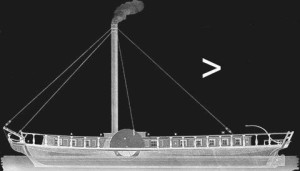

There were two steamers of the Castle Company that were very long-lived. One was the Edinburgh Castle of 1844, lasting till 1927 as Messrs MacBrayne’s Glengarry on the Caledonian Canal. She is featured in an article published in June, 2016, a decade ago. The other was the Inverary Castle, and she is the focus of the present essay. Throughout her life, the Inverary Castle was lengthened twice. The photographs of steamer are exclusively those of her in her final condition, after 1873. She was built in 1839 by Messrs Tod & M‘Gregor, and fitted with the steeple engine of the Tarbert Castle that was lost on Loch Fyne that year. She was finally broken up in 1892 after 53 years, almost completely on the sailings to and from Loch Fyne from Glasgow.
At the end of the essay, I have appended some slides showing Tarbert on Loch Fyne, that, together with Inveraray, was the main destination of the Castle steamers in their hey-day.
With the break-up of the Messrs Burns’ Clyde fleet in 1851, the Inverary Castle of 1839 passed to a new entity, the Glasgow and Lochfine Steam Packet Company, and maintained the sailings from Glasgow to Loch Fyne and Inveraray along with the Dunoon Castle and the Mary Jane. The Mary Jane was acquired around the same time from the Stornoway service of Sir James Matheson. Typically, there was a daily service to Tarbert and Ardrishaig—three days a week in winter—extended to Inveraray once a week in winter, and twice a week in the summer. This was mainly a cargo run, though passengers were carried, and the single voyage occupied the whole day. During the summer season, the Messrs Hutcheson also ran the Pioneer, connecting with the track-boat on the Crinan Canal.
The old Dunoon Castle was sold in 1854, and replaced by the Duke of Argyll. For three years the three steamers, Duke of Argyll, Mary Jane, and Inverary Castle continued duties to Loch Fyne.
“The Glasgow and Lochfine Steam Packet Company’s Steamers, Duke of Argyle, Mary Jane, and Inverary Castle, will sail as under toe further notice, unless prevented by unforeseen causes. From Glasgow Bridge Wharf daily (Sunday excepted), at 6 a.m., for Ardrishaig, calling at the usual intermediate ports, and returning to Glasgow in the evening.*
“From Lower Steam Boat Wharf daily (Sunday excepted), at 6.30 a.m., for Inverary and intermediate ports, and from Inverary daily (Sunday excepted) at 6 a.m. for Glasgow and intermediate ports.
“Return tickets are issued for all the ports in the route beyond Rothesay at fare and half, available for eight days—thus affording pleasure parties and tourists time to view the interesting and romantic scenery of the Clyde, Kyles of Bute, and Lochfyne.
“*On Saturday 30th inst., Saturday 6th August, and Monday 8th August, there will be no steamer from Glasgow Bridge Wharf at 6 a.m., nor from Ardrishaig about 1 p.m.
“This company are prepared to charter the Dunoon Castle for conveyance of stock, &c., applications for which are to be addressed to 83 Jamaica Street.—David Roxburgh.— 83 Jamaica Street, Glasgow, 28th July, 1853.”—Glasgow Herald, July 29, 1853
In 1857, the Company was absorbed by Messrs Hutcheson, who continued the daily cargo and passenger service to Loch Fyne, extending to Inveraray two days a week, on Wednesday and Friday. The Dolphin (ex-Islay) was added as a consort, and took the place of the Duke of Argyll. On the daily cargo service in summer, one steamer devoted the whole day to the outward sailing while the other sailed inward. The days were long, beginning at 6 or 7 a.m., and sometimes ending after 6 in the evening, requiring more than just two steamers for the service. In winter, there were three sailings a week to Ardrishaig, extending on Friday to Inveraray.
“Glasgow and Lochfine.—The steamers Duke of Argyll, Mary Jane, Dolphin, and Inverary Castle are intended to sail as undernoted, till further noyice, and unless prevented by any unforeseen circumstance:—Glasgow to Ardrishaig, calling at the various intermediate ports, every Monday, Wednesday, and Friday, at 7 a.m.; train to Greenock, 9 a.m. Ardrishaig to Glasgow, every Tuesday, Thursday, and Saturday, about 8 a.m. Glasgow to Inverary, every Friday, at 7 a.m.; train 9 a.m. Inverary to Glasgow, every Saturday, at 6 a.m.—David Hutcheson & Co., 83 Hope Street.—Glasgow, Feb. 18, 1857.”—North British Daily Mail, February 18, 1857
Duke of Argyll was sunk in the Sound of Mull when sailing to Stornoway in January 1858, leaving the Mary Jane, Dolphin, and Inverary Castle to cope with the traffic to Loch Fyne. The freight was substantial, especially during the herring season.
“Herring Fishing.—The Lochfyne herring fishing, which had been slack for a week previously, became brisk on Tuesday morning, when there was a good take, the steamers Dolphin and Inverary Castle having nearly 1,000 boxes on board. The drift fishing is confined to Ardrishaig and the upper part of the loch, while the fish caught near Tarbert are all taken by the trawl, as they keep close to the shore and lie among the rocks. The latter fish are smaller in size and poorer in quality than those taken by the net near Inverary. At Tarbert the price was from 1s 6d to 2s 9d per hundred, while at the fishing stations higher up it was 5s per 100”—Glasgow Courier, August 22, 1857
Inverary Castle was originally poop-decked, but in 1862, she was lengthened and had her poop-deck removed. Donald Watson in his book “From Comet to Caledonia,” published by Brown, Son & Ferguson (Glasgow, 1999), has provided drawings of the original Inverary Castle and in her lengthened, flush-decked form.
“Glasgow to Ardrishaig, calling at Greenock, Kirn, Dunoon, Innellan, Rothesay, Kyles of Bute, and off Tarbert. On and after Monday, the 31st March, the swift Royal Mail steamer Mountaineer, with passengers only, from Bridge Wharf, daily (except Sunday), at 7 a.m., *train to Greenock, 7.45 a.m.; leaving Ardrishaig for Glasgow and intermediate places daily (except Sunday), about 1 p.m.—*The steamer is not bound to wait later than 9 a.m.
“Glasgow to Lochfine.—The steamers Dolphin, Mary Jane, Inverary Castle, or other vessels, will sail as undernoted from Bridge Wharf, till further notice.—Glasgow to Tarbert and Ardrishaig, with goods and passengers, every Monday, Wednesday, and Friday, at 6 a.m. Tarbert and Ardrishaig to Glasgow, with goods and passengers, every Tuesday, Thursday, and Saturday, at 8 a.m. Glasgow to Inveraray, with goods and passengers, every Wednesday, and Friday, at 6 a.m. Inveraray to Glasgow, every Thursday, and Saturday, at 6 a.m.”—Greenock Advertiser, April 15, 1862
Early in 1864, Inverary Castle had a breakdown at Colintraive when her paddle shaft broke.
“Greenock.—Accident to the steamer Inveraray Castle.—While the Inveraray Castle was on her passage from Lochfyne to Glasgow, on Wednesday, she injured her paddle shaft at Colintraive, Kyles of Bute. The tug steamer Vixen was sent to her assistance, and towed her here for repairs. On the arrival of the Pioneer, on her passage to Ardrishaig, the mails and passengers of the Inveraray Castle were despatched under the charge of Mr M‘Donald, purser of the Inveraray Castle, to Rothesay, to which place the Pioneer returned previous to proceeding on her own passage. From Rothesay the mails and passengers were brought here by the Petrel on her regular passage up, they having been delayed only one hour and a half. Yesterday morning the screw-steamer Staffa was placed on the Inveraray station in place of the disabled Inveraray Castle.”—Glasgow Herald, January 15, 1864
A month later, one of her “passengers” made the newspapers.
“Greenock—A Scene—Man and cow in the water.—On Friday afternoon, a quay jobber, named Wallace, while assisting, by use of a rope, to land a cow from the steamer Inveraray Castle, the animal becoming restive, and the gangway port being open, the cow dashed into the river, dragging Wallace after it. Fortunately the tide was high at the time, and Wallace was enabled to scramble to the quay little worse for his ducking. Considerable difficulty and trouble was experienced, however, ere ‘crummy’ was brought to terra firma; but a sling having got round her, she was hoisted upon the quay in safety.”—Glasgow Herald, February 15, 1864.
However, it was later in 1864 that attention was focused on Inverary Castle, and some of her peculiarities. On November 30, 1864, a few minute after the Inverary Castle passed up river about 6.20 p.m., the Clyde Street ferry, crossing from the North Bank met a surge of two large waves in the center of the river. The first wave came over the gunwale, causing panic among the occupants, and the second capsized the rowing boat. Nineteen souls, including the ferryman, John Rodger, were drowned. This catastrophe created discussion and led to the introduction of steam-powered ferries. Although it was generally acknowledged that it was the surge from the Inverary Castle that led to the disaster, the subsequent inquiry focused more on the ferry-boat, and its occupants. The ferry was licensed for 24 passengers and the single ferryman. It was established that there were 27 including the ferryman, on board, mostly workmen from the shipyards, and the overcrowding became a factor. As was customary, the oars were in the hands of a passenger while the ferryman was collecting the fares. Consequently, the ferry was caught broadside by the waves where a skilled ferryman would have turned the boat’s bow into the surge. Again, as usual, many of the men were perched on the gunwales, and not sitting on the seats that were generally reserved for ladies and more timerous passengers—there were no ladies on board. The initial wave flooded the boat knee-deep with water, and the second, combined with the panic among the occupants and poor handling of the oars, brought about the capsize.
Just two weeks later, about 10 o’clock on the night of December 14th, at Finnieston, there was an almost identical occurrence. Again, it was the passing of the Inverary Castle, but this time, the ferryman managed to take the oars and point the bow up-river so that the worst that occurred was a soaking for the occupants.
“Narrow escape of another ferry-boat—A correspondent sends us the following:—‘There was almost another ferry-boat accident on Wednesday night. As far as I can learn the particulars are as follow”—The ferry-boat at Finnieston Quay was crossing about ten p.m. when a steamer passed up the river there were eighteen passengers (now the restricted number) in the ferry-boat besides the ferryman. On reaching the centre of the river the waves were so large, and the boat rolled about so much, that she that had she not been kept head on to the waves she might have been swamped. As it was a large quantity of water came dashing into her and the passengers were wet to the knees. Of course they were all very much alarmed; and had it not been for the ferryman’s presence of mind in keeping her head to the waves there might have been a repetition of that deplorable calamity which occurred so lately at Clyde Street Ferry.’ ”—Glasgow Herald, December 16, 1864
The passengers in the ferry-boat were mainly marine engineers and other workmen who had finished work on the steamship Aleppo at Messrs. G. and J. Thomson, on the south side of the river. The ferry left the stairs but was held up at the stern of the Aleppo as there was a steamer, identified as Inverary Castle, passing up the river. While waiting for the steamer to pass, the ferryman collected the fares and although the night was dark, the passengers had time to note the progress up river of the steamer. It was this delay that saved the passengers as the ferryman had collected the fares and was able to take up the oars for the crossing. A number of the passengers gave evidence that the steamer was progressing at more than half-speed, about 8 or 10 miles an hour, rather that the “dead slow” required of steamers in the harbour. It was the ferryman, William Hart, who identified the steamer as the Inverary Castle, and consequently, her master, George Fletcher, was charged with culpable and reckless sailing to the danger of the lives of the lieges, aggravated by his having been previously convicted of a similar offence. The evidence for the defence gives some interesting detail of the workings of the vessel.
“The following evidence, was then led for the defence:—William Tulloch, mate on board the Inveraray Castle, deponed—I first heard of something extraordinary having happened to one of the ferryboats through seeing a notice about it in the newspapers. I am always at the wheel of the steamer when going up the river. I was there on Wednesday night. We left Greenock about half-past seven o’clock, and arrived at the point between Napier’s Dock and Clyde Street at about ten o’clock. There was then a little fresh in the river. We make it a general practice to go dead slow before coming to Govan, and we did that on the occasion in question. We also go dead slow after reaching Stephen’s yard, at Kelvinhaugh, till we arrive at our berth. We stop occasionally if any ferry boats are seen; and we so stopped on Wednesday night, but at what ferry I cannot tell. Just as we were approaching the ferry we saw two boats into their berths and their passengers landing. They had both crossed before we passed. The surge from a steamer will take about five or seven minutes to reach the ferry stairs after the vessel passes; but it will take even longer when the fresh and the tide meet. At the time in question we were, I am sure, going dead slow. I do not think our steamer was going at the rate of more than four or five knots. We make it a practice to have a man standing by our bell, and often to ring it before approaching the ferries.
“Bailie Taylor—Do you know whether or not the Inveraray Castle causes a greater surge than the ordinary river boats?—Yes she does, in consequence of her construction and her floats.—Will the Inveraray Castle, when going dead slow, create a greater surge than the ordinary river boats at half-speed?—Yes.
“The Witness—We were ringing our bell when we approached the ferry, and at that time we were going dead slow. We could not have gone more slowly without bringing our steamer to a dead stand. The captain, who stands on the paddle-box and signals to the engine room, did so that night. I heard the signal given, and I can hear by the engines when the steamer is going dead slow. On this occasion I heard the knock given at Govan for dead slow.
“James Maccallum, one of the hands on board the Inveraray Castle—I was on the bridge of the steamer along with the mate when we passed Stobcross Ferry on Wednesday night last. I saw no ferry-boat, as far as I can recollect. Our speed was dead slow. I heard the order given at Stevens’ yard to go dead slow. Our steamer makes a considerable surge, I believe, even when going at that rate, but I cannot say that she makes more surge than other ships of the same class.
“William Bain, engineer on board the Inveraray Castle—I recollect coming up the river on Wednesday night last. We always go slow at Govan Ferry, I mean dead slow; that is, as slow as the engines will go, so as to keep them working. In the case of the Inveraray Castle that would be about 13 revolutions a minute; at half speed about 19 or 20, and at full speed about 29 or 30. Three knocks are for her to go at full speed, two to go back, and one to go dead slow. On last Wednesday night we worked the engines as slowly as ever we possibly could; we went as slow as I could make the engines work. We were heavily laden.
“On Wednesday evening we were late, and had a heavier cargo than usual. We had previously got orders to be as cautious as we could, after the accident that happened in the river, and on the occasion in question our steamer would be going at the rate of about 3½ miles an hour. I never heard of her making an unusually heavy surge, but I have heard she caused a surge backward, like into the middle of the river. We have never, in my experience gone at a faster speed than dead slow after passing Stevens’ yard, and on this particular evening I could not make the engines go slower. I know, however, there are other engines that do go slower—that make about nine or ten strokes a minute.”—Glasgow Herald, December 20, 1864
In his verdict Bailie Taylor said—“I find from the evidence given that you are not guilty as charged; but I would observe that there must be something in the construction of the vessel, causing the extraordinary surge, which deserves the attention of the Clyde Trustees, and that a regulation should be so made as that when you are going dead slow you may be dealt with in some other way than the ordinary boats. There is no doubt that, from the peculiarity in your engines or construction of your steamer, your boat causes more surge than any other that passes up the river, so far as I can learn; and it is therefore deserving of your attention as captain of that vessel, knowing the melancholy accident that happened some time ago, that you should be very careful when coming up or going down the Clyde. I find, however, that you are not guilty of this charge.”
“Glasgow for Lochfyne.—Steamer Mary Jane or Inveraray Castle, from Bridge Wharf, for Ardrishaig, daily, at 6 a.m., train 7.40 a.m. with goods and passengers, calling at Greenock, Kirn, Dunoon, Innellan, Rothesay, Kyles of Bute, and Tarbert—proceeding to Inveraray Tuesdays and Fridays. Goods received at shipping box every day, from 6 a.m. till 8 p.m.”—Glasgow Herald, January 16, 1865
The Inveraray Castle was fitted with feathering floats in 1868 that greatly improved her performance. The 1870s were marred by a number of mishaps and accidents.
“Gale.—Yesterday a severe Gale from the northward prevailed in the Channel. Steamers arriving reported the sea outside as being very heavy. Last night the weather moderated. The storm drum, however, was hoisted at Greenock. Our Rothesay correspondent writes—A strong gale of wind blew yesterday from the north-west. The bay was filled with storm-bound vessels. No casualties are known, excepting a collision between the Inveraray Castle and the Argyll at the quay yesterday afternoon. The Inveraray Castle had towed a schooner from the battery shore to near the quay, and on leaving the schooner she came in collision with the Argyll which was leaving the quay. The Argyll had her bows a little damaged, and the Inveraray Castle part of her stern stove in. Both vessels proceeded on their passage.”—Glasgow Herald, March 19, 1872
Inverary Castle performed well in the worst of weathers. It is a tribute to her masters and crew that accidents were not more common.
“During a snow storm on Monday morning, the Ardrishaig steamer Inverary Castle ran out of the bed of the river while on the passage down, and remained on the bank till the afternoon, when she floated, and proceeded on her way.”—Gazette, January 25, 1873
In 1873, she was further lengthened, and had a small saloon added to her after deck. It is in this condition that she is seen in the photographs.
“For Lochfyne.—The Mary Jane, Inveraray Castle, or other steamer sails, with goods and passengers, every Monday, Wednesday, and Friday, at 6 a.m., train 7.20 a.m., for Greenock, Kirn, Dunoon, Innellan, Rothesay, Kyles of Bute, Tarbert, and Ardrishaig—proceeding to Inveraray every Wednesday and Friday. Goods received at Shed 12, foot of York Street, daily, from 6 a.m. till 8 p.m.”—North British Daily Mail, July 26, 1873

Inveraray Castle at Tighnabruaich

This photograph of Inveraray Castle won an International Photograph Prize
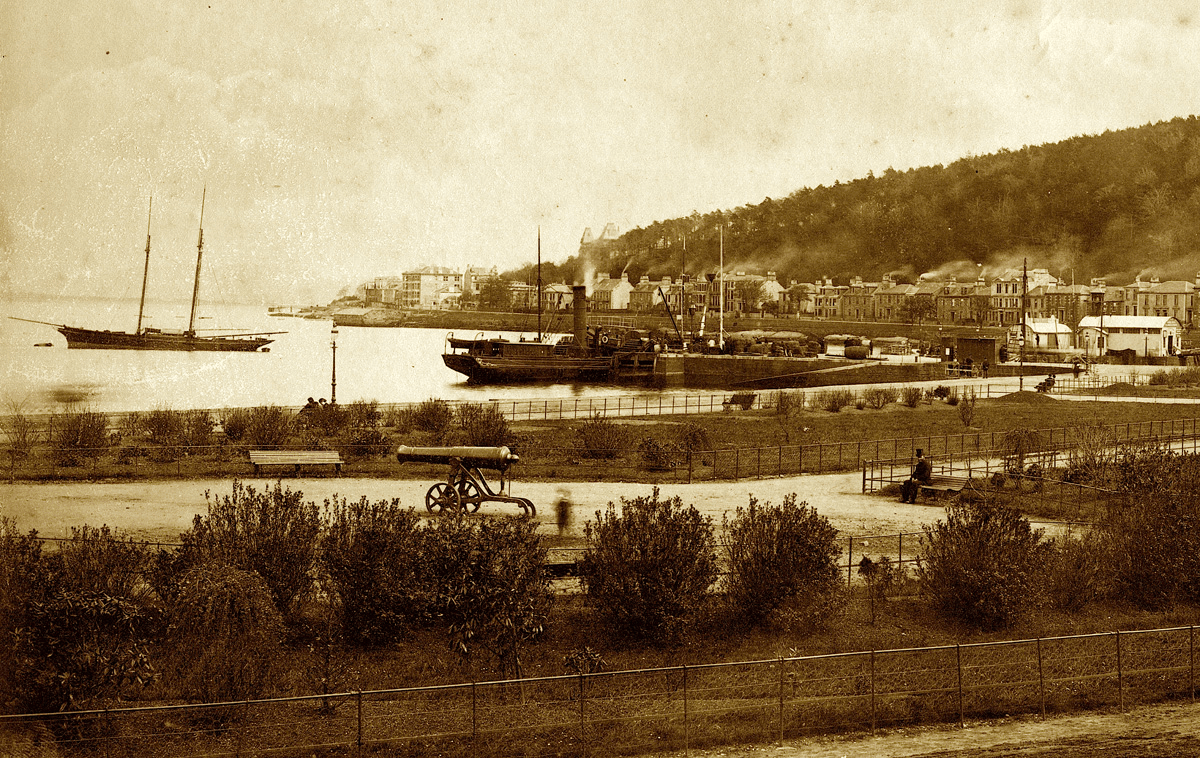
Inveraray Castle at Rothesay
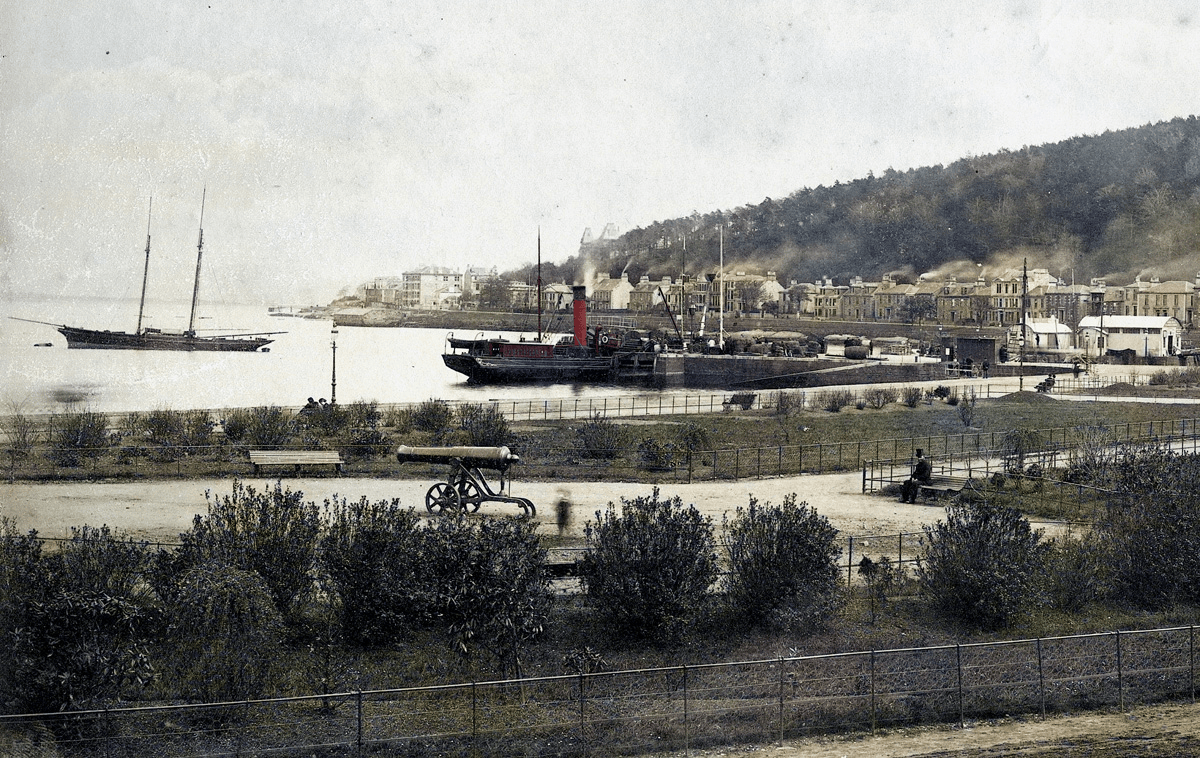
A colorized version of the above

Rothesay Pier with Inveraray Castle (Valentine)

The paddle steamer in the Bay has not been identified (Valentine)
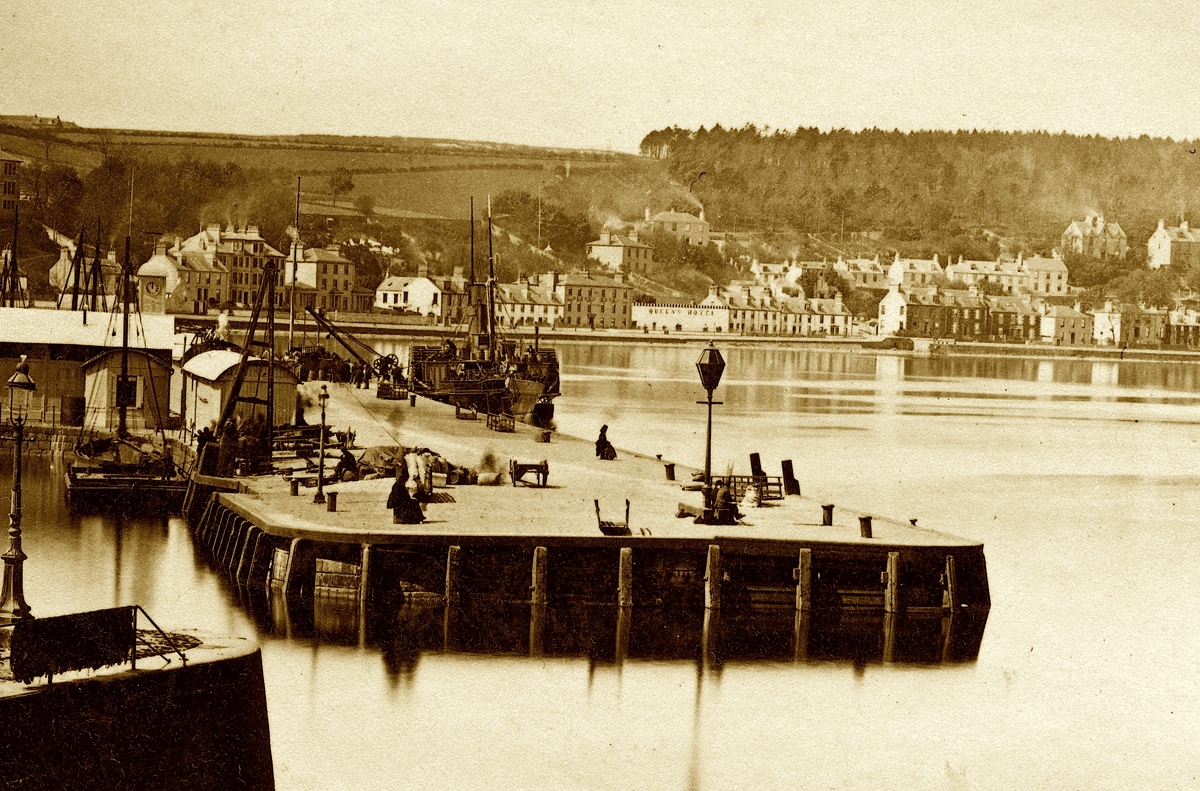
Inveraray Castle at Rothesay enlarged. The date is before 1877
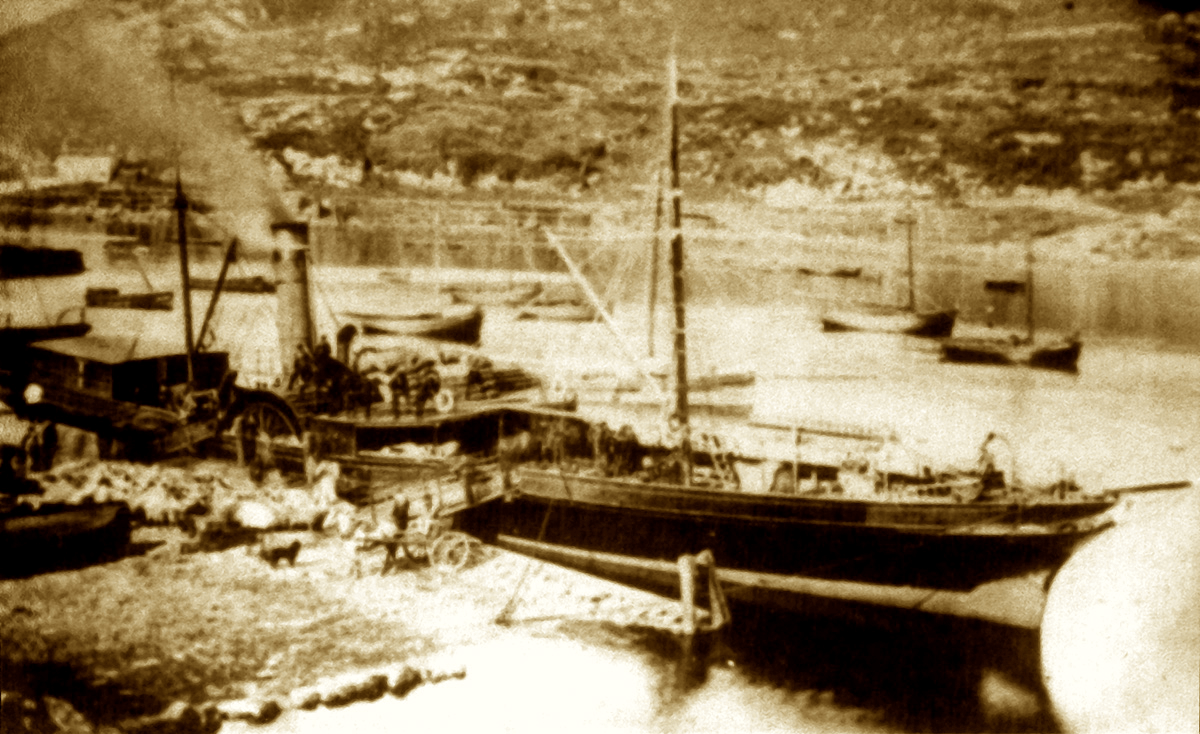
Loading livestock on Inveraray Castle at Tarbert
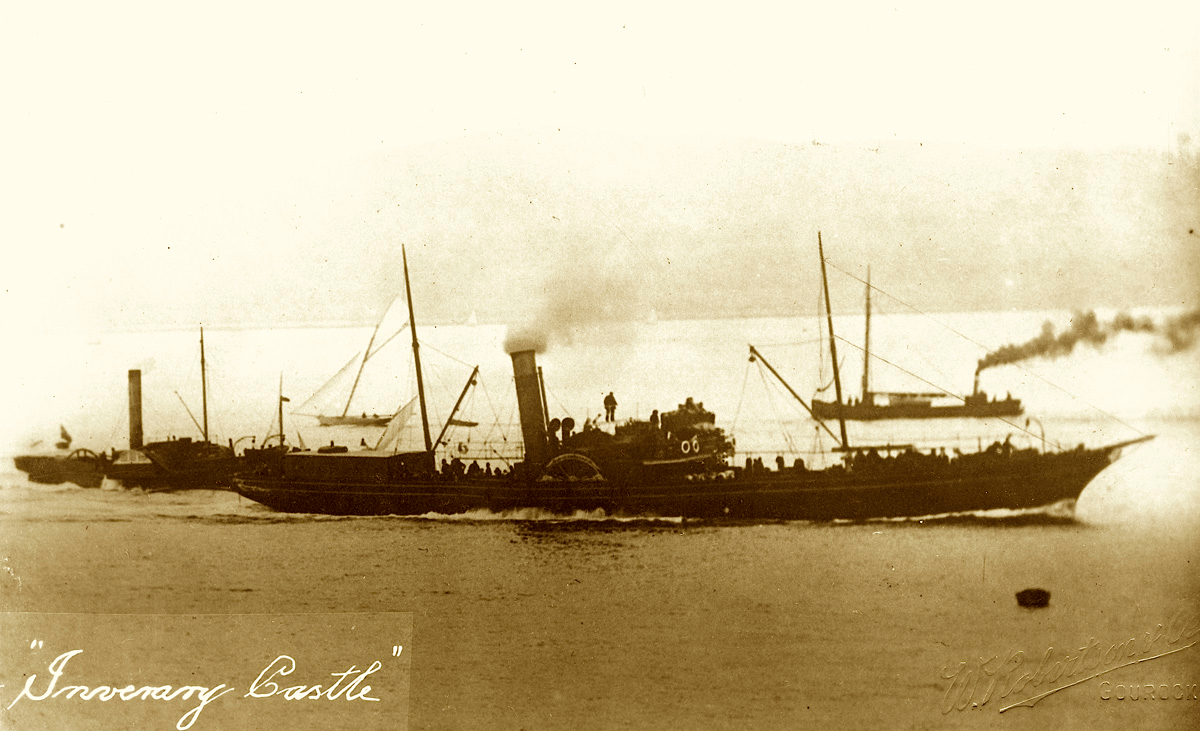
Inveraray Caste off Gourock (Robertson)
She also had one of her brief spells outside the Mull of Kintyre in 1873, on the Corpach sailing.
“The Inverary Castle (s), while passing from Fort William for Corpach yesterday morning, struck on the Lochy Banks. After much backing she managed to get off, but went aground again on the first island. She, however, got off, and proceeded for Corpach.”—Shipping and Mercantile Gazette, October 1, 1873
A name change to Inveraray Castle occurred in 1874, although the new spelling had been used previously. The following year the Mary Jane was withdrawn for a major renovation, emerging as Glencoe. This left Inveraray Castle to continue on her own to provide the service three days a week in each direction.
A collision with the Langland’s steamer Princess Alice landed both masters before the River Bailie.
“Collision Case.—Yesterday at the River Bailie Court, Bailie M‘Bean presiding. George Fletcher, master of the steamer Inveraray Castle, and William Gilchrist, master of the steamer Princess Alice, were charged with a contravention of the river regulations. It appears that on the 3d inst. both vessels were proceeding up the river, the Princess Alice being ahead. At Garmoyle floating light, a little below Dumbarton, the Inveraray Castle overtook the other steamer. The Princess Alice being the slowest boat, ought to have slowed and ported, to allow the Inveraray Castle to pass, and the last mentioned craft ought also to have slowed until she got clear ahead of the Princess Alice. Neither the one or the other obeyed the rules, and the consequence was that the steamers came into collision, and the Inveraray Castle was damaged on her port side abaft the paddlebox. Both of the accused pleaded guilty and they were each fined in the sum of £5, failing payment 60 days’ imprisonment. The fines were paid.”—Glasgow Herald, April 13, 1875
By 1875, much of the herring traffic was being handled by specialized herring fish carriers that got the catch to the railheads more quickly and the Loch Fyne traffic was able to be handled with Inverary Castle on her own.
“Glasgow and Lochfyne.—The Inveraray Castle, or other steamer, sails with goods and passengers, every Monday, Wednesday, and Friday, at 6 a.m., train 7.35 a.m., for Greenock, Kirn, Dunoon, Innellan, Rothesay, Kyles of Bute, Tarbert, Ardrishaig, and Inveraray. Goods received at Shed 12, foot of York Street, daily from 6 a.m. till 8 p.m.”—Glasgow Herald, June 5, 1876
In October 1876, the Inverary Castle ran onto rocks at Ardrishaig. She was got off and returned to Greenock for repairs.
“Caledonian and Crinan Canals.—Yesterday in the Ardrishaig Hotel, an inquiry was held by Lord Lorne, M.P., and Mr Mathieson, M.P., commissioners or the Caledonian and Crinan Canals, as to the alleged grievances set forth in a petition which had been presented in the course of the past summer by a number of merchants, farmers, shippers, and others in the district of Lochgilphead and Ardrishaig. The complainers stated that the landing dues were excessive, and more than necessary for the upholding the quay at Ardrishaig, that the manner of levying them was irregular and arbitrary; that, notwithstanding the large revenue derived, the quay was unsuitable for the traffic and dangerous for horses; that the rates charged are in many cases contrary to the printed regulations, especially with regard to merchandise; that in the summer season the crane is removed: Further, that, as compared with other canals, the mileage and wharfage rates on the Crinan Canal are excessive; and that generally, in consequence of the high rates, many vessels trading to the West Highlands are sent round by the Mull of Cantyre to the great risk of property and life. A large number of the petitioners appeared and gave evidence in support of these allegations; and, further, stated that the 1d charged each person for using the quay was a source of great annoyance and irritation to the inhabitants, as well as hurtful to the prosperity of the two villages. It was also stated that the light at Ardrishaig pier was insufficient and misleading, in so far as several vessels have taken the lights in the village for the pier light, the stranding of the Inveraray Castle on Monday night being a case in point. The inquiry was adjourned until to-day. The steamer Inveraray Castle, from Glasgow, went ashore on Monday night on a reef near Ardrishaig Harbour, and remains fast. The goods were transferred ashore on skiffs. Any attempt to get her off has hitherto been unavailing. The night was extremely dark and wet.”—Glasgow Herald, October 8, 1876
A more serious accident occurred on the night of February 2d, 1877, when Inveraray Castle was attempting to enter Tarbert Harbour. The night was dark with a gale blowing, and heavy showers of hail and sleet. The entrance to Tarbert Harbour was narrow and hazardous, and blinded by sleet, she struck on Beacon Rock and damaged her starboard paddle. Repairing the damage to the paddle took over an hour after which she made for Iona’s pier outside the harbour and landed her passengers. She then proceeded into the harbour without difficulty, but at the quay, she was found to be filling with water from hull damage in the forehold, and was run on to the beach. Although the steamer had watertight bulkheads, she had sluices that allowed the water to pass through. The Master had instructed them to be closed in December but in the meantime they had been re-opened, and the tool for closing them could not immediately be found.
“Tarbert—Argyle—Feb. 3: The Inverary Castle (s) in coming into the harbour here last night, struck on a rock; she was filling with water, and the master had to run her on the beach; she is now almost under water; part of cargo saved.”— Shipping and Mercantile Gazette, February 5, 1877
On the following Saturday, the tug Vanguard was dispatched with pumps to raise her.
“On Saturday night, the tug steamer Vanguard left Greenock for Tarbert with a diver, pumps, &c., in order to commence operations for the raising of Messrs Hutcheson & Co.’s steamer Inveraray Castle, which sunk near Tarbert on Friday, while on her outward trip from Glasgow to Inveraray. This is the second time Inveraray Castle has foundered in Lochfyne within a short time. The Glencoe will in the meantime occupy the station.”—Glasgow Herald, February 5, 1877
An inquiry was held in March.
“The Inveraray Castle.—Yesterday an inquiry at the instance of the Board of Trade was commenced in the J.P. Court Hall into the circumstances attending the stranding of the s.s. Inveraray Castle, at Tarbert, Lochfyne, on the evening of 2d February last. Messrs Coulborn and Swan, Justices of Peace, presided, and the nautical assessors were Captains Grant and Ward. Mr Douglas, P.F., conducted the inquiry on behalf of the Board of Trade, Mr Geo. Gray was legal assessor, and Mr Geo. B. Young, writer, appeared for the captain and mate of the steamer. Mr Douglas, in stating the case to the Court, said that the Inveraray Castle was a paddle steamer, built of iron in 1839, and lengthened in 1873, had engines of 90 horse-power, and had a gross tonnage of 230 and a register tonnage of 129. She had a crew of 14 hands all told, and was in charge of Neil M‘Tavish, master, and Alex. Buchanan, mate. The vessel was owned by Messrs Hutcheson & Co., Glasgow, and belonging to such an eminent firm she was thoroughly well found in every respect. On the 2d February the Inveraray Castle sailed from Glasgow for Inveraray, having a moderate cargo and four passengers, and she reached Ardlamont Point at 5.30 p.m. At 6.30 she reached Darroch Point. The weather at this time was very thick, with hail and rain showers and a strong gale of wind, and the night was exceedingly dark. As was usual when going into port, the mate took the wheel, and alongside of him there was a sea-man to assist; the master was on the bridge, and on the forecastle there were two look-outs. The intention was to enter Tarbert harbour to put out goods. The entrance was by a narrow channel which ran between a small island in the centre of Tarbert Loch and the south mainland. On this latter point there was a rock called the Beacon Rock, which might be called a perch but was called by sailors a “stick with a cross at the end of it.” The beacon was not easily distinguished; in fact it could not be seen at all on dark nights. After passing Darroch, the vessel, according to custom, was slowed to half speed, and on coming close to the channel it would appear that the master gave the order three times to starboard the helm. This order was not obeyed at first; the reason would be explained afterwards. At last the order was obeyed; and almost immediately afterwards— within a minute or so— the vessel struck on the Beacon Rock. She immediately slid off, and having damaged the floats of one of the wheels the engine was stopped. The vessel drifted out, and became perfectly helpless. The engineer, however, managed to clear away the obstruction; the engines were again set in motion, and the vessel was brought alongside the pier, the passengers being there safely landed. It was then seen that the steamer was making water, and as she would in all probability sink; she was run ashore, where she sank early in the morning. The points for the consideration of the Court were these:—1, What was the cause of the stranding of the vessel; 2, whether she was navigated with sufficient care on the occasion; 3, whether the lead was used, and if not, the reason why; 4, whether the master was justified in attempting to enter Tarbert harbour, having regard to the state of the weather and the peculiar darkness of the night; 5 whether the mate. was justified in in promptly obeying the master’s orders to starboard, 6 (he had to ask their Honour’s particular attention to this point), whether the want of a proper beacon or light at the rock, or near it, caused, or in any way contributed to the casualty; and 7, whether either the master or mate, or both of them, were in default.
“The master and mate were afterwards examined. The master stated that the steamer was now on her station. On the occasion of the stranding the lead was not used, because he knew the depth of the water. There were no lights to steer by in going into Tarbert harbour. It was difficult to get into the harbour when it was dark, the entrance being narrow and crooked. He considered Tarbert harbour the worst they had to take. A beacon or light would be useful there; indeed, he would say it was necessary. The damage caused by the vessel striking was in the forehold, and the sluice being open, the water got into the engine-room. In the beginning of December he gave instructions for the sluices to be closed. The mate told him that he had done so, and he did not know when or by whose orders they had been opened. The mate in his examination stated that when they got near the Beacon Rock he got the order to starboard from the captain. He did not do so at once, because he thought they were too far off the island, and that the master’s order might be a mistake. The order was repeated, and he then obeyed. The master called a third time to starboard, and at that time, or immediately afterwards, the ship struck. He had been about three weeks in the Inveraray Castle when the mishap occurred. He did not know that there were sluices in the ship. He was doing duty for two or three runs on the Inveraray Castle for the regular mate, who was disabled. He was mate of the Glencoe, in which he had been first officer for 11 years, and there were bulkheads in that steamer, but no sluice valves. If it had kept clear, as when they were passing Darroch Head, there would have been no danger in entering the narrows. A shower of sleet came down very heavily as they entered the narrows. If the helm had not been starboarded, they might have cleared the rock. He never thought of anchoring.—The inquiry was adjourned until twelve o’clock to-day.”—Glasgow Herald, March 13, 1877
“The Stranding of the Inveraray Castle.—Two seamen. the engineer, and Mr D. MacBrayne of Messrs D. Hutcheson Co., one of the owners of the s.s. Inveraray Castle, were the only additional witnesses examined yesterday in the Board of Trade inquiry into the circumstances attending the stranding of that vessel at Tarbert, Lochfyne. The Court having adjourned for half-an-hour, returned with their decision, which was to the effect that the Inveraray Castle struck on a rock on the south side of the channel leading into Loch Tarbert, on the 2d February last, between 6 and 7 p.m., that on the rock there is only a wooden perch or post, with a cross bar at the top, which the Court considered insufficient for safe navigation during the night, and that this casualty is attributable to the fact of a sudden squall of hail obscuring all objects just as the vessel was entering the narrows, but for which there was every probability that she would have entered safely as she did subsequently the same night. The Court, holding that the master and mate are not to blame under the charges preferred against them, returned their certificates, and were also of opinion that all parties should pay their own costs in the investigation.”—North British Daily Mail, March 14, 1877
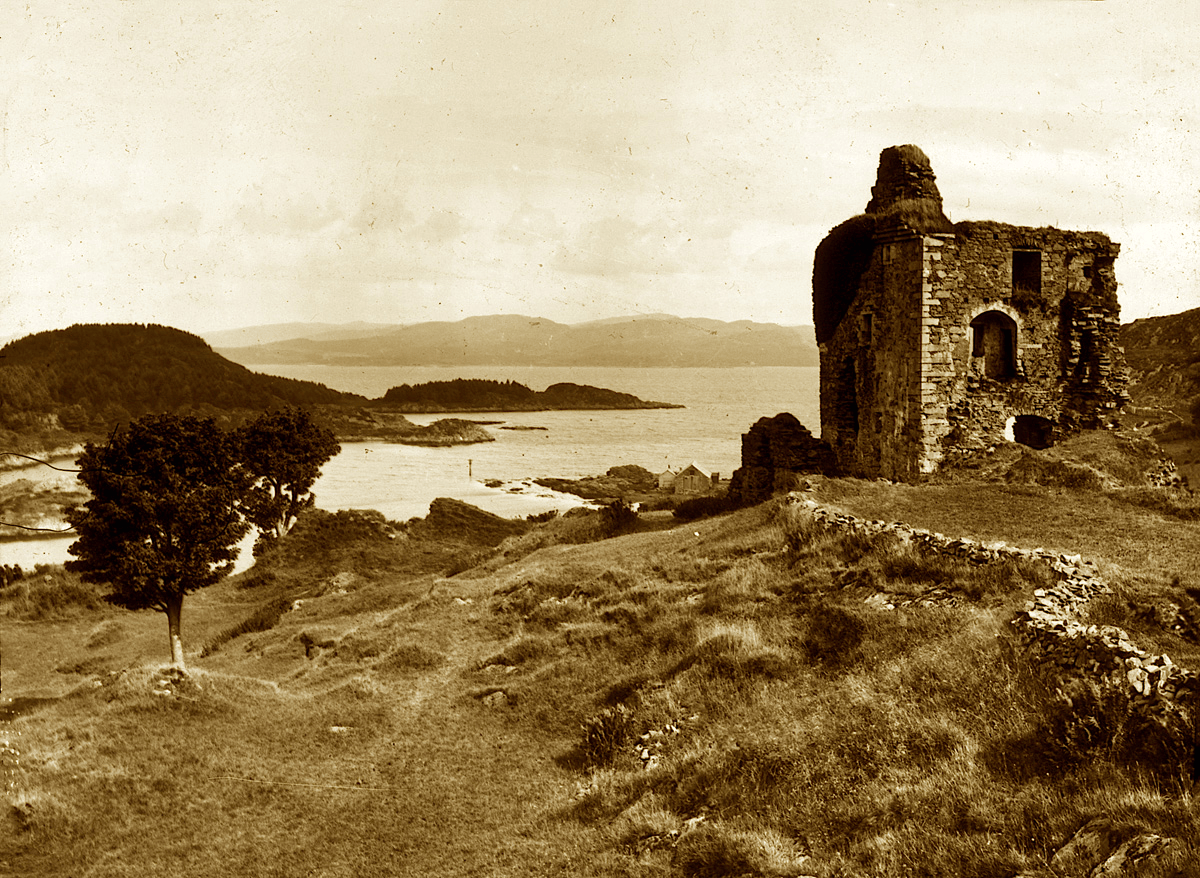
Tarbert Castle and the narrow entrance to Tarbert Harbour

Iona’s Pier at Tarbert outside the Harbour
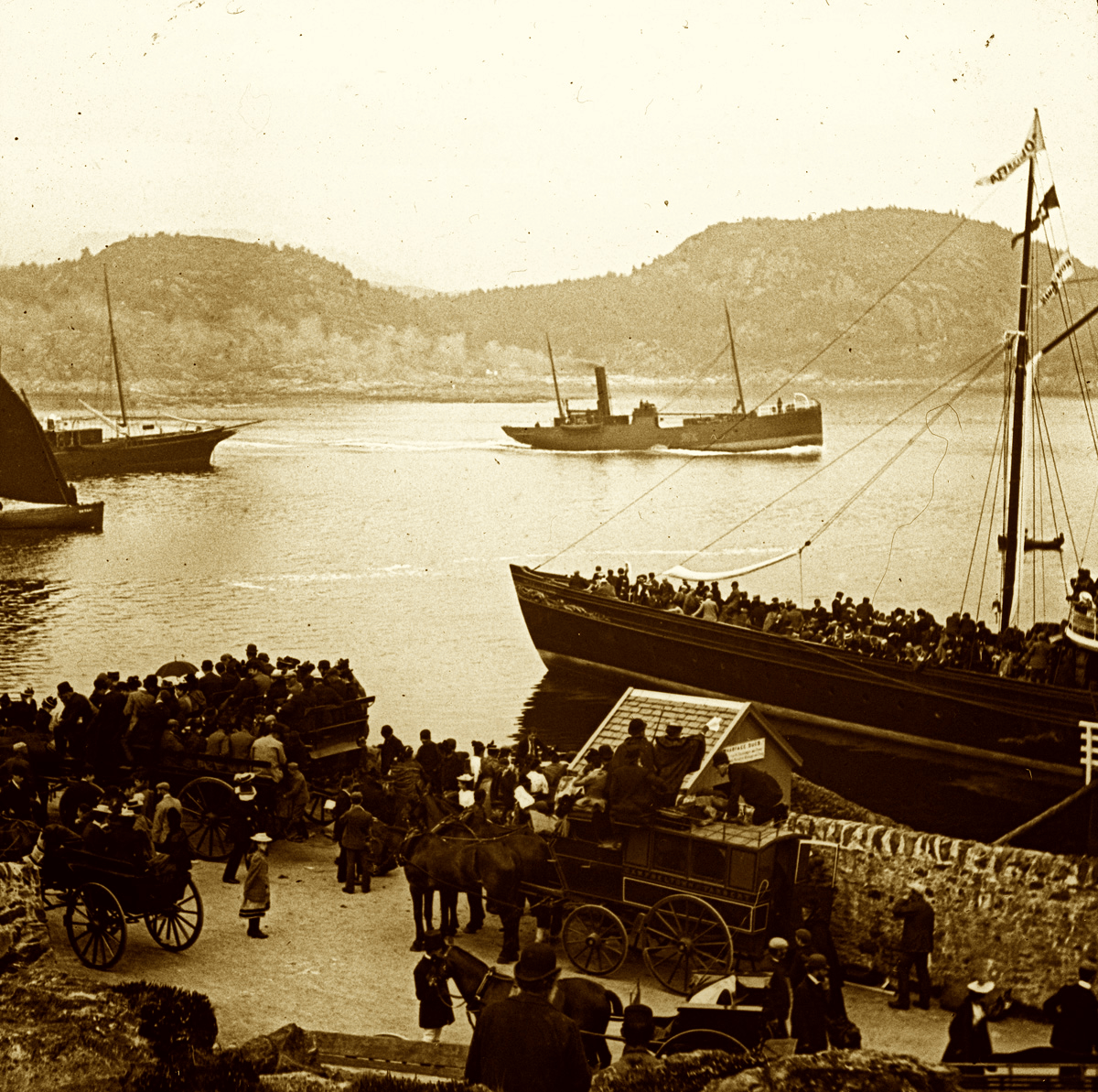
The bow of Columba at Iona’s Pier with a fish carrier leaving the Harbour
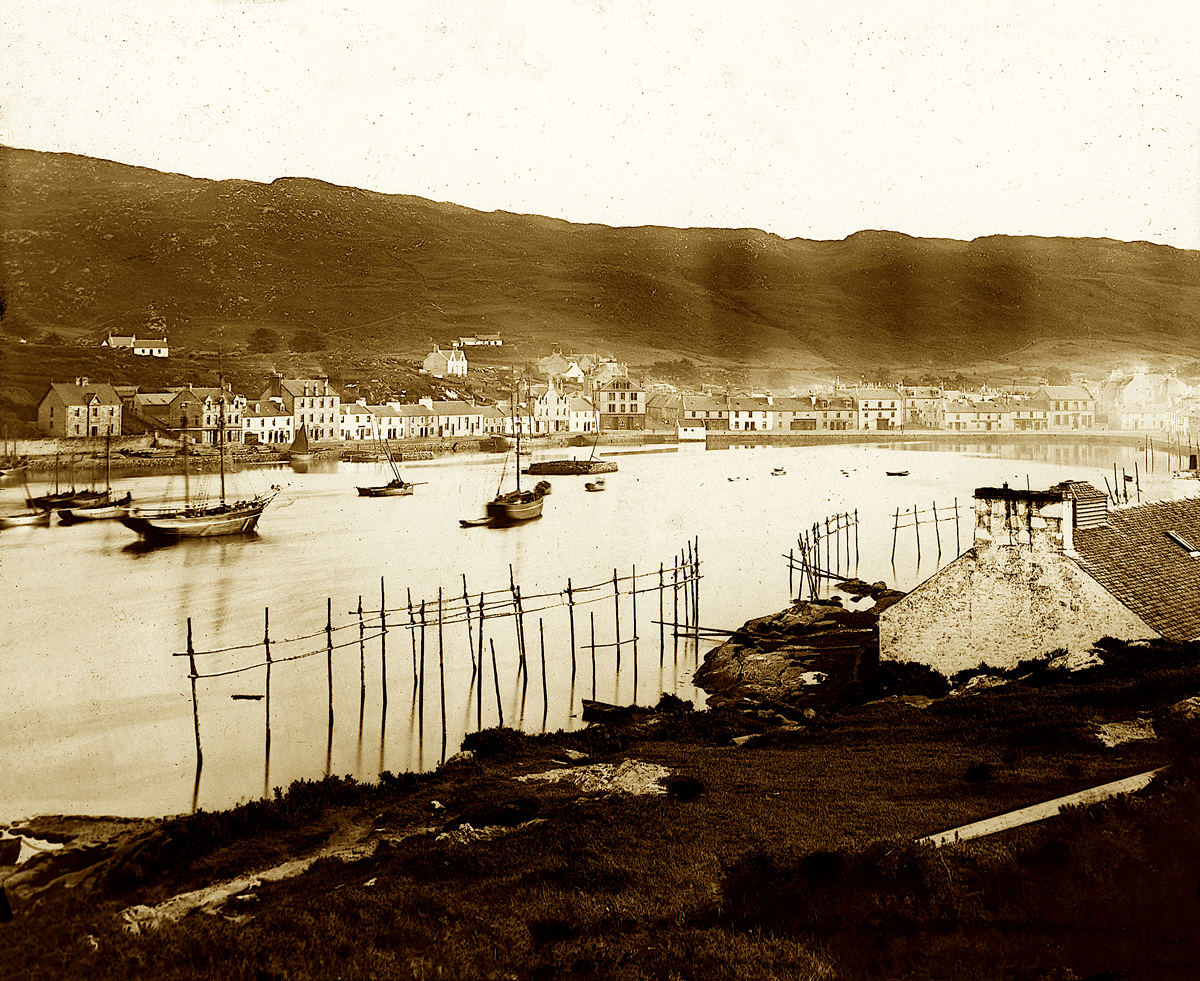
Tarbert (Washington Wilson)
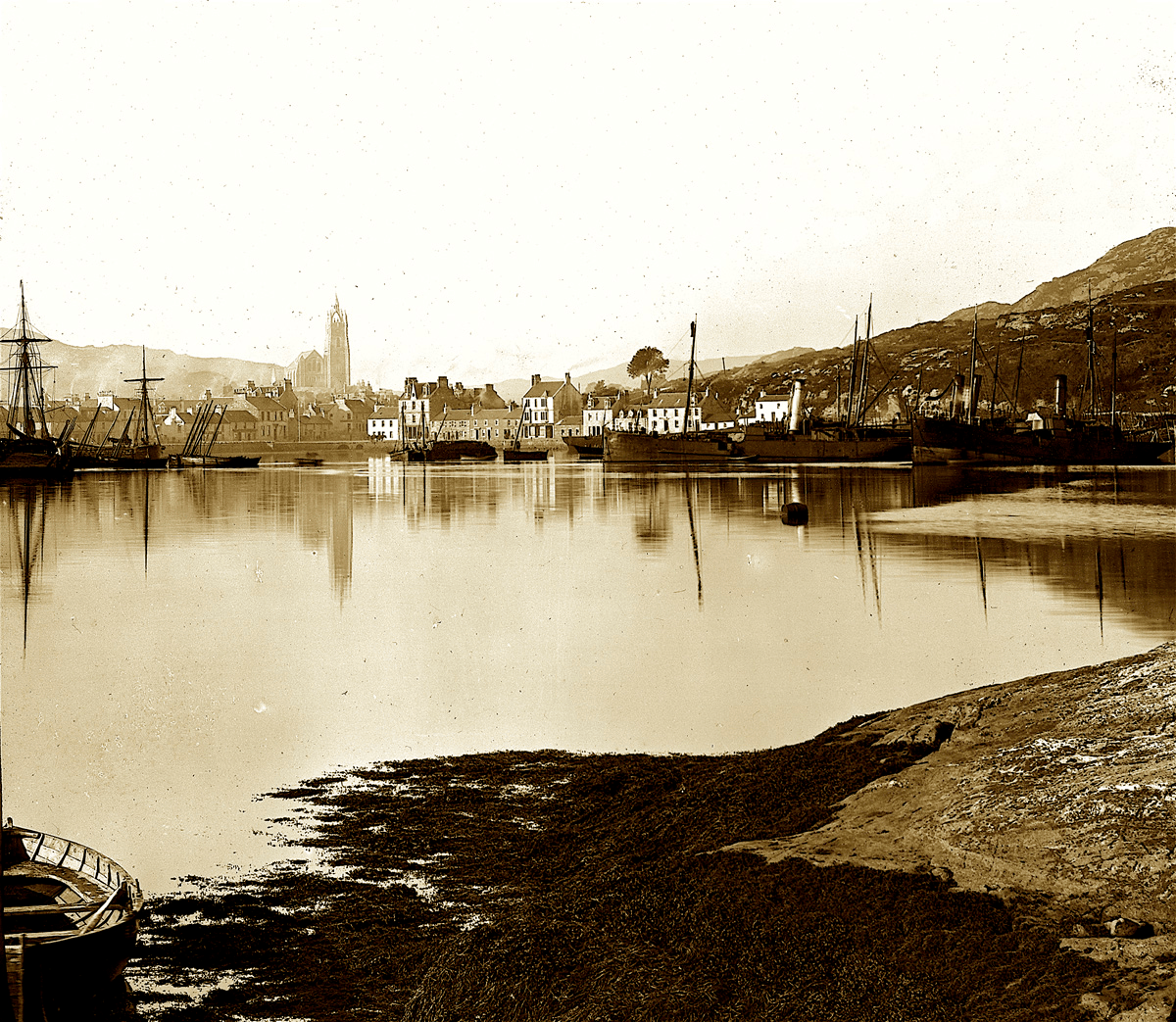
A busy Tarbert (Washington Wilson)

A Tarbert skiff
The new pier at Skipness received a weekly call.
“Glasgow, Rothesay, and Lochfyne.—Inveraray Castle with goods and passengers, Mon., Wed., and Frid., at 6 a.m. (train 7.45 a.m.). for Greenock, Kirn, Dunoon, Innellan, Rothesay, Kyles, Tarbert, Ardrishaig, Inveraray. To Skipness, Frid. Out, Tues. In. Goods received at Shed 12, foot of York St., daily from 6 a.m. till 8 p.m. David Hutcheson & Co., 119 Hope Street.”—Glasgow Herald, May 1, 1879
“Steamer ashore at Tighnabruaich—While the steamer Inveraray Castle, which sails daily, was taking Tighnabruaich pier, she, owing, to the way that was on her ran on and stuck fast in the sand close by the pier. The steamer Chevalier at once embarked her passengers, and endeavoured to take her off, but in vain, as the tide at the time was ebbing. It is expected the steamer will be got off at high water.”—Glasgow Herald, November 2, 1880
With forty years under her belting, hard-worked, six days a week, in fair weather and foul, Inveraray Castle entered the 1880s, a decade in which the strain and punishment of her long service began to be revealed.
“Glasgow to Kirn, Dunoon, Innellan, Rothesay, Kyles of Bute, Tarbert, and Ardrishaig. Notice.—As the Inveraray Castle is withdrawn for repairs, the Talisman will convey goods until further notice.—Inveraray Castle or other steamer, with goods and passengers, every Mon., Wed., and Friday, at 6 a.m. Goods received at Shed 12, foot of York St., daily from 6 a.m. till 8 p.m. To Inveraray every Wednesday and Friday.”—Glasgow Herald, April 9, 1884
During the Glasgow Fair of 1885, she fell afoul of the Harbour-master at Rothesay, but escaped a fine.
“Rothesay.—Contravention of Harbour Bye-Laws.—At the Police Court yesterday—before Bailies Mackinlay and Brown—Duncan M‘Isaac, mate of the steamer Inveraray Castle, was charged with having on Wednesday, 8th July, failed to obey the orders of the harbour-master. He pleaded not guilty, and was defended by Mr George Thomson, writer. From the evidence led it appeared that on the day named, while the Inveraray Castle was discharging goods at the pier, the steamer Elaine came in, and as the latter had three horses on her lower foredeck, it was necessary that she should get berthed alongside the slip, in order to get the animals landed, the tide at the time being within half-an-hour of low water. The harbour-master had gone for his dinner, but the harbour-constable, who has power to act in his absence, asked M‘Isaac, who as in charge of the Inveraray Castle that day, to shift his vessel in order to let the Elaine get to the slip. This it was alleged he refused to do. He also refused to slack his quarter rope so as to let the Elaine betwixt his steamer and the slip. The Elaine was afterwards brought alongside the Inveraray Castle, and although at first M‘Isaac made some objection he ultimately allowed the horses to be landed across his deck. It was also alleged that on account of this delay the Elaine was kept fully half an hour behind her time of starting from Rothesay. For the defence it was argued by Mr Thomson that the clause under which this case was tried did not apply to vessels in the act of discharging, that the Inveraray Castle had a very heavy cargo that day, and about 20 men engaged in discharging it, so that to shift her berth at the time would have been very inconvenient, besides causing delay at a time when they were in a hurry to get away. He also pointed out to the Bench that M‘Isaac was not aware that the harbour-master had such authority; and this being the first time a case of this sort had been brought up, he hoped their Honours would consider the whole circumstances. Bailie Mackinlay, in imposing a fine of one guinea, said the harbour-master must be supported in carrying out his arduous duties, and if any of the steamboat captains had reason to complain of vexatious interference it was their duty to communicate with the Harbour Trust. Mr Thomson intimated that he had instructions from Mr Macbrayne to appeal the case. to the High Court of Justiciary. —Archibald M‘Ewen, master of the steamer Argyll, was charged with a similar offence on the same date. He pleaded not guilty, and in the course of evidence it came out that the harbour-master gave orders to the pilot to take the steamer out to the bay for a short time, to make room for the Columba and Lord of the Isles. The pilot said that he could not do it as there was no engineer on board at the time. In consequence the Lord of the Isles was kept five minutes lying off the pier until the Columba left. The Magistrates dismissed the charge, on the ground that Captain M‘Ewen was away at the time, and there was no evidence that the orders of the harbour-master had reached him. It was the opinion of the Court, however, that Captain M‘Ewen did wrong in going away from his steamer at that particular time. In the months of July and August it was very necessary for captains to stand by their steamers when so many were coming and going.”—Glasgow Herald, July 16, 1885

Inveraray Castle at Rothesay in the 1880s
A series of mishaps in the second half of the 1880s signalled that all was not well. On March 19th, 1886, Inveraray Castle experienced a breakdown of her paddles at Greenock on her morning run to Tarbert and Ardrishaig. She was repaired at the quay. On November 2d, 1887, she broke her shaft at Ardrishaig, and the following day was towed to Glasgow for repair. In May, 1889, she broke a paddle shaft, and was laid-up in Bowling Harbour, but was repaired and resumed duties in June; but her days were numbered.
Here was a final resumption of service in 1891.
“Glasgow and Lochfyne.—The Inveraray Castle, from shed 12, Mon., Wed., and Fri., at 6 a.m..”—Glasgow Herald, April 1, 1891
Later in the year, she had her machinery removed at Finnieston, awaiting an inspection of her hull.
“To the Editor of the Glasgow Herald.—Sir,—Coming up the Clyde lately I noticed the old river steamer Inveraray Castle lying at Finnieston crane having her engines and boilers removed, preparatory to a complete gutting out. The Inveraray Castle was built early in the ’40s, I believe, so that for nearly half a century she has plied between Glasgow and Lochfyne, winter and summer. Should the Board of Trade survey of her hull prove condemnatory she will probably be broken up. Her engine, however, which is an early type of the steeple engine, once so popular on the Clyde, ought to be saved from the fate which usually overtakes old specimens of our marine engineering, and placed in the West-End Park alongside the old side-lever engines already there. It would in some measure show the gradual advance we have made in this great industry since the Comet was built. Perhaps some of our influential citizens who were instrumental in preserving the engines at present in the Park and elsewhere we’ll take the matter up ere it is too late.—I am &c.,—Hillhead.”—Glasgow Herald, November 2, 1891
Alas, in early 1892, she was broken up in Bowling Harbour.
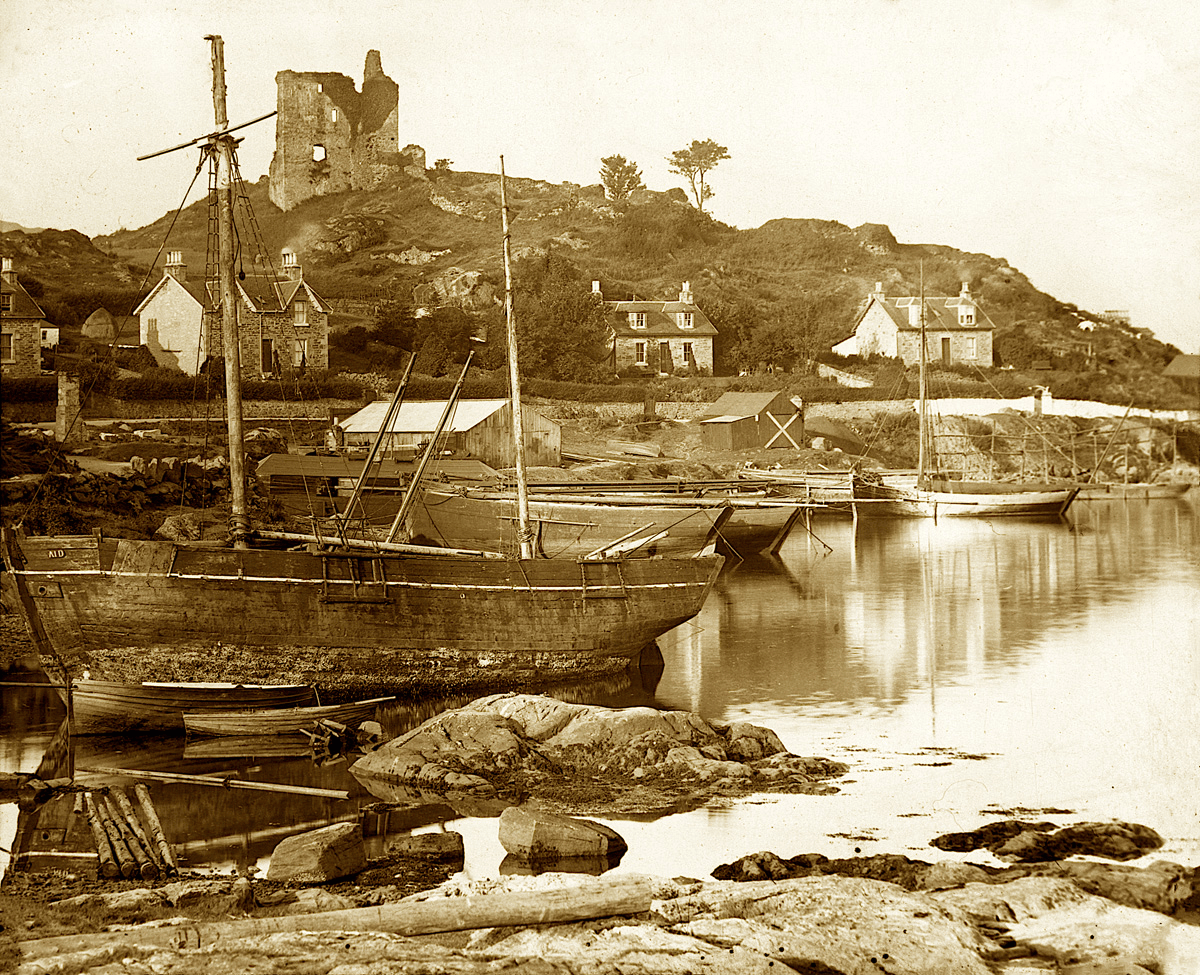
Tarbert Harbour
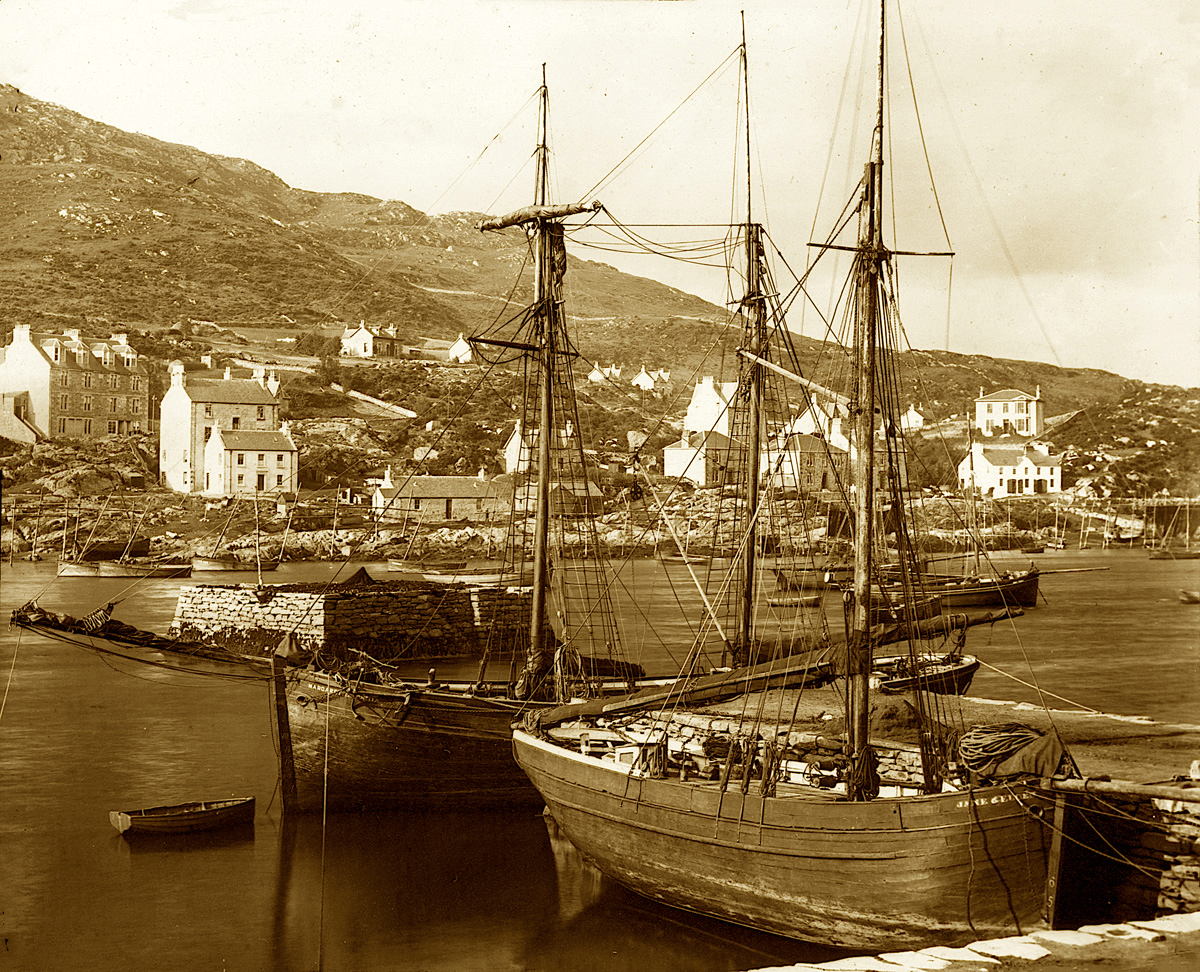
Smack, Jane & Ellen, and schooner, Margaret and Sheila, at Tarbert
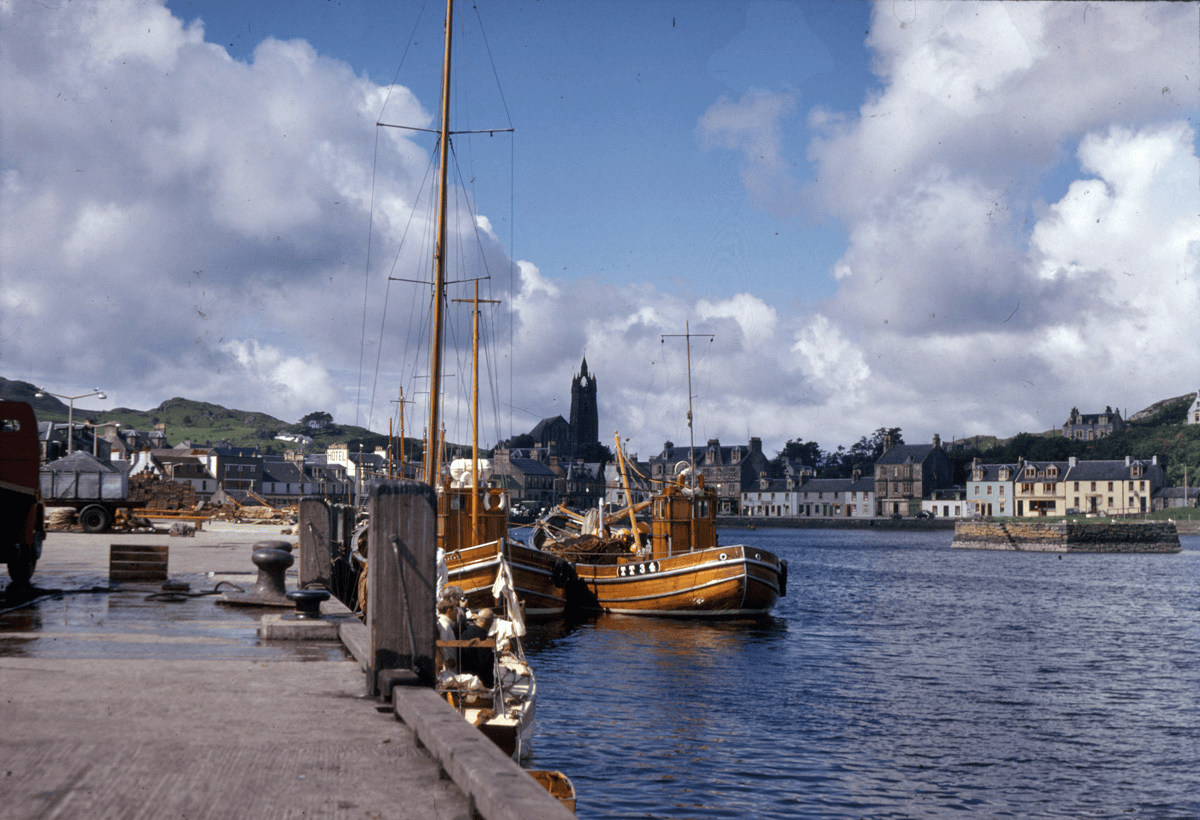
A view of Tarbert Quay in the 1950s