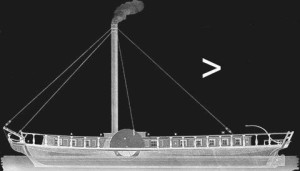

A leader in the Glasgow Herald in May 1863, laments the sale, to the Emperor of China, of the best of the Clyde steamer fleet, and the prospects for the coming season. This essay recounts the impact of the new Iona, and particularly the view of the steamer from a correspondent in Tigh-na-bruaich in the Herald on July 1st. A further leader in the same may issue of the Herald, provides some background on the Herring Fishery on Lochfyne. Again, the view from Tigh-na-bruaich is recounted.
“If it had been our custom to preface with titles the observations which we are wont to make in this part of our sheet, we might appropriately introduce the remarks which are about to follow under the heading of—“Dispersion of our River Steamer Fleet; or How are we to get to the Coast?” for it is a fact patent to every one that the best of our river steamers are with us no longer, and that difficulties will be experienced this season in reaching those charming marine towns on the Firth of Clyde which have not been felt for a long series of years. We all made an ample allowance for the losses and privations which would fall to our share in consequence of the terrible struggle which is now going on in America. We knew that it would cut off our cotton supplies, reduce thousands on thousands of industrious operatives to the rank of paupers, and keep us in perpetual anxiety regarding the question of peace or war with our Transatlantic kinsmen; but few of those who have villas of their own at the coast, or who rent summer sea-side lodgings from others, could have conceived that by means of this disruption in the United States, the distance between Glasgow and Dunoon on the one hand, and Largs on the other, would have been lengthened out to an extent which has been unknown to the present generation. It was readily admitted that the large coasting steamers, which are built to perform rapid voyages in the heaviest weather, might stand high in the account of these adventurous people who are ready to risk their capital in running the blockade; and accordingly not a few of these magnificent ships have been transferred from their late owners on the Clyde to the hands of that personage who is known, in a general way, by the title of the “Emperor of China.” But it did not enter into the head of any one that the Emperor could have need of those little, light, and rapid passenger boats, which are only in their glory when summer days are prime, or that they would have the courage to face the perils of the stormy ocean in his service, even though he should call for them.
“But it is even so. The crack members of last year’s river fleet are on the Clyde no longer. Whoever has got them, we have them not; and among those, the disappearance of which we lament, are the Iona, the Ruby, the Neptune, the Pearl, the Kelpie, the Eagle, the Hero, the Juno, the Jupiter, the Vesta, the Mail, and others; and possibly the unkindest cut of all is, that some first-rate little steamers which were being built to fill the places of those which have departed, have already been purchased to follow them into the distant seas in which they are now plying. From the evection of so many steamers, and these the very best of their class in this kingdom, the sea-bathing means of locomotion are likely to be crippled very sorely. It is true that Gourock, Helensburgh, also Troon, and Ardrossan, which can be reached by railway or road, have nothing to fear, and, indeed, may be filled to overflowing; but in proportion as they, or inland places of summer resort, like Bothwell, Bridge of Allan, or Moffat may be crowded, there may be empty lodgings in Dunoon, Rothesay, Largs, Miliport, and Arran; which latter are only accessible by steamboat. We have still, however, a large number of vessels left, and although, generally speaking, they have neither the speed, finish, nor capacity of those which are away, still they are as good as the people have got elsewhere, and we must make the best of them, in the full confidence that they will maintain the high character which some of them have borne on the Clyde for upwards of twenty years! A great deal may be done by good arrangements, and should a portion of these vessels confine their sailings between Greenock and the coast, depending on the railway for the remainder of the trip to Glasgow, the opportunities of departing and returning may be as frequent as before.
“We are afraid that the South side of the Clyde is likely to fare worst of all. The Company which has worked the Largs, Millport, and Arran trade so long and so well seems to be on the point of abdicating the route which has hitherto been its own. They to have sold their best steamers, and it is possible that others may change hands ere long. But the case of this Company is peculiar. Before another year the Wemyss Bay Railway will be opened, by which a great portion of the traffic hitherto performed by these steamers will be accommodated. Fewer steamers will certainly be required for this route at the outset, and the proprietors of the Largs line have only done what everybody else would do in the circumstances, by taking advantage of a good demand for ships which before another season may not be needed on the station on which they are now working. We look forward to the Wemyss Bay terminus becoming in course of time a grand starting point for Millport and Arran, for new coast residences on the shores of Kintyre, as well as for the opposite shores of Rothesay; but the complete establishment of these lines must be a work of time.
“As it is, the owners of the river steamers have the game in their own hands. The competition has been so great of late, and the fares have been so low, that the profits in every case have been trifling, and in some cases last year the steamers did not return a penny to their proprietors. Now that the tables are turned, however, we trust that these gentlemen will use their power mercifully, and with the vessels on hand that they will accommodate all parts of the coast as well as they can.”—Glasgow Herald, May 11, 1863
The first Iona, dating from 1855, was sold at the end of the 1862 season, and on October 2nd, 1862, when sailing from the Clyde for Nassau, was run down and sunk by the steamship Chanticleer off Gourock. Her replacement, launched in May and entering service in June, was heralded for the greatly improved accommodation she offered passengers on the Glasgow to Ardrishaig station.
“Launch of the new Iona.—The frequenters of the Clyde, who had last year to regret the withdrawal from the river and subsequent loss of their favourite steamer, the Iona, may now congratulate themselves on the near prospect of seeing that crack boat replaced by one every way fitted to succeed to her well-earned popularity. We refer to a splendid new steamer, the property of Messrs. D. Hutcheson & Co., which was launched yesterday afternoon from the building-yard of Messrs. J. & G. Thomson, Govan, and named after the boat whose place on the Ardrishaig station she is intended to fill. The new Iona is a beautifully modelled iron vessel, measuring 245 feet in length, or 20 feet more than her predecessor. Her breadth of beam is 25 feet, being an increase of 4 feet on that of the old Iona. Her depth is 9 feet; and it is expected that after her engines have been put on board she will draw about 4 feet of water. She is to be propelled by oscillating engines of 150 horse-power, fitted up with tubular boilers, superheaters, and all the latest improvements. The paddle-wheels, which have a diameter of 20 feet, will be furnished with patent feathering floats. The accommodation provided for passengers is of a very superior description—such, indeed, as cannot fail to render the boat a prime favourite even among the commodious steamers of the Clyde. In the after-part of the vessel there will be a spacious dining-room about 70 feet in length, with a range of handsome Ionic pillars, supporting the deck, running down its centre. Round the sides of this apartment will be placed sofas, covered with crimson velvet; and the walls will be decorated with tasteful mirrors alternating with the windows. In connection with the dining-room are two retiring-rooms for ladies and gentlemen respectively, with appliances for washing, &c.—an improvement which will, no doubt, be highly appreciated. The steerage, occupying the other end of the vessel, will be fitted up, of course, in a less luxurious style; but here, too, several improvements are introduced, which will tend greatly to increase the comfort of the passengers. But the most striking feature in the internal arrangements of the new Iona remains to be noticed. It consists in the introduction of a deck-saloon about 180 feet in length, and affording accommodation to both first and second class passengers. The portion of this saloon abaft the paddle- boxes, appropriated to cabin passengers, will be fitted up in a style corresponding to that of the dining-room already referred to, the windows being constructed on the principle adopted in first class railway carriages, so as to afford the greatest facility in pulling them up or down, as the state of the weather may require. In the forward portion of the saloon a plainer style of fittings will be adopted, in keeping with that of the steerage beneath. On the roof of the saloon, and extending along its entire length, will be a promenade, protected with railings, where passengers may enjoy a splendid view, or on hot days inhale the sea breezes in all their freshness. From the above details it will be seen that the Messrs. Hutcheson, in this new vessel, have brought their extensive experience to bear in the shape of improvements which every passenger can appreciate. They will no doubt have their reward in the continuance, and, if possible, the increase, of that public favour which their steamers have so long enjoyed.
“The launch of the new Iona took place at two o’clock yesterday afternoon. After having been named by Miss Hutcheson, daughter of Mr. A. Hutcheson, the beautiful craft moved gently down the ways and glided into the water, amid the cheers of a large assemblage of spectators. She was afterwards towed up the river to Lancefield Quay, where her engines are to be put on board. It is expected that in the course of a month from the present date she will be completed, so that ere the present season comes to a close the public will have ample opportunities of testing her qualities.”—Glasgow Herald, May 20, 1863
“The new Iona.—This magnificent river steamer passed down the river yesterday on a preliminary trial trip, but we were unable to learn with what result. The workmen seemed busily employed on board in giving her a finishing touch. Her progress through the water seemed very rapid, and her appearance as a marine specimen of architecture was one of the finest every seen on the Clyde.”—Glasgow Herald, June 13, 1863

From the Glasgow Herald, the Iona left Glasgow at 7 a.m.
“Rothesay.—Our new steamers Iona and Victory—Expectation was on tiptoe this morning amongst a large crowd on the quay, for the arrival of the first-named vessel, than which one could hardly conceive a more magnificent specimen of naval architecture. We shall not attempt any detailed description of this splendid steamer, she must be seen to be sufficiently admired. She arrived here at eight minutes past ten, thus accomplishing the passage from Glasgow in three hours and eight minutes, including stoppages. We were particularly struck with the readiness with which she obeyed her helm in approaching the quay and leaving it. The large number of passengers on board did not at all approach to the appearance of a crowd, distributed as they were over the spacious deck. The Iona is certainly a vast acquisition to the passenger traffic of the West. The Iona was followed bv the new steamer Victory, in twenty-two minutes, she having left the Broomielaw at half-past seven a.m., thus accomplishing the run to Rothesay: with the additional, stoppage at Gourock, in two hours and 56 minutes. Captain Stewart has certainly been exceedingly happy in the selection of the name of his vessel; and we have no doubt whatever that ere long both will attain to a still greater degree of speed. We wish both of these fine vessels, so welcome at this particular season upon the station, the full amount of the success which their owners so well deserve.—Glasgow Herald, June 25, 1863
“Tigh-na-bruaich.—The New Iona.—Whatever the Emperor of China may have to answer for as regards other watering places on the Clyde, he has, as yet, done nothing to prevent access to Tigh-na-bruaich. On the contrary, his celestial Majesty deserves the gratitude of the inhabitants—natives and strangers—for having, by his somewhat unfortunate and unprofitable acquisition of the old Iona, added yet another to the many inducements to visit this beautiful and quiet spot, by causing her public-spirited owners to place on the Ardrishaig station a steamer not only worthy to succeed the old Iona, but far surpassing her in everything which can add to the comfort, convenience, and pleasure of her passengers. Since this novel and beautiful steamer began, on Wednesday last, to make her daily calls at our pier, on going to and returning from Ardrishaig, crowds have assembled to see her pass, to admire her beauty, to welcome the numerous visitors whom she daily lands on our shores to spend a few hours till she returns from Lochfyne, and heartily to join in the praises universally bestowed, here and elsewhere, on the public spirit and fine taste of her owners. Long may she continue in her daily course, rejoicing those who take advantage of her elegant accommodation for the enjoyment of the splendid scenery of the Kyles and Lochfyne. There have been those who have sighed for a new pleasure, and we opine that had they been passengers on board the new Iona they would have got their wish realised, for everything about this vessel is not only novel but eminently fitted for gratifying the utmost wish of the most fastidious traveller, or the keenest hunter after a new pleasurable sensation. But, after all, this Imperial Majesty has a tremendous maw for Clyde steamers, and swallows them by the dozen; and should he, contrary to expectation, set his heart on the new Iona, we verily believe the gallant Buteshire Artillery and Rothesay Glendaruel Rifle Corps would instantly to a man join the Tae-pings, and blow his Majesty up into his celestial kingdom.”—Glasgow Herald, July 1, 1863

Iona of 1855
Like her predecessor, the new Iona was purchased for the Emperor in September, and stripped of her deck saloons—later used for her replacement—she left the Clyde at the end of January 1864. She fared no better than the first Iona, and sank of Lundy Island on February 2nd, 1864.

Iona of 1863
“Extension of Tigh-na-bruaich.—This place, a very few years ago, the residence of the laird and a few fishermen and cottars, has now the appearance of a thriving watering place. The extent of ground along the shore is not such as to permit of a very large increase of buildings, and it is only when you approach Kames that the land on Poltalloch estate flattens from the shore and will permit of extensive feuing. But everywhere there are symptoms of increase. A new church, connected with the Establishment, has recently been completed, and is now occupied; and the Free Church has a place of worship also nearly finished. Each of these will accommodate about 300 sitters, and the sittings may be increased by galleries when required. There is also a new hotel in course of erection midway between Tigh-na-bruaich and Kames piers. Along the shore, from the Rhu-ban to the new Established Church, there is a line of handsome villas, and the comfort of the inhabitants is attended to by the usual complement of purveyors in shape of grocers, bakers, and butchers. Visitors who sojourned here a very few years ago, when the quiet retirement of the place was one of its greatest recommendations, almost regret now to see the number of fine houses which have displaced the primitive huts of the natives, and the vastly increased number of visitors now to be found along the shores; but it is impossible to destroy the natural grandeur and beauty of the hills, or to lessen the shelter the place enjoys from almost every cold wind; and hence it is that many who have in former years. and under different circumstances, spent the summer months here, still continue to visit its shores—grumbling, it may be, at the changes, but yet still preferring the place as the quietest and one of the most beautiful on our western shores, within easy access to Glasgow.”—Glasgow Herald, July 1, 1863
“There are few persons in Scotland who have not a personal interest, more or less direct, in the suppression of trawling and the maintenance of a close time. Those engaged in the Herring Fishery have been the first to take active measures for the protection of the Acts recently passed for that purpose, simply because they are the class that would suffer first, and suffer most, were these Acts repealed or allowed to become a dead letter, as they seem in imminent danger of being. But a question that materially affects the supply of one of the most common, and one of the most wholesome articles of food claims the attention of the general public. Our readers will have observed that, not long since, large meetings of those directly interested in the Herring Fishery in Lochfyne and our Western Coasts were held in Glasgow, Greenock, Campbeltown, Inveraray, Largs, the and other places; and on Friday we published a report of a large and influential meeting, held the day before at Rothesay, for the same purpose, and attended by upwards of nine hundred fishermen, from Lochfyne and all parts of the West Coast.
“For the sake of general readers, it may be necessary to state that the objectionable practice of fishing with the trawl-net began to be introduced about twenty-five years ago. The trawl-net is so made and so used that it sweeps up everything, taking not only full-grown fish, but those that are diminutive, immature, and unwholesome, at the same time tearing up the spawning beds and destroying the spawn. So destructive did this practice threaten to prove to our Herring Fisheries, that the fishermen and fish-curers raised an outcry against it. Accordingly, in 1851, an Act was passed declaring the use of the trawl-net illegal; and in 1860 and 1861 further enactments were found necessary before the obnoxious practice could be completely suppressed. The Act of 1860, besides providing against trawling, imposed a “close time,” a time during which fishing was to be desisted from—extending from the beginning to the middle of the year. This prevision, however, though much approved in the Lochfyne and other fisheries, was considered injurious to the fishing population of the Western Isles, owing to their peculiar circumstances, which rendered a supply of herring bait requisite in close time; and the Legislature was again applied to, last session, when a Royal Commission—consisting of two scientific and one military gentleman—was appointed to inquire into the whole subject. Their report was to presented to Parliament the month before last, and was of such a kind as very much to surprise and alarm those who are engaged and interested in the Herring Fisheries in Scotland. It contained the following startling statement:—“Our inquiries satisfy us that the fishery of Lochfyne has suffered no diminution by the operation of the trawlers, but, on the contrary, is a steadily progressive fishery, when the periods of comparison are made sufficiently long, to correct the annual fluctuations, which are always considerable in this as in all other herring fisheries.” It also referred to the fact that “in the years 1855-56 trawling revived, receiving a great impulse receiving a great impulse in the latter year from the Report of a Treasury Commission, laid before Parliament in 1857, and containing the following recommendation—‘We earnestly recommend the repeal of a statute [against trawling] which [statute] has no other result than to keep a considerable population in habitual and successful of violation of it.’” The appearance of the Commissioners’ Report, containing such paragraphs, and being, in effect, nothing more nor less than a recommendation that trawling, under certain restrictions, should be legalised, naturally excited much alarm amongst those interested in the Fisheries, and acquainted by personal observation with the mischievous nature of the practice. They foresaw that trawling would revive after this Report, as it had after the Treasury Report quoted from. They also saw good reason to apprehend that Government might give effect to the dangerous suggestions of the Commissioners, and repeal the statutes which were obtained with so much trouble, and on which the preservation of our Fisheries, as a prolific source of food to the country, and of support to tens of thousands of families, appears so much to depend. For the protection of these valuable statutes, the meetings to which we referred have been held; and of these meetings the one held in Rothesay is the most recent and has not been the least important.
“The meeting was composed of men who had spent their lives in fishing, and carefully attending—for their own interest, which happens in this case to be identical with the interests of the public—to the circumstances, that increase or diminish the productiveness of their Fisheries. The resolutions were moved and seconded by men also practically acquainted with the subject. The consequence was, that the plausible theories of the two savants, and the military gentleman who constituted the Royal Commission, were utterly demolished in a very short space of time. We only trust that due weight will be attached in Parliament to the emphatic and unanimous testimony of the very men who are the most competent judges in this matter—men who reason not on speculative grounds, but by the logic of facts and experience—who speak of that which they have seen, and testify that which they do know—the very men, we beg to submit, on whose evidence the conclusions of the military gentleman and the two savants ought to have been based. We trust the Legislature will not forget that men may be eminent naturalists, theoretically, and yet make fearful blunders when they attempt to reduce to practice theories that run counter to experience; also, that a man may know a great deal about military evolutions and yet know very little about fish.”—Glasgow Herald, May 11, 1863
“Tigh-na-bruaich.—Herring fishing.—The past has been a busy month with the Kyles fishermen. Several new boats, the result of last year’s successful fishing, have been added to the fleet, and the whole native population have been actively engaged in fitting out the boats and preparing their nets for another, and, it is to be hoped, successful, season’s fishing. Nearly two weeks ago one or two of the boats joined those from other places fishing along the shores of Arran, but their success was not such as to induce others immediately to follow. With a limited length of nets, they tried to “mark the herring” in the Kyles; and they proved their presence there, but in such small numbers as to forbid further experiment. Last week about a dozen boats left for the Sound of Kilbrannan and Lochfyne, and they returned on Saturday, and report that their take has averaged about eight hundred a boat—that the price varies from 6s. to 10s. a hundred, and that, when they left Lochfyne on Saturday morning, there was a better appearance of fish than they had seen during the week. The quality of the fish is also fast improving, and those brought home on Saturday were of excellent quality, and sold readily at a penny each. This week every boat is off to Lochfyne, and the fishermen are in high spirits. They have now no annoyance from trawlers, in the way of interference with the fishing or breaking the “eyes” or shoals of the fish, and thus driving them back into deep waters. But notwithstanding that the shores of the Kyles and Lochfyne now abound with policemen, and although every net bladder is numbered, one of the boats from the Kyles had a barrel of her nets stolen when last week fishing off Tarbert. This kind of depredation it is surely within the power of the police to put down, and we hope that we shall hear nothing more of such losses to the industrious and honest drift-net fishermen, who are entitled to receive, as they by their uniform good conduct deserve, both encouragement and protection from all in authority.
“Amateur fishing.—We are keen fishers, and pursue the whiting, the haddock, the cod, the flounder, or the mackerel with as persevering a determination to destroy such of them as are to be found in a mature state, as the trawler followed and sought to destroy the immature herring on the fishing banks in the Kyles, or along the Kerry or Bute shores. We have thus been led to mark the decrease of these fish from year to year on our favourite banks just as trawling increased, until they entirely disappeared. For several years fishing for white fish has, in these waters, been a vain and profitless occupation, and hence our sympathy with the drift-net fishermen, who attributed similar results in their occupation from a like cause. But trawling has had its day and is forever dead; and in spite of all the Royal Commissioners that ever pocketed public money for profitless and useless services it shall never be revived, for has it not been shown to demonstration that with the cessation of the trawl came the increase of the herring, so that last year never had the drift-net fishermen such a fishing since trawling began. So also, we rejoice to say, the white-fishing begins to recover from the deplorably destructive consequences of the trawl system; and we can bear testimony to the fact that with two hand-lines, and within two hours, the following take was obtained in the Kyles on Saturday, viz.:—Nine dozen good-sized whitings, eight cods, four flounders, two skates, and one dogfish. This reminds us of former days, when an hour’s pleasant work produced as many fish as the family could consume next day, and when boating and fishing were the universal sources of healthful and profitable amusement for summer visitors, along the shores from Gourock to Ardlamont Point or Pladda Light, wherever a fishing bank was to be found. It seems to be consistent with reason and common sense that if the breeding banks and young fish be undisturbed fish must increase, and anything the trawler swears to the contrary will convince no one unless he lives within hail of Tarbert.”—Glasgow Herald, July 1, 1863
There is always a gripe, and it is generally about money, and Tigh-na-bruaich is no exception.
“Tigh-na-bruaich.—The pier.—Every place has some public grievance—something that interferes with the interests or hurts the feelings of the inhabitants, and Tigh-na-bruaich is no exception. It has its grievance in its pier. The pier is in itself no grievance—it is, on the contrary, a great public convenience—but its management does not please either the native or transient inhabitants. This pier was, we believe, erected by the proprietors of the line of Highland steamers for the convenience of their vessels calling at the Kyles. It was by them handed over or sold, we do not know which, nor on what terms, to the laird of Tigh-na-bruaich, who keeps it up ostensibly for the benefit of the public. There is a scale of pier-dues exacted for goods, and passengers pay one penny for going on board or landing from a steamer. These seem to be fair and reasonable charges, inasmuch as if the burden of maintaining the pier falls on the laird he is entitled, unless he could see it to be his interest to make it free, to demand as much in shape of dues as will keep it in repair. So far the public go with the laird, and give utterance to no complaint; they pay when receiving goods, and they pay when going to or coming from the steamer. But, unless on such occasions, the public have until last year been at liberty to go upon the pier without payment; and every one knows that the dull monotony of places even more lively than Tigh-na-bruaich there is a kind of relief from ennui in a visit to the pier on the arrival and departure of steamers, to look out for acquaintances, to meet friends, or even to gratify idle curiosity. But things are changed, and every visitor to the pier, whatever his purpose, must now pay one penny if he pass the gate. This is the grievance, and about it there has been a world of gossip, much angry talk, and keen discussion, and we fear some unjust censure of the laird. That this penny exaction is felt to be an annoyance both to the natives and visitors is, however, unquestionably true; and, without going into the question of right, we wonder that for so small a yearly sum as these pennies must produce the proprietor should injure his own more important interests, and at same time raise angry feelings in the whole population. The proprietors of Tigh-na-bruaich and Poltalloch have a good deal of valuable ground along the shore yet to feu, and they are anxiously desirous to dispose of their land. Feuing can only succeed if there be a demand for houses for summer residence, and it would seem to be the interest of the proprietors to throw out every inducement to strangers to come to these shores. The inducements the place really offers are those provided by nature, in the beauty of the hills, the purity of the atmosphere, the protection from cold winds, and the facilities for safe boating and fishing which the placid waters of the Kyles ever afford. There are also places of worship and zealous ministers of the Established and Free Churches, and the native inhabitants and proprietors of houses are civil, obliging, and not greedy. It really seems suicidal for the proprietor to act as he does. He thereby raises questions as to his rights, and the owners’ loss of the foreshore, which would otherwise never have been mooted. He may think that a penny is a trifling sum; but if the public have the notion that the penny is improperly exacted it becomes important and its exaction is at once magnified into a public grievance —it is felt to be an annoyance, and is the cause of grumbling, and there are many who, rather than submit to it, will make choice of other places where they are more liberally dealt with. We have been looking on to see how this thing works. Every day members accompany their friends to the steamers, but they cannot see them safely on board without each paying the penny tax. Ladies are anxiously waiting the arrival of their lords, but must stand at the end of the pier or pay the tax; young ladies, looking out for sweethearts, are staring their eyes out through the bars of the pier-gate, and the whole romance of their meeting is lost by this toll-gate exactions. Many are desirous to get newspapers from the newsboy on board the steamer, and this can only be accomplished by paying as much as they pay for their newspapers. The pier, too, in the absence of well-kept roads, would be much frequented as a promenade, especially about the time of the arrival of steamers; but such pleasure is too heavily taxed, and cannot therefore be enjoyed. In fine, without joking, this penny affair is felt to be a grievance requiring a remedy, if visitors and natives are not to have their tempers ruffled, and if houses are to be let. But we confess it is much easier to find fault than to suggest a remedy. The laird and the feuars should, however look to find one in time, for, if the evil ingredients created by this matter are once thrown into the legal condition, it will then remain for the witches to predict the future of the pier.”—Glasgow Herald, July 1, 1863