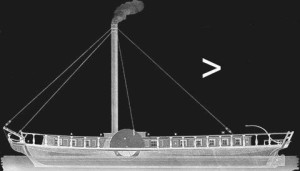

In Part 4, the opening of the Greenock Railway had a profound effect on the Castle Company as their main competitor on the Rothesay station was absorbed into a new company, sailing in connection with the railway trains. The steamers of the Castle Company were sold, and the new management had a positive effect, with new construction and a re-opening of the Arran sailings.
“New boats” was the cry of 1844.
“The Clyde.—From the following preparations for the coming summer traffic, we anticipate still farther improvements in the speed of our communications with the watering-places on the Clyde. We are informed that the Castle Company have ordered two new iron steamers, hull and machinery, from Messrs. Caird & Co., Cartsdyke Foundry, Greenock. The Greenock Railway Company have specifications in the hands of contractors for an iron steamer about the size of the largest river-boats, intended, we believe, for the Rothsay station. One of the conditions in the contract is to be, that she will equal or excel in speed both the Lady Kelburne and Lady Brisbane, or a large amount of the price be forfeited.”—Scottish Chronicle, January 19, 1844
There were signs that the depressed economic conditions that had affected the Paisley and Greenock area were improving, and shipbuilding was playing an important role.
“Steam-boat building on the Clyde.—An extraordinary degree of activity prevails at present on the Clyde in the building and fitting out of steamers. The Engineer, which ran during a portion of last year, has been lengthened and improved, and is a remarkably fine vessel. The Superb has also been lengthened, and so much improved to entitle it to rank among the new vessels of the season. A beautiful new steamer named the Invincible was lately launched, and now plying on the Largs and Millport station. Three new steamers for the Castle Company are expected to be ready shortly, and will no doubt sustain the high reputation which “the Castles” have so long enjoyed. At Paisley there are no fewer than four new steamers in course of erection. Two of these are intended ply in connection with the Greenock Railway—the one to Helensburgh, and the other to Rothesay; the third is to run in conjunction with Lady Brisbane and the Lady Kelburne on the Largs station; and the fourth is a small pleasure yacht for Lord Eglinton. Two other steam pleasure yachts are erecting elsewhere—one of them by Messrs. Thomas Wingate & Co. to fitted up with the screw-propeller; the other by Mr. Robert Napier, for Ashton Smith, Esq. late M.P., on ordinary principle. The spirited firm of Messrs. Thomson & MacConnell have ordered handsome steamer companion to the Shandon. It is, we understand, in advanced state, and it is to called the Dolphin. We hear also of a fine steamer being nearly finished to ply between Glasgow and Stranraer, entitled the Albion, and of another beautiful new vessel, the station for which is not yet fixed, to fitted up with Kebble’s patent paddle. A new steamer is already afloat, intended to ply upon Lochlomond. This will make three steamers on Lochlomond this season; and as they are owned, we believe, rival companies, the public may anticipate “cheap fares” on this queen of Scottish lakes. Mr. William Napier is building two small steam-tugs for the Forth and Clyde Canal, to be propelled by screws instead of paddles. In addition to the steamers which we have enumerated, a number of large steam-ships are in progress. Among these may be mentioned a magnificent vessel built by Mr. Steel, Greenock, the engines by Mr. Robert Napier, to supply the place of the Columbia in the Liverpool and Boston trade, and to be called, we believe, by the same name. The City of London is another fine steam-ship in the course of erection: with the exception of the Great Britain, the latter is the largest vessel ever built of iron—she is to run between Aberdeen and London. Three large Government mail-packets are being built and fitted out by Mr. Robert Napier, at Govan: their names are the Bloodhound, the Jackal, and the Lizard. In Mr. Napier’s building-yard there is also an iron gun-brig erecting for the Indian Government. The same eminent engineer lately completed the Dundalk, a magnificent large steamer, now plying between Dundalk and Liverpool. Two large vessels for the Ardrossan and Fleetwood station are building by Messrs Tod & M‘Gregor. This firm are likewise engaged on large vessel to ply, we believe, between Liverpool and Belfast. There are thus no fewer than from twenty to thirty steamers—some of them of heavy tonnage—and representing vast aggregate of capital.—either lately completed, or at present in course of erection on the Clyde.”—Glasgow Citizen, April 13, 1844
With new steamers building, the Castle Company sold the Arran Castle to Mr Lewis M‘Lellan, and placed the Windsor Castle for sale. Arran Castle sailed to the Burns Festival at Ayr on August 6th, and some time afterwards was sailing out of Dublin.
“Steam-packet for sale, by private bargain.—The well-known steam-packet Windsor Castle, built by Messrs Tod & M‘Gregor in 1838, and since that year plying betwixt Glasgow and Rothesay, is now for sale. She is about 130 feet in length, 16½ feet in breadth, is propelled by a capital engine of about 80 horses’ power, draws only about four feet of water, and has been long recognized as one of the swiftest steamers on the Clyde.—Apply to Mr John Macarthur, Castle Company’s Office, Broomielaw; or Mr John Kerr, writer, 7, South Hanover Street.—Glasgow, 24th January, 1844.
“N.B.—If not sold within fourteen days from this date, the above Packet will be withdrawn from the market, and ply as before in connection with the Castle Company’s other packets.”—Greenock Advertiser January 26, 1844
Windsor Castle was sold to owners in Dundee in July and left the Clyde on August 1st.
“Tour round the North.—The Royal mail packet steamer, Windsor Castle, will leave the Broomielaw, Glasgow, on Thursday 1st August, ten o’clock morning (on the arrival of the railway train from Edinburgh), on a voyage round the North to Leith. Fare, 80s.—Andrew Craig, Chain Pier.—29th July, 1844”—Dundee Courier, July 30, 1844
Unfortunately, on Tuesday, October first, after just two months sailing on the east coast, she was wrecked on her return to Granton from an excursion from to view the embarkation of Queen Victoria at Dundee
“Wreck of the Windsor Castle Steam Packet.—Miraculous escape of the passengers and crew.—It is our duty to record to-day another of those serious accidents which during the last few years have frequently befallen the steam vessels of this country; but we rejoice to say, that on this occasion no lives have been lost. The Windsor Castle, which for some months past has been regularly plying betwixt Granton and Dundee, was advertised to sail on Tuesday morning from Granton to the latter port, and to return in the afternoon, thus affording an opportunity to persons wishing to witness the embarkation of the Queen to fulfil their purpose and return home the same evening. The passage to Dundee was performed both safely and with expedition, and about four o’clock in the afternoon the Windsor Castle left the west protection wall of Dundee with passengers to the number of nearly 250 on her return home. The vessel steered directly out to the royal squadron, which had not yet got under weigh, and sailed five or six times round the Albert and Victoria, in order to gratify the passengers with a view of her Majesty and her royal consort, both of whom appeared on the deck, and graciously acknowledged the enthusiastic and oft-repeated cheers of those on board the Windsor Castle. The royal yacht left the roadstead at half-past four o’clock, followed by the other steam vessels, and by the Windsor Castle. On arriving at the mouth of the Tay, the Black Eagle, which had been astern of the Windsor Castle, passed the latter, which was steered into what is known by nautical men as the Pool, being a nearer cut across St Andrew’s Bay, and which the high state of the tide at the time rendered available. The wind, which, at this time was but a slight breeze. being off the land, the sea in the Pool was quite smooth, so much so, that the passengers being entirely free from sickness, and taking advantage of a band of music which was on board, betook themselves to dancing, and seemed determined to wile away the time in the most harmonious and pleasing manner possible, little imagining the sad catastrophe which was rapidly approaching. When off the town of St Andrew’s, the Victoria and Albert, followed by the Black Eagle, the Princess Alice, the Stromboli, and the Eclair, were seen far a-head, rapidly fading from sight. It was now half-past seven o’clock; the vessel had reached the East Neuk of Fife, and all things were apparently going on safely and speedily, when suddenly a loud cry was heard from those in the forecastle to stop and back the engine, a request with which the engineer immediately complied; but scarcely was the stoppage of the engine accomplished, when the vessel, still under the impulse of its former velocity, came with a tremendous crash against the beacon on the North Carr Rock. Instantaneously the air was rent with shrieks from the women and children, the men rushing backwards and forwards making eager and fruitless inquiry as to the cause of the shock; some passengers clung to each other, appalled with the prospect of immediate destruction; others, with great presence of mind, began to lay hold of carpet-stools, pieces of wood, and other lumber lying on the decks, by which they might support themselves in the event of the vessel sinking, while several gentlemen divested themselves of nearly all their clothes, so that they might with more chance of success be able to sustain themselves on the bosom of the ocean, and struggle with the surf should they be fortunate enough to obtain a footing on the rocks. At the moment the vessel struck, a large party were below at dinner, and as may be easily imagined, all the dishes on the table were simultaneously with the concussion hurled precipitately, and in unspeakable confusion to the other end of the room, to the great dismay and utter astonishment of the regaling company. It was on the deck, however, that the most heart-rending and indescribable spectacle was to be seen; all was confusion, sonic looked moody and pale, others bawled vociferously to the captain and Mr Greig the owner, who was on board, to run the vessel ashore regardless of the nature of the rocks, while many rushed to the hurricane deck above the engine room, thinking that there they would be more secure. By this time the sea water had attained to a considerable depth both in the engine room and the main cabin, that made the vessel lurch to one side, upon observing which, the passengers rushed to the high side of the vessel, which of course was thus swung over to the same side, causing the passengers to betake themselves again to the opposite side, and thus the vessel was kept rolling from side to side, the sea water being by the motion lashed up on either side of the vessel’s hold. In this awful and helpless condition the helm was put hard aport and after nearly twenty minutes of gloomy suspense, the Windsor Castle grounded, most providentially, as was afterwards found, between two large rocks a little to the east of Kilminning, and about two miles from Crail. On approaching the shore, a loud and general cry was raised for boats! Boats! accompanied with “Land the Ladies first.” Accordingly a small boat belonging to the steamer, with only one oar, was lowered from the stern, by which the female passengers were conveyed ashore in six voyages, the boat being capable of carrying only six or seven at a time besides the rowers. Some gentlemen were despatched in the first boatful to seek for assistance, who forthwith went to Mr Crombie, farmer, Kilminning. and got a man despatched on horseback to Crail to obtain boats and other aid. By the time the ladies were nearly all landed, three fishing boats arrived at the scene, and were immediately employed in conveying the remaining passengers to land, but before they could be all brought ashore—which altogether occupied an hour and a half—the tide, which was fast ebbing, had so far receded as to enable many of the male passengers to land, by swinging themselves from the bowsprit of the steamer with the aid of ropes. Happily all got safely on dry ground, most of them. also succeeded in securing their luggage, and with the exception of some whose feet were immersed in the water, no personal injury was sustained. The entire company then betook themselves to find out shelter for the night, a task by no means easy on the bare shores of the East Neuk. After scrambling in the dark along the beech, over hedges, dykes, and ditches, the greater number arrived at Crail, where all got under roof; some of the more fortunate being provided with beds at Mr Dickson’s, of the Golf Inn. A great many however, procured accommodation of some kind or other in Crail or from the farmers and cottars in the neighbourhood, the inhabitants evincing the greatest sympathy with the fate of the sufferers, by their anxiety to minister to their necessities as far as their circumstances could permit. Among thesw we may mention, besides Mr Crombie and Mr Dickson, Mr Morton of Craighead, the Reverend Mr Marson, and Mr Webster, the parish minister and school-master, whose assistance, along with several men of the preventive service, was also promptly given at the landing of the passengers. Up to the time when all the passengers were safely landed, the weather had continued favourable, but soon thereafter it began to blow a violent gale, which continued all night, causing a heavy sea to beat against the unfortunate vessel, as it lay exposed to its furious action. The consequence was, that the steamer, on the return of the tide, shifted from its first position, and was driven violently on a ledge of rocks close by, against which it continued to grate till yesterday morning, when it appeared nearly cut in twain, being broken in the back, and presenting all the features of a total wreck. Some more luggage was secured from the wreck, and it was expected that the remains of the fore part of the vessel would be the only portion, if indeed any at all, that would hold together for another day.
“We may mention, that a few of the passengers returned yesterday, by St Andrew’s, to Dundee, but the greater number tarried at Crail, and were taken up by the Modem Athens this afternoon, on her passage from Dundee to Granton.
“We refrain in the meantime from expressing any opinion on the circumstances which led to this melancholy catastrophe. It cannot, however, be disguised, that at the time it happened the sea was comparatively calm; that the beacon against which the vessel struck is one with which all who have the least pretension to knowledge of that passage must be thoroughly acquainted, and, knowing it to be a dangerous point, those in charge of the Windsor Castle should be able to give some satisfactory explanation to the public, otherwise all confidence in such means of conveyance will be withdrawn. From the inquiries we have made, we learn that the vessel was, at time of the accident, under the command of Captain Greig, and that Mr Black, who early in the summer brought the Windsor Castle round the north of Scotland from the Clyde, was acting as pilot. It is said that the steamer, in consequence of the smoothness of the sea, had made more progress than was calculated upon, and that the leading light on the Island of May was not distinctly seen, the atmosphere being hazy at the time, and that these two causes combined to mislead the pilot, and make him think he was farther out at sea than he really was.
“Several seafaring men have given it as their opinion, that had the Windsor Castle struck the North Carr Rock stern on, she would immediately have split in two, and all on board would have been consigned to a watery grave. As it was, it appears the vessel, which is made of iron, made a sliding stroke over the rock, and that one of the iron stauncheons of the beacon had, by the concussion, opened up the joining of two plates immediately under the bulk-head, through which the water rushed into the vessel, placing her and the hundreds of souls on board in a position of such helpless and imminent danger, that it was agreed on all hands they were saved in a maimer entirely miraculous and providential
“The Windsor Castle, we believe, was built on the Clyde in 1838, and was generally considered one of the strongest iron vessels of her size afloat. Tuesday was to have been the last of her double trips this year. Unfortunately, it appears to have been her last for ever!”—Caledonian Mercury, October 3, 1844

Wreck of the Windsor Castle
Back on the Clyde, the early season timetable for the Castle steamers was little changed from previous years, and again there were no regular sailings to Arran.
“Castle Company Steamers.—The Castle Steam Packet Company intimate that their packets are appointed to sail as follow:—From Glasgow, for Greenock, Gourock, Dunoon, & Rothesay, every day, from foot of Broomielaw, at 6 o’clock a.m., every day, from Glasgow Bridge at half-past 9 o’clock a.m., every day, from Glasgow Bridge at 1 o’clock p.m. From Greenock at 8 and half-past 11 a.m.; and 3 p.m.
For Tarbert and Lochgilphead, every day, from foot of Broomielaw at 6 o’clock a.m.; and from Greenock at 8 o’clock.
For Inverary, every Wednesday and Saturday, from foot of Broomielaw, at 6 o’clock a.m.; and from Greenock at 8 o’clock.
For Port-Askaig, Islay, every Wednesday from foot of Broomielaw, at 6 o’clock a.m.; and from Greenock at 8 o’clock. Passengers conveyed from West Tarbert direct to Islay the same evening, by the Maid of Islay steamer.
The regular 4 o’clock afternoon steamers will shortly resume plying to Greenock, Gourock, Dunoon and Rothesay.
On and after Monday the 20th instant, the Castle Company intimate that their sailings, to and from Glasgow and Islay, will be as follows:—From Glasgow for Port-Askaig by Tarbert, every Monday and Thursday, from foot of Broomielaw, at 6 o’clock morning; for Port-Ellen by Tarbert, every Tuesday, from foot of Broomielaw, at 6 o’clock morning; from Port-Askaig, Islay, by Tarbert, every Tuesday and Saturday, about 5 o’clock morning; from Port-Ellen, Islay, by Tarbert, every Thursday, about 5 o’clock.
For Glasgow.—From Rothesay, Dunoon, and Greenock.—Hours of sailing may be seen on the sailing boards at each of these ports.
The steamer for Islay, on Monday the 20th instant, will suit the accommodation of parties attending the Market to be held there on the 21st and 22d instant. The new and powerful steamers will shortly be placed the Rothesay and Lochfine stations, by the Castle Company.
“The freight of all goods shipped for places between Glasgow and Inverary, and vice versa, except Dunoon, Rothesay, Tarbert, Islay, Lochgilphead, and Inverary, must be paid previous to shipment, otherwise they will not be taken.—Passengers are requested to take charge of their own luggage, and the Proprietors will not be responsible for any article whatever, unless booked and signed for previous to shipment. Goods for Islay received at the Office every day..—John MacArthur, Manager.—Castle Steam Packet Office, Glasgow, 11th May, 1844—Agent for Greenock, James Morrison, 2, Shannon’s Close.”—Greenock Advertiser, May 14, 1844
A few days later there were some modifications.
“The Castle Steam Packet Company intimate that their packets are appointed to sail as follows:—From Glasgow, for Greenock, Gourock, Dunoon, and Rothesay, every day, from foot of Broomielaw, at 6 o’clock morning; every day, from Glasgow Bridge at ½-past 9 o’clock morning; every day, from Glasgow Bridge at 1 o’clock afternoon; on and after 1st June, every day from Glasgow Bridge at 4 o’clock afternoon.
For Tarbert and Lochgilphead, every day, from foot of Broomielaw at 6 o’clock morning.
For Inverary, every Wednesday and Saturday, from foot of Broomielaw, at 6 o’clock morning; on and after 1st June, every day at the same hour.
For Port-Askaig, Islay, by Tarbert, every Monday and Thursday from foot of Broomielaw, at 6 o’clock morning.
For Port-Ellen, Islay, by Tarbert, every Tuesday, from foot of Broomielaw, at 6 o’clock morning.
From Port-Askaig, Islay, by Tarbert, every Tuesday and Saturday, about 5 o’clock morning.
From Port-Ellen, Islay, by Tarbert, every Thursday, about 4 o’clock morning.
“An additional conveyance will be given to Lochfyne, about the latter end of June.—John MacArthur, Manager.—Castle Steam Packet Office, Glasgow, 24th May, 1844.”—Glasgow Constitutional, May 25, 1844
In June there was a flurry of reports from the shipyards of Messrs. Caird & Co., Greenock, and Messrs Smith & Rodgers, Glasgow with the launching of the three new Castle steamers. The first was Cardiff Castle.
“About one o’clock yesterday the Cardiff Castle, one of the new iron steamers for the Castle Company, was launched from the building-yard of Messrs. Caird & Co., of this town. When she began gently to slide from the ways, the name was given by Miss Charlotte Thomson, who broke a bottle of wine over the bow of the vessel—and as she went easily into the water, amidst the firing of cannon, the flag was unfurled displaying the name to all the spectators. Her appearance in the water called forth the admiration of all who beheld her. She is of a very beautiful model, is finished in the most perfect manner, will be a valuable accession to the fine steamers belonging to the same highly respectable and well-managed company, and promises to be one of the swiftest sailers on the Clyde. The Cardiff Castle was immediately towed round to the crane at the East Harbour, where she will have her engines put on board with all speed. These are made by the same far-famed engineers who built the vessel—they are on the diagonal principle, and finished in the most beautiful style—and are confidently expected to give the highest satisfaction to all parties concerned. The builders will be ready in about fourteen days hence to hand over the vessel, finished in all respects; and about the same time a second steamer, built by them for the same Company, will be ready for launching. We may add, and we do so with the greatest pleasure, that Messrs. Caird & Co. are about to lay on in their yard here, two large iron steamers for the English and the north of Ireland trade; one being intended to ply between Liverpool and Drogheda, the other between Liverpool and Londonderry”—Greenock Advertiser, June 4, 1844.
This was followed by Edinburgh Castle.

Edinburgh Castle
“On Wednesday, the Edinburgh Castle, one of the excellent line of vessels belonging to the Castle Company, was launched from the building yard of Messrs Smith & Rodgers, Broomielaw, Glasgow. This enterprising Company on the Monday previous, had a new vessel, called the Cardiff Castle, launched from the premises of Messrs Caird & Co. of this town, from which there is another called, we believe, the Craignish Castle, to be launched in a few days. The public spirit of this Company has been long known to the denizens of the West of Scotland—they have, we hope, profited thereby—and sure we are that the public have been greatly benefited by their exertions.”—Greenock Advertiser, June 11, 1844
And finally Craignish Castle.

Craignish Castle
“On Wednesday morning another splendid iron steamer, the second within the last fortnight, was launched from the building-yard of Messrs. Caird & Co., of this town. She is named the Craignish Castle, and is intended to ply, as a consort with the Cardiff and Edinburgh Castles, on the Glasgow and Rothsay station. These vessels are owned by the enterprising, well-managed Castle Company, who have adorned our beautiful river with the finest and best conducted boats for a quarter of a century, and the important addition now made will raise still higher the character of their standard steamers. The Craignish, like the Cardiff, is about 180 feet in length, and is of exquisitely beautiful model. She was drafted by Mr. Alexander Denny of Glasgow, a gentleman who has acquired a just celebrity in the introduction of an improved class of steamers on the Clyde, and who has been highly successful in every boat which he has modelled. As the Craignish began slowly to glide into the water, she was named by Miss M‘Gowan, with the customary formalities. Her engine is now being placed on board with all speed. In a very few days, the Cardiff will be on the old station, which has been filled for so long a period with honour, and we trust profit, to the proprietors, and with convenience and comfort to the public. This beautiful steamer, we may just add, affords a striking proof of the perfect accuracy with which the form and displacement of water of steamers are calculated, and at the same time of the skill and judgment of both draftsman and engineers, as she has not varied a hair’s-breadth, since she has had her machinery put on board, from the line originally fixed. When she was launched we remarked her admirable appearance on the water, and now that she is near her completion, we repeat with pleasure the observation.”—Greenock Advertiser, June 28, 1844
The Company was keen to advertise their new acquisitions.
“Cheap and expeditious sailing.—Greenock, Gourock, Dunoon, and Rothesay.—New steamers, Edinburgh Castle, every day at half-past nine o’clock morning from Glasgow Bridge. Cardiff Castle every day at one or four afternoon.—Also, in addition, this (Saturday, 27th July,) evening, the Edinburgh Castle will leave Glasgow Bridge about half-past 7, for Greenock, Gourock, Dunoon, and Rothesay. Leaving Rothesay for Glasgow on Monday morning at half-past 5, Dunoon, about a quarter-past 6, Gourock about half-past 6; and calling at no other pier or ferry. Fares to or from Greenock, Gourock, and Dunoon, Cabin 1s.; Steerage 6d.—John MacArthur, Manager, Glasgow, 27th July, 1844.”—Glasgow Gazette, July 27, 1844
By the end of July, all three new vessels were in service.
“The Castle Company’s Steamers. —The Castle Company, we observe, have just added to their powerful, elegant, and well-managed fleet, three new steamers, named the Cardiff Castle, the Craignish Castle, and the Edinburgh Castle, all of which are admirable specimens of the skill, ingenuity, and good taste of their respective builders. The two first mentioned were built at Greenock by Messrs. Caird & Co., and are very handsome and commodious vessels, capable of carrying large number of passengers, and of good sailing qualities. The third vessel, the Edinburgh Castle, is not so large as either of the other two, but a remarkably neat and swift-sailing craft, and has already performed several incredibly quick trips to and from Rothesay. She was built and furnished with engines by Messrs. Smith and Roger of Glasgow, on whom she reflects great credit. The whole three are indeed first-rate vessels, and form a valuable addition, not merely to the Castle Company’s means of transit, but to the noble fleet of steamers plying on our river. At this season, in particular, they must be of no small service to the numerous pleasure seekers travelling to Dunoon, Rothesay, &c., affording, as they do, a very speedy and agreeable conveyance to these delightful watering-places.— Glasgow Argus, August 5, 1844
The Rothesay Castle was used for excursion work. In the middle of August, she had a collision with the Lochgoilhead steamer Lochlong, but the damage was slight, requiring no more than a day or two for repairs.
“Steamers’ collision.—On Monday last, as the Rothesay Castle steamer which leaves the Broomielaw at four o’clock for Rothesay, was proceeding down the river and was about Govan, she was met by the steamer Lochlong on her passage up, and by some casualty or other, the two came into collision—the Lochlong stripping more than half of the outside planking of the Castle’s paddle box, and leaving the wheel almost entirely exposed. The passengers were of course thrown into a state of alarm, which was soon allayed, and both proceeded on their trips otherwise little injured.”—Glasgow Chronicle, August 16, 1844
With three new steamers, the Castle Company could fill their schedule with ease. In the season, they sailed from Glasgow daily, at 6 a.m., 9 a.m., 10 a.m., 1 p.m., and 4 p.m. The 6 a.m. steamer sailed from the old berth to Lochgilphead, and to Islay at Tarbert, and returned in the afternoon. The others sailed from the new Bridge Wharf, with the 9 a.m. destined for Inveraray remaining there overnight, and the others for Rothesay. Season Tickets, in dozen quantities, were available to Dunoon for twelve shillings, and to Rothesay for fifteen shillings.
In September, to encourage pleasure sailing, new fares were introduced for parties of more than three travelling together.
“Castle Company’s Steamers.—New steamers—Cardiff Castle, Edinburgh Castle, Craignish Castle, Duntroon Castle, Inverary Castle, Rothesay Castle. On and after this day, the Castle Company’s steamers are appointed to sail as follows:—From Glasgow, for Greenock, Gourock, Dunoon, and Rothesay, every day, from foot of Broomielaw, at 6 o’clock morn.; every day, from Glasgow Bridge at ½-past 9 o’clock morn.; every day, from Glasgow Bridge at 1 o’clock after.; on and after 1st June, every day from Glasgow Bridge at 4 o’clock after.
“For Tarbert and Lochgilphead, every day, from foot of Broomielaw at 6 o’clock morn.; every day, from Glasgow Bridge, at 1 o’clock after.
“For Inverary, every day, from foot of Broomielaw, at 6 o’clock morn.
“To Islay, for Port-Askaig, by Tarbert, every Monday and Thursday from foot of Broomielaw, at 6 o’clock morning; for Port-Ellen, by Tarbert, every Tuesday, from foot of Broomielaw, at 6 o’clock morning.
“From Rothesay, Dunoon, Gourock, and Greenock, four times a-day. Hours of departure may be seen on the sailing boards at each of these ports.
“From Islay, from Port-Askaig, by Tarbert, every Tuesday and Saturday, about 6 o’clock morning; from Port-Ellen, by Tarbert, every Thursday, about 6 o’clock morning.
“The new steamers Cardiff Castle, Craignish Castle, and Edinburgh Castle, sail every day, at half-past 9 morning, and 1 and 4 o’clock afternoon.
“Pleasure sailing.—Pleasure parties, consisting of not less than three in number, will be conveyed to and from any of the above ports, and back, where they may remain for one day, by taking tickets, at the undermentioned fares:—Each person, from Glasgow to Rothesay and back, Cabin 2s. 0d., Steerage, 1s. 6d.; from Glasgow to Gourock and Dunoon, Cabin 1s. 6d., Steerage, 1s. 0d.; from Glasgow to Tarbert and Lochgilphead and back, Cabin 5s. 0d., Steerage, 2s. 6d.; from Glasgow to Inverary and back, Cabin 5s. 0d., Steerage, 2s. 6d.; from Greenock or Gourock to Rothesay and back, Cabin 1s. 6d., Steerage, 1s. 0d.; from Greenock or Gourock to Tarbert and Lochgilphead and back, Cabin 4s. 0d., Steerage, 2s. 0d.; from Greenock or Gourock to Inverary and back, Cabin 4s. 6d., Steerage, 2s. 6d.; from Dunoon or Rothesay to Tarbert and Lochgilphead and back, Cabin 3s. 0d., Steerage, 2s. 0d.; from Dunoon or Rothesay to Inverary and back, Cabin 4s. 0d., Steerage, 2s. 0d.; from any of the above to Port-Askaig and Port-Ellen, Cabin 10s. 6d., Steerage, 5s. 0d.—John MacArthur, Manager.—Castle Steam-Packet Office, Glasgow, 29th Aug., 1844.”—Glasgow Herald, September 2, 1844
The Rothesay Castle’s day excursions extended to Inveraray, albeit from Greenock.
“The good steamer Rothesay Castle continues her pleasure excursions to several of the most delightful places in Bute, Arran, Argyleshire, and Ayrshire. It will be seen from an advertisement elsewhere, that she proceeds to-morrow morning to Inverary, returning in the evening; thus giving to passengers the opportunity of enjoying in one day a long and beautiful trip for a trifling sum.”—Greenock Advertiser, September 10, 1844
“Pleasure sailing, on Wednesday (to-morrow), 11th September.—The Royal Mail Steam Packet Rothesay Castle, will leave Greenock to-morrow morning at 6 o’clock, Gourock at ½-past 6, Dunoon about 7, and Rothesay about 8; and will sail direct from thence to Inverary, returning by the same route in the evening. Fares, for the whole days sailing:—Cabin, 2s. 6d.; Steerage, 1s. 6d.—Greenock, Sept. 10, 1844. Refreshments of all kinds to be had on board the steamer, at moderate rates.”—Greenock Advertiser, September 10, 1844
“Pleasure sail, on Saturday (to-morrow), 14th September.—The Royal Mail Steam Packet Rothesay Castle, will leave Greenock at 8 o’clock, Gourock at half-past 8, Dunoon at 9, and Rothesay at 10; on a pleasure excursion through the Kyles of Bute to Tarbert, returning in the evening. Fares, for the whole days sailing, from Greenock or Gourock, Cabin, 2s.; Steerage, 1s. 6d., from Dunoon or Rothesay, Cabin, 1s. 6d.; Steerage, 1s.—Greenock, 13th September, 1844.”—Greenock Advertiser, September 13, 1844
Though Rothesay Castle was based at Greenock, there was no railway connection from Glasgow for these excursions. The first train of the day arrived after the steamer had sailed.
The new steamers showed their paces, but they were a step or two slower than the new Railway steamer Pioneer.
“Quick sailing.—We understand that, on Monday last, the Craignish, one of the new steamers belonging to the enterprising Castle Company, made the passage from Lochgilphead to Glasgow in the unprecedented short space of six hours.”—Glasgow Argus, September 2, 1844
There was a notable event at Inveraray in the third week in September when the Duke of Argyll celebrated the arrival of the Marquis of Lorn and his new bride at the Castle with a gathering of the clans. For a few weeks there had been rumours that the Queen and Prince Albert might attend, and in Edinburgh there was a rush to purchase bales of the Campbell tartan. In the end it was the Duke of Cambridge who represented the Royal Family, arriving in Her Majesty’s cutter Shearwater. The Duntroon Castle arrived with passengers from Glasgow; the Duke of Cornwall from Kintyre, and the Cardiff Castle from Islay.
“Great highland gathering, and meeting of the clans at Inverary.—On Tuesday first the 24th inst., the Royal Mail new and fast-sailing steamer Craignish Castle will sail from Glasgow Bridge at a quarter before 5 o’clock morning, for Inverary, calling at Greenock, Gourock, Dunoon, and Rothesay, sailing through the Kyles of Bute, calling off Tarbert and at Lochgilphead, arriving at Inverary shortly after 12 o’clock noon, returning to Glasgow by the same route in the evening, after remaining some hours there.
“By this superior steamer parties will be landed at Inverary in time for the day’s rejoicings in honour of the Marquis and Marchioness of Lorn. Fares for the whole day’s sailing: From Glasgow, Greenock, or Gourock to Inveraray and back, cabin, 5s.; steerage, 3s. From Dunoon or Rothesay to Inveraray and back, cabin 4s. 6d.; steerage 2s. 6d.
“In addition to the daily six o’clock morning steamer from Inverary, one of the Company’s steamers will leave Inverary on Wednesday and Friday, the 25th and 27th inst., at an hour to suit parties returning. The one o’clock steamer will cease plying to Tarbert and Lochgilphead on and after Wednesday the 25th inst.—John M‘Arthur, Manager.—Castle Steam-Packet Office, Glasgow, 19th September 1844.”—Glasgow Citizen, September 21, 1844
The Engineer joined the throng.
“Great rejoicing at Inverary.—By particular desire, the steamer Engineer will leave the Broomielaw Bridge, at 5 o’clock on Tuesday morning, 24th September, for Inverary—(calling at Greenock, Gourock, Dunoon, Rothesay, and Lochgilphead)—where she will arrive about 1 o’clock, in time to accommodate parties going to attend “The Grand Reception of the Marquis and Marchioness of Lorn.” To be received by the Duke and Duchess of Argyle, Duke and Duchess of Sutherland, Duke of Cambridge, Marquis of Douglas and the Princess Marie of Baden, Lord Blantyre, and a number of other distinguished Nobility, all in Highland costume.
“Three grand balls are to be given in honour of the occasion. 500 Horsemen, and all the Duke’s Tenantry, dressed in Highland garb, to enter Inverary in procession from the Triumphal Arch at the Garren Bridge, about two miles distant from the Castle, at half-past 3 o’clock.
“The Queen and Prince Albert have been specially invited to be present, and it is fully expected that they will honour the occasion with their presence. Fares—going and returning next day:—Cabin 5s.; Steerage, 3s.”—Glasgow Citizen, September 21, 1844
The schedule of the Castle Company had not advertised sailing on Sundays since the early 1830s when they were obliged to carry the mails on Sundays between Rothesay and Greenock. Likewise the Greenock Railway did not offer a service on the Sabbath, despite the urging of many of the shareholders who considered that this would be a profitable undertaking. The Sabbatarian lobby was strong in the west of Scotland at the time, and Sir Andrew Agnew, M.P. for Wigtownshire, one of the leading voices in the movement, railed against the Edinburgh and Glasgow Railway for running Sunday trains. One of his associates was a Mr Leadbetter, a shareholder in the Castle Company, was the focus of criticism when the Rothesay Castle was noted to have sailed with a commercial cargo on a Sunday.
“Rubs for Hypocrites.—Instead of clamouring away incessantly against the directors of the Edinburgh and Glasgow Railway for running their trains on Sunday for the accommodation of the public,—an accommodation which has never yet been abused in anyone instance that we are aware of, but on the contrary has been most peaceably conducted, and of the greatest advantage in many cases of real necessity and mercy. Instead, we say, of clamoring at every public meeting against the respectable directors of this railway, we really wish that the good Sir Andrew Agnew would look after some of his own very particular friends, who attend and second him at these meetings, and that he would inquire more minutely than he seems hitherto to have done, into their mode of public traffic on the Sabbath-day.
“We learn that on Sunday the 25th ult., (ere Sir Andrew had left Glasgow on his last anti-desecration mission), the Rothesay Castle steam-packet made a trip, with a full cargo of cattle, from Lochfine for Glasgow, which cattle were sold in Glasgow at the shambles on Monday morning and it is not improbable that Sir Andrew himself smacked his lips at a delicious piece of Pope’s-eye steak of one or other of them ere he left our “desecrating” city on the aforesaid occasion.
“Now we put it to him with all humility, whether the bringing of a cargo of live cattle to Glasgow in a steamer on Sunday for traffic, is worse than the running of a railway train for the convenience of human beings on that day?
“Mr. Leadbetter was as usual, the bottle holder of Sir Andrew at this railway meeting. He has an undoubted right to aid and encourage Sir Andrew at these meetings. But the value of that aid—its pure and unalloyed quality—is a different thing. Now, don’t let Sir Andrew startle at what we are going to tell him; but let him inquire, if he pleases, that he will probably find that the same Mr. Leadbetter is the chairman or one of the directors, or at least a shareholder, of the said Rothesay Castle Steam-boat Company, trafficking with cattle for hire on the Sunday; and we have yet to learn that Sir Andrew attacked that company on its larboard or starboard side for so doing.
“Ye hypocrites! Pluck the beam out of your own eye ere you look to the mote in your neighbour’s. And so with this apostolical injunction ringing in their ears, we remit Sir Andrew and his confederates to the knowledge of the public.”—Glasgow Gazette, September 14, 1844
Shandon continued her direct sailing with passengers only for Lochgilphead from Glasgow on Tuesdays, Fridays, and Saturdays at 6 a.m., and added a call at Greenock. The Greenock departure time was later adjusted from 7.30 a.m. till 8 a.m. Sailing from Glasgow to Lochgilphead and back in a single day set a standard for speed and efficiency. There was the new and fast steamer, Dolphin, provided for the link between Crinan and Oban. Built of iron from the yard of Messrs Robert Napier, Govan, she was 161 feet in length by 20¼ feet in breadth on a draft of 5 feet, and powered by a side-lever engine of 100 h.p.
“For Lochgilphead, from Greenock for Lochgilphead, direct, with passengers for Oban, Fort-William, Tobermory and Portree, (no goods taken,)—Shandon, Friday, 3d May, and every Tuesday and Friday thereafter till Friday 25th October, at 7½ morning; and on Saturday 8th June, and every Saturday thereafter, till Saturday 5th October, at 7½ morning. On Saturdays the Shandon will call at Gourock and Dunoon, both going and returning.
“Oban passengers leave every Tuesday, Friday, and Saturday; those for Fort-William and Inverness every Tuesday and Friday; those for Skye every Tuesday. The Dolphin will convey the passengers from the Crinan Canal to Fort-William, putting passengers for Skye aboard the Toward Castle at Oban. The Shandon will not stop at any of the ferries except to land or receive passengers to and from the North.
“From Oban for Staffa and Iona.—Dolphin, on Wednesday, 5th June, and every Wednesday and Saturday thereafter till Wednesday, 9th October, leaving on the Wednesday at 6 and Saturday at 5 morning. On The Saturdays the Dolphin will run direct from Iona to Crinan, thence to Oban. Passengers will be conveyed from Ardrishaig to Greenock, same evening, by the Shandon. The Dolphin will be ready about the middle of June, till which time her place will be supplied by another steamer. She will be very superior in point of speed, and in accommodation unequalled by any vessel of her class. Passengers leaving Greenock with the Shandon on Friday, and Inverness and Portree on the Thursday, can visit Staffa and Iona, and reach Greenock on Saturday evening. This arrangement, as will be seen from the above advertisement commences on 8th June—Greenock, April 1844.”—Greenock Advertiser, April 30, 1844

Dolphin
“The new steamer Dolphin.—We were much gratified, on arriving at the west end of the Crinan Canal on Thursday last, to find the new, elegant, and fast-sailing steamer Dolphin. Her predecessor, the Brenda, was also lying there, having brought down the passengers from Oban; and gallantly took the lead in starting. She had not got many hundred yards out the way, however, when her successor gave her the slip, and in about half an hour after, fairly took a last look at her struggling against the tide at the Dorresmohr. The Dolphin made the run to Oban in 2¼ hours; the Brenda arrived in 2 hours and 5 minutes after. So far so well. We started next morning for Staffa, by going by the south of Mull, and after spending 2 hours at Iona (being an hour extra), and an hour and a half at Staffa, arrived in Oban at 5 o’clock the same afternoon, being 4 to 5 hours sooner than the trip was usually done in. The weather was most delightful, the passengers numerous, and everything went “merry as a marriage bell.” —Correspondent.”—Glasgow Argus, September 2, 1844
“The Highlands.—Summer arrangements.—To end on Friday, the 25th October, 1844.—The splendid new steamer Dolphin, Captain M‘Killop; Shandon, Captain M‘Lean; Staffa, Captain Simpson; Helen M‘Gregor, Captain Turner; Rob Roy, Captain Duncan.
“From Glasgow to Lochgilphead, direct, with passengers only, Shandon, every Tuesday and Friday morning from Glasgow at 6, and from Greenock at 8. The sailing of the Shandon from Glasgow on Saturdays has, in the meantime, been discontinued. Passengers taken through the Crinan Canal, as on former seasons by swift track boats, and by the steamer Dolphin from the Canal to Oban and Fort-William, and by another steamer from Oban to Tobermory reaching these places on the same day that they leave Glasgow, and Inverness and Skye on the day following. Passengers for Oban, Fort-William, and Inverness, conveyed on Tuesday and Friday; and for Skye, on Tuesday. The Shandon will not stop at any of the ferries except to land or receive passengers to and from the North.”—Glasgow Constitutional, September 14, 1844
For the Railway, with the steamers Isle of Bute, Maid of Bute, and Royal Victoria, the prospect of two new steamers from the yard of Messrs Barr & M‘Nab was exciting. Skilled in the construction of iron vessels designed by the Naval Architect, Alexander Denny, the Paisley yard had produced some of the fastest and most reliable steamers on the Firth. The summer arrangements appeared before the new steamers were launched.
“Glasgow, Paisley, and Greenock Railway.—Summer arrangements, 1844.—Communication with the western coast by Railway and Steam boats are at present advertised by their owners to depart from Greenock for the under mentioned places (weather, &c., permitting,) on the arrival of the down-trains which leave Glasgow at the hours specified below:—To Gourock, Dunoon, and Rothesay, 8 a.m., 12 noon, 5 p.m.; to Helensburgh, 8 a.m., 10 a.m., 12 noon, 4 p.m.; to Row and Roseneath, 12 noon, 4 p.m.; to Gareloch-head 4 p.m.
“Steam boats are at present advertised by their owners to arrive from the under mentioned places (weather, &c., permitting), for the up-trains which leave Greenock at the hours specified below:—From Rothesay, Dunoon, and Gourock, half-past 8 a.m., half-past 1 p.m., half-past 5 p.m.; from Helensburgh, half-past 8 a.m., half-past 10 a.m., half-past 12 p.m., half-past 3 p.m.; from Roseneath and Row, half-past 8 a.m., half-past 3 p.m.; from Gareloch-head, half-past 8 a.m.”—Glasgow Gazette, April 27, 1844
In May, the first of their new steamers was launched.
“The Pilot.—A fine new steamer for the Greenock Railway Company, was launched on Saturday by the building yard of Messrs Barr & M‘Nab. The Countess of Eglinton launched this day fortnight, is nearly finished, and will soon be on her station. The engines and machinery for the Pilot are finished, and that vessel also, will be ready for sea in little more than two weeks hence.”—Glasgow Chronicle, May 8, 1844
“Another of these fine moulded and substantial iron-built steamers, named the Pilot, was thrown off this afternoon (Saturday) at three o’clock, from the building-yard of Messrs Barr & M‘Nab. She glided into the river, her natural and future element, in fine style, amidst the booming of cannons and the deafening huzzas of thousands who were assembled to witness the interesting spectacle. She is not quite so large as the Countess of Eglinton, but in shape, model, and workmanship, we venture to say that she is not surpassed by any iron-built steamer in the kingdom; and if fame in steam boat building is got by true merit and ability, we do think that Messrs Barr & M‘Nab should rank among the highest in their profession. This being Saturday, together with the fineness of the weather, there were many thousands in attendance to witness her exit from her former trammelings.”—Glasgow Gazette, May 4, 1844
On June 1st, new steam-boat connection arrangements were introduced.
“Glasgow, Paisley, and Greenock Railway.—Communication with the western coast by Railway and Steam boats are at present advertised by their owners to depart from Greenock for the under mentioned places (weather, &c., permitting,) on the arrival of the down-trains which leave Glasgow at the hours specified below:—To Gourock, Dunoon, and Rothesay, 8 a.m., 10 a.m., 12 noon, 4 p.m., 5 p.m.; to Helensburgh, 8 a.m., 10 a.m., 12 noon, 3 p.m., 4 p.m., 5.p.m.; to Row, 8 a.m., 10 a.m., 12 noon, 4 p.m., 5.p.m.;to Roseneath, 10 a.m., 12 noon, 4 p.m. 5.p.m. to Gareloch-head 10 a.m., 4 p.m. 5.p.m.
“Steam boats are at present advertised by their owners to arrive from the under mentioned places (weather, &c., permitting), for the up-trains which leave Greenock at the hours specified below:—From Rothesay, Dunoon, and Gourock, half-past 8 a.m., half-past 9 a.m., half-past 1 p.m., half-past 3 p.m., half-past 5 p.m.; from Helensburgh, half-past 8 a.m., half-past 9 a.m., half-past 10 a.m., half-past 12 p.m., half-past 3 p.m., half-past 5 p.m., half-past 6 p.m.; from Row, half-past 8 a.m., half-past 9 a.m., half-past 10 a.m., half-past 12 p.m., half-past 3 p.m., half-past 6 p.m.; from Roseneath, half-past 8 a.m., half-past 9 a.m., half-past 10 a.m., half-past 12 p.m., half-past 3 p.m., half-past 6 p.m.; from Gareloch-head, half-past 8 a.m., half-past 9 a.m., half-past 6 p.m.”—Glasgow Courier, June 6, 1844
“The new steamer Pioneer is to be launched on Saturday afternoon next from the building yard of Messrs Barr & M‘Nab, Abercorn Street, Paisley. She is the largest of the steamers that have been built here recently, and is to ply in connection with the Greenock Railway trains. The last vessel launched, the Pilot, has outstripped all the steamers that have competed with her in speed. It is expected we believe that another steamer will be laid down shortly after the Pioneer is launched.—Paisley Advertiser.”—Greenock Advertiser, June 14, 1844

Pioneer
Pioneer was launched on June 15th. The day of the launch was wet and consequently the spectators were not so numerous as on former occasions. The naming ceremony was performed by Mrs. Barr. On her trial trip on July 2nd, she went from Greenock to Largs in one hour 6 minutes this was unparalleled in Clyde navigation.
“Tuesday morning last, the new steamer Pioneer left the Cart on a trial trip—a trip which, we think, will have proved her the swiftest steamer on the Clyde. The time taken from Greenock to Largs was exactly one hour and three minutes and a half. She then took a trip to Ardrossan, where she lay a couple of hours, returned to Greenock, took in a party of the railway directors, started for Dunoon and Rothesay, and in the evening, after touching again at Greenock, ran up the Gareloch. We need not give the time at all the places, but we may state that her run from Rothesay to Greenock was made in one hour and five minutes, and that too, against a head-tide. The engines worked thirty-four strokes per minute, with the most perfect sweetness: and so completely was vibration overcome, that the feelings of those on board seemed rather those experienced in a sailing vessel than in a steamer. Mr. Denny, the marine architect to whom she is indebted for her beautiful mould, has surpassed his previous exertions, great as these have been; and Messrs, Barr & M‘Nab, the builders, have taken special care to keep close up to him in all his improvements. Great crowds of people visited the vessel at Ardrossan and Largs, and all admired her for beauty and symmetry. She is now on her station between Greenock and Rothesay, in connection with the Greenock railway trains. On Saturday evening, the Pioneer made the voyage from Greenock to Rothesay, calling at Gourock, the Kirn, and Dunoon, in one hour and twenty minutes; and Monday morning she left Rothesay at seven o’clock, and after touching at all the places above named, and being detained unnecessarily both at Dunoon and the Kirn by persons who were not forward in time, she brought a full load of passengers to Greenock in good time for the train which started at half-past eight for Glasgow. The passengers from Rothesay, by this combined conveyance were set down in Glasgow in two hours and nineteen minutes after leaving Rothesay.”—Greenock Advertiser, July 9, 1844
The Paisley poets had their fun with the new steamer, reflecting on the two fliers for the Largs and Millport route, Lady Brisbane and Lady Kelburne; and now the Pioneer surpassing both of them.

Although Pilot was originally meant for the Greenock and Gareloch station, over the summer, she was used on the Greenock to Gourock, Dunoon, and Rothesay route, along with Pioneer and Maid of Bute. The Helensburgh and Gareloch station was served by Isle of Bute and Royal Victoria.
In August, Isle of Bute was placed for sale, and Maid of Bute transferred to the Gareloch service.
“Steam-boat for sale at Greenock.—The Isle of Bute built, by Mr. John Wood of Port Glasgow, of wood, and copper-sheathed, propelled by an engine made by Mr. Robert Napier of Glasgow of sixty-five horse power. Has at all times been kept, and is now, in excellent working order. Is one of the most substantial steamers on the Clyde, and is of the following dimensions:—length aloft 109 feet 9-10ths; breadth amidships 15 feet 2-10ths; depth amidships 8 feet 6-10ths; engine room length 32 feet; diameter of cylinder 43¼ in.; stroke 3½ feet; diameter of paddle wheel 14 feet. For further particulars apply to James Oughterson.—Greenock, 22nd August, 1844.”—Greenock Advertiser, August 27, 1844
“A melancholy accident occurred on the evening of Thursday last at the head of the Gairloch. Mr. M‘Auslan, steward of the Superb, had, in the course of the night, paid a visit to Mr. M‘Dougall, steward of the Maid of Bute railway steamer; and when about to return to his own vessel, his friend took the boat, with the intention, it is believed, of accompanying him to the side of the Superb. It is supposed that in going on board Mr. M‘Auslan missed his footing and fell into the water, and that Mr. M‘Dougall, in endeavouring to save him, fell or was drawn over the boat’s side. The melancholy result was that both were drowned. In the morning the boat was found on the shore, as was Mr. M‘Dougall’s cap, but the bodies of the unfortunate men were not recovered till Saturday, when they were picked up near the spot where the sad occurrence is supposed to have happened. Mr. M‘Dougall was an old steward on the Clyde, having sailed in some of the first steam-boats on the Helensburgh station. Mr. M‘Auslan was, we understand, in the prime of life. Both were married and have left families to deplore their premature and unexpected end, which is also deeply lamented throughout the vicinities where they were long known as respectable and industrious men.”—Greenock Advertiser, October 8, 1844
The winter arrangements came into force on October 1, 1844, with the 9 a.m. down-train connecting with steamers for Gourock, Dunoon, and Rothesay, and Helensburgh, a connection to Helensburgh for the 1 p.m. down-train, and connections to Gourock, Dunoon, Rothesay, and Gareloch-head for the 3 p.m. down train. The steamers from Rothesay, Dunoon, and Gourock met the 9.30 a.m. and 3.30 p.m. up-trains, while the Gareloch and Helensburgh steamer met the 9.30 a.m. up-train, with additional connections to Helensburgh for the 12.30 p.m. and 3.30 p.m. up-trains.
After the shareholder’s meeting in September, results from the summer encouraged investment in further new vessels for the Largs and Millport, and Ardrishaig trade.
“New Steamer.—We are happy to learn that our enterprising local builders, Messrs Barr & M‘Nab, have now concluded a contract with the Greenock Railway Company for the construction of a new steamer for the Largs and Millport stations, the keel of which they have just laid down. As this vessel must, by the terms of the contract, be warranted to beat the Pioneer, also built in Paisley, and the fastest steamer afloat, we feel assured of Messrs Barr & M‘Nab fully sustaining our local reputation for building the fastest steamers.—Renfrewshire Advertiser.”—Scottish Guardian, November 12, 1844
The Kilmun route also saw some changes. At the beginning of the year, the Luna was offered for sale.
“Steamers for Sale by private bargain.—First, the new and very fast-sailing steamer Water Witch, built at Greenock last summer by Messrs Caird & Co., of the best materials, and now in capital order. The length of keel is 125 feet, and breadth of beam 16 feet, with horizontal engines of fifty horses power. She is built of iron, and when ready for sailing, draws only 2 feet 4 inches. The speed of the Water Witch is equal to that of the fastest steamer on the river. She is now lying below the Bridge, and may be seen on application to the watchman, on board.
“Second, the well-known iron steamer Luna, now plying on the Kilmun station. This vessel is in first-rate condition, having got considerable repairs last season, together with a new boiler, and an overhaul of her machinery. Her speed and accommodation are good. For further particulars, apply to Robert Aitken, accountant, 35, St. Vincent Place or A. & A. Macgeorge, writers, 21, St. Vincent Place.—Glasgow, 29th Feb., 1844.”—Glasgow Herald, March 4, 1844
The Water Witch was sold to sail on Loch Lomond, but the Luna remained sailing to Kilmun.
Just the day before the above announcement, on February 28, 1844, a new steamer, Caledonia, was launched at the yard of Messrs Smith & Rodger, Govan. She was 130 feet in length by 16 feet in breadth, and was destined for the Kilmun station.
“To parties of pleasure and others.—The steamer Luna will, on and after Tuesday first the 7th May, commence plying as follows:—To Greenock and Gourock, every day at half-past ten morning. Fare going and returning: cabin one shilling!; steerage sixpence! To Greenock, Gourock, Dunoon, and Kilmun, every evening at six o’clock.—Glasgow, 4th May, 1844.”—Glasgow Courier, May 4, 1844
“Dunoon and Kilmun.—The new and swift-sailing steamer Caledonia, Capt. Dugald Thomson, will commence to ply on Monday the 20th instant, to Greenock, Gourock, Dunoon, and Kilmun, leaving Glasgow every morning at ¾-past 9 o’clock, and Kilmun for Glasgow every afternoon at 3 o’clock. And on and after Saturday the 25th current, she will leave Glasgow every day at ¾-past 9 o’clock morning, and 6 o’clock evening, and Kilmun for Glasgow every day at 6 o’clock morning and 2 o’clock afternoon.—16th May 1844.”—Glasgow Citizen, May 18, 1844
The two Kilmun steamers were in a tough contest with each other, but the newer and faster Caledonia made two journeys while the Luna offered a single journey that could be used as an excursion with a return sailing for the same price as a single journey.
“Dunoon and Kilmun.—The new and swift-sailing steamer Caledonia, Capt. Dugald Thomson, sails from Glasgow Bridge for Greenock, Gourock, Dunoon, and Kilmun, leaving Glasgow every day at three quarters past 9 o’clock morning, and six o’clock evening; and leaves Kilmun for Glasgow, calling at the above places, every day, at six o’clock morning, and half-past 1 o’clock afternoon.—24th May 1844.”—Glasgow Gazette, May 25, 1844
“Cheap sailing.—The swift-sailing steamer Luna, Captain M‘Farlane, sails from Glasgow Bridge Wharf every forenoon at half-past 10 o’clock for Greenock and Gourock. Fares for the whole excursion, going and returning same day,—cabin one shilling!; steerage sixpence! Parties going this trip are back by 4 o’clock.”—Glasgow Gazette, May 25, 1844
Caledonia received some press plaudits.
“New steamer Caledonia.—We are much gratified to find that the splendid new iron steamer Caledonia, which has begun to ply betwixt Glasgow, Greenock, Gourock, Dunoon, and Kilmun, is proving herself fully equal to all that was anticipated of her before she was sent afloat. This steamer is on the most approved principle, both as regards speed and safety. She is constructed with a double bottom of iron, which forms her condenser, and has, besides, this important advantage, that although she should strike on a rock or any other hard substance, and damage her outer bottom, she will still be sea-worthy. She has, in addition, two large pumps in constant action with the engine, which would be sufficient to keep her afloat, although both bottoms should be damaged. Her boiler is on the tubular principle, is entirely circular, and has already been carefully proven to resist a pressure of 50 lb. on the square inch, above the actual working pressure; her engine and paddles are also upon a new construction, the effect of which is to take away that disagreeable and tremulous motion so often complained of. Having two safety-valves, one opening as usual to the atmosphere, and the other opening into her condenser, which, from its immense size and peculiar construction, condenses instantly any over-plus steam that may be generated while stopping at the different quays, there is given to this vessel a degree of security against explosion which perhaps no other steamer on the Clyde can offer to the public. The Isle of Thanet, the Eclipse and Waterman No 9, which have distanced every other steamer on the Thames, are of precisely the same construction as the Caledonia.”—Glasgow Argus, May 30, 1844
“New steamer Caledonia.—This beautiful little vessel is maintaining her position of the fastest of all the Clyde fleet—no mean distinction. Her preeminence is to be attributed to the adoption of the latest improvements in the marine steam engine, while there is in her machinery various practical novelties we consider as most worthy of the notice of the mechanical amateur; and who of our coast visiting citizens has not more or less pretensions to be able to discuss every suggested improvement. The four part piston rod, the recently patented invention of David Napier, Esq. for many years a leader in bringing forward fast boats, affording four points of support to the piston, superseding the massive and cumbrous cross heads and arms of the common upright engine, avoiding friction against the cylinder, and ensuring an increase of speed to the piston, and consequently to the paddle wheels, and to the vessel itself, not hitherto attained. The same vessel is thus enabled with ease to make two voyages per day instead of one. The Castle Company, with their usual readiness to adopt every practical improvement, have ordered from Messrs Smith & Rodger, an engine on the same construction in their new steamer just launched, and from which the same unrivalled speed is to be expected.—From a correspondent.”—Glasgow Argus, June 10, 1844
“Gourock, Dunoon, and Kilmun steamer.—Change of hours—The steamer Luna will, on and after Monday first, the 17th June, sail for Greenock and Gourock at ½-past 11 forenoon (in place of ½-past 10), and for Greenock, Gourock, Dunoon, and Kilmun, every afternoon at ½-past 5. The Luna will sail from Kilmun for Greenock and Glasgow every morning about ¼ to 7 o’clock.”—Glasgow Courier, June 15, 1844
“Greenock, Gourock, Dunoon, and Kilmun steamer.—Change of hours—The steamer Luna will, on and after Wednesday first, the 3d July, sail from Glasgow Bridge for the above places at 3 o’clock afternoon, leaving Kilmun for Glasgow every morning about 8 o’clock.
N.B.—Passengers by the 4 o’clock train may join the Luna at Greenock.—Glasgow, 1st July, 1844.”—Glasgow Courier, July 2, 1844
At the end of the season, the Luna was again offered for sale.
“River steamer for sale.—The well-known steamer Luna at present plying between Glasgow and Kilmun; is in capital condition, and sails fast. For further particulars, apply to John Macindoe. 125, Buchanan Street, Glasgow.”—Greenock Advertiser, September 13, 1844
“Steamer Luna for sale by public roup.—To be sold by auction in the Monteith-Rooms, 67 Buchanan-Street, on Wednesday the 13th Nov. at 2 o’clock afternoon, the iron steamer Luna, well known on the River Clyde as a substantial and fast-sailing vessel. Her boiler is only eighteen months old, and her engine is in excellent condition. She sails fast on a light draught of water, and is very steady with passengers on deck. The steamer may be tried and examined any day, as she is at present plying on the River.—Barclay & Skirving, Auctioneers.—Glasgow, 5th Nov., 1844.”—Glasgow Citizen, November 9, 1844
Luna was sold to Mr J. Kibble, Glasgow, who had an earlier association with the Queen of Beauty.
The Lochlong continued on the Lochgoil route to Inveraray although the new Castle steamers provided competition with their improved speed on the journey by sea. Later in the year, there was a complication with the connection with the Argyll on Loch Fyne.
“Steam-boat for sale.—The steam-boat Lochgoil, at present at the Broomielaw, is for sale, by private bargain. She was built in 1835, and has an excellent engine of 45 horse power, in good order, which is capable of being used as a land engine. Apply to Captain Graham of the Lochlong steamer; or to Mr. Hector Macdonald, 35, Buchanan Street.—Glasgow, 23d March 1844.
“The Lochlong, on and after Monday the 1st April, will sail from the Glasgow Bridge Wharf at 7 o’clock morning, as formerly.”—Glasgow Herald, March 25, 1844
“Inverary via Lochgoilhead.—The steamer Lochlong, Captain Graham, sails from Glasgow Bridge every morning at a quarter-past 7 o’clock, for Greenock, Ardentinny, and Lochgoilhead, with passengers for Inveraray, and the Argyll steamer leaves Inverary every morning at a quarter-past 9 o’clock, with passengers from Glasgow via Lochgoilhead, but on and after Monday the 13th inst., the Argyll will leave Inverary at a quarter before 9 o’clock.
“N.B.—The steamer Argyll conveys passengers from Inverary to St. Catharine’s, as formerly; but passengers from St. Catharine’s for Inverary are now ferried over in the ordinary wherry or row-boat, owing to the present Tacksman refusing to contribute the trifling proportion of his receipts formerly allowed towards supporting the steamer.”—Glasgow Constitutional, November 9, 1844
The Engineer continued on the Rothesay station. She had undergone lengthening and some improvements over the winter and reappeared in March. At the end of July, she was in collision with the new Countess of Eglinton.
“To pleasure parties and others. The new and swift steamer Engineer will commence plying in a few days, between Glasgow and Rothesay calling at Greenock, Gourock, Kilmun, and Dunoon; leaving Glasgow at 10 o’clock morning, and returning from Rothesay at 3, and Greenock at 5 o’clock afternoon.—Glasgow, 5th April, 1844.”—Glasgow Herald, April 19, 1844
To pleasure parties and others.—The new and well-known swift-sailing steamer Engineer, Captain P. Chalmers, sails every morning at ten o’clock, from Glasgow Bridge, to Rothesay, calling at Greenock, Gourock, Kilmun, and Dunoon; and returning the same evening, calling at the above places.—Glasgow, 18th May, 1844.”—Glasgow Constitutional, May 25, 1844
“Engineer steamer.—In consequence of a slight accident to the paddle shaft of the Engineer steamer, she will be prevented plying on her usual station for two or three days. Due notice will be given when she resumes.—Glasgow 15th July 1844.”—Glasgow Courier, July 16, 1844
“Alarming occurrence on the River. —On the afternoon of Tuesday last, the steamers Engineer and Countess of Eglinton, having touched at and left Greenock, within a few minutes of each other, on their voyage up the river, came into contact a little above Port-Glasgow. The Countess of Eglinton was in advance—the Engineer rapidly coming her wake, and as they neared, and a collision seemed unavoidable, the utmost alarm prevailed amongst the passengers. In passing, the projecting platform of the paddle-box of the Engineer came in contact with the quarter of the Countess, tearing away the wooden carved work with a loud crash, and giving cause to many to fear that a rent had been made in her stern. At this moment the scene on board the Countess was exactly that which may be believed to attend the sudden sinking of a ship; the men were alarmed and thoughtful; some of the ladies silently implored the mercy their Creator; others had fainted, and lay in a state of insensibility on the deck, while the screams of the majority were perfectly appalling. The damage, fortunately, however, was trifling, and the steamers in a moment or two got clear, and went their way. It is possible that from the first there was no actual danger, but people who travel in steam boats in conscious security were not to be aware of this. Where the blame rests we do not pretend to say; but the public, and we are sure every steam-boat proprietor, will expect a searching inquiry at the hands of the River Bailies’ Court, the Procurator Fiscal of which has, we believe, received a complaint on the subject.”—Glasgow Herald, August 2, 1844
Captain Crawford of the Countess was found guilty of contravention of the River Regulations, and fined £5, while Captain Chalmers of the Engineer was acquitted as he had slowed his vessel prior to the collision.
Engineer was put up for sale early in 1845, and she was sold to owners in Liverpool.
“For sale by private bargain, the swift and powerful new iron steamer Engineer, elegantly fitted up in all her departments; of the following dimensions:—length of keel 160 feet, length of deck 168 feet, breadth of beam 18feet, breadth over paddle boxes 34 feet, depth 8 feet, registered tonnage 68 62/106 tons, carpenter’s measurement 201 34/100 tons. The boat has been plying for the season on the River Clyde, between Glasgow and Rothsay and intermediate ports, and is the fastest and most favoured on the station, her speed averaging from 15 to 16 miles per hour; she is fitted up with an upright engine, having a cylinder 54½ inches diameter with 4½ feet stroke and four patent tubular boilers; there is a spare space of 13½ feet at the ends of each set of boilers, capable of being converted into holds. The engine and boilers are as good as new, having only been used nine months.—Apply in London, to Mr. Alexander Gordon 22 Fludyer-street, Westminster; in Leith, to Mr. William Ringhorne, builder; in Glasgow to Mr. William Napier, snr., 30 Washington-street who will afford intending purchasers any further information necessary; or to David MacIver & Co., Liverpool.”—Gore’s Liverpool General Advertiser, February 6, 1845
On April 25th, the new steamer for the Greenock Railway was launched at Paisley. She was named Petrel, although the newspaper accounts mis-spelled this as Peterel. The un-named steamer for the Largs station on the model of the Queen of Beauty mentioned in the article is the Mars.
“Launches.—On Friday afternoon, a fine steamer of 120 horse power, named the Petrel, built for the Greenock Railway Company, was launched from the building-yard of Messrs Barr & M‘Nab, of Paisley, the builders of the Pilot, Pioneer, Lady Kelburne, and other elegant river steamers. On the same day, the Prince of Wales, a very handsome iron steamer, intended for passenger traffic on the east coast, was launched at Port-Glasgow, from the building-yard of Mr. John Wood, the far-famed ship-builder. The Prince was brought up to Glasgow on Saturday, to be engined by Mr. Robert Napier.
“On the 23d alt., another fine steamer intended as a consort for the Invincible, on the Largs and Millport station, in the room of the Victor, was launched from the building-yard of Messrs Wingate & Son. This new steamer is built after the model of the Queen of Beauty, launched last year, and which is allowed to be one of the handsomest vessels on the Clyde.”—Glasgow Courier, May 1, 1845
Petrel was 175 feet in length; 18 feet beam; with a single engine of 120 h.p. According to Craig’s Historical Notes on Paisley, on her trial trip she started from Renfrew Wharf at 9 minutes to 11; at Port-Glasgow at 14½ minutes to 12; Greenock at 7½ minutes past 12; Largs at 4½ minutes to 1; Millport at 30½ minutes past 1. On her return, her Captain, seeing one of the river steamers, shut off steam and waited for her to come up, when the Petrel sailed round her rival and then left her behind. Faster than the Pioneer, she earned a welcome premium for her builders.

Petrel
“The steamer Petrel.—This fine new steamer, built by Messrs Barr & M‘Nab, for the Glasgow and Greenock Railway Company, intended to ply in connection therewith, on the Rothsay station, made her first trial trip upon Saturday the 31st May, which excited unwonted interest—the builders being bound under a large penalty, to outstrip any steamer on the Clyde, the fastest being the Pioneer, also built by Messrs Barr & M‘Nab, for the same Company. True to anticipation, she performed her distance to the astonishment of all present, fully realizing the sanguine expectations of her spirited builders, performing the distance from Largs to Greenock in the unprecedented short time of 59 minutes. On the same evening she went from Greenock to Rothsay in the short space of 1 hour and 2 minutes, being the shortest passage ever known, it is stated a distance of not less than 17 miles. Captain Gillies, her commander, is willing to undertake to sail her the same distance direct within the hour. Mr. Denny, the well-known marine architect who modelled her, declared her to be the quickest sailing vessel afloat.”—Glasgow Chronicle, June 18, 1845
The new steamer was placed on the Rothesay station.
“Glasgow, Paisley, and Greenock Railway.—The Petrel steamer from Greenock to Rothesay, in connexion with the trains, and farther steamboat accommodation. On and after Saturday the 31st May, steam-boats are advertised:—
“For Dunoon and Rothesay, 8 a.m., 10 a.m., 12 noon, 4 p.m., 5 p.m. For Gourock, 5 p.m. For Helensburgh, 8 a.m., 10 a.m., 12 noon, 3 p.m., 4 p.m., 5 p.m. For Row, 12 noon, 4 p.m., 5 p.m. For Gareloch-head, 4 p.m., 5 p.m. For Largs, 8 a.m., 12 noon, 5 p.m. For Millport, 12 noon, 5 p.m.
“From Rothesay and Dunoon for the 8.30 a.m., 9.30 a.m., 12.30 p.m., 3.30 p.m., 5.30 p.m. From Gourock for the 8.30 a.m. From Helensburgh for the 8.30 a.m., 9.30 a.m., 10.30 a.m., 12.30 p.m., 3.30 p.m., 5.30 p.m. From Row for the 8.30 a.m., 9.30 a.m.,3.30 p.m. From Gareloch-head for the 8.30 a.m., 9.30 a.m. From Largs for the 8.30 a.m., 12.30 p.m., 5.30 p.m. From Millport for the 8.30 a.m., 5.30 p.m.
“Passengers will please take notice, that it is the Railway Steamer Pilot which calls with passengers by the 5 o’clock Down-train, and to take passengers for the half-past 8 Up-train. Pleasure parties may have a day’s sail in the Railway Steamers plying between Millport, Largs, Rothesay, Dunoon, Gareloch-head, Row, Helensburgh, and Greenock. For fares and tickets, apply to the Captains on board. The Royal Victoria steamer is advertised to sail at 12 o’clock noon, from Greenock to Helensburgh and Gareloch-head, with pleasure parties.—Greenock, 26th May, 1845.
In the early part of 1845, the Castle Company purchased the Maid of Islay, continuing to sail her as the steamer between West Loch Tarbert and Islay. They also purchased the Vale of Leven from the Dumbarton Company, most likely as an additional cargo steamer as some of the newer steamers were now advertised as “for passengers only,” to accelerate the journeys by avoiding the delays involved with handling goods. Like the Railway Company, they also had a new steamer building.
The Company began to include Kilmun as a call. This was a defence of the Loch Fyne trade. There was speculative talk of building a railway along the side of Loch Eck from Kilmun to Loch Fyne, and the rights to the quay at Kilmun were dependent on providing steamer service to David Napier’s feuars. The Company also built, and opened, Innen’s Quay in the Kyles of Bute to facilitate feuing there.
“Castle Company’s Steamers.—Glasgow, Greenock, Kilmun, Dunoon, and Rothesay.—On and after Monday the 24th inst., the new and swift steamer Edinburgh Castle will sail from the upper wharf every day at 10 o’clock morning, calling it Greenock, Gourock, Kilmun, Dunoon, and Rothesay, waiting at Greenock till the arrival of the 11 o’clock train from Glasgow; returning by the same route in the afternoon, leaving Rothesay at 3 o’clock, and will be at Greenock in time for the ½-past 5 o’clock train for Glasgow.
“N.B.—Another of the Company’s new and swift steamers will be placed shortly on the Rothesay and Lochfine stations.—25, Anderson Quay, Glasgow, 20th March, 1845.”—Glasgow Herald, March 21, 1845
Early in the year, in addition to the 10 o’clock steamer to Greenock, Gourock, Kilmun, Dunoon, and Rothesay, mentioned above, there was a steamer for Greenock, Gourock, Dunoon, and Rothesay at 1 o’clock afternoon, and the usual 6 o’clock morning steamer for Greenock, Dunoon, Rothesay, Tarbert, Lochgilphead, and Inveraray three days a week, Tuesday, Thursday, and Saturday, from the foot of the Broomielaw.
On the 3d of May, an expanded schedule of sailings was presented. The 6 o’clock morning steamer sailed every day from the foot of the Broomielaw for Greenock, Gourock, Dunoon, Rothesay, Tarbert, Lochgilphead, and Inveraray, with a connection to Port-Askaig at Tarbert on Tuesdays. The return from Inveraray was at 5 o’clock morning, except Thursdays when the steamer started an hour later to accommodate the connection with the Maid of Islay that left Port-Askaig at 4 o’clock morning on Thursdays. The steamer was timed to reach Greenock in time for the half-past 1 o’clock afternoon, Up-train to Glasgow. The other sailings to Greenock, Gourock, Dunoon, and Rothesay left from Glasgow Bridge at 10 o’clock forenoon, 1 o’clock, and 4 o’clock afternoon.
The new steamer, Windsor Castle, was launched in May. Her dimensions were 174½ feet in length by 17¾ feet in breadth and 9¼ feet moulded depth. She was powered by a steeple engine of 120 horse power.
“Launch of the Windsor Castle.—On Saturday afternoon, about three o’clock, another new iron steamer was launched from the building yard of Messrs Tod & M‘Gregor. She was named the Windsor Castle, and, as her name imports, is intended as an addition to that handsome and regular line of steamers on the Dunoon and Rothesay station, which belong to the old-established Castle Company. Her model is very beautiful, and her general appearance is smart and attractive. She measures 170 feet in length, and her engines, which, for lightness, are to be of malleable iron, and of 130 horsepower, are the workmanship of her eminent builders. We have no doubt but that the Windsor Castle will maintain her place among the swiftest steamers on the river, and support that high character which has so long distinguished the Castle Company. We understand that this is the third steamer which Messrs Tod & M‘Gregor have launched this month, and we observe other two upon the stocks.”—Glasgow Argus, May 26, 1845
“It is now about thirty years since the first Castle steamer commenced plying on the Clyde. during which time the Company have kept pace all the improvements of the day, and their steamers ban always been, as regards speed and accommodation, at least equal to any on the river. At present their fleet on the Clyde consists of seven fine vessels, all in excellent condition, and several of surpassing splendour and accommodation. The new one launched on Saturday, and added to the above number, makes the eighteenth steamer built for this Company since its establishment. The following is a list of the different steamers which have been in the Company’s service, and how they here been disposed of, or are at present engaged:” —Glasgow Chronicle, May 28, 1845

Captain Campbell was promoted from the Cardiff Castle to take charge of the Windsor Castle. The new steamer was well received but proved to be a disappointment in terms of speed when compared to the new Railway steamers Pioneer and Petrel. Her fine lines also made her a bit of a crank, listing, and difficult to handle.
Bookings for the Clyde resorts were healthy, although there was still plenty of lets available in Rothesay.
“The coast.—The season which has now commenced bids fair to be a prosperous one to the various watering places on the coast, and at no former period have such opportunities been afforded for traveling, both as regards speed and comfort. Clyde has this year produced some very swift sailing steamers; and, in consequence, the time required for conveyance to the various healthful resorts has been very materially diminished. Gourock, Dunoon, and Kilmun present a very gay appearance; and those favourite watering places, Largs and Millport, seem to enjoy their accustomed patronage. Whilst we are gratifying to see these charming villages so well frequented, we have been somewhat surprised to find that Rothsay has not yet received that share of the general prosperity which it has hitherto been among the first to command. This cannot arise from Bute having lost any of its many attractions; nor can it be from want of good or quick modes of conveyance, for the passage is now made down the river in little more than three hours, and by the railway in little more than two. The falling off, we believe, is rather to be attributed to a very general impression that the houses are all let. This, however, is far from being the case. Rothsay can furnish accommodation for all classes, and some of the finest marine residences on the coast are to be found on its shores. In addition to these important advantages, the climate, for geniality and salubrity, has long been acknowledged to be unsurpassed in Scotland; whilst the many walks on the island, beautiful and varied in themselves, open up to the tourist scenes rich in every natural beauty.”—Glasgow Courier, June 24, 1845
“New steamer.—We understand the trial trip of the new steamer Windsor Castle was made yesterday, when she proved herself to be one of the fastest steamers ever built: she made the passage from Rothsay to the Broomielaw, calling at Dunoon, and including stoppages in the river, in the unprecedentedly short time of two hours and twenty-eight minutes, which, we believe, is the fastest trip on record. She was built and fitted out by Messrs Tod & M‘Gregor of this city for the Glasgow Castle Steam-packet Company.”—Glasgow Courier, June 26, 1845
To compete with the railway, the fastest run to Dunoon and Rothesay were stripped of calls at the river ferries and Greenock.
“Notice.—The new steamer Windsor Castle will sail from Glasgow Bridge to-morrow (Saturday), direct for Gourock, Dunoon, and Rothesay, at 5 o’clock afternoon, leaving Rothesay at an early hour on Monday morning, calling at Dunoon and Gourock only. The Windsor Castle will not call at Greenock nor any of the Ferries.—27th June 1845.”—Glasgow Herald, June 27, 1845
At the beginning of July, the busy Rothesay and Loch Fyne schedule was available. The new steamer, the fastest in the fleet, took the express afternoon sailing from Glasgow.
“Sailings to Dunoon, Rothesay, Lochfyne, and Islay.—The Castle Company’s swift and powerful steamers sail from Glasgow Bridge every lawful morning at 6 o’clock for Greenock, Gourock, Dunoon, Rothesay, Kyles of Bute, Tarbert, and Lochgilphead, with passengers only, returning to Glasgow in the afternoon.
“For Dunoon and Rothesay, at 6, 9, and 10 forenoon; and 1 and 4 afternoon.
“For Inverary calling at all the intermediate ports, every day, from foot of Broomielaw at 9 o’clock morning, returning the following day.
“For Port-Askaig, Islay, by Tarbert, direct, every Monday and Thursday, from Glasgow Bridge at 6 o’clock morning. From Port-Askaig, every Tuesday and Friday at half-past 8 o’clock morning. And for Port-Ellen, Islay, direct, every Tuesday from Glasgow Bridge at 6 o’clock morning. From Port-Ellen every Thursday at 8 o’clock morning.
“The new steamer Windsor Castle sails at 4 o’clock.
“Season Tickets in number not less than a dozen to Dunoon for twelve shillings, and to Rothesay for fifteen shillings—to be had at the Company’s Office, 83, Jamaica Street.
“N.B.—The public are respectfully requested to observe that the 6 o’clock steamer proceeds only to Lochgilphead, and returns the same day. The steamer at 9 o’clock proceeds to Inverary, and returns the following day. For particulars see handbills.—John M‘Arthur, Manager.—83, Jamaica Street, Glasgow, 30th June, 1845.”—Glasgow Courier, July 3, 1845
In addition, there were two sailings to Greenock, Gourock, Dunoon, and Kilmun at 10 o’clock morning, and ½-past 4 o’clock afternoon. The Inverary steamer leaving at 9 o’clock morning waited for passengers by the 10 o’clock Down-train from Glasgow with passengers by the Edinburgh and Glasgow Railway. A second steamer for Inveraray on Mondays, Wednesdays, and Fridays, leaving Glasgow at 7 o’clock, and returning on Tuesdays, Thursdays, and Saturdays, was introduced on July 16th.
Castle steamers left Rothesay for Glasgow every day at ½-past 6 o’clock and 10 morning, about noon (from Inveraray), ½-past 3 o’clock and ½-past 4 afternoon, and after July 16, about 2 o’clock afternoon on Tuesdays, Thursdays, and Saturdays. For Glasgow from Dunoon, there were sailings at ¼-past 7, ½-past 9, ¾-before 11 morning; about 1, at ¼-past 4, ¼-past 5 afternoon, and after July 16, about 3 o’clock afternoon on Tuesdays, Thursdays, and Saturdays. For Glasgow from Kilmun, the schedule was ½-past 6 and 9 o’clock morning (in time for the half-past 10 o’clock Up-train at Greenock), and ½-past 4 o’clock afternoon. The cheap pleasure fares for two or more travelling together introduced the previous year were continued.
“Notice.—On Saturday the 23d instant to-morrow the Castle Company’s swift and powerful steamer Windsor Castle sails at 4 o’clock afternoon direct for Gourock, Dunoon, and Rothesay; the Edinburgh Castle direct for Gourock, Dunoon, and Kilmun, at 5 o’clock, instead of ½-past 7 o’clock as formerly. The ½-past 4 o’clock steamer calls at Greenock and all the Ferries, and carries passengers to Renfrew and Bowling, with liberty to return by the Craignish Castle in the evening, for sixpence each. This arrangement will allow parties about two hours at each place.—John M‘Arthur, Manager.—83, Jamaica Street, Glasgow, 22d August, 1845.
“The Edinburgh Castle will sail to-morrow (Saturday 23d) at 8 o’clock morning for Dunoon and Rothesay; the Cardiff Castle at 10 o’clock for Gourock, Kilmun, Dunoon, and Rothesay.”—Glasgow Herald, August 22, 1845
Services were scaled back considerably in the third week in September as the season drew to a close.
On the competing services, the Shandon continued sailing to Lochgilphead with connections on Mondays and Fridays through the Crinan Canal for Oban.
“The steamer Shandon leaves the Broomielaw with passengers for Oban, Fort-William, and Inverness, every Monday and Friday, at 5 o’clock morning; and with passengers for Oban, Tobermory, and Skye every Tuesday, at 5 o’clock morning, and, after 30th June, will leave with passengers for Oban, in addition to the above days, every Thursday, at 5 o’clock morning. Passengers leave Inverness for Glasgow, every Monday and Thursday, at 8 o’clock morning and after 30th June, in addition to the above days every Friday, at 6 o’clock morning. Passengers leave Oban for Glasgow, every Monday, Tuesday, and Friday, about 7 o’clock morning, and, after 30th June, in addition to the above days every Thursday about 7, and every Saturday at 5 o’clock morning. The Dolphin will leave Oban for Staffa and Iona on Wednesday, 11th June, at seven o’clock morning, and every Wednesday and Saturday thereafter, at the same hour, till Wednesday 2d July, when she will leave on the Wednesdays at 6 and the Saturdays at 7 o’clock morning.—Thomson & MacConnell, 15, Jamaica Street.—Glasgow, May, 1845.”—Glasgow Herald, May 5, 1845
In addition to the Castle steamer Edinburgh Castle, the Luna, under her new owner, continued on the Kilmun station. Caledonia appears to have been laid up.
“Steamer Luna.—On and after Monday the 24th inst., the steamer Luna which has been completely refitted in an elegant and commodious style, will commence plying for the season for Greenock, Gourock, Kilmun, and Dunoon, leaving the upper wharf every morning at ½-past 9 o’clock.—Glasgow, 22d March 1845.”—Glasgow Citizen, March 22, 1845
“The steamer Luna will leave Glasgow Bridge on Saturday, May 17, for Greenock, Gourock, Dunoon, and Kilmun at 6 o’clock evening, leaving Kilmun on Monday morning at ½-past 5 o’clock, and will continue to do so till further notice.—Glasgow, 16th May, 1845.”—Glasgow Herald, May 16, 1845
Luna was sold off the river after the end of the season.
The Lochgoilhead route to Inveraray was the domain of the Lochlong with Captain Graham. Saturday evening cruises to Renfrew and Bowling were offered to squeeze out some extra summer revenue.
“Inverary, via Lochgoilhead.—On and after Monday next, the 12th instant, the steamer Lochlong, Capt. Graham, will sail from Glasgow Bridge every morning precisely at 7 o’clock (instead of one ¼-past 7, as at present), for Greenock, Gourock, Ardentenney, and Lochgoilhead, with passengers for Inverary. The steamer Argyll leaves Inverary every morning at 9 o’clock, and takes passengers to and from St. Katherine’s as formerly.—Glasgow, 5th May, 1845.”—Glasgow Herald, May 5, 1845
“The Lochlong steamer sails from Glasgow Bridge to-morrow afternoon at half-past 5 o’clock (and every Saturday at the same hour until further notice), returning to Glasgow in the evening, for Renfrew and Bowling Wharves, allowing passengers to spend two hours at the farmer and one hour at the latter. Fare for the whole excursion, sixpence. The Lochlong sails every morning at 7 o’clock, for Greenock, Gourock, Ardentenny, Lochgoilhead, and Inverary.—Glasgow, 25th July, 1845.”—Glasgow Herald, July 25, 1845
The Queen of Beauty was an experimental craft, built in 1844, with a novel method of propulsion using the Kibble patent belt with paddles attached. Teething problems where the paddle came apart from the belt had prevented her use in the previous year, but her owners were sufficiently confident that she could be used in the summer of 1845 on excursions to the Kyles of Bute. Alas, there were short lived, and she was removed from the river and fitted with the engine of the Leven steamer, Robert Napier’s first marine engine, and conventional paddle wheels. She was later moved to the Caledonian Canal.
“Pleasure trip to the Kyles of Bute.—The Queen of Beauty steamer will sail at half-past eight o’clock on Thursday and Friday morning next, on a pleasure trip to the Kyles of Bute, calling at Greenock, Gourock, Kilmun, Dunoon, and Rothsay, passing along the shores of Cowal, the Mouth of Loch-Strivan, to the beautiful scenery in this romantic pass, and returning by Rothsay at four o’clock afternoon, afterwards calling at the intermediate ports on her return to Glasgow. Fares for the day days sailing—cabin, 2s. 6d.; steerage, 1s. 6d., for intermediate distances—cabin, 1s. 3d.; steerage, 9d. On Saturday she will again sail for Greenock, Gourock, Kilmun, and Dunoon at half-past eight morning, and half-past four afternoon. Fares for Saturday’s sailing—going and returning—cabin, 2s.; steerage, 1s. Intermediate distances, half-price.”—Glasgow Courier, July 15, 1845
“Pleasure trips.—We request the attention of our holiday-keeping citizens to the series of pleasure-trips advertised for Thursday, Friday, and Saturday of the present week, in the fine steamer the Queen of Beauty. The sail by Kilmun, Dunoon, Rothsay, and the Kyles of Bute, is one of the most agreeable which the Clyde affords; and we need not say that for speed of sailing and steadiness and smoothness of motion, the Queen of Beauty is not surpassed by any vessel afloat. We may notice with satisfaction that the difficulty of keeping on the floats on the peculiar paddles of this vessel has been now overcome, and there can be no doubt of the efficiency and success of the improvement in her moving power, which has been patented by her proprietors not only in this country, but in France and America.”—Glasgow Chronicle, July 16, 1845
At the end of the 1845 season, the Windsor Castle was returned to her builders, and her engine was refitted into a new hull of dimensions 162½ feet in length by 19 feet breadth by 9 feet moulded depth, launched on the 11th December. Shorter and broader than the Windsor, the handling of the new Dunrobin Castle was improved, but in terms of speed, she could not quite match the Petrel. Messrs Duckworth and Langmuir in their “West Highland Steamers,” speculate that some of the fittings of the Windsor Castle may have been used for the steamer Mary Jane, building for Mr. Matheson’s Stornoway service, but the problematic hull was broken up.
“New Steamer Dunrobin Castle.—This steamer, the property of the enterprising proprietors of the Glasgow Castle Steam-packet Company, made a trial trip on Saturday last, and proved to be a first class sailer. She left the Broomielaw shortly after eight o’clock morning, making the passage from Glasgow to Rothsay in the short time of two hours and fifty minutes, including a stoppage at Greenock of ten minutes. The Dunrobin was built by Messrs. Tod & M‘Gregor, engineers, and adds much to their established celebrity.”—Glasgow Courier, March 10, 1846
In March, the rivaling Largs and Millport steam-boat companies joined together to form the Largs & Millport Union Steam Boat Company. This followed the loss of the Countess of Eglinton, by stranding a year earlier, and was the final route-monopoly to be established on the Clyde. It also signalled a new willingness to cooperate with the Greenock Railway, and in the notices of sailings from Glasgow, there were more frequent references to the times of trains that would connect at Greenock. This new air of cooperation also extended to some of the Castle Company’s advertisements.
“Notice.—For the accommodation of families taking houses for their summer residence, one of the Castle Company’s steamers, on and after Monday the 16th instant, leaves the Upper Wharf, at 10 o’clock a.m. for Gourock, Kilmun, Dunoon, and Rothesay, and returns from Rothesay at ¼-past 3 o’clock p.m. This will allow families 4 hours at Gourock, 3½ hours at Kilmun, 3 hours at Dunoon, and 1½ hour at Rothesay.
“N.B.—This steamer will wait at Greenock the arrival of the 11 o’clock train from Glasgow; and on her return will arrive at Greenock in time for the ½-past 5 o’clock train for Glasgow. Daily departures for Gourock, Dunoon, and Rothesay, from foot of Quay at 7 o’clock a.m.; from the Wharf at 10 o’clock a.m. and 1 o’clock p.m. Parties by the 7 a.m. steamer will have 4 hours at Rothesay.—John M‘Arthur, Manager.—Castle Co.’s Office, 83, Jamaica Street, Glasgow, 13th March, 1846.”—Glasgow Herald, March 13, 1846
In April, 1846, behind the scenes, and almost imperceptible to the travelling public, the asset-rich Glasgow Castle Steam Packet Company came under the control of the Glasgow & Liverpool Steam Packet Company owned by Messrs G. & J. Burns. By June, some of the steamers were transferred to the new owners. The steamer Edinburgh Castle was removed from the Clyde and took up duties between Oban and Banavie. The new Dunrobin Castle was placed on the most popular sailing from Rothesay, with a train connection at Greenock.
“Until further notice.—The steamer Dunrobin Castle will leave Rothesay on Monday morning, the 20th current, and every lawful morning thereafter at ¼-before 8 o’clock, and will be at Greenock in time for the ½-past 9 o’clock train for Glasgow.—John M‘Arthur, Manager. Castle Company’s Office, Glasgow, 17th April, 1846.”—Glasgow Saturday Post, April 18, 1846
“Until further notice.—The Castle Company’s steamers will sail from Glasgow, at 7 o’clock a.m., for Inverary, every Monday, Wednesday, Friday, and Saturday, returning the following lawful days at 6 o’clock a.m. And for the accommodation of parties attending the Argyllshire County Meeting at Inverary, an extra steamer will proceed to Inverary on Thursday the 30th current, returning the following day at 6 a.m.—John M‘Arthur, Manager, Castle Company’s Office, Glasgow, 24th April, 1846.”—Glasgow Herald, April 24, 1846
The preliminary summer schedule came out at the end of April.
“Summer sailings of the Castle Campany’s steamers.—New steamers, Dunrobin Castle, Craignish Castle, Cardiff Castle, Edinburgh Castle, Duntroon Castle, Inverary Castle, Rothesay Castle.—On and after Saturday, 2d May, the Castle Company’s steamers will sail every lawful day, until farther notice, as follows:—
“From Glasgow.—For Greenock, Gourock, Dunoon, and Rothesay, every day, from foot of Broomielaw, at 7 o’clock morning; every day, from Glasgow Bridge, at 10 o’clock morning; every day, from Glasgow Bridge, at 1 o’clock afternoon; every day, from Glasgow Bridge, at *4 o’clock afternoon.—For Kilmun, every day, from Glasgow Bridge, at 10 o’clock morning. On and after the 15th May, every day, from Glasgow Bridge, at ½-past 9 o’clock morning, 11 forenoon, and ½-past 5 afternoon.—For Tarbert and Lochgilphead, every day, from foot of Broomielaw, at 7 o’clock morning.—For Inverary, every Monday, Wednesday, Friday, and Saturday, from foot of Broomielaw, at 7 o’clock morning. On and after the 1st June, daily.—For Port-Askaig, Islay, by Tarbert, every Tuesday, from foot of Broomielaw, at 7 o’clock morning. Passengers taken direct to Islay the same day.—For Port-Ellen, Islay, by Tarbert, every Thursday, early in May, of which due notice will be given.
“For Glasgow.—From Inverary, every Monday, Tuesday, Thursday, and Saturday, at 6 o’clock morning. On and after the 1st June, daily.—From Lochgilphead, every day, about 8 o’clock morning.—From Tarbert, every day, about 9 o’clock morning.—‡From Rothesay, Kilmun, “Dunoon, and Greenock, see boards.—From Port-Askaig, Islay, by Tarbert, every Thursday, at 4 o’clock a.m. Passengers will be conveyed from Tarbert direct to Glasgow same day.—From Port-Ellen, by Tarbert, ever Tuesday at 4 a.m., early in May, of which due notice will be given.
“*On Saturday evenings the four o’clock steamer will not call at Greenock, nor any of the ferries. ‡The half-past six o’clock steamer from Rothesay, on Monday mornings, will only call at Dunoon and Gourock, not stopping at Greenock, nor at any of the ferries. Early in June, an additional conveyance will be placed on the Dunoon, Rothesay, and Lochfine stations, of which due notice will be given.—John M‘Arthur, Manager, Castle Co.’s Office, 83, Jamaica Street, Glasgow, 30th April, 1846.”—Glasgow Herald, May 4, 1846
The press plaudits were positive for the new steamer—and her rival.
“The Coast.—Already numbers of our citizens have betaken themselves, from the smoke and din of the town, to the green hills and the pebbly shores of the various watering places on the coast, and many more are busily preparing to follow. The steamers also have mostly commenced their summer hours, and being all in first rate condition, a lucrative traffic is expected. On Saturday week, the Dunrobin Castle, a fine new steamer, built for the Castle Company, made a run to Dunoon in the short space of two hours and twenty-five minutes, after calling at all the ferries, and stopping several minutes at Greenock, Gourock, and the Kirn; and on Monday week, the Petrel, Railway Steamer, ran the distance from Dunoon to Greenock in thirty-one minutes.”—Glasgow Constitutional, May 2, 1846
There can be no doubt that the advances made in speed with the new steamers made an impression with the public.
“The Castle Company’s steamers.—We beg to direct attention to the arrangements of this enterprising company which are announced in this day’s paper, and which are very complete, as regards the accommodation afforded to the public; at present they have six fine steamers plying on the river with passengers, besides two others at present laid up to get in new boilers. The Craignish Castle, celebrated for her quick trips, made the run from Rothesay to the foot of the quay, yesterday morning, in exactly three hours.”—Glasgow Constitutional, June 10, 1846
“Quick passages.—On Monday the Cardiff Castle left Glasgow at twenty minutes past ten, and arrived in Greenock twenty minutes before twelve, and thus making the run, calling at Renfrew and all the ferries besides, in one hour and twenty minutes. This was the quickest passage, we believe, ever made between Glasgow and Greenock; but shortly afterwards it was completely outstripped by the Dunrobin Castle, another new and excellent vessel belonging to the same company. The Dunrobin left the wharf at Jamaica-street Bridge at two o’clock, and arrived at Greenock quay at three minutes past three, thus running the whole distance, not less we think, than twenty-four miles, in the incredibly short space of one hour and three minutes. The current of the river was strong, occasioned by the heavy rains of Sabbath night and Monday morning, and of course, was considerably in favour of this unusual speed.”—Glasgow Examiner, July 11, 1846
Under the new management, there were changes in the Islay service, where Maid of Islay (Captain Henry) was replaced on the Tarbert connection by the Modern Athens, bought in from the east coast. Maid of Islay was sailing round the Mull of Kintyre from Glasgow to Oban and Corpach. The Modern Athens sailed from Glasgow to Islay on Monday, and to West Tarbert on Tuesdays and Thursdays, before returning from Port-Ellen on Fridays. Connections on the Clyde were maintained by the Castle steamers and by Shandon. At the end of August, Maid of Islay relieved Modern Athens, but her spell with the new Company was limited.
“Steam conveyance between Glasgow and Islay.—The Modern Athens, Capt. Adamson, till further notice, will sail from Glasgow to Islay, direct, with passengers and goods, every Monday, at 7 o’clock a.m.; Railway 8 a.m. Port-Ellen, Islay to Glasgow, direct, with passengers and goods, every Friday at 8 o’clock morning. The above is the only conveyance for goods to and from Islay. Goods from Glasgow must be alongside the vessel on the afternoon of Saturday.
“In addition to the above, passengers will be conveyed to and from Islay by the Castle steamers, via Tarbert, and the Modern Athens will sail from West Tarbert half-an-hour after the arrival of the steamer from Glasgow. From Glasgow for Port-Askaig, Islay, every Tuesday at 6 a.m., from foot of Quay, by the Duntroon Castle. From Glasgow for Port-Ellen, Islay, every Thursday, at 5 a.m., from Glasgow Bridge by the Shandon steamer. From Port-Ellen, Islay, for Glasgow, every Tuesday at 8 a.m. From Port-Askaig, Islay, for Glasgow, every Thursday at ½-past 7 a.m. For further information apply in Glasgow and Greenock at the Castle Steam-Packet Offices; and in Islay to the agents at Port-Ellen and Port-Askaig.—Castle Steam-Packet Office, 83, Jamaica Street, Glasgow, June 8,1846.”—Glasgow Herald, June 8, 1846
Changes were notified in other parts of the schedule, trimming here and extending there, with a focus on increasing options for the public.
“Notice.—The one o’clock p.m. steamer from Glasgow will proceed through the Kyles of Bute to Tarbert and Ardrishaig every Monday, Wednesday, and Friday, until farther notice—returning the following mornings at 6 o’clock —John M‘Arthur, Manager.—Castle Steam-Packet’s Office, 83, Jamaica Street, June 5, 1846.”—Glasgow Examiner, June 6, 1846
“Notice.—On and after this date the Castle Steam-Packet that leaves Glasgow Bridge Wharf at 10 o’clock a.m. for Greenock, Gourock, Dunoon, and Rothesay, will not call at Kilmun as formerly. This will afford considerable time to parties at Rothesay, and return in the evening. Cheap pleasure sailing.—Fares for the whole day’s sail to Dunoon:—cabin, 2s.; steerage, 1s. Fares for the whole day’s sail to Rothesay:—cabin 2s. 6d.; steerage, 1s. 6 d.—John M‘Arthur, Manager.—Castle Steam-Packet Office, 83, Jamaica Street, June 8th, 1846.”—Glasgow Herald, June 8, 1846
“Castle Company’s Steamers.—By reference to our advertising columns, it will be seen that this enterprising company, in addition to their regular line of steam packets to and from Greenock, Kilmun, Dunoon, Rothesay, &c., have made arrangements whereby pleasure parties and others desirous of a day’s enjoyment on the coast will have an opportunity every day during the fair week of going to and returning from the Kyles of Bute. The fares are exceedingly moderate, and thousands, we have no doubt, will avail themselves of the arrangement.”—Glasgow Saturday Post, July 11, 1846
On the sailings between Kilmun and Glasgow, there were also changes. The Caledonia was offered for sale.
“Iron steamer for sale.—The new iron steamer Caledonia, of about 110 tons burden, 130 feet keel, 16 feet beam, and a light draught of water; is in perfect order; has run only five months; has excellent passenger accommodation; and the cabins are neatly fitted up; is one of the very fastest of the passenger steamers on the Clyde.—Apply to Smith & Rodger, engineers, Glasgow.—2d May, 1846.”—Glasgow Examiner, May 9, 1846
There was no offer for the steamer and she renewed her efforts on the Kilmun station.
“The new and swift-sailing steamer Caledonia, Capt. Captain Dougal Thomson, will commence to sail on Friday the 22d current, leaving Glasgow every forenoon at ½-past 10 o’clock, for Greenock, Gourock, Dunoon, and Kilmun; and on Saturday afternoons at 6 o’clock, till 1st June, when she will sail daily at the above hours.—Glasgow 20th May, 1846.”—Glasgow Herald, May 22, 1846
“Dunoon and Kilmun steamer.—The Caledonia steamer, Captain Dougal Thomson, sails for Greenock, Gourock, Dunoon, and Kilmun, every forenoon at half-past 10 o’clock, and every afternoon at 6 o’clock.—30th May, 1846.”—Glasgow Gazette, May 30, 1846
The reappearance of the Caledonia on the river, together with the faster speeds of the newer steamers, provoked an accusation in the Reformer’s Gazette.
“High-pressure steamers on the Clyde.—Is it really possible that such daring and glaring conduct is practised and attempted to be continued on the Clyde under the very eye of the River authorities themselves? Or, have the River Trustees a Procurator Fiscal, or is he a mere stoic? Why does he not look about him? Or, must we ask the Lord Advocate to send one of his deputies to Glasgow, or address the Home Secretary to send down a special officer from the Admiralty? Are the lives of the lieges to be sported with in some of these crowded high-pressure steamers? Or, is everybody to remain quiescent till some terrible disaster again occurs? These are serious questions. We have been punished most severely, and we will add, most unjustly, by the law of libel, for telling the truth to guard the public against imposition of various kinds; but no law will hinder us from stepping forward to protect the lives of the innocent from peril and imminent danger. The respectable steam-boat proprietors themselves will thank us for doing so; and we intimate that, if the communication made to us, in virtue of which we have made these few observations, be authenticated next week, or if, by our own investigations we shall become satisfied of its truth, then we shall proceed to perform the duty which the public are entitled to expect at our hands.”—Reformer’s Gazette, June 6, 1846
The initial rumours were backed up by some more “expert” speculation!
“We have received the following from a most respectable engineer:—To the Editor of the Scotch Reformer’s Gazette.—“Sir,—the following is a list of the steam pressures at present in use on the River Clyde, on board of some of the small river steamers, which the public will be none the worse of knowing, through the medium of your valuable journal; and is the principal reason of the great speed arrived at by some of them over others who do not choose to risk so much. The pressure most common is from 20 to 25 lbs per square inch. Some have got as high as 30; while some of them, as their boiler gets old, lighten to 15 and 10 lbs, the smallest of which is capable of doing a great deal of mischief to all on board. But should any of those at the high pressures give way, both boiler and deck, from the engine room aft, will go into the air; and I do not think that the forecastle will be by any means enviable quarters when such an occurrence takes place, although to a certain extent defended by the engine. It is also an ascertained fact that a boiler may be so much injured by carelessness, in one trip, as to render it highly dangerous at any pressure, however small.”
“We repeat the question which we put last Saturday—Is this a state of matters which ought to be permitted on the Clyde, where hundreds and thousands of people traverse daily? Does it not demand the immediate attention of the Fiscal of the River Clyde—if there be such an officer in existence,? Or if he be in existence, is he sleeping, or nodding, or winking at his post? Or must we have some Government Inspector to visit these boats, and report to the Executive?
“When the Telegraph blew up she had not more than 30 or 50 lbs per square inch. Now it is stated to be a common thing for some of these vessels to have from 20 to 25 lbs per square inch to their engines. Is that a comfortable state of matters for passengers or public? We shall recur to the subject and probably speak of it in more precise terms.”—Reformer’s Gazette, June 13, 1846
It was left to the Glasgow Constitutional to tamp down the issue, and reassure the public.
“The River Steamers.—Some of our contemporaries have of late been sounding an alarm, rather needlessly we think, against certain steamers on the Clyde which are said to be constructed on the high-pressure principle. We have no doubt but that those who thus raise the alarm are actuated by the best desires to provide for the safety of the public in so doing; but if anyone has reason to believe that there are dangerous vessels on the Clyde, it would be more prudent to lodge a complaint against the particular boat in the proper quarter, than, by a general statement in the newspapers, alarm the public; and while the utmost caution is commendable, it is quite possible that the danger to which passengers are exposed may be over-estimated by such general charges, and thus cause uneasiness amongst the timid. As regards what is generally understood to be high-pressure engines, we are pretty safe in assuring the public that there is not one single case of a high-pressure engine being in any steamer on the Clyde, far less one like that of the unfortunate Telegraph, to which reference has been made. The engine of that vessel was constructed in the same manner as the locomotives on railways, which are wrought with a pressure of about 60 lbs. on the square inch with perfect safety. At present all the river steamers have the regular condensing engine, and are perfectly safe so far as the machinery is concerned. Besides this, most of the passenger steamers are either nearly new vessels, or have lately been completely overhauled, and received new boilers; and taken as a whole there never was a fleet of river steamers in the kingdom in better condition than that on the Clyde this season. As to the pressure on the boilers, of course it is not very easy to state the precise weight which each is capable of bearing, without risk to those on board. The usual pressure is however we believe about 9 or 10 lb. on the square inch; in some cases as low as 5 lb.; and rarely exceeding 13 or 15 lb., where the common or patent horizontal boiler is employed; and in these cases the boilers are tested before being put on board, to the extent of a from 40 to 60 lb. on the square inch. In two or three of the smaller boats a new description of tubular boiler was introduced, two or three years ago, which is constructed of such strength and force as to be able with safety to sustain a much greater amount of pressure than those formerly in use; and being in the form of a number of metal tubes or pipes, in an upright position, and not in one large compartment like the common boiler, the danger, in cases of accident, would not be as great as when the boiler is of the ordinary description. Notwithstanding all this, however, we are satisfied that a good deal of foolish rivalry exists amongst the different steamers on the Clyde during the summer months, which ought not to be encouraged; but, generally speaking, the captains and engineers, although fond enough of going a-head, are generally very cautious and prudent men—and, being always placed right above the engine-house—they have too much good sense and self love to blow themselves into the air in order to get up to Glasgow or down to Greenock half a-minute before another boat; and to show that it is not always those steamers which carry the most pressure that sail fastest, it is worthy of notice that so late as Saturday last, the Dunrobin Castle, with a pressure not exceeding 10 lbs., made the passage from the foot of the quay to Rothsay, calling at Greenock, Kirn, and Dunoon, in two hours and fifty-two minutes including thirteen minutes of stoppages by the way; and on Monday the Duntroon Castle (another vessel belonging to the same company) came from Inverary to Glasgow, calling at all the intermediate ports and ferries—a distance of 120 miles—in nine hours. While we think it right to make this statement, it is not with any desire to enter into controversy on the subject, but merely to satisfy the public mind;—at the same time we do not say that there is no occasion for a government overseer to look after all these steamers on the Clyde; on the contrary, we think such an officer would be an acquisition to all concerned, not only to overhaul the machinery of the various steamers, but to examine the hulls as well, and to see that they are all fitted up with water-tight bulkheads, dividing the vessel into separate compartments, and furnished with a sufficient supply of small boats, life preservers, &c., in case of accident. Besides this, the Clyde Trustees should make a point of seeing that the river regulations are carried into effect, as, by strict attention to the bye-laws on the part of steam boat masters, all accidents may, in a great measure, be avoided, as the danger from collision is more imminent than from any other cause.”—Glasgow Constitutional, June 17, 1846
In April, Messrs Barr & M‘Nab launched a new steamer for the Gareloch Company of Messrs Henderson and M‘Kellar. She had inherited the salved machinery of the luckless Countess of Eglinton that had gone ashore at Toward, and become a total wreck.
“Launch at Renfrew.—About six o’clock, last Friday afternoon, a splendid iron steamer was launched from the new works of Messrs Barr and M‘Nab at Renfrew. The vessel is the property of Messrs Henderson and M‘Kellar, and is intended for the Glasgow and Gareloch trade. She will be propelled by an engine of about seventy horse power. On all things being got ready, and the shores cleared away, the signal was given, and the vessel glided into her proper element in beautiful style. Miss Wallace of Renfrew had the honour of performing the customary ceremony of christening the vessel, which she performed in gallant style, pronouncing, at the same time “The Monarch,” the name of the steamer. The beauty of the mould and the business-like workmanship of this vessel, the first launched from the new works, elicited the highest encomiums from the most competent judges, and she is expected to support the high character which her eminent builders have already obtained. The Messrs Barr & M‘Nab have at present other three steamers on the stocks. One of them is destined for Russia, and another of them for the Mersey, and it is expected that the whole will be launched in the course of a few weeks.”—Glasgow Gazette, April 11, 1846

Monarch
The Monarch joined with the Castle Company to act as consort, or substitute, for the Edinburgh Castle on the Kilmun station.
“Dunoon and Kilmun Steamers.—The steamers Monarch, or Edinburgh Castle, sail every morning at ½-past 9, ½-past 11 forenoon, and ½-past 5 afternoon, for Greenock, Gourock, Dunoon, and Kilmun.—Glasgow, May, 1846.”—Glasgow Herald, May 29, 1846
“Notice.—One of the Kilmun steamers leaves Glasgow Bridge every Saturday evening at 7 o’clock calling at the ferries on the river, and at Greenock, Gourock, Dunoon, and Kilmun.—John MacArthur, Manager.—Castle Steam-Packet Office, 83, Jamaica-street, June 5, 1846.”—Glasgow Examiner, June 6, 1846.
There was some jockeying between the rival steamers.
“Change of hours.—The Caledonia steamer will, on and after Monday first, the 17th current, sail for Greenock, Gourock, Dunoon, and Kilmun, every afternoon at three o’clock.—Glasgow, 12th August, 1846.”—Glasgow Gazette, August 15, 1846
“Change of hours.—Dunoon and Kilmun steamers.—The steamer Monarch will sail every forenoon at 10 o’clock for Greenock, Gourock, Dunoon, and Kilmun, returning to Glasgow in the afternoon, on and after Tuesday, 3d November. All the other hours will be discontinued.”—Glasgow Courier, October 31, 1846
The Caledonia was sold to Russian owners at the end of the season. The Monarch reverted to the Gareloch trade in 1847. As the main party now interested in providing steamer service to Kilmun, the Castle Company, or more exactly, Messrs G. & J. Burns, secured exclusive use to Kilmun Pier from David Napier. They also secured the rights to a new pier at Strone, that extended the old stone quay. Such was the feuing of the Holy Loch shore eastwards from Kilmun, that David Napier had agreed to provide this new pier provided the residents were willing to pay pier dues of 2d, twice the rate at most other piers. After the Castle Company took over the lease, these were reduced to 1d.
With the changes taking place within the Castle Company, it might be assumed that matters were much proceeding much more smoothly with the Railway Company. Not so!. The Caledonian Railway were in the process of acquiring the Glasgow, Paisley, and Greenock Railway. It was not in their countenance to run steamers as they sought Parliamentary approval for the move.
A summer program of steamer connections was advertised in May.
“Glasgow, Paisley, and Greenock Railway.—Dunoon and Rothesay.—On and after Monday the 25th instant, the Railway steamers will depart from Greenock for Dunoon and Rothesay (weather, &c. permitting) on the arrival of the Down trains, which leave Glasgow at the hours specified below, and will arrive from these places (weather, &c. permitting) for the Up trains, which leave Greenock at the hours specified below:—Down, from Glasgow. 8 a.m., 10 a.m., 12 noon, 4 p.m., 5 p.m. Up, from Greenock. 8.30 a.m., 9.30 a.m., 12.30 p.m., 3.30 p.m., 5.30 p.m.—Greenock, 21st May, 1846.”—Glasgow Gazette, May 23, 1846
However, at the beginning of October, the railway steamers were withdrawn, and the steamers laid up.
“Glasgow, Paisley, and Greenock Railway.—On and after Monday, the 5th instant, the steamer Pilot will be withdrawn from the Helensburgh, Row, Roseneath, and Gareloch head stations. The Railway Company have arranged with Messrs Henderson and M‘Kellar, and the owners of the Superb, to run their boats in connection with the trains—as to which see their advertisements.—Greenock, 1st October, 1846.”— Glasgow Gazette, October 3, 1846.
“Glasgow, Paisley, and Greenock Railway.—On and after Monday, the 5th instant, the Railway Steamers will be withdrawn from the Dunoon and Rothesay stations. The Railway Company have arranged with the Castle Company to run their boats in connection with the trains—as to which see their advertisements.—Greenock, 2d October, 1846.”— Glasgow Gazette, October 3, 1846
The Railway Company had come to an agreement with Messrs G. & J. Burns for the Castle Steamers on the Dunoon, Rothesay, and Holy-Loch sailings; and with Messrs Henderson & M‘Kellar on the Gareloch sailings. An arrangement was also made with the Largs and Millport Union Company.
The remaining routes had not been opposed to railway cooperation. The Lochgoilhead steamers continued to provide the fast route to Inveraray. The steamer Lochlong was, however, becoming out-moded by the new vessels on the Clyde.
“Inverary; via Lochgoilhead.—The Lochlong steamer will continue plying, as at present, until Saturday first, when she will be withdrawn, in order to receive a general overhaul, and new boilers. Due notice will be given when she resumes sailing for the summer, at her usual hour of 7 o’clock morning from Glasgow.—Glasgow, 14th April, 1846.”—Glasgow Herald, April 17, 1846
“Inverary, via Lochgoilhead.—The fine steamer Lochlong, Capt. Graham, having now undergone a thorough overhaul, and been refitted with new boilers of the most approved construction, has resumed plying, and sails from Glasgow Bridge every morning at 7 o’clock for Greenock, Gourock, Ardentenny, and Lochgoilhead with passengers for Inverary. The steamer Argyll having also been repaired and put in first-rate order, leaves Inverary every morning at 9 o’clock with passengers for Glasgow.
“Cheap pleasure sailing every Saturday evening.—The fine steamer Lochlong sails from Glasgow Bridge every Saturday evening at half-past 5 o’clock, commencing on Saturday first (to-morrow), for Renfrew and Bowling Wharves. Passengers will be allowed to remain two hours at Renfrew, or one hour at Bowling, and afterwards return to Glasgow. Fare for the whole excursion, sixpence.—Glasgow, 29th May, 1846.”—Glasgow Herald, May 29, 1846
“Inveraray, via Lochgoilhead.—The steamer Lochlong, Captain Graham, continues to sail, as usual, from Glasgow Bridge, every morning, at seven o’clock, for Greenock, Gourock, Ardentenny, and Lochgoilhead, with passengers for Inverary. But on and after Thursday first, the 15th instant, the Lochlong will cease calling at Gourock; and also will leave Greenock for Glasgow, every afternoon, at half-past one, instead of two o’clock, as at present.—12th October, 1846.”—Glasgow Herald, October 12, 1846
There was need of light in the darkness.
“River steamers.—It has been represented to us that on board of the Clyde river steamers there is practiced great economy, or rather niggardliness, in the way of lighting the cabins at night. Although their cabins are fitted up in the most gorgeous style, with redundance of carving and gilding, a half-penny dip is all that the steward after dark can afford to illuminate the splendor withal.—Glasgow Railway Journal.”—Greenock Advertiser, November 24, 1846
The saga of the Castle Company will be concluded in Part 6