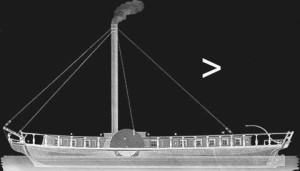

I first came across the “Salt-Water Gazette,” when I bought a disbound volume from a book-dealer on speculation that it might contain something of interest. Published by Messrs James Hedderwick & Son, 43, Argyll Street, Glasgow, in weekly parts, on Fridays, over the summer of 1835, it was a one-year wonder of literary contributions and anecdotes to amuse the public as they travelled to and stayed at their summer resorts on the Clyde Coast. As was normal in such ventures, essays, poems, and letters were solicited and from regular correspondents and the readers, and if they were found of sufficient interest, they were published. There were a few serialized accounts, and the one presented here recounts a trip on the Arran Castle from the Broomielaw to Greenock, where the journey was broken to view the launching of a ship, and a meeting with friends and Mr Hedderwick. The journey resumes the following day on another unnamed Castle Steamer to Dunoon and Rothesay.
Clutha.—No. I.—The Broomielaw—Govan.—Well, this is delightful! here we are on board the Arran Castle—a capital steamer—just ready to start, and there is not a cloud in the heavens! We could scarcely have selected a more charming day. The sun is looking down from the high cerulean with a clear, steady lustre; and every object we behold, is sparkling and radiant with his beams. What a concourse of happy individuals are here, all stealing like ourselves from the turmoil of the city, to their summer quarters on the coast! They are seated round the deck, or idly walking to and fro; while the central part is occupied with their luggage—chairs, beds, trunks, carpet-bags, and one piano-forte;—we think we can see the young lady to whom the last mentioned article belongs. She is busily engaged in directing a stupid porter concerning the arrangement of some pieces of furniture, that her own delicate bandbox may lie unmolested. What can be in that bandbox to make her so careful of its safety? A bonnet?—yes; and of the newest pattern, the colour pink or pale blue—the latter, we warrant, from her complexion. And we were right; she is the fair musician. She has ordered the instrument to be removed to a better situation. Heavens! what a pair of eyes! she has turned them full upon us, and we can read their meaning as if the language of the eyes were our mother-tongue. She chides us for staring at her; and indeed we must recall our modesty, which the tide of youthful feeling had borne for an instant away.
What men are these, threading their way among the passengers, with papers in their hands, and baskets hanging from their arms? They are venders of cheap periodicals—persons generally who have been unfortunate in the world—whom disease perhaps has rendered incapable of hard labour, or whose labour has been insufficient for their maintenance. From their present avocation they derive a decent livelihood for individuals in their sphere of life; while, at the same time, they confer a positive benefit on the sea-bathing population. Among the various papers of which they are endeavouring to dispose, the most prominent we observe is our own little Gazette. This we ascribe, not to its superior merit, but merely to its local interest. We may, however, venture to hope, that even in point of intrinsic worth, it will yet, and ere long, stand forward in proud rivalry with the ablest of its contemporaries. True, it has had a small beginning, but maturity in everything is attained only by degrees. The acorn is small when it is cast into the earth; but it gradually swells, and sprouts, and peers above the surface, and grows, and strengthens, and strikes deep its root, and puts forth its branches, and bursts into foliage, and becomes a stately tree. The silver streamlet is small when it trickles from the crevice in the mountain, but it widens and deepens at length into a mighty river. Time is progressive, the world is progressive, man is progressive; and so may it be with our humble periodical. As yet it is in its infancy; but we trust to see it speedily ripen into strong and vigorous existence. We perceive a copy of it in the hands of the young lady of whom we have already spoken. She seems earnestly engaged in its perusal—and there is a smile upon her lip which goes to our heart like flattery. But we must look no longer on that countenance, for it were dangerous in a person of our susceptibility again to encounter the irresistible artillery of her eyes.
Beautiful!—the Antelope, which was lying farther up the quay, has just started, and is rolling down upon us with irresistible majesty. She is an Irish vessel. The crowd of poor wretches in the bow, proclaim, “in accents trumpet-tongued,” the misery of their unfortunate country. Alas! that Ireland, “with her fine soil and rich bowels of minerals,” should lie mangled and bleeding beneath the butcher-knife of misgovernment!—and that, in order to preserve the lives of her children, she should be obliged to fling them from the warmth of her own bosom, and quarter them on the reluctant hospitality of strangers! Here we behold a little handful of her hardy sons returning again to their parent land. Their homes are there, their friends are there, their hearts are there, and they are ready to pour out their dearest lifeblood on the altar of their country’s weal.
From our soul we love that people. There is a wild buoyancy—a boundless benevolence, which sparkles in their eyes and plays upon their lips, to us irresistibly delightful. They may go forth in hope and return in disappointment; but the cloud of despondency will never quench the lightning flashes of their own native humour, or stem the torrent of generous and manly feeling, as it gushes from their hearts when innocence is to be protected or wretchedness relieved; and as a light figure shows best on a dark ground, their very poverty gives an additional brilliancy to their character. Look, now, at that man who is sitting on the projection before the paddlebox, with his legs dangling over the side. Mark him well. Is there not a rich vein of pleasantry laughing out at every aperture of his many-mouthed habiliments? He does not in one iota resemble the poor man of any other country; for, somehow, with every mark of wretchedness about him, he does not appear wretched. There is a magnificent dash of the poetical in his appearance, of which it is impossible to divest him. He looks more like the child of adversity as represented on the stage, than the hero of real life. His rags, it is true, are of the coarsest description, but they are tastefully and knowingly put on; and his shirt, white, as if it had been bleached beneath an Italian sun, forms a fine contrast to the ruddy bronze of his complexion. He has a hat, too, and all crownless and brimless as it is, there is a characteristic waggery about it altogether original. Then his coarse corduroy breeches hanging loose at the knee,—his long bare legs that have never felt the soft touch of silk any more than if they had lived in the days of Alfred—his tough, brown leathern shoes, garnished with anklets of straw, complete the picture, with lively and striking effect. We cannot keep our eyes off that man. We would give a week’s work to know his history. What are his hopes—his prospects? has he talent—has he integrity? has he a wife—a family—a home? These are questions we cannot answer; but there is something in his appearance, which, were we about to journey through a wilderness, and wanted a friend to lighten the tedium of the way and stand fast by us in the time of danger, would incline us to choose him as our companion. But there are fifty such on board; we have only selected him as a specimen. We would fain, however, dwell a little longer upon that interesting group, and narrowly examine the faces of all that are there assembled, and try to read in them the history of their misfortunes, for surely they have all been unfortunate,—but the vessel is passing—is passed,—and the swell she has occasioned in the water is lifting us against the quay to which we are still attached, and rolling in one huge dull billow along the opposite bank of the river.
On turning round, we observe a considerable accession to the number of passengers on board our own steamer. The omnibuses have arrived from the centre of the city, and are pouring out their several contents. As the moment of departure approaches, the bustle and anxiety increase. That man dressed in blue, with the glazed hat, and whose general appearance indicates his authority, has given the command to start. The bell is rung, the ropes are let loose, and we are just pushing off, when a sudden stir among the loungers upon the quay, announces the arrival of another passenger. He is a little stout man, with a red face, and a huge bundle under his arm, which in his anxiety he has thrown on board, and now he stands in an agony of suspense as to whether he should follow it himself. But, fortunately perhaps, his courage fails him, as he gazes on the enlarging distance between the vessel and the quay, and he abandons the thought of leaping. Poor fellow! he has evidently been running furiously in order to be in time, and he has just arrived to find himself too late!—eh! what?—no, faith! After all, the pilot has got him in by the stern, and he is perhaps the happiest individual on board. It is really worth a gallon of perspiration to experience such a comfortable feeling of pride and security as he must now enjoy, at having accomplished an object of which he had utterly despaired.
Proudly and gallantly now we glide along the smooth surface of the water, curling it into snow-wreaths at our prow, and dashing it imperiously from our sides, leaving it to buzz and bubble in our wake. Not a breath is stirring. That lumbering smack before us is lying altogether motionless, with her broad canvas hanging loosely and lazily from the yards. But we are independent of the winds, and wait not on their pleasure. Onward and onward still, winding through the sunny landscape, and feasting our vision as we go, on handsome dwellings, and gardens, and green trees, and grassy banks, and playful children—how shall we describe our joy? And now, the modest spire of Govan rises through the foliage. What a world of association does it recall within our mind! This was the extent and limit of our boyish rambles, as we wandered in voluptuous reverie along the banks of the Clyde, forgetful of all on earth that could lessen the measure of our felicity—when every pulse of our heart, attuned to the music of our own imaginings, beat with unutterable joy, as our too exuberant fancy expanded in the sunshine of youth, and revelled in the wild luxuriance of untutored hope. This is the spot which is said to resemble so much the birth-place of that immortal youth, who, all unconscious of his power, carolled his wild lay upon the shores of Avon with such angelic sweetness, that posterity, to the end of time, shall listen with enchanted ear to the undying melody of his song. This is the place where sleeps the only one whom it has ever been our lot sincerely and deeply to lament; for he, whose ashes are deposited there, grew up beneath the same paternal roof—our brother, and our brothers’ playmate. Although considerably younger than ourselves, he was not less the object of our affection. Our hopes, indeed, were in that boy; for in him we discovered the evidence of a more than ordinary mind. By the strength of his own genius, and, as it were, by an instinctive power, he had opened the way to knowledge, and unlocked the treasures of the library, ere yet he had been sent to school. It was the glory of a Newton to reveal the mysteries of the firmament,—of a Franklin to snatch the lightning from the clouds, and lay the thunderbolt at his feet,—and his might have been the glory of accomplishing even a higher flight. Scarcely, however, had he begun to try the majesty of his pinions, than the shaft of disease transfixed him to the heart, and he fell! We had even secretly indulged a hope, that the lustre of his name might shed a gleam upon our own. But, alas! while we watched with unspeakable delight the early developement of that little flower,—while we saw it put forth its petals and golden bosses, and expand its leaves even to the vernal sun, how little did we think that the canker-worm was gnawing it within, and that it so soon should wither! In the first paroxysm of our grief, we trembled lest the violence of the shock might destroy the tender machinery of our own frame; and although that fear has now fallen a prey to its own devouring energy, in our moments of melancholy musing, our former doubts return, and we shudder at the appalling uncertainty of life. Up to the period of that boy’s death, our heart was as light as that of the May-fly as it flutters in the sunbeam, or sips the morning dew from the buttercup; but then we thought not, indeed we knew not of the feeble tenure by which our felicity was held. We were surrounded by the members of a happy and healthy family, and we cast not our eyes beyond. The idea that one of them might be snatched away, never once overshadowed our bliss-dreams; and when the hour of this bereavement did come, it seemed to kindle a consuming volcano in the deepest recesses of our bosom. We did not weep, for the throng and crush of our sorrows had choked up the passage of their outlet. We uttered no lamentation, but if we seemed unruffled, it arose from the very depth of our feeling; for it is the shallow stream that breaks into murmurs on the surface. We should not have obtruded these reminiscences upon the reader, did we not think that the feelings they attempt to describe are as broad as humanity, and will find an interest and a sympathy in all hearts. But enough, enough;—and yet a little while—we are now directly opposite the churchyard. There perhaps shall our own bones find their resting-place; and how many a young and joyous passer-by shall look, as we do now, but with far different feelings, on these graceful trees, when they wave their green foliage over our unconscious clay. The time was, when we ventured to indulge a hope, that the dark mantle of oblivion might not altogether be closed over our name; but that the stranger and sojourner might inquire the spot of our interment and pay to our memory the tribute of a passing tear. That hope, however, has now vanished—vanished like the light of the setting sun, which the fond traveller pursues till total darkness falls black on every side.
Pursuing these reflections, we fell into a deep and gloomy reverie. We had now left our own favourite Govan far behind; but we still fixed our gaze upon her neat taper spire, which pointed like a dumb monitor to heaven, and gave to our drooping thoughts an upward turn of devotion.

Arran Castle
Clutha.—No. II.—Renfrew—“The Water-Neb.”—Man is really a most peculiar animal—always changing, never at rest—one thing to-day, and another to-morrow—neglectful of his promises, and rebellious to his resolutions. For example, when we condescended to employ our great powers for the entertainment of the public, thereby demeaning ourselves mightily, by becoming, as it were, a kind of common cook or caterer for every ragged urchin who can boast a couple of copper pocket-pieces, we seriously determined to be uniformly humorous; but somehow or other, the very first church-yard we came to, drove us headlong into a fit of dreamy melancholy, although the very grave-stones were shining and sparkling, and the long grass waving around them, and the green trees so beautifully festooned above them, that no one could desire a couch more sublimely curtained; and every thing so seemingly happy, as far as the eye could stretch on either side, that we should have felt and owned that it was good to be alive,—and even pleasant to die, with so lovely a spot to repose in. The truth is, that the circumstance to which we hastily alluded, as well as some others which we reserve for a future occasion, have infused into our character a dash of the sentimental. This, we fear, will too frequently break forth in the midst of our speculations, and shed, perhaps, a sickly gleam upon our scenes of merriment, like a pale moonbeam stealing its way into the festive hall.
Henceforth, however, we shall endeavour to be gay—as gay, indeed, as our nature will permit. At the same time, we must request our readers not to press us too nearly on this point. Our intellect, we own, is rather unwieldy—admirably adapted to crush and overwhelm—(tremble, thou wretch! that hast in aught offended)—but not at all calculated to excel in manœuvre, trickery, dexterity, or legerdemain. We are, in short, more of the elephant than the ape; and we are not sorry for this, because the ape, it is well known, is a sad mimic. Now, next to wealth, and in some respects above it, originality we take to be the all in all. It is the passport to notoriety—the purchase-money of fame. Without it, a man is to society what a billow is to the ocean. He can only by a sudden effort heave himself into a temporary elevation, and sink again to his natural level, with a murmur of disappointment. Nor is this circumstance a just ground of complaint to any one. The sons of genius are the aristocracy of the intellectual world—originality is the stamp thereof, and no man is entitled to assume an empire, however limited, over the minds of others, until he can exhibit the badge of his authority. There is, however, a deceitful eccentricity which is frequently mistaken for genuine originality. It counterfeits the shape and appearance, but wants the solidity of the sterling coin. But with humility, and with all deference to the opinion of the acute and stern reader, we believe, for truly the belief has been thrust upon us, that ours has the ring of true metal. On all occasions, therefore, we shall issue it with the greatest degree of self-satisfactory assurance.
Some raw schoolboy, who, on account of his overgrowth, is beginning to fancy himself exalted above his fellows, and consequently entitled to pop his remark occasionally into the conversation of his elders, may observe, that it is surely presumption on our part to attempt the character of harlequin or pantaloon, when we are manifestly adapted only for heavy tragedy. The lad, of course, would employ different words;—such a sentence as we have put into his mouth would be sufficient to pack him instantly to college, that his precocity might be properly attended to. We merely quote the idea; and i’faith, it is somewhat shrewd. But we think it the duty of every man to make himself a fool as frequently as he possibly can, inasmuch as laughter is a friend to health and happiness, and an enemy to blue-devils and doctors.
But to proceed with our subject. The silent reverie in which we last parted with our readers, was interrupted by a character of the most singular appearance, who had thrust himself closely by our side. We had observed him while yet the vessel lay at the Broomielaw, as he stepped timidly on board. There was a world of wonderment depicted in his visage at every thing he saw and heard; a general stare of simplicity joined in paradoxical combination with a look of cunning bordering upon duplicity. He wore a short green coat with clear brass buttons, a dirty white vest, and knee breeches which apparently had once been yellow; and his hat was one, which, to all appearance, had outlived the fashion some seven years. As he appeared to be an original, the duty which we owed to our readers, determined us to cultivate his acquaintance. Accordingly, we turned to accost him with a remark upon the excellence of the weather; but before we accomplished this, he popped the following query—“Pray, sir, vill you ’ave the goodness to tell me the name of that ’ere place as we ’ave just passed?” “Govan, sir,” we replied. “Oh!” he exclaimed, “I vould misses vas ’ere, how she vould enjoy it!” “Yes,” said we, “it is a delightful spot! but you should have brought your misses along with you; why did you leave her behind? “Not because I don’t love her.” said he, “for she’s a charming voman is misses; but you know, sir, as how it is only the priest and the beggar as ’ave the hart of travelling vithout money; and then my misses is such a dash!-—la! sir, she almost ruined I; and to be plain vith you, sir, I am just now running avay from her, seeing as how I did not vish a sitivation in the Hold Bailey.” “And where, my honest fellow,” said we, “do you mean to run to?” “Oh!” he replied, “Americar! pray vich is the vay to Americar?” “It lies due west,” said we; “you may find a vessel at Greenock, and provided you have money enough to pay your passage——.” “Money!” he exclaimed; “money! la, bless your simple ’art, I han’t got no money! I mean to vork my vay hout!” “And what,” said we, “can you work at?” “Oh!” he replied, “I could turn a w’eel, like that ’ere chap be’ind us; only I am subject to womiting and wery afraid of the hocean!” Here we indulged in a hearty laugh at the poor Cockney’s expense; but with somewhat more discernment than we had given him credit for, “I ’ope, sir,” said he, “as how you’re not a laughin’ at I!” “Oh dear no!” we exclaimed, “we are laughing—ha, ha, ha! not at you, sir, ’pon honour, no! we are laughing at a foolish thought, sir, of our own-that’s all!” “It von’t do!” said he, at the same time making use of a vulgar expression in which his nose was a principal agent, and sneaking off towards the fore part of the vessel, with a look of singular significance.
After passing the elegant mansion of Mr. Rowand the banker, and the ponderous abode of the Elderslie family, we find ourselves opposite the “finished town” of Renfrew—one of those places, which, being in the neighbourhood of a large and flourishing city, that sucks up all their sources of increase, are never permitted to attain any considerable growth. On the other side of the river, we have seen little worthy of observation, with the exception of Scotstoun in the foreground, Jordanhill in the distance,—and some unwieldy vessels, heaved up on the dry land, looking black and crest-fallen, and seemingly “straining upon the slip,” as if in anxiety, to be launched again into their native element; but now a variety of pleasing objects begin to attract our attention. That beautiful villa, embowered among green foliage, with the glancing glass-house at one end, and the smooth lawn in front with its graceful flag-staff, is Yoker Lodge, the summer retreat of one of our most public spirited citizens and most efficient civic dignitaries.——Hallo! what queer animal is this? Like our friend the Cockney, it seems most marvellously given to sea-sickness! A deepening machine, forsooth! What next, I wonder? Verily, the steam-engine is a mighty instrument in the hands of little man!—more powerful than the lever of Archimedes.
“Slow—stop her!” cries the captain; and suddenly the liberated steam is roaring in our ears. We have passed the princely residence of Mr. Campbell of Blythswood, and reached the mouth of the Cart, or, as it is more generally and quaintly designated, the “Water-neb!”
This stream, which is tributary to the Clyde, is rendered somewhat famous on account of the lively and stirring town which is built upon its banks; and although “the shipping” is not very extensive, on account of the difficulty and danger of its navigation, we think it fairly entitled to rank among the noblest of our Scottish rivers! We should not have noticed it so particularly perhaps, or passed upon it this eulogium, which many may consider extravagant, but for the fear of offending our Paisley friends, who are remarkably sensitive on this point; and two boat-loads of whom have just come alongside. The Gleniffer, or as it is more generally termed, “our ain boat,” is at present, we believe, undergoing some repairs, and this accounts for the good fortune of the Arran Castle in receiving such an addition to her cargo.
What a quantity of goods!—bundles, baskets, and bottles of sweet milk for “the bairns.” We have here a fair specimen of a Paisley man. He is a person comfortable in his circumstances; economical in his habits, an old reader of “the Register,” and dreadfully liberal in his principles. His information is generally extensive. Upon all subjects he converses freely, and in a tone of voice which has been elevated by the sound of the shuttle. He is a man of shrewd common sense, a scoffer at the follies of fashion, a patron of porridge, and a tippler of tea. “He is not chargeable with any particular vice, nor in any way guilty of immoderate refinement. As he acknowledges no man to be hereditarily his superior, he is always at his ease, and makes himself perfectly at home in whatever situation he may be placed. His eldest daughter is at his side, most untidily attired, with a large gaping straw bonnet flaringly decorated with ribbons of the most dazzling colours. What a contrast to the elegant simplicity of the young lady opposite! But really we must not be too severe on “the Paisley bodies,” as they are vulgarly denominated, lest the shade of Tannahill rise up in judgment against us.
Clutha.—No. III.—Bowling—Dunglass—Dumbarton—Port-Glasgow—Greenock.—We remember to have heard a traveller remark, that the Clyde was the finest river in the world, and we have somewhere seen the same observation in print; and certainly if we consider the variety, and beauty, and grandeur of its scenery—its graceful windings, and sheltered bays, and devious lochs, and all the rich diversity of hill and dale, of civilised elegance and rugged sublimity, which continually invite the attention of the traveller—we shall find it difficult to mention another, better or even equally entitled to this proud distinction. So far, however, as we have gone, we have seen only the green and sunny banks, adorned with handsome villas, and variegated with beautiful gardens, and thick-leaved shrubbery, and nicely-trimmed hedges, and stately trees, casting their cool shadows in the glittering sheen of the smooth parterre, where the ruminating cattle were lazily reposing; but the glory and magnificence of Clutha remain to be unfolded.
After passing the Cart, the banks present a flat but beautifully verdant surface on either side, and as we approach Kilpatrick, the birth-place of that immortal saint of valiant memory so celebrated in Irish song, the river seems closed in front by an amphitheatre of hills. Onward a little way, however, and Dumbarton Castle bursts upon our view; and far beyond, the imperfect and undefined mistiness which indicates an outlet to the ocean. Now let our hearts expand with joy unspeakable, as we gaze upon this scene! We have just passed Bowling, the mouth of the great canal which connects our own Frith with that of the Forth, and have seen Dr.Hooker and his tail of rising botanists, towering—if our imagination, despotic from the plenitude of its power, will grant us the liberty of one sentence wherein there is no metaphor—towering, we say, up the hill of
knowledge; for truly it is a hill of knowledge to them, transformed by the magic words of the learned Doctor. Close upon our right, the ancient ruin of Dunglass—supposed to have been the western termination of Antoninus’ wall—crumbles in beautiful decay beneath the green ivy’s mantle. Farther on, the ponderous rock of Dumbarton, teeming with historical association, stands in proud loneliness, as if it had been torn and rent from the main land by some convulsion of Nature, and lashed into rugged roundness by the scourging eloquence of storms. As we gaze upon this bulwark of old Clutha, a throng of dim remembrances rush upon our mind:— a daring and dangerous enterprise—the moon shrouded in mist—breathless anxiety and scaling-ladders—a furious onslaught—and shrieks of horror mingled with shouts of triumph. But now, how peaceful! The same sun, which, on the morning of that night when Mary—the lovely and unfortunate—was deprived of this last fortress, which she had retained from the first out-bursting of the civil war, dried up the bloodstains from its summit, is shining upon it at this moment; but the dry moss and short brown grass with which it is partially clothed, are no longer reeking in his beams with the life-blood of loyal hearts. Looking northward, we behold Ben-Lomond—that mighty monarch-mountain, towering in awful majesty to heaven; while the limpid Leven, upon whose banks the youthful Smollett “first tuned his rural pipe to love,” steals round the Castle-base and pays to the ocean its tributary ripples. Here the river widens into a glorious expanse of water, sleeping peacefully within a girdle of far-stretching mountains which embrace it lovingly upon all sides. The spirit of tranquillity and peace sems brooding over the sunny landscape. Nothing meets the eye but objects of beauty, and the ear is only awakened by sounds of gladness—the carolling of the sky-lark as it poises its pinions in the still azure, or the joyous rush of our vessel’s prow through the blue water, and the vigorous beating of its own mighty heart—the vital engine by which it is propelled forward into the bosom of this delightful prospect. Look up to the clear, blue canopy above!—all there, too, is loveliness. One little white cloud alone breaks the monotony, as it sails along like the pale hand of beauty over a flower-bed, and sprinkles the refreshing shower upon the soil beneath.
Right in front, as we run in an angular direction athwart the Frith, is Port-Glasgow. This town, like Renfrew, has been dwarfed and stunted in its growth, and the reason is as broad as daylight. Port—Glasgow! What need has Glasgow of this port? Is not her own Broomielaw wide and deep enough—thanks to the deepening-machine!—for all her purposes of traffic? Questionless! and this poor jackall of a village, unable to cater for itself, must starve upon the offal of the great lion. A few miles below, a cloud of pale smoke creeping upward from the base of the hill, announces the locality of Greenock; and nearly opposite, far away upon our right, Helensburgh—ever sunny and shining, displays her long line of white and sparkling villas, bordering the beach like water-lilies. Then there is the rugged mountain-tops, significantly termed the Argyle Bowling Green; and the tongue of land between Loch-Long and Helensburgh, which (observe our tropical consistency!) speaks of all that is lovely in nature concealed behind the thicket of trees—for there it is that the modest Gairloch withdraws from the vulgar gaze, and sleeps, an unbroken mirror, in the bosom of a quiet valley; upon whose gentle acclivities the liberal hand of Spring first showers her blossoms, and sear-leaved Autumn steals crouchingly for shelter, when grey-beard Winter strips from the surrounding mountains their scanty covering of verdure.
In sailing down the Clyde, our attention is ever on the stretch, from the variety of objects that present themselves; and we are sometimes at a loss in which direction to turn, in order to drink the deepest draught of enjoyment. On one side, perhaps, we behold the type of an industrious man toiling against the stream of fortune with the burden of a dependent family, in the form of an humble tug-boat; and on the other—oh, fine contrast!—a yacht, skimming like a thing of air, along the surface of the water, which she scarcely seems to touch, all life and light and loveliness.
Bustle, bustle—crowds without crushing, and activity without confusion! Where are we? Greenock, by all that’s stirring! We know it by the forest of shipping—by the huge Custom-house with its stately portico—by the westward stretch of fashionable villas—by the old Mansion-house, looking down from its lofty elevation with aristocratic indifference, on the multitude of parvenus below; and recalling to our recollection many an agreeable reminiscence of kindness which we ourselves have experienced beneath its hospitable roof—by the assemblage of barrels, bags, and boxes—by the throng of gazers upon the quay, waiting the arrival or departure of vessels—by sea-brown sailors and sun-burnt fishwomen. Hallo! What’s that?—a shot? On turning to the left, we observe a vessel upon the stocks fantastically decorated with flags. A launch! we must see it. Good-bye, Captain Barr! Well, once more on dry land, we shall proceed no farther at present. Huzza! the launch is over. The ship—for ’tis a three-master-gambols away light and frolicsome over the glassy brine, like a noble. steed let loose from harness upon the green meadow, and a shout of exultation issues from a thousand throats. Ha! old boy, how are you? Reader!—but over the left—we make this salutation to a most generous and good-natured gentleman who lives next door to Tom Toozle, and the excellence of whose wines is attested in the face of the latter. Bravo!—but we expected it—he has invited us to dinner, when, to a dead certainty, we shall encounter our luminous correspondent who carries “the lantern i’ the poop;” and indeed we know not which we shall most enjoy—the sober jollity of our host, the savoury fragrance of the viands, or the brilliant corruscations of wit, flashing at intervals from the cavity concealed under the “imperial purple” of our brother guest. Of this, however, we do not entertain a doubt, that during the next two hours we shall be much too busy to think of either pencil, pen, or paper; and accordingly, with all pomposity we consign our note-book to the able guardianship of our pocket-button. There let it rest while we perform our alimentive duties; for, unluckily in the present instance for our readers, we are not romantic enough to live without eating. Such delicacy and refinement we leave to your modern heroes—your Belmonts, your Faulklands, and your Cliffords. But that the reader may not altogether lose by the time we are about to devote to the vulgar practice of mastication, we shall embrace the opportunity of coaxing Toozle, when the internal influence of a third tumbler shall have rendered him easy of persuasion, to produce something for our next Gazette.
Clutha.—No. IV.—Greenock—Gourock—Kempock.—Off and away again, reader!—one word, however, before starting. Last night, after leaving you, we found Toozle as brilliant as ever—absolutely dazzling. “I should like to know, friend Toozle,” said our host, “to what thou owest the splendour of thy proboscis? Methinks it resembleth a bunch of purple grapes, for it smelleth strongly of the vine.” “Or smelleth the vine strongly,” said he of rubicund celebrity, “and you have hit it.” “What! Your nose?” exclaimed the merry host. “No,” said Toozle, “but the mystery of its complexion; which, after all, is no mystery, for that which is mysterious is dark and invisible, now it I take to be a bright and most palpable object.” “Why, that,” said the host, “I shall not dispute, lest thou should’st lift up the light of thy countenance upon me, and show me to be in the wrong; but it ought to serve as a beacon to all sober men, such as you and I, Mr. Editor, against tumbling into toddy-tippling propensities: meanwhile, fill up your toddy-tumblers!—for truly intemperance is a most dangerous sea to embark on—“a sea of troubles.” “Troubles!” cried Toozle, by this time somewhat elevated, being half under the table; “troubles! drown them in a stoup o’ liquor! I love the bottle! True, it has sometimes vexed me, but it has always dried up my grief again with a little heavy-wet; and so I love the bottle! It is the father of my nose, which has taken in consequence the Christian name of bottle, and evinced every evidence of filial affection, even for the scent thereof. Let me forget my looking-glass, then I shall cease to remember that I am glass-looking; and be my bottlenose obedient to its father the bottle, although it should be the death of it—for if it does kill it, ’twill be with over-kindness. So fill up, gentlemen, and drink the Salt-Water——“Drink salt water!” interrupted our host; “hem! I have joined the Temperance.” “The Salt-Water Gazette,” continued Toozle. “Oh, I’ll drink that,” said the host, “’tis a precious draught filled with pearls like the goblet of Cleopatra, together with a spicy admixture of salt—Attic, by my troth!—the Salt-Water Gazette!” “And,” added Toozle, “may it contain as many gems as the ocean, and, above all, may it circulate as widely!” After a speech on our part, in which we made a considerable figure—we mean a figure of speech in reply to this toast, or rather toast and butter, for truly they did not spare it—we concluded by observing, that as for the gems to which they had alluded, it was not for us to decide their merit, or whether those of the Salt, were really of the first water; but one thing was certain, that some “odd fish” had appeared in the Gazette, and we adduced Tom Toozle as a specimen. Up to this point, we can rely upon the accuracy of our memory, but positively no farther. Our notion of what followed, is vague and in-distinct, and eludes our grasp like the “air-drawn dagger” of Macbeth. The reason of our forgetfulness—plague on this headach!-we are at a loss to conjecture, but not to conjecture a loss therefrom. Next time we meet, however, we shall endeavour to make it up.
Grant us your patience, reader!—our wits have been a wool-gathering; and lend us your companionship in an omnibus to Gourock—come on, at least in fancy. Good things are these omnibuses, especially in wet weather. “All right!” crack goes the whip, and off we are, rumbling and whizzing on our way! The first duty we perform on entering a public vehicle, is, to dart an inquisitive and satisfactory glance upon our fellow-travellers. That big, burly gentleman ensconced in the corner, is an individual of some weight in
society bless me, how the wheels are creaking!—a man who loves a good dinner, and can relish a pithy jest. He is a very different sort of personage from the wretched barebones on the other side. The character of the latter is not so obvious in his appearance. True, he seems a man of very long standing, but may, in reality, be a mere upstart. The one is evidently travelling on pleasure, the other on business. The former, to gain an appetite; the latter, the means of appeasing one.
It is amusing to fix one’s eyes upon the square window of the carriage, as on a picture, and watch the various objects—hedges, dykes, trees, hills, and houses, that pass in rapid succession before you—a living panorama! Many are the genteel villas that adorn this road, as they stand removed at aristocratic distance from the vulgar throng—the dingy dwellings of the shop-keeping. But we cannot pause amongst them, to contemplate, expatiate, and moralise, on account of the rapidity with which we are whirled along in this commodious box, even like Bob Acres, “with a tail of dust as long as the Mall.” Already we have passed the point where stands the battery, in mock dignity, like a half-pay officer, who still retains some of the trappings of his craft;—and now all Gourock bursts upon our view. Gourock! “with all thy faults, I love thee still.” So sings the bard of England, and so sing we of this renowned sea-port. The feelings with which our boyhood gazed upon thee—sported among thy rocks, and clambered up thy mountains, have long since departed. Our heart was then as frolicsome as the billows that kiss thy pebbles, or the breezes that fan thee from the ocean. But although we can no longer love thee with a boyish enthusiasm, thou still art dear to our bosom, and enhanced by the memory of the past! There is the old quay (if quay it may be called, which quay is none) a shapeless pile of stones—a monument of its own unworthiness. The testing energy of the elements it has been unable to withstand, and is now a mere ruin. Yet this mockery of a quay, is almost the only key to the knowledge of our locality—the only mark by which we can recognise the Gourock of our early days. For this village is changed and changing, even like a young and blear-eyed girl expanding into the loveliness of woman. We search our memory in vain, for that city-like building which rears its lofty tower from the centre of the village; and Kempock is altered almost in every feature. Where is the old lady—Lady Kempock, to wit—who for ages courted the public gaze upon that high eminence. Alas! her days of adversity have arrived “her back is to the wall;” or rather like another Amazon, she has shaken off “the cankers of a calm world and a long peace,” and seeks “the bubble reputation even in the cannon’s mouth!” albeit a dumb one.” The green table-land on which we were wont to recline in the sunshine, and look down upon the mighty magnificent water beneath, spotted with vessels that looked like flies stealing along the surface of a vast mirror, is now surmounted by a little, square, castellated building, bristled all round with warlike engines. Nay, do not tremble-—for they are poor phlegmatic creatures, and will not harm you—wax dolls for children—guiltless alike of evil and of good report—lifeless scare-crows—“wooden Xenophons!” This important point is indeed doubly guarded; for between the road and the sea, is Fort-Kempock, of “Seestu” notoriety. But all modern. Then there is a host of new dwellings of great elegance and beauty stretching along the shore towards the west, the most conspicuous of which is Rock Bank, every way worthy the genius of the proprietor—all poetry! not a regular epic—but a throng of vast conceptions—a collectior of striking ideas thrown incongruously, but vividly together, like the pencilled thoughts jotted down at random on the leaves of an author’s notebook! Farther down, peeping from the green trees, like a beauty from Venetian curtains, is Ashburn, the retired residence of a family, whose praise is loud in the whisperless silence of calumny. And on the great landing-place, midway up the hill upon our left, a singular animal attracts our notice, in the fashion of an old English cottage, as if it had slid down from the top in a sitting posture, and left a huge coat-tail spread upward on the slope. But these we remember not of yore.
Let us then return to the quay, for in that we can recognise the characteristic features of an old friend. Now, we feel ourselves at home; for here we behold Ritchie, Eccles, M‘Glashan, and M‘Kinnon—all Johns! and all essentially Gourock, as much so, indeed, as her hills and her rocks, her houses and her harbour. Who could fancy M‘Kinnon in Rothesay, or Eccles in Dunoon, or Ritchie in a longtailed, superfine blue coat, majestically erect upon the paddle-box of a steamboat? And then, there is Storm and Ferguson, and Park and Bauldy, and Marquis and Mains—all familiar, and all friendly faces. Now, John M‘Glashan keep your temper! “I’ll tell you what, sir, you’ll not put my name in your Gazette! Me want the agency of your Gazette? I’ve a better business on hand!” Tut, tut, man! look at Ritchie, that good-humoured carle! Says the minister to him the other day, “I never see you in the kirk, John!” “I never see you there aither!” was the reply. But he is always jocular. Take a lesson, my good fellow!—follow his example; and who knows but that you may yet be a captain!
“Certainly, Mr. Hedderwick!”—This to our publisher, who asks us to breakfast. So, good-bye for the present.
Clutha. —No. V.—A Walk by the Sea-Shore—Levan Castle—Cloch Lighthouse.—We are standing on the rocky margin of the broad sea; we are gazing on the ponderous bases, the gigantic slopes, and the rounded skyward summits of the Argyleshire mountains; and we are drinking in deep draughts of holy inspiration from the sublime contemplation of a scene unutterably grand. Come with us, look with, and feel with us! We are gourmands in imaginative dainties, and ignorant of intellectual satiety; and oh, the magnificence of the banquet, which nature with a prodigal hand has here scattered on every side! The sweet marine villas which line the extensive reach to the west of Kempock, are all behind us; and the road is now distinguished by a greater variety of graceful windings, bordered with beautiful shrubbery, briar, and bramble-bushes on the one hand—and on the other, young hazel and ash and oak trees climbing up to the summit of the hill, and standing in clear relief against the blue sky. At every turn of the walk, some little streamlet meandering with soft and silvery gushings, through rocky crevices, and pebble-bedded basins, and leafy arches, steals its way to the vast circle of the ocean, to lose its individuality and its name. Here is a bush beautifully starred with wild roses, in full leaf. It is growing by the side of a small rural bridge, which affords a passage underneath the road to a boiling and bubbling cataract. Oh, the sweet emblem of woman’s loveliness—of beauty’s frailty! Formed to delight the eye and charm the senses, it lends a pleasing perfume to the very air, and throws a fascination around the sphere of its locality; but a little while, and it will droop with a pallid sickliness, and lose its freshness and its fragrance, and fall away leaf by leaf into the gurgling stream; then shall the thunder-riven cloud break on the bare mountain-top, and roll down its torrents with irresistible ferocity, and sweep away into the devouring billows the last remnant of its beauty. Let us prize it the more, however, while yet it is in bloom. The prospect as well as the reality of pain, ought only to enhance and give an intensity to our pleasure.
Close by the road-side, upon our right, we observe a thin volume of smoke curling upward from behind a bush. It rises from the brushwood ingle of a small tinker band, who have there pitched their camp. A couple of squalid women and savage-looking men, with a group of brown and ragged children seated round a boiling caldron, now open upon our view, and only want the mystery of midnight, to resemble the witches in Macbeth. On one side of them, an old cart with the trams resting on the ground, exhibits within, a variety of pots, pans, and other articles of household utility; and on the other, a small low-roofed tent, which can only be habitable in a recumbent posture, exposes its dingy and dirty mouth, to the loathing of the refined gazer.
A miserable hack grazes at a little distance, and looks for all the world, like the Rosinante of Don Quixotte. That girl scrambling over the wall, is evidently one of the gang. She has been gathering the dried whins from the hillside, in order to burn them for fuel, and is now returning with the burden upon her shoulders. Poor creature! she seems only in her first youth; but bronzed by exposure to the elements, and hardened in feature by the toils and crosses of a wandering and vagrant life: yet her countenance is not unpleasing; and we can fancy her in the gay garments with which opulence attires the fair votaries of fashion—the brightest gem of a coronet, with a palace for her home, and titled striplings for her slaves,—while we, even we, pass her by at the present moment with a look of pity—we had almost said of contempt. After all, this is a strange world, and filled with contrasts!—kings and beggars, wealth and poverty, luxury and destitution, power and impotence, age and infancy, intelligence and ignorance, intellect and idiocy, are mingled promiscuously together; and this poor girl, is perhaps in reality as worthy of admiration and honour, as the lady whom circumstances over which she had no control, may have placed among the highest in the realm.
Wheeling round a sudden promontory, we behold the elegant mansion of Levan Temple, so light and lovely that we gaze on it with the same glad-hearted serenity as we would on the gossamer form of a young nymph. A few steps onward, and the stately habitation of Mrs. Crooks is visible among the trees; but before proceeding farther, let us turn up this green lane, and wind our way between close cut hedges, till we arrive at Levan Castle. Beautiful ruin! It is clothed all over with ivy and twining honey-suckle. A grey stone peering from the corner of yonder turret, alone betrays the venerable fabric, which these green leaves have been so ambitious to conceal. As we contemplate this monument of our fathers’ strength—this relic of our fathers’ weakness,—the spirit of a thousand years seems to diffuse over our soul a deep devotional solemnity, and to shut up our utterance in one gaze of mute adoration. These massive walls are mouldering away stone by stone. The animated bones that reared them have long since been laid bare by the worm; nay, they have crumbled into dust, minigled and mingling with the common soil of the earth. Alas, for human frailty! man and the most colossal evidences of his power are doomed alike to perish. Where is the boasted glory of the Athenian Acropolis—the statue of Olympian Jupiter—the Parthenon and the Athenæum? Falling in the breathless stillness of their own decay, or living only in the mouldy records of the past! It is the works of Nature alone that sink but to revive. The vegetation of the fields dies away by degrees on the approach of winter, but the winter only ushers in a new spring. The day-light gradually vanishes on the approach of night, but the night only ushers in a new morning. And man himself, the divinest specimen of Nature’s handiwork, will find a glorious re-awakening after the winter of age, and an everlasting day to succeed the darkness of the tomb.
Let us ascend by this shattered staircase to the sky-roofed chambers of long-hushed festivity. The floors, where the silken feet of the young and beautiful once twinkled in the festive dance, are now greenly luxuriant with long soft grass, and fern, and woodbine, and star-leaved woodroof. The windows, small and peeping, as if contracted by age like the eyes of an old man, are now curtained with long festoons of ivy. Of the roof, not a fragment remains, save a few stones at one corner, jutting inwards, and supported by the linked arms of a crowning ash-tree. From this very spot, the mailed and kilted warriors of old, have looked forth, as we do at this moment, on the curving and sweeping shore, the broad sea, and the high ridge of mountains on the other side, that seemed to their warlike minds, as if they had heaved up their rock-mailed crests into the air, in order to withstand the stormy invasions of the ocean; but presenting to us only an image of peace pouring a thousand rills into her bosom, and receiving them back again in showers, as it were of gratitude. The objects of Nature are still the same—the rocks, the water, and the hills. But this dark and sapless edifice is crumbling away even in the green bosom of reviving summer—diffusing life all round it, but unable to sustain its own, like an aged parent resigning his whole substance to his children, but sinking at last from their grateful and affectionate embrace.
This ancient castle is situated by the side of a deep ravine, through which a clear and limpid stream runs down rejoicingly to the ocean, making its own purling the soft music of its course. As we descend the steep bank, we are struck with admiration of the pictorial beauty which presents itself. A little waterfall rolling over shelving rocks, pours its silvery streamlets through the trailing ivy which drops its long ringlets from the bank above, and warbles away through leaves and lichens, and fern and tall grass. Then there is the delicate primrose, and the blue-eyed violet, and the tender honeysuckle, blending their various perfumes in this cool retreat; and the high trees on either side, overarching the whole with their festooned foliage, and the peeping sunbeams gleaming and glancing through the wet leaves, and sparkling amid the foam-bells that bubble up on the surface of the stream at the bottom of the little cataract. Sweet stream! We almost envy the tiny birds that build their airy dwellings among the boughs that bathe their tresses in thy crystal waters, or the playful minnows that sport their lives away in the nectar of thy fairy basins! Here could we linger, and listen to thy gentle melody, till nought beside save memory could remind us of thy presence, and dream the night away with thy soft lullaby stealing almost unheard upon our ear;—but fare thee well, thou warbler!—loiteringly and listeningly—farewell!
After passing the Cloch Inn, with the row of plane-trees in front, we have only to turn a point and we are close upon the lighthouse. As all lighthouses are similar in form and construction, it will be unnecessary to describe particularly that of the Cloch, which indeed must be familiar to every one. It is simply a round column seventy or eighty feet in height, with a two-storied house attached to it. When we have ascended the spiral stair inside, we find ourselves in the lighting-room. This small circular apartment is whitened all round, and every means adopted to produce the clearest and brightest light. And oh! on this little chamber, when illuminated in the dark midnight, how many an anxious gaze has been fixed from the far sea, as on the kindly eye of an honest guide!—how often, as the light from this little room glimmered in the distance over the black billows, and through the phosphoric surge, has the tempest-tossed and wearied mariner uttered an ejaculation of gratitude to Heaven, that the lamp of hope had shone forth in the darkness to dissipate the gloom despair!
But come at once to the little balcony outside; and here let us pause a while in silent wonderment, for utterance is inadequate to express the full swell of feelings which such a situation must conjure up in every bosom. Looking downwards, we behold the broad sea breaking into a light fringe of surf—swilling, and lashing, and interlacing the black rocks beneath; while the white sea-gull bending from its midway fight, skims along the surface of the water, and the swift swallow sweeps in graceful curvatures around, as if rejoicing in their freedom. What an expanse of water is now reposing at our feet!—and lo! a ship in full sail, fresh from the storms of ocean, comes gliding proudly up the centre of the Frith! Upon our right, the ponderous mountains of the Holy-Loch and of Loch-Long appear in awful majesty; and directly opposite, the huge hills of Cowal with the handsome village of Dunoon, and a variety of beautiful cottages scattered along their base. Turning to our left, the river we observe, widens into a noble breadth, sweeping into the bay of Largs upon the one hand, and stretching into the Kyles upon the other. Beyond that, it narrows into a comparatively small space between the larger Cumbray, and the low-lying island of Bute, and forms as it were a gateway from the ocean to the basin of the Clyde, through which the blue peaks of Arran are distinctly visible.
O Clutha! thou prince of rivers! How would the Hindu fall down and worship thee! At all times thou art our pride, our admiration, and our love—whether shaking thy bearded billows in the cold face of winter, or spreading out the mirror to thy fair mistress the moon! We glory in the land of our nativity, and in thee its chiefest glory.
Clutha.—No. VI.—Kilmun—Dunoon—Rothesay.—Verily the sea-breeze gives one an appetite! We have just eaten to breakfast, three hot rolls, two fresh herrings, a couple of eggs, and, let me see—but I have lost count—no matter. Suffice it, that we feel ourselves vastly comfortable, and ready for another excursion.
“Once more upon the waters!” The early mist is melting into sultriness before the growing sunshine, and the girdling mountains are slumbering obscurely in the warm haze. The morning seems scarcely awake. There is a misty drowsiness over the whole scene—a voluptuous weariness—a luxurious satiety. Yet is it beautiful. Nature has a thousand moods, a thousand varying aspects; and in each of these there is something on which the eye may rest with delight, and which the mind may contemplate with profit. “Once more upon the waters!” We have left Gourock upon our left, and are dashing over and onward to Dunoon. Upon our right, the mountains of the Holy-Loch are towering in all their grandeur. This lovely little loch is but a portion of old Clutha sideling inland, as if delighting to linger in the bosom of these lofty mountains. And here it is, that the once beautiful village of Kilmun is situated, but now deformed by the erection of a row of six unhandsome houses, generally known by the name of “the tea-canisters.” These houses are so exactly alike, that it is easy to imagine a variety of awkward mistakes on the part of the indwellers, especially if any are addicted to an over-indulgence in intoxicating beverages. Excellent subject for a farce! Suppose, for example, that some old curmudgeon resided in No. 3 of the canisters, and that he was the guardian of a beautiful ward—for never was there a farce without a cross old guardian and a beautiful ward. Now, suppose that the latter had a lover—there is nothing you know more natural than that; besides, who ever saw a farce without a lover? The old guardian is, of course, averse to the match—the lovers determine to make their escape together—old surly overhears them, and defeats their scheme, by locking up the lady in one of the apartments. Now, suppose some corresponding affair going on, pat at the same instant, in the neighbouring house—that is, No. 2 or 4 of the said canisters. Then comes the denouement. It is the simplest thing in the world to compel the frightful old monster of a guardian to enter the wrong house by mistake; and the catastrophe might be contrived in the following very ingenious manner, viz.—But we are close upon Dunoon. The ridiculous speed of these steamers are sadly inimical to the full enjoyment of one’s cogitations!
Dunoon is the nucleus of a long tail of beautiful cottages, which extends to the mouth of the Holy-Loch. It is adorned with a number of dark trees; but the mountain behind, is sterile to the top. The parish-church towers pre-eminently from the centre of the village, and is connected to the Castle-hill by a mass of foliage, through which rises the elegant summer residence of our late member of Parliament, James Ewing, Esq. The Castle-hill is a green knoll surmounted by a flag-staff, from which, on a clear day, the rock of Ailsa is easily visible. It is beautifully clothed with verdure, and on the summit a small part of the ruin is still standing. To the west of Dunoon, there are several handsome houses, dotting the shore at intervals, like the bosses on the tail of a boy’s kite—the most prominent of which are those of Mr. Malcolm, Mr. Hamilton, and Professor Buchanan. The long range of mountains is now discovered to be variegated with hill and valley, and Dunoon is observed to stand upon a point of considerable prominence.
Creeping along by the Cowal shore—sometimes so near, that we almost fancy
we could touch the mountains by putting forth our hand—how diminutive in comparison are the houses at their base! See, midway up yonder hill, there is a little clachan looking down upon the white cottages beneath, like the dark aborigines of America upon the fair Europeans who have taken possession of their country. On the other side of the Frith, a new line of coast has come in sight beyond the Cloch. There is a slight ripple on the sea, and the sun is flashing down a broad line of sunshine upon the water, which is broken into innumerable glancing sparkles by the refracting wavelets. Beauteous object!—a sea-gull winging its equable flight past the stern of our vessel, and wheeling fearlessly seaward. Right in front, lie the Cumbrays, but obscured by the thick ground-haze; while the small coasting vessels are looming in the distance, on the farthest verge of the visible horizon. Forward upon our right, is Toward Lighthouse, situated on the point of a low-lying peninsula; and immediately beyond, the celebrated Island of Bute—while a few clouds above, seem luxuriating in the sultry mist. On rounding Toward Point, the noble seat of Mr. Kirkman Finlay, is seen rising over the bend of the hill; and a stretch of three miles across the entry to the Kyles, places us at the quay of Rothesay. This town is beautifully and snugly situated in a deep bay, and stretches out its lovely arms, on both sides, as if to welcome the delighted visitor.
Hasten we to the Chapel-hill. We have heard one, whose words it is a charm to remember, speak of it by moonlight, in strains of pure devotion. Moonlight! sweet word, it recalls to us a thousand endearing recollections; for we have felt its softening influence, and owned that there was a music in its very silence. After winding through several tolerable streets, and turning up a narrow lane, between two uncultivated hedge-rows, and climbing almost to breathlessness, we find ourselves on the summit of the hill, which is covered with green sward, and is in all respects, similar to that at Dunoon. A few stones of the ancient chapel are still remaining; but the voices which sounded within the walls are long since hushed. Here let us rest. We can fancy the surrounding scene silvered over with moonlight; but even in its present aspect, we lack words to express our admiration. The sun is gazing lustrously from the glorious south, and autumn has variegated the mountain-slopes with her golden hues. Downward upon our right, is the irregular town of Rothesay, with its ancient castle and jail in the centre. The former is in ruins-and covered with ivy, and surmounted with foliage of a more independent character. Looking backward, a fine undulating and well-cultivated country opens upon our view, with Loch-Fad glancing from one of the hollows. It was to the margin of this lovely lake, that the erring Kean stole at times from the turmoil of a bustling and giddy life. Peace to his manes! It is only as a mighty intellect that we wish to hold him in our memory. His vices were common to others, but his genius was all his own. Away to the left, the road winds along the shore to Port Bannatyne; and beyond that, the glorious mountains of Cowal cast up their round summits to the blue sky; while far southward, over the broad sheet of water, is the Lighthouse on Toward-Point. Glorious prospect! We last parted with our readers in rapturous admiration of the view from the Cloch Lighthouse; and we cannot better terminate our sketches for a season than on the Chapel Hill at Rothesay.