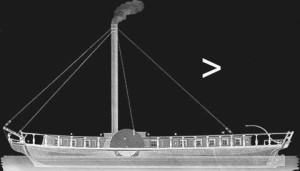
Victoria on the Clyde—1847

on Apr 19, 2015

In 1847, the Clyde and Western isles steamboat services were in flux. The Greenock Railway had opened six years earlier in 1841 and had challenged the dominance of steamboat companies in providing transportation in the Clyde area. After attempting to attract the steamboat companies to provide ongoing connections with the railway at Greenock, the Railway Company had begun to run its own connections. The principal services to Rothesay and Lochfyne were at this time in the hands of the Castle Steam Packet Company, and in 1845, Messrs. G. & J. Burns, who had hitherto been associated with the Glasgow and Belfast trade, acquired a controlling interest in the Company and its steamers. The following year, they added the steamers of the Greenock Railway and achieved a virtual monopoly of the Clyde connections with the Western Highlands and Islands. The West Highland services themselves were...

The Allan Line

on Apr 6, 2015

To the south of the main channel of the Clyde behind Plantation Quay, lay Princes Dock where much of the Transatlantic Passenger Traffic from Glasgow originated. Construction of the Dock, originally called Cessnock Dock was begun in 1886 and completed in 1897. There were three basins. The North Basin was the berth of the Allan Line and the above picture by Brandon shows three Allan Line ships lined up alongside Shed A. The steamship in the foreground is the State of Nebraska, built by the London & Glasgow yard at Govan in 1880 for the State Line, but taken over with the rest of that Line in 1891 by the Allan Line. On the south side of the Basin alongside Shed B there is a U.S. Lines steamship with its narrower white band and what appears to be another Allan steamship, with a large sailing vessel nearest the entrance to the Basin. The tall chimney of the hydraulic pumping station...

The Teetotal Steamer—Ivanhoe

on Apr 5, 2015

Drunkenness and unruly behaviour on the river steamers of the Clyde were problems that “respectable” working class folk had to deal with in the period leading up to 1880. In that year, a syndicate was formed by Mr. Alexander Allan of the Allan Line, Mr. George Smith and Captain James Brown, both of the City Line, Mr. Robert Shankland, of Greenock and Captain James Williamson to obtain and run a steamboat run on temperance principles. Captain James Williamson, one of three sons of Captain Alexander Williamson of the “Turkish Fleet” was to manage the company and was to command the new steamer Ivanhoe for nine seasons until he assumed management of the Caledonian Steam Packet Company. Drinking on a river steamer—frowned upon! The new steamer was to sail on one of the most attractive excursions from Helensburgh to Whiting Bay on the Island of Arran by way of Rothesay and the Kyles of Bute,...

Killarney—Langlands Cruises

on Mar 28, 2015

The venerable company of Langlands had its founding in the early days of coastal steam navigation when, in 1836, Mr. Matthew Langlands became the Glasgow agent for the Glasgow & Liverpool Royal Steam Packet Company. The company had an extensive interest in coastal trade around the shores of Britain and also briefly participated farther afield in the trans-Atlantic trade. As M. Langlands and Sons Ltd., they provided a regular service between Liverpool and Glasgow and in addition ran a series of cruises to the Clyde and West of Scotland with a number of well-appointed screw steamers.  The black funnel with two white bands and black between was well known on the Clyde. Princess Royal on the Clyde The first to be illustrated is the Princess Royal, the fifth of the name for the company. Built in 1876 by the London & Glasgow Engineering and Shipbuilding yard in Govan, she was...

The Loss of the Janet McNicol

on Mar 22, 2015

The Janet McNicol was an Ardrossan registered wooden smack owned by Mr Alexander McNicol of Brodick, Arran. She had been carvel built by Messrs J. & H. Halliday at Rothesay in 1875 and was 42.5 feet in length, 14.8 feet in breadth and had a depth of hold of 6.4 feet, giving her a gross tonnage of 23.15 tons and registered tonnage of 19.49 tons. Janet McNicol at Lamlash Quay around 1900 On 8th October 1907 at Irvine, the Janet McNicol, loaded a cargo of bricks for Brodick and sailed at 10:00 a.m., under the command of Mr. John B. McNicol, son of the owner. The crew consisting of Neil Stewart, mate, and Alexander Russel, deck hand. The Janet McNicol sailed over to Lamlash Bay where she anchored near the north-west end of Holy Isle, about three hundred yards from the shore. It was a safe anchorage, almost opposite a farm-house and the farmer, Mr. John McIntyre noted that the master...

Lord of the Isles—1877

on Mar 15, 2015

Lord of the Isles in her first season off Inveraray (George Washington Wilson) In the middle of the 1870s, the ducal seat of Inveraray was poorly served by steamboats. David Hutcheson provided the flagship Iona on the important tourist link with Tarbert and Ardrishaig, but the upper part of Lochfyne was relegated to the slow Inveraray Castle and Mary Jane which were mainly concerned with goods traffic and spent a whole day on the one way journey, returning the next, reminiscent of the 1840s. Indeed both steamers on the route had been built in that decade. Inveraray around 1865 In 1875, the Mary Jane was withdrawn and converted into the Glencoe for use as a tourist steamer on the west coast, leaving the Inveraray Castle to provide three sailings a week to Inveraray. Inveraray Castle (Robertson Gourock) The fastest route to Inveraray involved sailing to Lochgoilhead and then traveling by...

Millport

on Feb 28, 2015

The island town of Millport commands a sheltered bay on the Island of Great Cumbrae off the Ayrshire coast.  In the eighteenth century, the bay provided an anchorage for the revenue cutter and the town developed some importance.  The coming of the steamboat provided a more ‘genteel’ location for the summer visitor than Largs, Dunoon or Rothesay and the town has maintained this position of understated popularity to this day. In Lumsden’s Steamboat Companion of 1820, the entry barely mentions Millport.  “On the West side of the large Cumbray, is the village of Millport, the annual retreat of bathers; and opposite to it, the small Cumbray. Both these islands are remarkable for remains of antiquity; for some singular formation and arrangement of rocks; and for various excavations of curious and grotesque appearance. On the smaller island is a lighthouse of...

Columba

on Feb 27, 2015

  In her day, the Columba was a magnificent vessel and is perhaps the best known of the steamers that ever sailed on the Clyde. Launched from the yard of J. & G. Thomson at Clydebank on April 11th, 1878, she was over 301 feet long by 27 feet broad and 9 feet in depth, dimensions that were not exceeded for a century. She had a simple oscillating two-cylinder engine served by four boilers that propelled her at 18 knots on her daily schedule from the Broomielaw to Ardrishaig and back. While her engine room was rather old fashioned, in every other way, Columba reached the forefront of convention. Her saloons, fore and aft, were the full width of the hull providing excellent accommodation for her passengers, and her passengers ranged from the simple highlander to the elite of British society making its way to the shooting and fishing estates on the West Coast, to foreign tourists...