Steamboat Traffic on the Clyde—Article V

on Oct 27, 2022

“Steamboat Traffic on the Clyde “Article V “In our last article, we reviewed very briefly the history and growth of what may be called the West Highland trade. In the present, we propose saying a word or two about the Largs and Millport traffic some thirty or forty years ago. At the time we speak of there were two lines of steamers contending for the Ayrshire trade, owned respectively by what were known as the “Young” and the “M‘Kellar” companies. Few Clyde skippers were better known than Captain M‘Kellar, of whom we have already spoken and of whom we should say in passing we are largely indebted and to Captain M‘Farlane, the able and energetic superintendent of marine constabulary, for much of the information here presented on this branch of our subject. Captain M‘Kellar was all through the Peninsular war, and fought at Waterloo before he came to settle in Glasgow in...

Steamboat Traffic on the Clyde—Article IV

on Oct 24, 2022

“Steamboat Traffic on the Clyde “Article IV “One of the great feats of early navigation was the journey from Glasgow to Belfast, the Giant’s Causeway, and back, all in four days—the distance being 267 miles. On account of the shallowness of the river, and the great size of the Liverpool steam-vessels, these ships could seldom get up the river, and a smaller boat, the Post Boy, was employed to convey passengers to the Liverpool packets from Glasgow every Monday, Wednesday, and Saturday. These packets were fitted up exclusively for the accommodation of passengers, and belonged to a joint-stock company, composed chiefly of Glasgow merchants. Of the vessels, the Majestic was the finest—at that time, indeed, the largest and most powerful—steamship belonging to the Clyde. It had three cabins—one for ladies exclusively—and performed the passage in 28 hours. This year of...

Steamboat Traffic on the Clyde—Article III

on Oct 21, 2022

“Steamboat Traffic on the Clyde “Article III “For many years by far the larger portion of the coast passenger trade went on the Helensburgh and Largs lines. The Rothesay traffic was of slower and later development, Kirn and Innellan were not in existence, the latter now fashionable watering-place being then called “Inland” or “Innerland,” and represented by one house, the residence of Mr. M‘Pherson, road surveyor, which was carried away by a land slip. Nor was Dunoon much more advanced, being little better than a fishing hamlet. Largs and Millport were the great coast stations, and for years after the introduction even of steamboats the good folks of Paisley used to drive across the hills to the former town. Down to the year of the Reform Bill, bellmen were employed to go through both these places, to inform the lieges that the good ship Lady Brisbane, or whatever...

Steamboat Traffic on the Clyde—Article II

on Oct 18, 2022

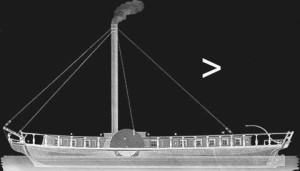
“Steamboat Traffic on the Clyde “Article II “Our last article closed with a statement to the effect that in 1817 Mr David Hutcheson came to Glasgow as a clerk to the two luggage boats, the Trusty and Industry. When a boy at Port-Glasgow, Mr Hutcheson witnessed the building of the Comet, and remembers being present when she was put on the station in the beginning of 1812. For many years subsequent to this date steamships were propelled by two paddle wheels, similarly constructed to undershot water mill-wheels places on each side of the vessel. In some boats they were fitted at right angles to the sides of the ship; in others in a circular direction; and in a third class, in an oblique form. An early Clyde steamboat from an “Essai” by Joachim Gilbert, published in 1820 Engine arrangement of the above steamboat showing oblique paddles “The cabins and...

An Early History—Steamboat Traffic on the Clyde—Article I

on Oct 14, 2022

The first comprehensive history of Clyde steamers was Captain James Williamson’s “The Clyde Passenger Steamer,” published by James Maclehose & Sons, Glasgow, in 1904, and has been followed by many others, brief and extensive. However, there are a few other early attempts that are generally overlooked. In May and June of 1872, a series of eight articles appeared in the Glasgow Herald, and a few days later in the Greenock Telegraph, relating some anecdotes and remembrances of Clyde steamers—a history that is not generally recognized. The articles are anonymous and unillustrated. Over the next few weeks, I will present these articles together with some relevant illustrations. “Steamboat Traffic on the Clyde “Article I “The history of the steamboat traffic of the Clyde has yet to be written.  Why it has remained unwritten so long it were hard to say...

Sailing on Loch Katrine

on Sep 25, 2022

In the mid-1820s, a traveller climber to the top of Ben Lomond on a September morning to view the sunrise over Loch Lomond, and there met an old highlander. The old man said he had been a guide for the north side of the mountain for forty years but that he would soon go and live with his daughter and her husband near Aberfoyle and give up his outdoor life. Over the years, he explained, he had made a living from tourists “but that Walter Scott, that every body makes such work about; I wish I had him to ferry over Loch Lomond; I should be after sinking the boat if I drowned myself into the bargain; for ever since he wrote his “Lady of the Lake,” as they call it, every body goes to see that filthy hole, Loch Catrine, then comes round by Luss, and I have had only two gentlemen to guide all this blessed season, which is now at an end. I shall never see the top of Ben Lomond again. The devil...