Early Gareloch Steamers

on Feb 17, 2021

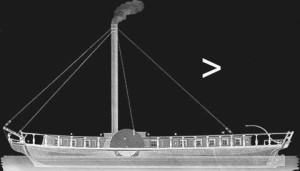
Although the pioneer steamboat on the Clyde, Comet, was placed on the river by the owner of the Bath’s Hotel in Helensburgh, the steamboat ran from the Broomielaw to Greenock. To get the additional distance from Greenock to Helensburgh, a sailing packet was required. Regular steamboat service to the north bank of the estuary began in 1815 with the Joint Stock Company in Dumbarton that provided the steam-boat, Duke of Wellington, to run between that town and the Broomielaw. By that time the steam boats Prince of Orange, Captain M‘Innes, and Princess Charlotte, Captain Duncan, and Clyde, Captain M‘Kenzie, every lawful day on the busy route to Greenock extended their sailings to include Helensburgh. Two years later, on May 26, 1817.—“The Marion steamboat will commence sailing to-morrow for Greenock and Helensburgh, and every lawful day at 8 o’clock morning and on Saturday evening at 6...

Innen’s Quay—A note on Tigh-na-bruaich

on Jan 16, 2021

The origins of some of the piers and landing places on the Clyde are shrouded in mist, perhaps none more so than Tighnabruaich. The previous article on the pier cited 1843 as the date when the pier was erected. This information came from Frank Arneil Walker’s tome, “The Buildings of Scotland, Argyll and Bute,” published by Penguin in 2000, and generally an impeccable source as it accesses architectural plans that are well-dated. The plans are presented in Ian McCrorie’s book “Tighnabruaich Pier,” published by the Tighnabruaich Pier Association in 2002. Indeed the plans for the quay at Tighnabruaich were likely drawn up in 1843 for the Castle Steamboat Company, but the construction of the pier was a year or so later. In the Glasgow Herald in February 1844, there is an advertisement for feuing of the shore at Over Innens that mentions the ferry at Tigh-na-Bruaich, and a year or so later,...

Roseneath and Kilcreggan

on Dec 24, 2020

The ferry at Roseneath was in existence long before steamboats graced the waters of the Gareloch. William Mauchan in his book “Rosneath Past and Present,” (Alexander Gardner, Paisley, 1893) recalls that the boat was large open wherry that was generally put under sail and took, sheep, cattle, horses and farm produce as well as passengers to Greenock. A similar craft was operated from the more exposed village of Kilcreggan by the M‘Farlane family of ferrymen. The Duke of Argyll used a six-oared barge to cross from Roseneath to Cairndhu between Row (Rhu) and Helensburgh, across the mouth of the Gareloch. The Helensburgh and Gareloch steamboats called at Roseneath Ferry, lying off the Ferry Inn, but it was expansion of feuing that brought about the promise of new piers to encourage the construction of summer residences for the affluent of Glasgow. In the Glasgow Herald of March 16, 1846,...

The Greenock and Helensburgh Steamboat Company

on Nov 26, 2020

The Clyde in 1865 had seen the long-awaited opening of the Wemyss Bay Railway that was expected to provide a convenient terminus for sailings to Rothesay, Largs, Millport, and Arran. The Largs, Millport and Arran routes had been the province of the steamers of Captain Duncan M‘Kellar and his sons, John and Alex, sailing from Glasgow. Anticipating the competition from the Railway, their steamers had been sold; their two flyers, Jupiter and Juno, going to the Confederates to run the blockade. However, the expected strong competition from the railway owned steamers did not immediately materialize, largely through mismanagement, and there were opportunities for an enterprising steamboat owner. On the north bank of the Clyde, the railway had reached Helensburgh in 1858 and efforts had been made to improve the town’s pier. Again, the coming of the railway had resulted in a running-down of...

Dumbarton’s Castle Pier

on Oct 12, 2020

The county town of Dumbarton on the river Clyde owes its origins to the rock that dominates the skyline and its bridge over the river Leven that provided access to the west. In its early history, Dumbarton was a sea-port of some importance but the industry of its larger neighbour, Glasgow, in deepening the Clyde diminished the trade. By virtue of an agreement made at the beginning of the eighteenth century, Dumbarton owned ships were exempt from the dues payable to Glasgow for the use of the waterway, and Glasgow worked over the years to remove this exemption, first limiting it to ships owed by burgesses of Dumbarton in 1825, then in 1858, after the railway had all but driven the Dumbarton steamboats from the river, it was removed altogether after compensation was paid by the Clyde Trustees, though ship-owning burgesses who served before that date were given continued exemption....

Clynder Pier

on Sep 14, 2020

Until the middle of the nineteenth century, the villages on the western shore of the Gareloch were poorly served with piers to connect with the frequent steamboat services from Glasgow and Greenock. The sometimes difficult means of boarding was by ferry boat and there were ferries at Rahane, Crossowen and at Roseneath. It was in 1845 that a pier opened at Roseneath, just south of the narrows that mark the boundary of the Gareloch proper. The good folk of the village of Clynder had either to walk to Roseneath or use the ferry at Crossowen, north of the village, where the ferryman was James Campbell, . Archibald Chalmers was born on March 22, 1836, the son of James Chalmers and Sarah M‘Cunn who lived, along with other members of the Chalmers family at Little Rahean. He was baptized on May 5 of the same year. James farmed Little Rahean with his older brother Robert who also had a son,...

A trip to Lochgoilhead

on Aug 10, 2020

The steamer Iona was placed on the Lochgoilhead and Arrochar service from the Broomielaw in 1922. I came across this exclusive story by the well-known humorist J. J. Bell in the July 16, 1922 copy of the Sunday Post. James Joy Bell created a number of characters, including Wee Macgreegor, with his Grandpa Purdie. This tale of Mrs M‘Leerie is told in similar vein. The accompanying illustrations are mainly taken from a small album of photographs that must have been taken on a similar trip around the same date. The photograph above shows Iona at Arrochar, the final destination for the day trip where she rested for an hour or two before returning to Glasgow by Lochgoilhead and the other calling places. The cartoons are taken from the original article in the Sunday Post. Mrs M‘Leerie’s Trial Trip, by J. J. Bell —Exclusively Written for The “Sunday Post.”— “Well, that’s that!” exclaimed Mrs...

Arrochar Pier

on Aug 1, 2020

The Royal visit to Arrochar in 1849 appears to have been the trigger that persuaded the local landowner, Sir James Colquhoun, that the time was right to erect a pier. There had been a jetty before, to facilitate visitors from the steamers getting in and out of the small boats that conveyed them between ship and shore. Sir James had endeavoured to extend this to facilitate the Royal visitors but it had been incomplete. Perhaps there was sufficient additional lumber to convert the jetty into a pier suitable to berth a steamer, or perhaps Sir James wanted to be prepared for a future visit by Royalty. A pier had been erected at Tarbet on Loch Lomond in 1846. Nevertheless, the pier at Arrochar was ready for the 1850 season to hansel in a new “Royal Route.” Sir James was not the only one inspired by the Royal visit. At the Dumbarton yard of Messrs William Denny & Brothers, progress was...