Steamboat Traffic on the Clyde—Article II

on Oct 18, 2022

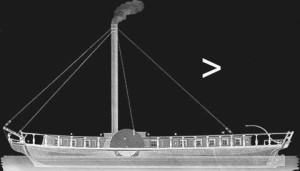
“Steamboat Traffic on the Clyde “Article II “Our last article closed with a statement to the effect that in 1817 Mr David Hutcheson came to Glasgow as a clerk to the two luggage boats, the Trusty and Industry. When a boy at Port-Glasgow, Mr Hutcheson witnessed the building of the Comet, and remembers being present when she was put on the station in the beginning of 1812. For many years subsequent to this date steamships were propelled by two paddle wheels, similarly constructed to undershot water mill-wheels places on each side of the vessel. In some boats they were fitted at right angles to the sides of the ship; in others in a circular direction; and in a third class, in an oblique form. An early Clyde steamboat from an “Essai” by Joachim Gilbert, published in 1820 Engine arrangement of the above steamboat showing oblique paddles “The cabins and...

An Early History—Steamboat Traffic on the Clyde—Article I

on Oct 14, 2022

The first comprehensive history of Clyde steamers was Captain James Williamson’s “The Clyde Passenger Steamer,” published by James Maclehose & Sons, Glasgow, in 1904, and has been followed by many others, brief and extensive. However, there are a few other early attempts that are generally overlooked. In May and June of 1872, a series of eight articles appeared in the Glasgow Herald, and a few days later in the Greenock Telegraph, relating some anecdotes and remembrances of Clyde steamers—a history that is not generally recognized. The articles are anonymous and unillustrated. Over the next few weeks, I will present these articles together with some relevant illustrations. “Steamboat Traffic on the Clyde “Article I “The history of the steamboat traffic of the Clyde has yet to be written.  Why it has remained unwritten so long it were hard to say...

Sailing on Loch Katrine

on Sep 25, 2022

In the mid-1820s, a traveller climber to the top of Ben Lomond on a September morning to view the sunrise over Loch Lomond, and there met an old highlander. The old man said he had been a guide for the north side of the mountain for forty years but that he would soon go and live with his daughter and her husband near Aberfoyle and give up his outdoor life. Over the years, he explained, he had made a living from tourists “but that Walter Scott, that every body makes such work about; I wish I had him to ferry over Loch Lomond; I should be after sinking the boat if I drowned myself into the bargain; for ever since he wrote his “Lady of the Lake,” as they call it, every body goes to see that filthy hole, Loch Catrine, then comes round by Luss, and I have had only two gentlemen to guide all this blessed season, which is now at an end. I shall never see the top of Ben Lomond again. The devil...

Three turbine steamers

on Aug 18, 2022

Another day on Bute, this time featuring three turbine steamers photographed on colour transparency film. I don’t know whether this was 1951 or perhaps 1952, but the photographs feature the Clyde in the early post World War II days of British Railways and David MacBrayne steamers, before motor vessels began to displace them. The first picture is the turbine steamer, the Marchioness of Graham, one of the three turbine steamers photographed that day. She looks well as she approaches Rothesay, perhaps on an excursion from Ayr. Marchioness of Graham The sequence continues on the way from Rothesay, showing yachts anchored in Port Bannatyne Bay. A peaceful scene The destination, Rhubodach, in reached with a view of a yacht sailing down the Kyles in light winds. Sailing in the Kyles The Rhubodach-Colintravie ferry, is on the Bute shore loading a Meikle and M‘Kellar removal van and a car....

A few days on Bute

on Aug 9, 2022

It is not often that I find a collection of photographs that gives insight into a visit of two or three days to a single location where Clyde Steamers play an important part of the views. In this case, a small collection from a trip to Bute around 1951, mainly featuring Rothesay Pier, where the comings and goings of the daily traffic provide a fascinating picture of the Clyde a year or so before the advent of motor vessels. Saint Columba in Rothesay Bay on her way to Ardrishaig Gingerly approaching Rothesay Pier. This was originally captioned as leaving the pier by as Jim Galt has nicely pointed out it is taken from Albert Pier and he provided the reason for the slow approach Saint Columba at Rothesay Pier At Rhubodach where the bell has summoned the ferry and a motor yacht passes Saint Columba passing up the Kyles Back at Rothesay Pier, Jupiter disgorges her passengers More visitors...

Lochlomond Steamboat Company—Early Years

on Jul 19, 2022

The Lochlomond Steamboat Company formed from an amalgamation of the New Lochlomond Steamboat Company, owners of the steamer Water Witch, and the assets of Messers Napier and M‘Murrich, owners of the steamer Lochlomond, in 1845. The agreement between the companies is presented below. It was drawn up in 1844 but the legal issues to obtain agreement with all the parties took several months. The basic agreement split the 80 shares of the new company equally between the original owners of the Water Witch (40 shares) and Messers Napier (20 shares) and M‘Murrich (20 shares). John M‘Murrich was in ill-health and 15 of his shares were sold to three new shareholders Duncan Mitchell (5 shares), James M‘Kinlay (5 shares), and William M‘Niven (5 shares). This also diluted the power of the Napier faction. Much of the information quoted comes from “Lochlomond Steamboat Companies,” by Donald Macleod...

Walter M‘Gregor—an Inversnaid boatman

on Jul 1, 2022

It is not often that I come across some old glass slides that identify a person or persons at their work. In this case it is the work of a boatman, Walter M‘Gregor, at the Loch Lomondside hamlet of Inversnaid in 1892. Walter M‘Gregor Inversnaid features in history as a convenient spot on the remoter east bank of Loch Lomond where access to Loch Arklet and Loch Katrine could be obtained. The Arklet falls are a distinguishing feature, though much diminished in recent years since the Loch was converted to a reservoir. Inversnaid is in Montrose country and there was a military garrison posted there in the late 17th century. Around 1790, the Duke of Montrose had a lodge built there for fishing and hunting, and the spot achieved fame with Wordsworth’s poem “To a Highland Girl” from his tour of the Highlands in 1803. However, it was the publication of the “Lady of the Lake,” and “Rob Roy” by...

Irvine Harbour

on Jun 11, 2022

The port of Irvine is a natural harbour on the south bank of the river Irvine, extending inward from near the confluence of the river with the Garnock to where it takes a meander from the town to the north. It was a very important trading center from the late middle-ages and indeed was considered the third port of Scotland at one time. The rights to the river frontage were contested for many years but in 1573 came into the possession of the Corporation of Irvine and the port was run by the town council. Irvine Harbour around 1890 (Washington Wilson) In 1815, with the arrival of the steamboat age, Irvine was a call made by the Greenock, on her weekly sojourn to Ayr. The return journey was made the following day. The Greenock was sold off the river the following year. “Steam Boat Greenock, Anderson & M‘Cowan, Captains, Sails every lawful day, to and from Glasgow to Greenock, and...