The Unfortunate Thistle

on May 21, 2022

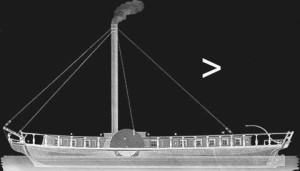
The iron paddle steamer, Thistle, was built for Messrs Laird’s Glasgow & Londonderry Steam Packet Co., by Messrs Robert Napier at Govan in 1848. She was 198½ feet in length by 26¼ feet in breadth with a depth of 16 feet. At her launch on Friday, September 1st, she stuck on the ways but finally entered the water the following day. She was fitted with two watertight bulkheads with her engine amidships. The engine providing 350 hp, was salved from the Rambler built by Messrs Napier for Messrs Laird in 1845, but sunk after a collision on the Mersey the following year. “Launch of the Thistle Steam Ship. On Friday this fine iron steamer, which was built by Mr. Robt. Napier, at his new building-yard, Govan, was partially launched. This vessel is the property of the Glasgow and Londonderry Steam Packet Co., and is the largest that they have as yet been furnished with. She is 200 feet keel...

Lost in fog

on May 13, 2022

On Sunday, November 14, 1909, a stubborn anticyclone settled in to dominate the weather pattern over the West of Scotland and Northern Ireland over the following week. On Monday morning, November 15, the weather forecast for Glasgow predicted light to moderate north-easterly breezes; cloudy to fair or fair, with local rain, hail, or sleet, nothing particularly out of the ordinary for mid-November. It was a cold morning, and inland there was widespread frost. The Campbeltown steamer Kinloch sailed from the Kintyre port at 3:30 p.m. for Carradale, Pirnmill, Lochranza, Gourock, Greenock, and Glasgow. There was only one steamer on the service at this time of the year, and she was expected to return from Glasgow the following morning at 6 a.m., connecting with the 7:55 am. train from St Enoch at Prince’s Pier and with the 8:35 a.m. train from Central at Gourock Quay. On her inward journey...

Puffers on the Forth and Clyde Canal

on May 1, 2022

The passage of commerce through the Forth and Clyde Canal was conducted mainly by horse-drawn barges until the 1850s, when the introduction of the marine screw that did not damage the canal banks, provided the opportunity for steam propulsion. The steam- or screw-lighter is generally acknowledged to date from 1856, when the barge, Thomas, was fitted with a steam engine and screw propellor by the Forth and Clyde Canal Company, and allowed to ply between Grangemouth and Glasgow. Steam lighters on both the Clyde and the Forth were not unknown by this time and there are some inklings that other experiments were also in progress such as the following court proceedings from 1854 that mentions a screw or lighter on the Canal. “Sheriff Criminal Court.—The following cases at the instance of the Procurator Fiscal have been disposed of summarily at this Court, before Mr Sheriff Robertson, during...

Bowling

on Apr 1, 2022

Until the latter years of the eighteenth century, the Bay of Bowling was best known for its sandy beach in the bend of the Clyde just upriver from the rocky Dunglass Point where the ancient keep of the Colquhoun Family stood in ruins. There was an inn and a hotel and it was a pleasant, sheltered spot for bathing. At Littlemill, on the Auchentorlie Burn, there was a disused mill that by the early 1770s had been at one time used as a bleaching works and then taken over as a distillery. It was the designation of Bowling as the western terminus of the Forth and Clyde canal that changed the Bay’s fortunes. Originally, the canal was meant to enter the Clyde at Dalmuir, but this was changed in 1785 when Robert Whitworth was appointed chief engineer of the Canal Company. Over the next few years the sea-lock and canal basin were excavated to meet the western extension of the canal from...

Captain William Buchanan’s Eagle

on Mar 10, 2022

There can be few steamers that are so completely associated with an individual owner as Captain William Buchanan’s Eagle of 1864. The ship was the second of the name with Buchanan associations. The first Eagle, built in 1852 by Messrs Denny at Dumbarton for the Glasgow and Rothesay service they had inherited from the Messrs Burns when they disposed of their Clyde fleet, was purchased the following year by Messrs Alexander Williamson, William Buchanan and John Cook. Captain Buchanan thus had his first command of a river steamer. The partnership broke up in 1862 when Captain Buchanan, John Cook and James Davie purchased the steamer and the following year sold her as a blockade runner, earning a considerable premium on the sale that allowed them to order a new vessel. The new vessel, larger and more powerful than the first, was launched in April 1860, and through the following weeks, her...

Nationalization

on Feb 9, 2022

For a small boy, one of the treats when going for a sail on the Clyde or a holiday visit on the Firth in the 1950s was to go to the steamer shop or stationery shop when ashore and, after much deliberation, choose a postcard depicting a favourite steamer of the day. Particularly prized were the photographic cards produced by Messrs W. Ralston, Ltd., the premier marine photographers who were renowned for their images of ships on trials. Their series of cards of Clyde Steamers covered most of the important members of the fleet. With the exception of the MacBrayne vessels, the uniform buff, black-topped funnels of the Caledonian Steam Packet Co. Ltd., gave the impression that this was standard for a passenger steamer, but careful attention to the photographs gave glimpses of a more colourful age that preceded the utilitarian post-war decade. This article is mostly pictorial in nature. The...

Navigating the Leven to Loch Lomond

on Jan 21, 2022

The river Leven flows seven miles from its source in Loch Lomond to the Clyde at Dumbarton. It was used by Viking raiders who hauled their longships from Loch Long at Tarbet and, after marauding around the shore of Loch Lomond, sailed to the Clyde by the river Leven. The beauties of Loch Lomond brought some of the earliest tourists to the area in the eighteenth century and the Loch became a sought-after destination, despite the mean accommodation available in the local inns and crofts. Towards the end of the century, certain of the landowners who controlled the shores of the Loch began to build for themselves, substantial mansions. Accommodation for the public also improved, particularly after the publication of Walter Scott’s novel “Rob Roy” in 1817, and the introduction of the steamboat Marion to the Loch the following year. For example, the hotel at Inversnaid opened in1820 and was...

Bridging the Leven

on Jan 17, 2022

The River Leven is the only outlet from Loch Lomond and flows seven miles through the Vale of Leven until it meets the Clyde at Dumbarton Rock. At Balloch close to the Loch, the river flows broad and deep and has not attained the swiftness that marks Scotland’s second fastest river when it passes Bonhill a few miles closer to Dumbarton. It was an excellent place for crossing the river, but necessarily by boat, as there was no convenient ford. Cattle, brought from the highlands to the west had either to be ferried across at Balloch—the very name means “pass to the field of still waters”—from where they made their way by Drymen and the Endrick Valley to the Falkirk Tryst, or negotiate the ford at Bonhill where the alluvial fan from the burn provided sufficiently shallow water, and thence the path, from the “dripping grounds” near the Church was up the side of the burn and across the...