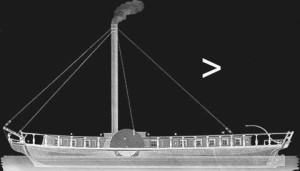
Messrs Hutcheson’s Clansman of 1855

on Mar 10, 2020

The loss of the Chevalier in 1854, just over a year after her commissioning was a significant loss to the expansion plans of Messrs. David Hutcheson & Co. The company had to scramble to the charter market to supplement the service when their problems were compounded with the closure of the Crinan Canal after a lock was broken. Through the winter, the opposition steamer, Islay, carried much of the traffic. In the middle of January, 1855, however, there was some relief on the horizon. The Crinan Canal reopened and it was announced that a replacement for the Chevalier would be ready early in the summer. Glasgow Herald, February 5, 1855 The new steamer was launched on Saturday June 16, 1855 at the yard that had built the Chevalier and in March 1855, had launched the new Iona for the Clyde connection of the swift steamer route to Oban and the highlands. “Launch.—There was launched on...

Ardentinny and Coulport

on Feb 29, 2020

The ferry across Loch Long at Ardentinny has been in existence long before steam boats gained access to the Clyde sea lochs. It formed part of an old drove road to bring cattle from the highlands to the Falkirk market. The crossing to Coulport, over to the Gareloch and thence by Glen Fruin to Balloch and the Endrick valley was a convenient track for the drovers from Lochfyneside. After the introduction of steam boats on the Clyde, the ferry also provided access for local residents and visitors who could sail from Glasgow on the steam boats bound for Lochgoilhead and Arrochar and land at the picturesque village on Loch Long. The landowner, General Sir John Douglas of Glenfinart was one of the promoters of the Caledonian Railway’s Gourock Harbour and Quay Bill to provide a pier and terminus at Gourock. In his statement in April 1883 he indicated that he never could understand why there...

Messrs Hutcheson’s Chevalier

on Feb 12, 2020

The west highland services of Messrs G. & J. Burns devolved to Messrs David Hutcheson & Co., in February 1851. The primary steamboat sailing from Glasgow to Oban, Skye, Gairloch and the Outer Hebrides by the Mull of Kintyre was the Duntroon Castle, dating from 1842. The replacement for the Duntroon Castle was Chevalier, launched in March 1853, and a great improvement on the older vessel. She came from the new Clyde  or Cessnock Bank shipyard at Govan, set up by Messrs J. & G. Thomson, and was the second vessel that they had built for the west highland service of Messrs Hutcheson. “Glasgow and Highland Steamers.—There was launched on Thursday, from the building-yard of Messrs James and George Thomson, Clyde Bank, a beautiful paddle steamer, the Chevalier, the property of Messrs David Hutcheson & Co., of this city, and intended for the trade between Glasgow and the...

The Great Canal

on Jan 10, 2020

The construction of the Great Canal between the Forth and Clyde was begun at its eastern end on the Carron in 1769. The enterprise had authorized capital of £150,000. By the time excavations reached Stockingfield, then on the outskirts of Glasgow, in 1775 the project was £40,000 in debt. However, the Glasgow branch to bring the canal closer to the center of the city was begun the following year and completed to the basin at Hamiltonhill in 1777. A loan of £50,000 from the fund created by the estates forfeited after the ’45 rebellion, allowed the extension to Bowling on the Clyde to begin. At that time also, the new harbour at Port Dundas, near the center of the city was built and the proprietors of the Monkland Canal agreed to provide a link to that waterway. Port Dundas The Forth and Clyde Canal was opened throughout in 1790 with a depth of 8 feet and locks roughly 70 feet long and 20...

Queen of Loch Earn

on Jan 5, 2020

Loch Earn had to wait until 1922 before her waters were graced by a vessel in public service. The Queen of Loch Earn was a 56 foot motor vessel built in Fraserburgh for Mr. Peter Crerar. Mr Crerar was an enterprising char-a-banc owner from Crieff who had popularized “Crerar’s Tours” that provided trips to the picturesque beauties of Perthshire and surrounding area. He also opened a cinema in Crieff and in Auchterader and eventually had interests in cinemas and theatres in Glasgow, Kircaldy and Dunfermline. The country areas were not left out and he ran a “travelling cinema” for villages in Perthshire. “Motor pleasure boat on Loch Earn. Launched this week. Early on Thursday morning, the motor boat, Queen of Loch Earn, intended to ply as a pleasure craft between St Fillans and Lochearnhead, was successfully launched at the former place. thus in a manner placing the lovely Loch Earn on a...

Some Puffer Tales

on Dec 5, 2019

The origins of the Clyde puffer are perhaps as murky as the depths of the Forth and Clyde Canal on which they first appeared. With a length constrained to 66 feet to fit the 70 feet locks of the Canal, they are first mentioned in the 1850s when efficient screw propulsion became possible. Steam lighters built on the Clyde prior to 1857 tended to be larger craft, not able to fit into the constrained locks on the Canal. “The Samson, an iron steam lighter, with two screw propellers, one each side of the stern post, was tried on Thursday last, when the satisfactory speed of 7 knots hour was obtained. She is propelled by an engine of 20 horse-power. The Samson was launched sometime ago by Messrs Bourne & Co.”—Greenock Telegraph, April 3, 1855 The late puffer historian, Dan McDonald, suggests that the conversion of the iron canal barge, Thomas, to steam propulsion in 1856, marks the...

Blairmore Pier

on Nov 16, 2019

The pier at Blairmore replaced a large and commodious ferry boat at Portinstuck when it was built in the summer of 1855. The new landing point was particularly needed by the feuars who had built houses on the north bank of the Holy Loch as the piers at Kilmun and Strone had fallen into disrepair, and indeed, the pier at Strone was closed to traffic for a while in a dispute arising from the ownership by Mr. David Napier. “A new pier about to built at Blairmore, situated upon Lochlongside, and at distance of a mile or so from Strone Point. A number of feus have been taken in the neighhoorhood, and the pier will be a source of convenience to all the feuars north of Port-in-Stuck. The bank of Lochlong, from Strone to Ardentinny, is admirably adapted for marine villas, and there is no doubt that after the erection of the pier, the shore will be dotted with a goodly number.”—Greenock...

A wreck at Tiree

on Nov 3, 2019

On the night of Friday, February 13, 1931, the Finnish steamship Malve lost her bearings between Coll and Tiree. There was poor visibility with gale-force winds and driving snow she, at low tide, she went aground on rocks at Balephetrish Bay on the north coast of Tiree. Initial reports were confused with indications that four men stranded on board were lost, but this report turned out to be incorrect and all were saved. “Finnish ship aground.—S.O.S. Calls from Tiree. On Saturday the Finnish steamer Malve, 2412 tons register, stranded on Tiree, two miles southwest of Gunna Sound. Being fitted with wireless she sent out messages for assistance which were picked up by the Malin Head station and relayed to Ballycastle life saving station and Tobermory. The Portrush and Campbeltown lifeboat stations were informed to hold themselves in readiness if required. A later message said the ship...

Strone Pier

on Oct 20, 2019

The development of the north bank of the Holy Loch by David Napier proved to be a successful enterprise for the new landowner. The key to this success was the accessibility of the area by the provision of a pier and steamboat connections. With the opening of the Greenock Railway, there was a new incentive to acquire coast properties with easy access to Greenock, now within an hour of Glasgow. Opportunities for feuing and the construction of villas extended eastwards from the head of the Holy Loch towards Strone Point. However, this was inconveniently distant from Kilmun Pier for discerning Glasgow businessmen, and a new pier was required to encourage growth in the area. Although David Napier had left the area in the 1830s, he continued to respond to the needs of his feuars on the Holy Loch. The building of a pier at Strone, extending the stone quay and making it available at all states...

Edgar Battersby’s trip to Rothesay

on Sep 25, 2019

I was recently contacted by a gentleman by the name of Rupert Battersby who has a large number of quarter-plate glass negatives taken by his great uncle, Edgar Battersby. Some of these were taken on a trip to Scotland in August 1913, and just over twenty feature views taken on the Clyde and Loch Lomond. This is an important and interesting collection and I have been given permission to reproduce the photographs of the Clyde on this site. I have to point out that these images are copyright and any further use requires permission of the owner. The Battersby family were hat manufacturers from Stockport in Lancashire. A history of the business has been documented in a book “Battersby Hats of Stockport — An Illustrated History” also by Rupert Battersby and published by Amberley in 2016. The factory in Stockport closed in 1966. Edgar Battersby was a young man on his visit to Scotland. He is...